Aurora stands as ancient Rome’s own personification of daybreak, a goddess whose Latin identity gave the Roman world its distinct literary and cultural vision of dawn separate from, though clearly rooted in, the earlier Greek tradition surrounding Eos. Anyone asking who is Aurora, the Roman goddess of the dawn is uncovering a figure whose significance extends through some of Latin literature’s most celebrated poetry, eventually reaching all the way into modern scientific terminology used to describe one of nature’s most spectacular light displays.
While Aurora shares her fundamental role and much of her underlying mythology with her Greek counterpart, her specifically Roman identity developed its own distinctive character through the particular treatment she received from Latin poets like Ovid and Virgil, whose vivid descriptions shaped how Roman audiences understood and visualized her daily journey across the sky. This Roman literary tradition gave Aurora a genuinely distinct cultural presence within Latin poetry separate from her earlier Greek origins.
Beyond her literary significance within ancient Rome itself, Aurora’s name carries a remarkable modern legacy extending directly into contemporary scientific vocabulary, connecting this ancient goddess to phenomena observed in skies far beyond anything ancient Roman poets could have witnessed firsthand. This lasting linguistic connection secures Aurora genuine ongoing relevance well beyond her original mythological and literary context.
What follows examines Aurora’s specific role opening the gates of day, the genuinely contested question of her exact parentage within Roman sources, her treatment of the Tithonus myth within Latin poetry, her significant and often overlooked story involving her son Memnon, and the remarkable scientific legacy that eventually connected her name directly to the aurora borealis itself.
Aurora’s Role: Opening the Gates of Day
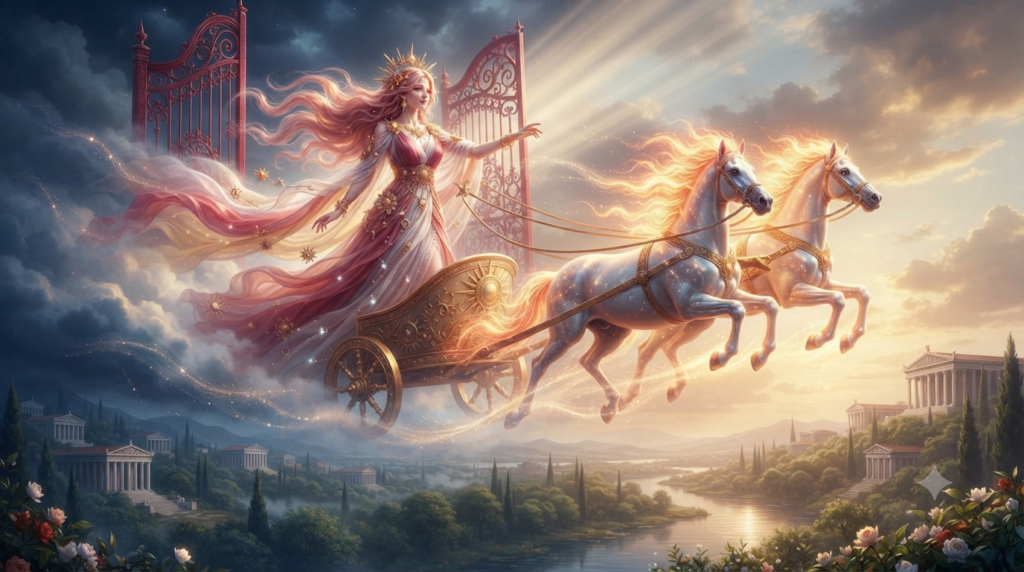
Aurora’s core mythological function centered on her daily journey across the sky specifically preceding the sun god Sol’s own chariot, clearing away the darkness of night to prepare the heavens for daylight’s full arrival each morning. Ovid, in his Metamorphoses, specifically described this process through the vivid image of Aurora opening what he called the purpureas portas, or crimson doors, filling the heavens with rose-colored light immediately before the sun itself appeared above the horizon.
This particular poetic image proved remarkably precise in capturing the actual visual experience of dawn, since the characteristic colors visible in the sky immediately before sunrise genuinely resemble a door gradually opening, with darkness pulling back to reveal the intensifying light building behind it. Roman poets clearly observed and carefully translated this genuine natural phenomenon into their specific mythological framework surrounding Aurora’s daily activity.
Latin sources additionally provide specific names for the horses drawing Aurora’s chariot across the morning sky, variously identified as Phaethon and Lampos, meaning “shining” and “brightness” respectively, or in other sources as Abraxas and Eous, each name directly evoking qualities of light and illumination appropriate to their goddess’s specific domain. This level of specific detail regarding Aurora’s chariot demonstrates the genuine care Roman poets invested in developing her particular mythological presentation.
This foundational role provides essential context for who is Aurora, the Roman goddess of the dawn, establishing the specific, carefully developed visual and poetic tradition Roman writers built around her daily journey preceding Sol across the morning sky, a tradition distinct in its particular details from earlier Greek treatments of this same essential dawn-bringing function.
A Contested Parentage: Hyperion or Pallas?
Roman mythological tradition regarding Aurora’s specific parentage reveals genuine inconsistency across different ancient sources, reflecting broader patterns of variation common throughout classical mythology when multiple poets addressed the same figure across different works and time periods. The more standard tradition, inherited directly from earlier Greek sources through Hesiod, identifies Aurora as the daughter of the Titan Hyperion and the Titaness Theia.
Ovid, however, presents an alternative genealogy within his own works, specifically identifying the Titan Pallas as Aurora’s father rather than following the more established Hyperion-Theia tradition. This particular divergence represents a genuinely distinct choice specifically within Roman literary treatment of Aurora, illustrating how individual Latin poets sometimes took creative liberties when adapting inherited Greek mythological material into their own original compositions.
Despite this parentage disagreement, Roman sources remain consistent regarding Aurora’s siblings, identifying her as sister to Sol, the sun god, and Luna, the moon goddess, maintaining the same fundamental family structure established within earlier Greek tradition even while individual details regarding her specific parentage varied between different Latin authors and their particular literary purposes.
This genealogical inconsistency provides an important, distinctly Roman dimension to who is Aurora, the Roman goddess of the dawn, revealing that even within a single mythological tradition, significant variation could exist regarding fundamental details like divine parentage, particularly when influential poets like Ovid chose to present alternative genealogical accounts within their own celebrated literary works.
The Tithonus Myth in Roman Poetry
Among Aurora’s various mythological narratives, her tragic love for the Trojan prince Tithonus received particularly extensive and psychologically sophisticated treatment within Roman poetry, with writers like Ovid and Virgil returning repeatedly to this specific story throughout their broader literary works. This myth, involving Aurora’s request for Tithonus’s immortality without the corresponding gift of eternal youth, already receives detailed treatment within dedicated coverage of Eos, Aurora’s Greek counterpart, since the fundamental narrative remained largely consistent across both traditions.
Roman poets specifically emphasized the genuine psychological and emotional dimensions of this tragedy, with Ovid treating Tithonus’s gradual, horrifying decline into ancient, withered old age with particular narrative precision, capturing the growing horror of Aurora’s situation as she cared for her beloved through his inexorable, endless aging process. This Latin literary treatment brought genuine emotional depth to a story whose fundamental outline originated within earlier Greek sources.
Virgil similarly referenced this myth within his own works, specifically describing Aurora rising each morning from Tithonus’s saffron-colored couch, a brief but evocative image that assumed audience familiarity with the broader tragic story while using this specific detail to mark the passage of time within his own separate narrative context. This casual literary reference confirms how thoroughly established this particular myth had become within Roman poetic tradition.
For readers seeking the complete narrative details surrounding this significant myth, including its origins and full tragic conclusion, dedicated coverage of Eos provides an extensive examination of this story’s complete mythological development. Within the specific context of who is Aurora, the Roman goddess of the dawn, this myth’s significance lies primarily in how thoroughly Latin poets embraced and further developed this narrative’s emotional complexity within their own distinct literary tradition.
Aurora and the Death of Memnon
Beyond her more widely known relationship with Tithonus, Aurora’s mythology includes a significant and often overlooked story involving Memnon, her son born through her union with Tithonus, whose own dramatic fate during the Trojan War provides genuine additional depth to Aurora’s broader mythological significance within Roman literary tradition. Memnon grew to become king of Ethiopia, eventually leading his own forces to join the Trojan side during the war’s climactic later stages.
Memnon’s involvement in the Trojan War ultimately concluded in tragedy when he faced the Greek hero Achilles in direct combat, a confrontation that resulted in Memnon’s death at his opponent’s hands. This loss devastated Aurora, connecting her broader mythology of maternal love and loss directly into the larger narrative framework surrounding the Trojan War itself, extending her significance beyond her own personal romantic tragedies into this larger heroic conflict.
Ancient tradition preserves two distinct, poignant details commemorating Aurora’s grief following Memnon’s death. According to one tradition, birds known as the Memnonides emerged from the ashes of his funeral pyre, while a separate, widely referenced tradition explains the morning dew itself as Aurora’s continuing tears, shed each day in ongoing remembrance of her lost son as she begins her daily journey across the sky.
This significant maternal narrative adds crucial depth to who is Aurora, the Roman goddess of the dawn, revealing a story of loss and ongoing grief that Roman poets specifically developed to explain observable natural phenomena, connecting Aurora’s daily appearance directly to this poignant tragedy in a manner distinct from her more commonly discussed relationship with Tithonus alone.
From Goddess to Scientific Term: The Aurora Borealis
Aurora’s most remarkable and lasting legacy extends directly into modern scientific vocabulary through her permanent association with the aurora borealis and aurora australis, the spectacular natural light displays visible in polar regions across both the northern and southern hemispheres. This connection between ancient goddess and modern astronomical terminology represents one of classical mythology’s more striking examples of lasting linguistic influence extending into genuinely contemporary scientific contexts.
Historical evidence specifically credits the astronomer Galileo Galilei with first applying Aurora’s name to this particular natural phenomenon during the early seventeenth century, recognizing the striking visual resemblance between the goddess’s traditional association with dawn’s colorful illumination and the equally colorful, dramatic light displays visible in polar skies. This deliberate naming choice permanently linked Aurora’s mythological identity to this genuinely separate natural phenomenon.
Beyond this specific scientific application, Aurora’s name additionally survives directly within numerous modern Romance languages descended from Latin, with the word for “dawn” in Italian, Spanish, Portuguese, and French all deriving directly from her original Latin name, ensuring her linguistic presence extends into everyday vocabulary across multiple contemporary European languages well beyond any purely mythological or scientific context.
This remarkable linguistic and scientific legacy provides perhaps the most compelling final answer to who is Aurora, the Roman goddess of the dawn, confirming that her name achieved a genuinely rare form of lasting cultural relevance, extending from ancient Latin poetry directly into contemporary scientific vocabulary and everyday language across multiple modern nations descended from ancient Rome’s own linguistic tradition.
Frequently Asked Questions
Is Aurora the same as Eos?
Yes, Aurora is the direct Roman equivalent of the Greek goddess Eos, sharing the same fundamental role and much of the same underlying mythology surrounding the personification of dawn.
Who are Aurora’s parents?
Sources vary; the more standard tradition identifies her as the daughter of Hyperion and Theia, while Ovid specifically names the Titan Pallas as her father instead.
Why is the aurora borealis named after her?
The astronomer Galileo Galilei named this natural light phenomenon after the Roman dawn goddess in the early seventeenth century, drawing on her traditional association with colorful morning illumination.
Conclusion
Aurora, while sharing her fundamental mythology with the Greek goddess Eos, developed a genuinely distinct Roman identity through the particular treatment she received from Latin poets like Ovid and Virgil, whose vivid descriptions and additional stories, including her poignant grief over her son Memnon, shaped a specifically Roman literary tradition surrounding dawn’s arrival. This rich literary legacy, combined with her remarkable and lasting connection to the modern aurora borealis, secures Aurora genuine ongoing significance extending well beyond her original ancient Roman context into contemporary science and language.

Orin Vale has spent the better part of two decades tracing the threads that connect the world’s oldest stories — from the halls of Asgard to the banks of the Nile, from Olympus to the jungles of the Maya. What began as a childhood fascination with flood myths and trickster gods grew into years of independent study across comparative mythology and ancient religion, always chasing the same question: what did these stories mean to the people who first told them? Orin writes for readers who want more than trivia — the ones looking for the beliefs, fears, and truths that myths were built to carry.