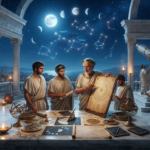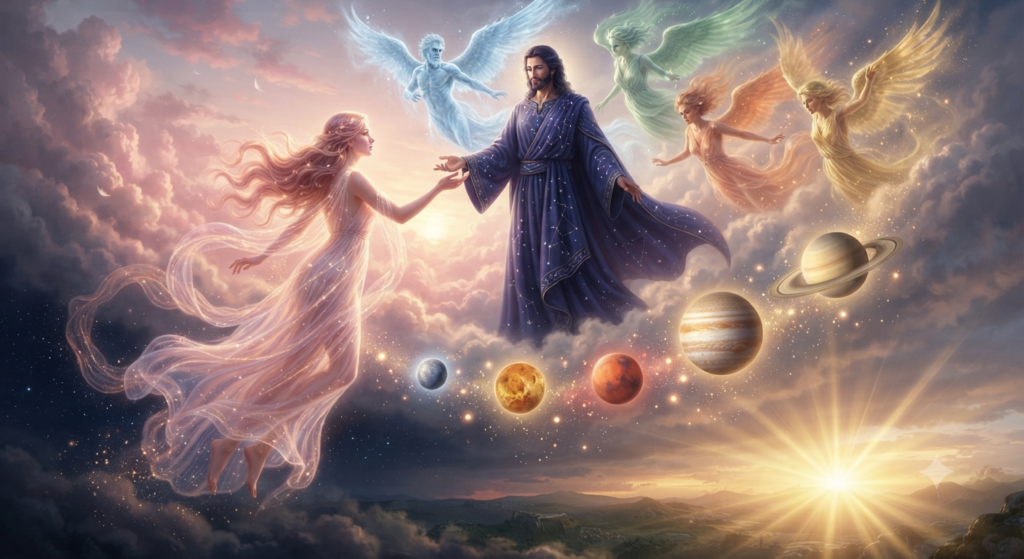
In the celestial hierarchy of Greek mythology, the figure who personified the very substance of the night sky stands as a testament to the ancient world’s fascination with the cosmos. Who is Astraios, the Titan god of the stars? He is the divine embodiment of the stars and the astral phenomena that fill the heavens, a second-generation Titan whose name is derived from the Greek word astron, meaning “star.” While not as widely known as the Olympians, Astraios held a position of profound importance in the mythological cosmology, representing the celestial bodies that guided sailors, marked the seasons, and inspired wonder in the ancient world. His role as the father of the winds and the stars cemented his place in the divine order of the universe.
Origins and Genealogy
Astraios was born from the union of two primordial powers: Crius, the Titan god of the heavenly constellations, and Eurybia, the Titan goddess of the mastery of the seas. This lineage placed him at the intersection of the sky and the sea, a fitting origin for a deity who presided over the celestial bodies that navigators relied upon. As a second-generation Titan, he was part of a divine dynasty that predated the Olympian gods. His siblings included Pallas, the Titan of warcraft, and Perses, the Titan of destruction, demonstrating that his family was associated with fundamental forces of both creation and chaos. This divine heritage established Astraios as a figure of immense cosmic significance.
Family and Consorts
Astraios was most notably the consort of Eos, the rosy-fingered goddess of the dawn. Together, they produced some of the most important celestial deities in the Greek pantheon. Their children included the Anemoi, the four wind gods: Boreas (the North Wind), Notus (the South Wind), Eurus (the East Wind), and Zephyrus (the West Wind). Additionally, they were the parents of the Astra Planeta, the five wandering stars—the planets as understood by the ancient Greeks—which included Phainon (Saturn), Phaethon (Jupiter), Pyroeis (Mars), Eosphorus (Venus), and Stilbon (Mercury). They also bore the Astra, the countless fixed stars that dot the night sky. This union between the dawn and the stars perfectly symbolized the transition from night to day, with the winds as the messengers of this cosmic cycle.
Mythological Role
Astraios’s primary role in mythology was to preside over the celestial bodies and the astral phenomena that governed the ancient world’s understanding of time and navigation. He was the divine authority over the stars, the constellations, and the planets, ensuring their proper course across the heavens. His association with the winds further connected him to the seasonal changes that were crucial for agriculture and maritime activities. In the Theogony of Hesiod, he is explicitly listed among the Titans, and his role in the cosmic order was so essential that the later Greek orphic tradition elevated him to a position of great importance, where he was sometimes considered the father of the constellations alongside his wife, Eos. It is important to distinguish Astraios from his son Astraeus, who is sometimes conflated with him; however, the earlier tradition firmly established the father as the primary star god.
The Starry Crown and Celestial Symbols
While Astraios does not have an extensive catalog of surviving myths or specific symbols, his domain itself served as his most defining attribute: the stars. He personified the celestial vault, and his influence could be seen in the constellations and planets that moved across the night sky. Unlike the Olympian gods, who were associated with specific physical objects like a trident or a thunderbolt, Astraios’s symbol was the entire cosmos itself. His very essence was embedded in the brilliant pinpricks of light that the ancient Greeks studied, interpreted, and worshipped. His marriage to Eos, the dawn, further enhanced his symbolism, representing the eternal interplay between the fading stars of night and the emerging light of a new day.
Worship and Cultural Importance
Evidence for the direct worship of Astraios is scarce, as he was a more esoteric figure in Greek religion, primarily appearing in the genealogical poetry of Hesiod and the Orphic hymns. However, his cultural importance cannot be overstated. He represented the divine principle behind the stars, which were essential to ancient Greek life. The constellations guided navigation across the Mediterranean Sea, and the rising and setting of certain stars marked the agricultural calendar, indicating when to plant or harvest crops. The planets were associated with various deities, and their movements were believed to influence events on earth. In the Orphic tradition, which emphasized a more mystical and cosmological understanding of the gods, Astraios was revered as the grandfather of the celestial bodies, with the stars being seen as a divine and living entity.
Frequently Asked Questions About Who is Astraios, the Titan god of the stars?
Who were the parents of Astraios?
Astraios was the son of Crius, the Titan god of the constellations, and Eurybia, the Titan goddess of the sea’s power. This lineage connected him to both the celestial and the maritime realms.
Who was the wife of Astraios?
Astraios was married to Eos, the Titan goddess of the dawn. Together, they were the parents of the winds, the planets, and the fixed stars.
Who are the children of Astraios?
The children of Astraios and Eos included the four wind gods (Boreas, Notus, Eurus, and Zephyrus), the five wandering stars or planets (Phainon, Phaethon, Pyroeis, Eosphorus, and Stilbon), and the countless fixed stars of the night sky.
What is the difference between Astraios and Astraeus?
In early Greek mythology, Astraios was the distinct Titan god of the stars and the father of the winds and planets. However, in later traditions, particularly the Orphic hymns, the names Astraios and Astraeus were sometimes conflated or used interchangeably, leading to confusion. The earlier sources clearly distinguish them.
What was the role of Astraios in Greek mythology?
Astraios was the divine personification of the stars and the astral phenomena. He presided over the celestial bodies, ensuring their proper movement across the sky, and was associated with the winds and the changing seasons, making him a figure of significant cosmological importance.
Conclusion
Who is Astraios, the Titan god of the stars? He is the embodiment of the ancient Greek understanding of the cosmos, a divine figure who personified the stars, planets, and winds that governed their world. Though largely absent from the dramatic narratives of heroic myth, his importance in the cosmic structure of the universe was undeniable. His union with Eos, the dawn, represented the eternal cyclical relationship between night and day, and his children—the winds and the stars—were the essential forces that shaped life on earth. In an age before modern astronomy, the stars were not merely physical objects but divine entities, and Astraios stood as their sovereign ruler. His legacy persists not in grand temples or epic tales but in the very heavens themselves, a silent testimony to the ancient world’s profound reverence for the celestial order.

Orin Vale has spent the better part of two decades tracing the threads that connect the world’s oldest stories — from the halls of Asgard to the banks of the Nile, from Olympus to the jungles of the Maya. What began as a childhood fascination with flood myths and trickster gods grew into years of independent study across comparative mythology and ancient religion, always chasing the same question: what did these stories mean to the people who first told them? Orin writes for readers who want more than trivia — the ones looking for the beliefs, fears, and truths that myths were built to carry.