In the rich tapestry of Greek mythology, where heroes are almost exclusively male, Atalanta stands as a singular and compelling exception. Who is Atalanta in Greek mythology? She is the legendary huntress, the swift-footed heroine whose prowess with a bow and unparalleled speed rivaled and often surpassed the greatest male heroes of her age. She is the only woman to have sailed with the Argonauts, the first to draw blood from the monstrous Calydonian Boar, and the champion who defeated the hero Peleus in a wrestling match . Her story is one of defiance—against the patriarchal expectations that sought to confine her to marriage and domesticity, and against the very gods who shaped her fate. Abandoned at birth by a father who desired a son, she was suckled by a she-bear and raised in the wild, becoming a fierce devotee of the virgin goddess Artemis . This article explores the complete mythological biography of Atalanta, delving into her origins, her epic adventures, the legendary footrace that determined her future, and her enduring legacy as a symbol of female strength and independence in a world dominated by male heroes.
The Origins and Early Life of Atalanta
The Arcadian and Boeotian Traditions
The mythology of Atalanta is complicated by the existence of two distinct, yet often conflated, traditions regarding her birth and homeland. The ancient sources generally distinguish between an Arcadian Atalanta and a Boeotian Atalanta . In the Arcadian tradition, she is the daughter of Iasus (or Iasion) and Clymene, making her a figure from the mountainous heart of the Peloponnese . This version is often associated with her participation in the Calydonian Hunt and her voyage with the Argonauts. In the Boeotian tradition, she is the daughter of King Schoeneus . This version is primarily associated with her famous footrace and her eventual marriage to Hippomenes. Both traditions, however, share the same core elements of her legend: her abandonment, her upbringing in the wilderness, and her exceptional hunting and running skills.
Abandonment and Nurture by a She-Bear
The beginning of Atalanta’s life is a story of rejection and improbable survival. Her father, disappointed at not having a son, ordered the newborn infant to be exposed on Mount Parthenion and left to die . However, fate had other plans. A she-bear, an animal sacred to Artemis, came upon the helpless child and, driven by maternal instinct after having recently lost her own cubs, nursed Atalanta . This act of divine intervention, often interpreted as a sign of Artemis’s protection, marks Atalanta as a favored mortal of the goddess from the very beginning of her life.
Atalanta was eventually discovered by a group of hunters who had been hunting the bear. They took the child in and raised her in the wilderness . In this harsh environment, Atalanta learned to be a skilled huntress, becoming “swifter and more deadly” than any of her male companions . She adopted the lifestyle of her patron goddess, wearing a simple, sleeveless tunic that reached her knees and swearing an oath of perpetual virginity . This early life, free from the constraints of traditional society, forged the fiercely independent and capable heroine she would become.
The Legendary Adventures of Atalanta
The Calydonian Boar Hunt
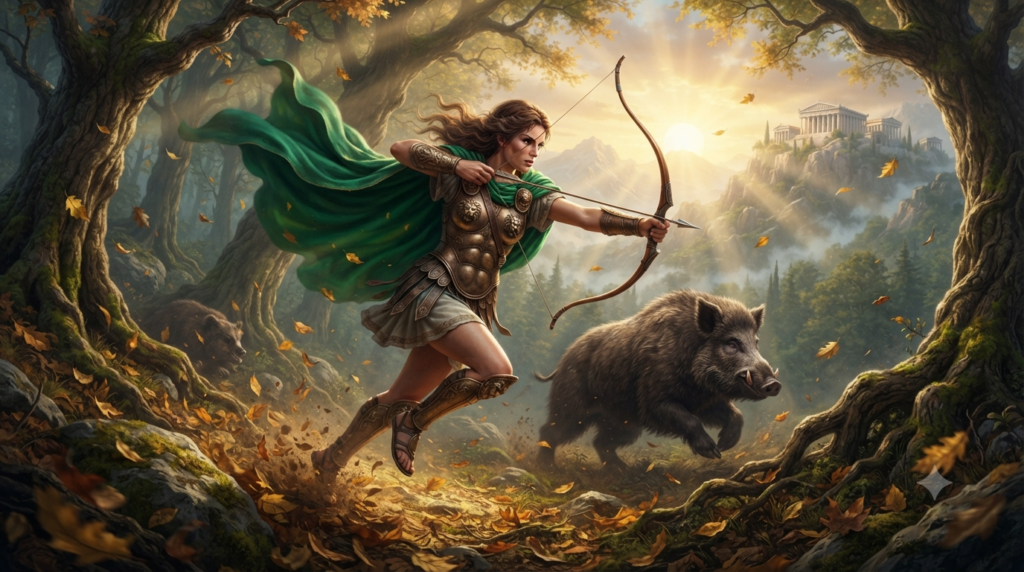
Atalanta’s most famous adventure is her participation in the hunt for the Calydonian Boar . This story, mentioned as early as Homer’s Iliad, begins when King Oeneus of Calydon neglected to honor Artemis with a sacrifice. In her anger, the goddess sent a monstrous boar of immense size to ravage the land, destroying crops and killing those who crossed its path . To rid the kingdom of this terror, Oeneus summoned a host of Greece’s greatest heroes, including Meleager, Theseus, Jason, Peleus, and the Dioscuri .
Atalanta was also called to join the hunt, but her presence was met with outrage by many of the male heroes, who refused to hunt alongside a woman . It was Meleager, the king’s son and leader of the expedition, who compelled them to accept her, motivated both by a sense of fairness and his romantic interest in her . The hunt was a bloody affair, with several men being gored to death by the ferocious beast. It was Atalanta, however, who drew first blood, piercing the boar’s back with an arrow . After the boar was finally slain by Meleager, he awarded the prized hide to Atalanta as a token of her valor and his affection . This decision sparked a quarrel with Meleager’s uncles, who believed it was disgraceful for a woman to receive the prize. In the ensuing argument, Meleager killed them, setting off a chain of events that would lead to his own tragic death at the hands of his mother, Althaea .
The Voyage of the Argonauts
Atalanta is also occasionally mentioned as one of the Argonauts who sailed with Jason on his quest for the Golden Fleece . According to Pseudo-Apollodorus, she was the only woman among the crew, invited and protected by Artemis . Diodorus Siculus goes further, stating that she not only sailed with the Argonauts but also fought alongside them in the battle at Colchis, where she was wounded alongside Jason and later healed by Medea .
Apollonius of Rhodes, however, presents a different account, where Jason prevents Atalanta from joining the expedition out of concern that her presence as a woman would cause strife among the crew . Regardless of the variation, her inclusion in the Argonautic tradition, even as a disputed member, highlights her reputation as a figure of extraordinary skill and courage, worthy of standing alongside the greatest male heroes of her generation.
The Wrestling Match with Peleus
Atalanta’s physical prowess is further demonstrated in her wrestling match against Peleus, the future father of Achilles. According to the myth, after the death of King Pelias, funeral games were held in his honor at Iolcus . Atalanta participated in the athletic competitions and famously defeated Peleus in a wrestling match . This victory was a remarkable achievement, as Peleus was himself a hero of immense strength. The match became a popular subject in Greek art, demonstrating Atalanta’s ability to compete and triumph in the most physically demanding of contests, traditionally the exclusive domain of male athletes. This event, like the Calydonian Hunt, reinforces her identity as a hero who transcends and challenges traditional gender roles.
The Footrace and Marriage of Atalanta
The Oracle’s Warning and the Challenge
Following her adventures, Atalanta was reunited with her father, who insisted that she must marry . Atalanta, however, had received a warning from an oracle against marriage, which was said to be her undoing . To preserve her freedom and avoid marriage, she devised a seemingly impossible challenge for her suitors. She agreed to marry only the man who could defeat her in a footrace . The terms of the contest were brutal: she would race the suitor, and if she caught him, she would kill him . Many suitors accepted the challenge and met their doom, their heads displayed in the stadium as a grim warning .
The Cleverness of Hippomenes
The suitor who would finally succeed was Hippomenes, a young man of remarkable boldness . Initially, Hippomenes dismissed the other suitors as foolish, but upon seeing Atalanta race, he fell in love and was determined to win her, even at the risk of his own life . Aware that he could not outrun her on his own merits, Hippomenes prayed to Aphrodite, the goddess of love, for assistance . Aphrodite, who was offended by Atalanta’s devotion to Artemis and her rejection of love, agreed to help him. She gave Hippomenes three irresistible golden apples and instructed him on how to use them to win the race .
The Golden Apples and the Victory
The race began, and Atalanta, as expected, quickly took the lead. Seeing that he was about to lose, Hippomenes threw one of the golden apples, and to the side. Atalanta could not resist the allure of the magnificent fruit, swerving off the path to retrieve it . She caught up with Hippomenes once more, but he threw the second apple, again distracting her. As she neared the finish line for the final time, Hippomenes threw the third and final apple, which Aphrodite had made heavier. Atalanta paused to pick it up, allowing Hippomenes to cross the finish line first . Having won the race, Hippomenes won Atalanta’s hand in marriage.
The Metamorphosis and Legacy
Transformation into Lions
The marriage of Atalanta and Hippomenes, however, was destined to be short-lived. Hippomenes, in his moment of triumph, forgot to properly thank Aphrodite for her divine assistance . Angered by this ingratitude, the goddess sought revenge. As the couple was walking one day, Aphrodite inflamed them with such an overpowering lust that they made love inside a sacred precinct belonging to Zeus, Cybele, or Rhea (depending on the version) . This act of sacrilege offended the deity, who punished them by transforming them into lions . It was a common belief in antiquity that lions could not mate with their own species, only with leopards, so their punishment was an eternal separation from the “intercourse of love” . In some versions, they were yoked to the chariot of Cybele, forced to pull it for all time .
Atalanta’s Legacy in Art and Culture
Atalanta’s story has been a rich source of inspiration for artists and writers from antiquity to the present. In ancient Greek art, she frequently appears as a huntress, easily identifiable by her short tunic, her bow and spear, or the animal skin she wears . She was depicted on the pediment of the Temple of Athena at Tegea, on the famous François Vase, and in numerous red-figure pottery scenes . The wrestling scene with Peleus also proved popular, appearing on Chalcidian hydriae and other vases. In the Roman period, her image remained a powerful one, appearing in mosaics that depict her as a skilled hunter on horseback.
In literature, her myth was retold by Ovid in his Metamorphoses, and she remained a popular subject in medieval and Renaissance art, often symbolizing chastity and independence. In the modern era, her story has been reclaimed and reinterpreted as a symbol of female empowerment and resistance against patriarchal norms, making her one of the most enduring and beloved heroines of Greek mythology. The Italian football club Atalanta Bergamasca Calcio, founded in 1907, is named after her, a testament to the enduring appeal of her swiftness and strength .
Frequently Asked Questions About Who is Atalanta in Greek mythology?
What is Atalanta most famous for?
Atalanta is most famous for her role in the Calydonian boar hunt, where she was the first to wound the monstrous beast, and for her legendary footrace, where she defeated her suitors until Hippomenes outwitted her with golden apples . She is also celebrated as the only woman to have sailed with the Argonauts and for defeating Peleus in a wrestling match .
Who were Atalanta’s parents?
There are two main traditions regarding her parentage. The Arcadian tradition names her father as Iasus and her mother as Clymene . The Boeotian tradition names her father as King Schoeneus . The variations in these traditions suggest that Atalanta was a figure of local cults that were later absorbed into a more unified pan-Hellenic mythology.
How was Atalanta raised?
Atalanta was abandoned by her father at birth because he had wanted a son. She was nursed by a she-bear that was sacred to Artemis. She was then discovered and raised by a group of hunters, growing up to be a swift-footed and skilled huntress who lived in the wilderness .
What was the race of Atalanta?
To avoid marriage, Atalanta challenged her suitors to a footrace. She would marry the man who beat her, but would kill those whom she overtook . Many suitors died until Hippomenes defeated her by dropping three golden apples given to him by Aphrodite to distract her, allowing him to win the race and her hand .
Who is Hippomenes in the story of Atalanta?
Hippomenes is the suitor who ultimately won the hand of Atalanta in marriage. He won the race by using the golden apples given to him by Aphrodite to distract her . He is also sometimes referred to as Melanion in other versions of the myth .
Why were Atalanta and Hippomenes turned into lions?
The couple was transformed into lions as punishment for their sacrilege. After their marriage, Hippomenes neglected to thank Aphrodite for her help. In revenge, the goddess inspired them with overpowering lust, causing them to make love inside a sacred precinct. For this act of desecration, they were turned into lions .
Did Atalanta have any children?
Yes, Atalanta was the mother of Parthenopaeus, who would later become one of the Seven against Thebes . Depending on the version of the myth, the father of her son was either Hippomenes (Melanion), Meleager, or the war god Ares .
What does the name Atalanta mean?
The name Atalanta (Ἀταλάντη) is derived from the Greek word atalantos (ἀτάλαντος), which means “equal in weight” . This is a reference to her ability to compete on equal terms with the greatest of male heroes in contests of strength, speed, and skill .
Conclusion
Who is Atalanta in Greek mythology? She is the defiant huntress, the swift-footed runner, and the greatest female heroine of the Greek world. From her miraculous survival as an abandoned infant nursed by a bear to her epic victories over the Calydonian Boar and the heroes of her age, Atalanta’s story is one of extraordinary resilience and transcendent skill. She challenged the deeply ingrained patriarchal norms of her society, refusing to be confined to the traditional roles of wife and mother, and instead dedicating her life to the goddess Artemis and the pursuit of athletic and martial excellence. Her participation in the Calydonian hunt and her voyage with the Argonauts place her on a level equal to the most celebrated male heroes, while her footrace, a contest of ultimate speed, became a defining testament to her unmatched abilities. Ultimately, her story is a tragic one, as she was punished for her defiance by being forced into a marriage that led to her animalistic transformation. Yet, even in her punishment, her legend endured, serving as an eternal symbol of female independence, strength, and the courage to challenge fate. She remains an iconic and inspiring figure, a testament to the power of a single woman to stand against a world of gods and heroes.

Orin Vale has spent the better part of two decades tracing the threads that connect the world’s oldest stories — from the halls of Asgard to the banks of the Nile, from Olympus to the jungles of the Maya. What began as a childhood fascination with flood myths and trickster gods grew into years of independent study across comparative mythology and ancient religion, always chasing the same question: what did these stories mean to the people who first told them? Orin writes for readers who want more than trivia — the ones looking for the beliefs, fears, and truths that myths were built to carry.