In the vast and luminous pantheon of Roman mythology, Aurora stands as the divine personification of the dawn, the goddess who heralds the arrival of the sun each morning. Who is Aurora, the Roman goddess of dawn? She is the celestial figure who renews herself every day, flying across the sky to announce the coming of light, ending the darkness and bringing illumination to both gods and mortals . Her name itself, derived from the Proto-Indo-European dawn goddess Hausos, connects her to a tradition of dawn deities that spans the ancient world, including the Greek goddess Eos, the Vedic Ushas, and the Germanic Ēostre . While Aurora’s mythological narratives often mirror her Greek counterpart, she holds a distinct place in Roman poetry and culture, appearing most frequently in tales of passionate love and tragic fate. Unlike many Roman deities, Aurora did not have established temples or a formal cult, yet her significance was recognized through the poetic traditions that celebrated her transformative power . This article explores the complete mythology of Aurora, from her origins and family relationships to her most famous myths, her symbols, and her enduring legacy in astronomy, art, and language.
The Origins and Name of Aurora
The Indo-European Dawn Goddess
The origins of Aurora extend far beyond Roman and Greek mythology, reaching back to a shared ancestral tradition that predates the classical world. Linguistic evidence demonstrates that Aurora, known in ancient times as Aurōra, is a direct descendant of a Proto-Indo-European dawn goddess, reconstructed by scholars as Haéusōs . This divine figure was not merely a Roman creation but a shared inheritance among the peoples of Europe and Asia, manifesting in various cultural forms including the Greek Eos, the Vedic Ushas, the Slavic Zorya, the Lithuanian Aušrinė, and the Germanic Ēastre or Ostara, from whom the English word “Easter” derives .
The name Aurōra itself is a testament to this ancient lineage. It stems from Proto-Italic ausōs, which ultimately traces back to the Proto-Indo-European haéusōs, the “dawn” conceived as a divine entity . Some ancient etymologists, including the 1911 Encyclopædia Britannica, suggested a connection between Aurora and the word aurum, meaning gold, linking the goddess to the golden hues of the morning sky . This linguistic continuity reveals that the personification of dawn as a goddess was one of the most ancient and widespread concepts in human spirituality, predating the rise of the Roman state by millennia. For the Romans, invoking Aurora was not merely a poetic flourish but a connection to a tradition of cosmic understanding that linked their culture to the most fundamental patterns of the universe.
Aurora’s Family and Genealogy
In Roman mythology, the parentage of Aurora was remarkably flexible, reflecting the fluid nature of Roman religious tradition. The poet Ovid, one of the most important sources for her mythology, offered two distinct genealogies. In some passages, he named Aurora as the daughter of the Titan Hyperion, making her the sister of Sol, the sun, and Luna, the moon . This lineage, adapted from Greek mythology, aligns Aurora with the ancient divine order that predates the Olympian gods, emphasizing her primordial status as a cosmic entity rather than a member of the later Roman pantheon. In other works, Ovid referred to her as “Pallantis,” the daughter of the Titan Pallas, demonstrating the adaptability of her mythological tradition .
Aurora’s siblings are consistently identified as Sol, the embodiment of the sun, and Luna, the personification of the moon . This sibling relationship underscores the Romans’ understanding of the celestial cycle: Aurora rises at the dawn of day, preceding her brother as he begins his journey across the sky, while her sister Luna appears after the sun departs. The triad of these siblings represents the natural rhythm of time itself, the eternal succession of dawn, daylight, and night. According to some later traditions, Aurora was also the mother of the stars and the Morning Star, which was the popular name for the planet Venus, further expanding her role as a figure who bridges the celestial realms .
Mythological Role and Divine Function
The Herald of the Sun
Aurora’s primary mythological function is her role as the goddess of the dawn and the herald of the sun’s arrival . Each morning, she renews herself and rises from the east, flying across the sky in her chariot, announcing the coming of the day . The Roman poet Ovid captured this vision of the goddess in his Metamorphoses, describing how “Far in the crimsoning east wakeful Dawn threw wide the shining doors of her rose-filled chambers” . Her appearance was the signal for Apollo, the sun god, to begin his daily journey across the heavens, bringing light and life to the world . This action was not merely ceremonial but foundational; Aurora ended the darkness and brought light to both gods and mortals, making her a figure of cosmic importance .
In Homeric tradition, which influenced Roman depictions of Aurora, the goddess was represented as rising from her couch with the mortal Tithonus, driven from the east in a chariot drawn by the horses Lampus and Phaëthon, carrying light to gods and men . The name of these horses—Lampus meaning “shining” and Phaëthon meaning “radiant”—emphasizes the luminosity of the dawn’s arrival. In earlier literary sources, Aurora’s course would end when the sun was fully risen, but in later Roman literature, she was often depicted as accompanying the sun throughout the entire day, evolving into a goddess of daylight more broadly .
Personification of the Dawn
The goddess Aurora personifies the natural phenomenon of dawn, embodying the transition from night to day. Ancient writers frequently described her using vivid, sensory imagery that evoked the beauty of the morning sky. The most famous of these descriptive epithets is “rosy-fingered,” a translation of the Greek rhododactylos, which was applied to Eos in the Homeric epics and subsequently to Aurora in Roman poetry . This epithet captures the delicate, pink-tinged light that spreads across the eastern sky as the sun begins to rise. Aurora was also described as “saffron-robed” and “saffron-colored,” referencing the warm, golden hues of the morning .
Beyond her visual representation, Aurora also embodies the transformative power of dawn. She is the end of darkness, the dispeller of shadows, and the beginning of new life and activity. This role connects her to the cycle of creation, growth, and renewal that was central to ancient agricultural societies. For the Romans, the arrival of dawn was not just a natural occurrence but a divine act of regeneration, a moment when the world was reborn from the sleep of the night. Aurora’s function, therefore, was not merely descriptive but performative; by rising each morning, she actively created the conditions for life, growth, and human endeavor . In the words of Ovid, Aurora herself acknowledges that her role is to bring light to people and gods alike, and this role is what makes her a deity, regardless of whether she had temples or formal worship .
The Myths and Loves of Aurora
The Tragedy of Tithonus
The most famous myth associated with Aurora is her tragic love affair with Tithonus, a prince of Troy . This story, adapted from Greek sources by Roman poets like Ovid, is a powerful meditation on the relationship between love, immortality, and the relentless passage of time. Aurora fell deeply in love with the mortal Tithonus and, desperate to keep him with her for eternity, begged Jupiter (the Roman equivalent of Zeus) to grant him immortality . The king of the gods, moved by her plea, granted her wish. However, in her haste, Aurora failed to ask for eternal youth to accompany his immortality. As Tithonus aged, he did not die but continued to grow older, weaker, and more decrepit, becoming a frail and helpless figure who had lost all the vitality that had attracted Aurora to him .
The myth’s conclusion varies in different sources. In the most common version, the once-beautiful Tithonus becomes forever old, and Aurora, no longer able to bear the sight of his decay, transforms him into a cicada . The cicada, in ancient Greek and Roman culture, was a symbol of immortality, or at least of long life, as the insect was believed to be able to live without food and was sometimes associated with the rejuvenation of the natural world. However, the transformation into a cicada also represents an eternal, trapped existence—a warning about the dangers of seeking immortality without understanding its consequences. This myth has resonated through the ages as a powerful cautionary tale, reminding us that even the greatest gifts from the gods can become curses if pursued without wisdom. In some traditions, Aurora and Tithonus had children, including Memnon, the Ethiopian king who fought in the Trojan War, and Emathion, the king of Arabia .
Aurora and Cephalus
Another significant myth involving Aurora is her infatuation with the mortal hunter Cephalus, a story that also ultimately ends in tragedy . According to this narrative, Aurora fell in love with Cephalus and attempted to seduce him, but he remained faithful to his wife, Procris . In some versions, Cephalus rejected Aurora’s advances outright, his loyalty to Procris unwavering. Other accounts, however, include a more complex story involving a test of fidelity. Some versions state that Aurora, seeing his steadfast love for Procris, revealed to Cephalus that his wife would be unfaithful to him if he were to disguise himself and test her virtue. This test, unsurprisingly, led to the destruction of the couple’s trust.
The story is perhaps best known through its depiction in the works of the French painter Nicolas Poussin and later artists, where Aurora is shown gazing longingly at a sleeping Cephalus, who rejects her by turning away towards a portrait of his wife held by a winged cupid . This myth highlights Aurora’s role in Roman erotic poetry, where she appears as a passionate and often frustrated lover, whose desires are thwarted by the devotion of mortals to their human partners. Aurora’s pursuit of Cephalus also connects her to other mortal lovers, including the hunter Orion. According to Homer, Aurora was also the lover of Orion, the great hunter, who was later placed among the stars as a constellation . This connection to Orion represents the myth’s astronomical dimension; Orion is a constellation that disappears at the dawn, fleeing from the goddess’s embrace.
Symbols and Attributes
The Chariot, Saffron, and Cicada
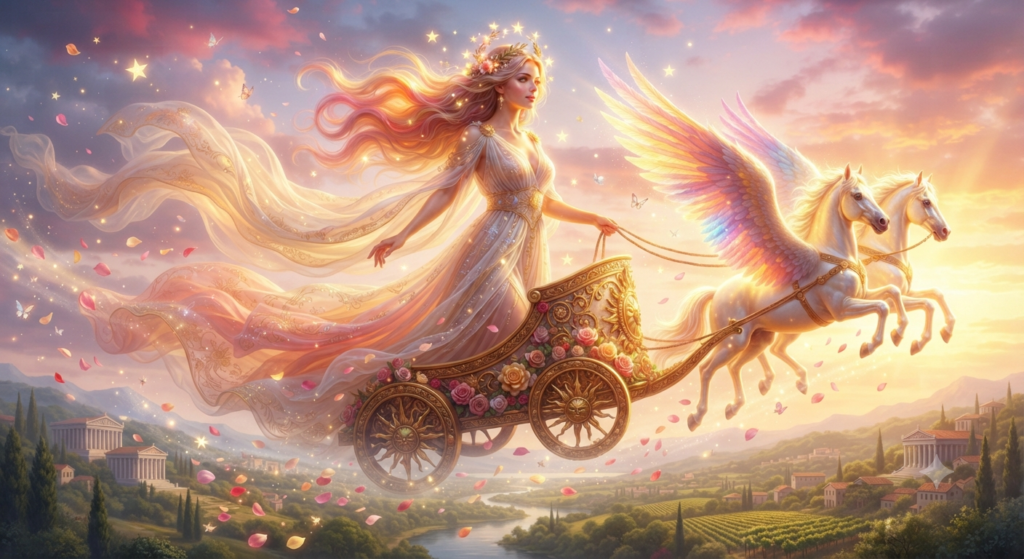
Aurora’s symbols in mythology and art are closely tied to her functions and her stories. The most prominent symbol is her chariot, which she drives across the sky every morning to announce the arrival of the sun . In artistic representations, she is often depicted rising from the sea in a chariot drawn by winged horses, her hair swept in the wind, scattering flowers or dew before her . This chariot is sometimes accompanied by other celestial figures, such as Apollo or the Hours, who serve as part of her retinue . The winged horses emphasize the speed and ethereality of the dawn’s arrival, while the flowers and dew represent the fertility and abundance that dawn brings.
Another significant symbol is saffron, a color associated with the goddess . The warm, golden hue of the morning sky was described as “saffron-colored,” and saffron-colored bread was offered at the Matralia festival, which may have been associated with Aurora’s fertility aspects . The cicada is another symbol connected to Aurora, resulting from her transformation of the aged Tithonus into the insect . This symbol represents the tragic consequences of her love and the immortal life without eternal youth. Beyond these symbols, the goddess was generally depicted in Roman poetry with the attributes of light and dawn, representing the transition from darkness to day. The roseate shafts of light that herald the dawn are associated with her epithet “rosy-fingered,” a phrase that emphasizes the beauty and gentleness of the rising sun .
The Horse Lampus and Phaëthon
In literary sources, Aurora’s chariot is drawn by two horses with significant names: Lampus and Phaëthon . The name Lampus comes from the Greek word meaning “shining” or “torch-bearing,” while Phaëthon means “radiant” or “shining one.” These names are not merely decorative but reinforce the essential character of the dawn: it is the beginning of light, the moment when darkness is dispelled by the radiance of the approaching sun. The horses themselves are personifications of the dawn’s luminous qualities. In Homeric tradition, which served as the basis for Roman depictions, Aurora’s chariot was drawn out of the east by these horses to carry light to gods and men .
The use of these horses also highlights the vitality and energy of the dawn’s arrival. They are not passive beasts but active agents in the transition from night to day, participating directly in the renewal of the world. This representation of Aurora emphasizes her role in the cosmic cycle, establishing her as a powerful and dynamic force rather than a passive observer of the dawn. The image of a chariot drawn by winged horses has become a lasting artistic motif, appearing in works ranging from Roman frescoes to Renaissance and Baroque paintings.
Worship, Temples, and Religious Significance
The Absence of Formal Cult
One of the most distinctive aspects of Aurora’s religious status in ancient Rome is the notable absence of formal temples, a formal cult, or established festivals dedicated exclusively to her . Unlike the major deities of the Roman pantheon, such as Jupiter, Mars, or Minerva, Aurora did not have a state-sponsored worship or a priestly college dedicated to her service. This absence of cult is so notable that Ovid’s Metamorphoses features Aurora herself lamenting her lack of temples: she proclaims, “I am the least of all, whom the golden heavens hold (since temples to me are the rarest in all the world)” . The Latin expression rarissima is a euphemism; in fact, she had no temples or altars at all dedicated to her divine worship .
However, the lack of a formal cult does not mean Aurora was insignificant or that her worship was nonexistent. In Roman religion, many deities were recognized without having a specific cult or priesthood, and their worship was often integrated into the broader practices of Roman life and poetry. As the goddess of dawn, Aurora was part of the natural order, and her presence was experienced daily by every Roman, regardless of whether they made sacrifices to her or not . According to the Roman poet Ovid, Aurora’s “class” or divine category was enough to make her an important figure in Roman mythology, and her role as the one who ends the darkness and brings light to gods and men is what makes her a divine entity . The lack of temples may even underscore her status as a goddess of liminal space—she existed at the boundary between night and day, and thus was not bound to any single place of worship.
The Relationship with Mater Matuta
Although Aurora did not have her own cult, she is often identified in certain sources with another Roman goddess, Mater Matuta, who was worshipped extensively . Mater Matuta was a goddess of fertility and motherhood, honored at the Matralia festival on June 11th, a celebration that women observed to pray for their children . The connection between these two goddesses is a subject of scholarly debate, with the earliest identification appearing in the work of the Roman poet Lucretius .
The connection between Mater Matuta and Aurora is likely based on the timing and symbolism of the Matralia festival. The celebration was held at dawn (prima luce), the exact time of day associated with Aurora, and was a day for mothers to pray for the fertility and protection of their children . The shared association with the first light of day, along with the offering of saffron-colored bread loaves to the goddess (saffron being a key attribute of Aurora), may have led to the identification or confusion of these two figures over time . In this context, Aurora’s role as the bringer of light was linked to the concept of maturatio, or maturation, suggesting that the dawn is not only the beginning of the day but also the beginning of growth and development, making her responsible for fertility—a role usually attributed to Mater Matuta . Despite the absence of her own formal cult, Aurora’s influence extended into the religious practices of Rome, albeit intertwined with other deities.
Ancient Sources and Literary References
Aurora in Latin Poetry
Aurora is a frequent and beloved figure in Latin poetry, appearing in some of the most celebrated works of Roman literature. The poet Ovid is one of the most important sources for her mythology, including the myths of Tithonus and Cephalus in his Metamorphoses . In Ovid’s works, Aurora is a passionate and often tragic figure, her love affairs with mortals driving much of her narrative. In the Metamorphoses, she appears as a sensual, sometimes vengeful figure, who pursues her mortal lovers with great intensity. The poet also presents her as a goddess of limited power, admitting in her own voice that she is the “least” of the gods, lacking temples and receiving little worship . This literary self-deprecation, however, is a poetic device that humanizes her and makes her more relatable to a Roman audience.
Other Roman poets also invoked Aurora. Virgil, in the Aeneid, uses the goddess’s name metaphorically to represent the East generally, a common usage that underscores her role as a symbol of light and the beginning of day . The poet Horace also references Aurora in his odes, associating her with death and fortune in purely literary terms. In these works, she is not a figure of formal religious significance but a personification of a natural phenomenon, a classic element of the poetic imagination. The Roman tradition of using Aurora as a metaphor for the East also reflects the practical understanding of the world; Rome was to the west of its empire, so the dawn was always associated with the eastern provinces and the rising of the sun.
The Influence of Greek Eos
A significant challenge in understanding Aurora is disentangling her from her near-identical Greek counterpart, Eos. The Roman poets explicitly adapted many of Eos’s stories and attributes, making it difficult to identify a unique Roman tradition for Aurora. In many cases, Roman writers used the names Aurora and Eos interchangeably, and the myths associated with them are fundamentally the same . The story of Tithonus, the tragedy of losing a lover to age, and the association with the hunter Orion are all borrowed directly from Greek sources .
However, the Roman tradition does offer a distinct perspective. The emphasis on Aurora’s lack of cult and her identification with Mater Matuta suggests a different religious context for the goddess in Rome than in Greece. While Eos was a more integrated figure in Greek religion, Aurora’s Roman identity was more marginal in terms of official worship but perhaps more central in the daily experience of the Romans, who would have invoked her name as a matter of course to mark the time of day. The lack of a formal temple, far from diminishing her, may have made her more personal and accessible, a presence in the sky rather than a figure confined to a sanctuary.
Artistic Representations and Cultural Influence
Aurora in Art
Aurora has been an enduring subject of Western art, inspiring countless painters from the Renaissance to the modern era. Her image is a classic motif in frescoes, oil paintings, and sculptures, often depicting her riding her chariot across the sky or interacting with her mortal lovers. In the works of Guido Reni, the goddess is represented strewing flowers before the chariot of the sun, an image that became iconic . The Baroque painter Guercino created a famous ceiling fresco showing Aurora and the Hours, a work that captures the dramatic energy of the dawn .
François Boucher painted the goddess in the Rococo style, showing her gazing longingly at the sleeping Cephalus, a tableau of seduction and unrequited love . Nicolas Poussin’s depiction of the same scene emphasizes the moment of rejection, with Aurora’s advances rebuffed by the faithful Cephalus . Giovanni Battista Tiepolo’s “The Chariot of Aurora” is a study for a royal ceiling, depicting the goddess crossing the sky with Apollo, the Hours, and figures of abundance . These diverse representations show Aurora as a symbol of beauty, desire, and the natural cycles of time. She is a figure of passion, yet her love stories often end in tragedy or rejection. This duality makes her a rich subject for artists seeking to explore themes of longing, the passage of time, and the limits of divine power.
The Legacy of Aurora in Astronomy and Language
The legacy of Aurora extends far beyond mythology into modern language, astronomy, and science. The most familiar modern usage of her name is in the term “aurora borealis,” the northern lights, and “aurora australis,” the southern lights . The Italian astronomer Galileo Galilei was the first person to apply the name “aurora” to this atmospheric phenomenon in 1616, recognizing the visual similarity between the glowing lights of the polar skies and the radiance of the dawn . The distinction between “borealis” (north) and “australis” (south) was added later, after explorers such as Captain Cook ventured into the southern hemisphere in the 1770s and realized that aurorae occurred in both poles .
In Roman times, aurorae were interpreted as omens of disaster, a sign of divine wrath or impending catastrophe. Pliny the Elder, a Roman writer of the first century AD, described aurorae as “them which there is no presage of woe more calamitous to the human race, a flame in the sky, which seems to descend to the Earth on showers of blood” . This understanding of aurorae as terrifying omens stands in stark contrast to the modern scientific understanding of the phenomenon as the interaction of charged particles from the sun with the Earth’s upper atmosphere. Today, the goddess’s name is also used in various contexts, from the naming of automobiles to hotels, further solidifying her image as a symbol of beauty, new beginnings, and the enduring connection between myth and the natural world.
Frequently Asked Questions About Who is Aurora, the Roman goddess of dawn?
Who is Aurora in Roman mythology?
Aurora is the Roman goddess of dawn, the personification of the morning light who renews herself every day and flies across the sky to announce the arrival of the sun . She is the Roman counterpart to the Greek goddess Eos and is a descendant of the ancient Indo-European dawn goddess . She appears most prominently in Latin poetry, where she is associated with the beauty of dawn and the tragic consequences of love .
What is the story of Aurora and Tithonus?
Aurora fell in love with Tithonus, a mortal prince of Troy, and begged Jupiter to grant him immortality so they could be together forever . Jupiter granted her wish, but she forgot to ask for eternal youth. As Tithonus aged, he became increasingly decrepit and weak. Eventually, Aurora, unable to bear the sight of his decline, transformed him into a cicada .
What is Aurora the goddess of?
Aurora is the goddess and personification of the dawn . She is responsible for ending the darkness each morning and bringing light to both gods and mortals . In some traditions, she is also associated with fertility, possibly due to her identification with Mater Matuta, a goddess of motherhood and growth .
Does Aurora have any temples?
No, unlike many major Roman deities, Aurora did not have a formal cult, temples, or a dedicated priesthood . As Ovid writes, she laments that her temples are “the rarest in all the world” . This absence of a formal temple cult suggests her worship was integrated into broader Roman life and poetry rather than confined to specific sanctuaries .
Who are the parents and siblings of Aurora?
Aurora’s parentage is flexible in the sources. The poet Ovid names her as the daughter of the Titan Hyperion or Pallas . She has two siblings: Sol, the sun god, and Luna, the moon goddess . This makes her part of a celestial family representing the fundamental rhythms of time and light.
What are Aurora’s symbols?
Aurora is typically associated with symbols such as her chariot, saffron, the cicada, and a torch . The chariot, drawn by winged horses, represents her journey across the sky at dawn . Saffron represents the warm, golden hue of the morning sky . The cicada symbolizes the tragic transformation of her mortal lover Tithonus .
What is the relationship between Aurora and Mater Matuta?
Aurora is sometimes identified with Mater Matuta, a Roman goddess of fertility and motherhood, particularly in the context of the Matralia festival . This identification likely arose because both goddesses were associated with the dawn, and the Matralia festival was held at dawn . The connection suggests that Aurora may have had a fertility aspect related to the nurturing of children and growth .
What is the legacy of Aurora in modern astronomy?
Aurora’s name is used in astronomy for the phenomenon of the aurora borealis and aurora australis, the northern and southern lights . Galileo Galilei was the first to apply the name “aurora” to this phenomenon in 1616, due to the visual similarity between the glowing lights of the polar skies and the radiance of the dawn . In Roman times, aurorae were interpreted as omens of disaster, a belief documented by the writer Pliny the Elder .
Conclusion
Who is Aurora, the Roman goddess of dawn? She is the celestial herald of the morning, the divine figure who every day brings light to the world and marks the transition from night to day. Her name, derived from the most ancient linguistic roots of human culture, connects her to a vast tradition of dawn goddesses that spans civilizations, from the Vedic Ushas to the Greek Eos. Her mythology, preserved primarily in the works of poets like Ovid, is a tapestry of passionate love affairs and tragic fates, embodying the powerful and often dangerous nature of divine desire. From her tragic relationship with the aging Tithonus to her frustrated pursuit of the faithful Cephalus, Aurora’s stories serve as meditations on the nature of love, time, and mortality. Her symbols—her swift chariot of the dawn, the saffron hues of the morning sky, and the cicada that was once her lover—continue to evoke the beauty and pathos of her mythology.
Despite the absence of formal temples or a dedicated cult, Aurora’s influence has been profound and enduring. She has inspired artists from antiquity to the modern era, appearing in masterpieces by Guido Reni, François Boucher, and Nicolas Poussin, capturing the imagination with her beauty and drama. Her name lives on in the aurora borealis, a spectacular natural phenomenon whose radiant, dancing lights echo the goddess’s own ethereal journey across the heavens. Aurora remains a powerful symbol of new beginnings, a reminder that each dawn brings not only light but also the hope of renewal, change, and the eternal cycle of life and time.

Orin Vale has spent the better part of two decades tracing the threads that connect the world’s oldest stories — from the halls of Asgard to the banks of the Nile, from Olympus to the jungles of the Maya. What began as a childhood fascination with flood myths and trickster gods grew into years of independent study across comparative mythology and ancient religion, always chasing the same question: what did these stories mean to the people who first told them? Orin writes for readers who want more than trivia — the ones looking for the beliefs, fears, and truths that myths were built to carry.