Athena stands among the most significant and consistently celebrated figures within Greek mythology, revered as the goddess of wisdom, strategic warfare, and skilled craftsmanship throughout the ancient Greek world. Anyone asking who is Athena in Greek mythology is exploring one of the twelve major Olympian deities, a goddess whose combination of intellectual and martial authority distinguished her significantly from many other figures within the broader Greek pantheon.
Athena’s significance extended well beyond typical divine authority into genuine civic and cultural identity, most notably through her role as patron goddess of Athens itself, the city that would eventually adopt her very name as its own. This connection between deity and city created a uniquely intimate relationship rarely matched elsewhere throughout Greek mythological tradition, positioning Athena as genuinely central to Athenian civic pride and religious practice.
Unlike many Olympian deities whose domains remained relatively singular and focused, Athena’s authority extended across multiple significant areas of human achievement, encompassing wisdom, strategic military planning, and skilled craft production simultaneously. This combination reflected a genuinely sophisticated understanding of how intelligence, careful strategy, and skilled execution worked together across numerous significant human endeavors throughout ancient Greek society.
What follows examines Athena’s extraordinary birth from Zeus’s own head, the multiple significant domains she governed, her pivotal role in Athens’s founding mythology, her distinctive symbols and sacred animals, her status as an eternal virgin goddess, her significant involvement in the Trojan War, and her notable mythological connections to both Medusa and the weaver Arachne.
Athena’s Extraordinary Birth from Zeus’s Head
Athena’s origin story begins with Metis, the Titaness personification of wisdom whom Zeus had taken as his first wife before learning of a troubling prophecy warning that any son born from their union would eventually grow powerful enough to overthrow him. Determined to prevent this outcome, Zeus made the dramatic decision to swallow Metis entirely while she remained pregnant, an episode explored in greater depth through dedicated coverage of both Metis herself and this specific dramatic event.
Rather than ending this pregnancy, Metis continued existing within Zeus, and her ongoing development eventually culminated in one of Greek mythology’s most visually striking birth sequences. When the time came for delivery, Zeus experienced a tremendous headache severe enough to require intervention, with the god Hephaestus specifically called upon to split Zeus’s head open using his own craftsman’s axe to relieve this overwhelming pressure.
From this remarkable opening, Athena emerged fully grown and completely armed, wearing full battle armor and wielding weapons from the very moment of her birth, a genuinely unique entrance into the world unmatched by any other major deity throughout Greek mythological tradition. This extraordinary manner of birth immediately established Athena as a figure combining both her mother’s inherited wisdom and a readiness for battle present from her very first moment of existence.
This remarkable origin provides essential context for who is Athena in Greek mythology, establishing from the very beginning that she would embody a genuinely unique combination of intellectual and martial qualities, born simultaneously wise and battle-ready in a manner reflecting her subsequent, lasting significance throughout Greek religious and mythological tradition.
What Is Athena the Goddess Of?
Athena’s divine authority centered primarily on wisdom itself, positioning her as one of Greek mythology’s foremost representatives of intelligence, careful reasoning, and thoughtful strategic planning across numerous significant contexts throughout ancient Greek life. This intellectual domain distinguished her meaningfully from deities whose authority rested primarily on raw physical power or more chaotic, unpredictable forces of nature.
Beyond pure wisdom, Athena additionally governed strategic warfare specifically, a domain she approached through calculated planning and tactical intelligence rather than the chaotic, bloodthirsty violence more commonly associated with Ares, the Olympian god more directly connected to war’s brutal, destructive aspects. This distinction positioned Athena as representing warfare’s more disciplined, thoughtful dimension, valuing strategy and calculated advantage over indiscriminate destruction.
Athena’s authority additionally extended into skilled craftsmanship, particularly weaving and other precise, technical crafts requiring genuine expertise and careful attention to detail. This connection to craftsmanship reinforced her broader association with intelligence and skill working together productively, extending her domain beyond purely military or intellectual pursuits into tangible, practical human achievement as well.
This combination of overlapping domains provides essential context for who is Athena in Greek mythology, revealing a goddess whose authority spanned wisdom, strategic military planning, and skilled craft production simultaneously, reflecting a genuinely comprehensive vision of how careful intelligence could productively guide numerous significant areas of ancient Greek human activity.
Athena and the Founding of Athens
Athena’s most historically significant mythological episode involves her direct competition with Poseidon for patronage over a newly founded city, a contest whose outcome would ultimately determine this significant location’s own permanent name and religious identity. Both gods presented gifts specifically intended to demonstrate their respective value to the city’s future inhabitants.
Poseidon struck the ground with his trident, producing either a saltwater spring or, according to certain traditions, the very first horse, a gift emphasizing raw power and military strength. Athena instead offered an olive tree, a gift representing peace, sustenance, and long-term prosperity rather than immediate, dramatic demonstration of pure divine power.
The city’s inhabitants ultimately chose Athena’s gift, naming their city Athens in her honor and establishing her as their permanent patron deity, a decision reflecting genuine values regarding sustainable prosperity over raw military might alone. This victory secured Athena an unusually intimate, lasting connection to this specific significant city, distinguishing her relationship with Athens from the more general worship most Olympian deities received across numerous locations throughout Greece.
This foundational contest provides crucial context for who is Athena in Greek mythology, establishing the specific mythological origin behind her unusually close, personal connection to Athens itself, a relationship that would continue shaping both her own mythology and this significant city’s cultural identity throughout ancient Greek history.
Symbols and Sacred Animals
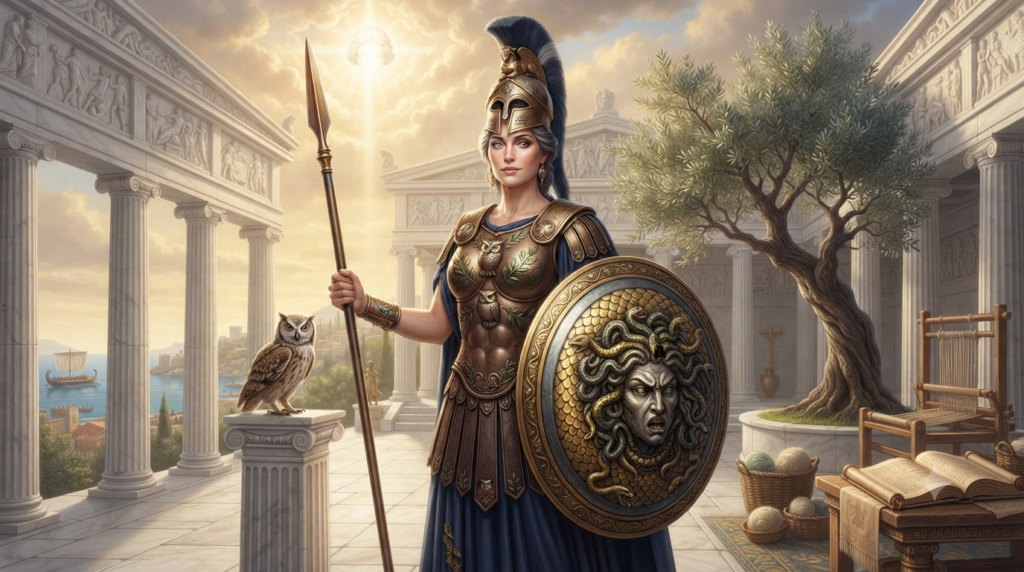
Athena’s iconography consistently featured several distinctive symbols directly connected to her broader domains and mythology, with the owl standing as perhaps her most immediately recognizable sacred animal, specifically representing wisdom and the ability to perceive truth even amid darkness or uncertainty. This particular bird’s association with Athena remains so strong that owls continue serving as a recognizable symbol of wisdom within contemporary culture.
The olive tree similarly held significant symbolic importance connected directly to Athena, commemorating her victorious gift during the contest for Athens’s patronage while additionally representing peace and sustainable prosperity more broadly throughout Greek cultural understanding. This particular symbol reinforced Athena’s broader association with thoughtful, long-term wisdom over more immediate, dramatic displays of power.
Athena’s distinctive armor and equipment additionally served as significant personal symbols, particularly her aegis, a protective shield or breastplate frequently depicted bearing the severed head of Medusa, along with her characteristic spear and helmet emphasizing her genuine martial readiness. Ancient sources additionally referenced Athena through several distinct epithets, including Pallas Athena and Athena Promachos, each emphasizing particular aspects of her broader divine character and significance.
This collection of distinctive symbols and epithets adds meaningful depth to who is Athena in Greek mythology, providing the specific visual and linguistic vocabulary ancient Greeks used to recognize and honor this significant goddess across countless artistic representations and religious contexts throughout the broader Greek world.
Athena, the Eternal Virgin Goddess
Athena belonged to a specific category of three significant Olympian goddesses, alongside Artemis and Hestia, who maintained permanent virginity throughout Greek mythological tradition, remaining unmarried and avoiding romantic or sexual relationships despite numerous mythological encounters with gods and mortals alike. This status reinforced Athena’s particular independence and self-sufficiency within the broader Olympian family structure.
This commitment to virginity appears notably within the mythology surrounding Hephaestus, the god of the forge, who attempted unsuccessfully to pursue Athena romantically despite her firm resistance to his advances. This frustrated pursuit nonetheless resulted in the birth of Erichthonius, a significant figure within Athenian mythology, born through unusual circumstances that preserved Athena’s own virgin status despite this connection to his ultimate origin.
Athena’s maintained virginity distinguished her meaningfully from numerous other Greek goddesses whose mythology frequently centered on romantic relationships, marriages, or maternal roles, instead positioning her identity primarily around her intellectual and martial authority rather than any romantic or family-centered narrative. This distinction reinforced her broader characterization as a goddess defined by independent strength and wisdom.
This distinctive status adds important nuance to who is Athena in Greek mythology, confirming that her identity remained centered specifically on her intellectual and strategic authority rather than the romantic entanglements defining considerable portions of mythology surrounding many other significant Greek deities throughout the broader pantheon.
Athena’s Role in the Trojan War
Athena held genuinely significant involvement throughout the Trojan War, consistently supporting the Greek forces against Troy, a position partially motivated by her own lingering resentment following the Judgment of Paris, when the Trojan prince selected Aphrodite over both Athena and Hera in a contest determining the most beautiful goddess. This earlier slight directly shaped her subsequent hostility toward Troy throughout the broader conflict.
Throughout the war itself, Athena provided direct assistance to several significant Greek heroes, particularly Odysseus, whose own renowned cunning and strategic thinking aligned closely with Athena’s broader domain over wisdom and calculated intelligence. This particular relationship would continue extending well beyond the war itself into Odysseus’s subsequent, lengthy journey home.
Athena additionally supported other significant Greek warriors, including Diomedes and, at various points, Achilles himself, frequently intervening directly to influence specific battlefield outcomes or provide crucial strategic guidance during particularly consequential moments throughout the broader conflict. This sustained involvement demonstrated Athena’s genuine investment in the war’s ultimate outcome.
This significant wartime involvement provides important context for who is Athena in Greek mythology, revealing a goddess whose strategic wisdom translated directly into meaningful, ongoing intervention throughout one of Greek mythology’s most consequential and thoroughly documented military conflicts.
Athena and Medusa
Athena’s mythology includes significant connection to Medusa, the monster later famous for her deadly, petrifying gaze and serpent-covered hair, through a myth involving punishment following an assault that occurred within Athena’s own sacred temple. This significant episode transformed Medusa from her original form into the fearsome monster more commonly recognized throughout later Greek mythological tradition.
Despite the complicated circumstances surrounding this transformation, Athena subsequently played a genuinely significant supportive role when the hero Perseus later undertook his own quest specifically to defeat Medusa, providing crucial guidance and assistance that ultimately enabled his successful, dangerous mission. This assistance reinforced Athena’s broader pattern of supporting resourceful heroes throughout Greek mythology.
Following Medusa’s eventual defeat, Athena additionally incorporated the monster’s severed head directly into her own iconic aegis, permanently connecting this significant mythological episode to her own established visual symbolism and further reinforcing the genuine complexity surrounding this particular myth’s broader significance.
This connection to Medusa adds meaningful depth to who is Athena in Greek mythology, revealing another significant thread within her broader mythology connecting her directly to one of Greek mythology’s most visually distinctive monsters through both punishment and subsequent heroic assistance.
The Myth of Arachne
Among Athena’s most notable mythological encounters with mortals, her competition with Arachne, an exceptionally skilled mortal weaver, provides a genuinely significant cautionary narrative regarding the dangers of hubris when confronting divine authority. Arachne’s remarkable weaving talent had earned her considerable acclaim, eventually leading her to boldly claim her skill surpassed even Athena’s own considerable weaving abilities.
This bold claim prompted Athena to challenge Arachne directly to a weaving competition specifically intended to settle this question of relative skill definitively. Despite genuinely impressive work from both competitors, Arachne’s tapestry specifically depicted the Olympian gods in an unflattering, disrespectful manner, compounding her earlier boastfulness with genuine insult toward the gods themselves.
Enraged by this combination of skilled work and genuine disrespect, Athena ultimately transformed Arachne into a spider, condemning her to weave for eternity in this new form rather than allowing her continued boastful pride to go unpunished. This transformation provided ancient Greeks with a mythological explanation for spiders themselves while reinforcing broader cultural lessons regarding appropriate humility before divine authority.
This cautionary myth completes a full answer to who is Athena in Greek mythology, demonstrating that despite her own generally supportive relationship with skilled, resourceful mortals throughout various other myths, genuine disrespect toward her divine authority still provoked serious, transformative consequences within Greek mythological tradition.
Frequently Asked Questions
What is Athena the goddess of?
Athena is the Greek goddess of wisdom, strategic warfare, and skilled craftsmanship, representing intelligence and calculated planning across these significant domains.
Who are Athena’s parents?
Athena’s parents were Zeus and Metis, with her remarkable birth occurring directly from Zeus’s own head after he swallowed the pregnant Metis.
Is Athena the same as Minerva?
Yes, Minerva is Athena’s direct Roman equivalent, sharing much of the same core mythology and divine authority within Roman religious tradition.
Conclusion
Athena stands as one of Greek mythology’s most significant and multifaceted deities, her remarkable birth from Zeus’s own head establishing a goddess whose combined authority over wisdom, strategic warfare, and skilled craftsmanship shaped countless significant myths throughout ancient Greek tradition. From her foundational victory securing Athens’s patronage to her substantial involvement in the Trojan War and her cautionary encounter with Arachne, Athena’s mythology reveals a goddess whose intelligence and calculated strength continue resonating as one of Greek mythology’s most enduring and celebrated figures.

Orin Vale has spent the better part of two decades tracing the threads that connect the world’s oldest stories — from the halls of Asgard to the banks of the Nile, from Olympus to the jungles of the Maya. What began as a childhood fascination with flood myths and trickster gods grew into years of independent study across comparative mythology and ancient religion, always chasing the same question: what did these stories mean to the people who first told them? Orin writes for readers who want more than trivia — the ones looking for the beliefs, fears, and truths that myths were built to carry.