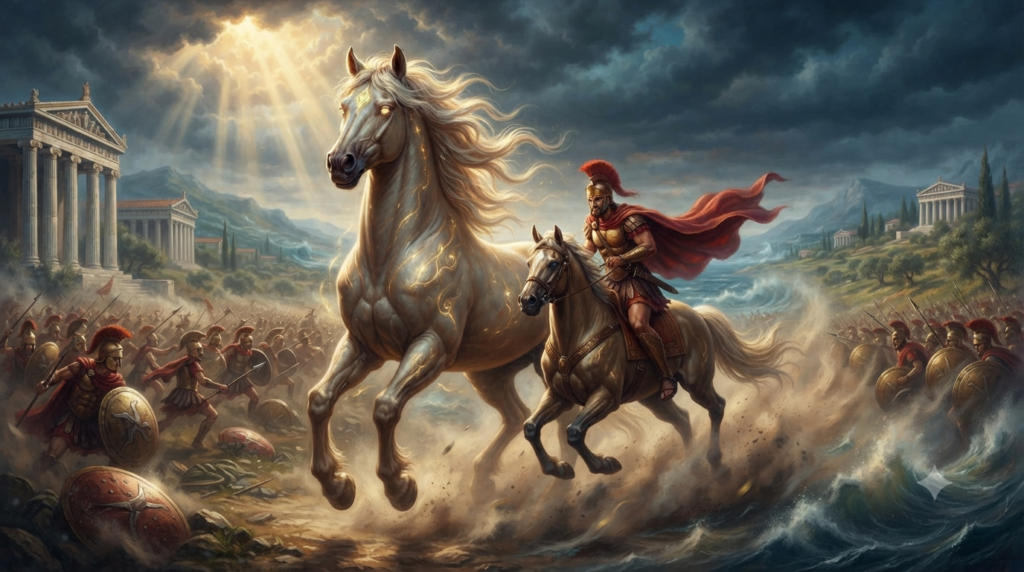
Areion, also spelled Arion, occupies a genuinely remarkable place within Greek mythology as an immortal, divinely-bred horse whose extraordinary speed and abilities repeatedly proved decisive across multiple generations of significant heroes and kings. Anyone asking who is Areion, the divine horse of Greek mythology, is uncovering a figure whose story extends well beyond his own remarkable birth into a genuinely eventful career serving some of Greek mythology’s most celebrated figures.
While Areion’s dramatic origin already receives detailed treatment elsewhere, his personal story continues considerably beyond this single birth episode, following him through a series of significant owners whose own heroic accomplishments frequently depended directly on his supernatural speed and endurance. This ongoing narrative distinguishes Areion from many other divine creatures whose mythology remains confined to a single originating episode.
Areion’s most consequential mythological moment arrives not through any battle he personally fought, but through his essential role preserving a king’s life during one of Greek mythology’s most catastrophic military disasters, cementing his lasting reputation as considerably more than simply an unusually fast animal. This achievement secured Areion genuine narrative significance extending across multiple significant works of ancient Greek literature.
What follows briefly acknowledges Areion’s divine birth before examining alternative traditions regarding his parentage, his remarkable capacity for speech, his early ownership under Oncus and Heracles, his pivotal role saving Adrastus during the war of the Seven Against Thebes, and his lasting literary legacy from Homer through later Roman poetry.
A Quick Recap: Areion’s Divine Birth
According to the most widely recognized tradition, Areion was born through an unusual union between Poseidon and Demeter, occurring after the sea god pursued Demeter while she had transformed herself into a mare specifically to escape his unwanted advances during her own desperate search for her abducted daughter Persephone. Poseidon, undeterred by this transformation, assumed the form of a stallion himself to complete this pursuit successfully.
This remarkable union produced both Areion and a daughter, whose name ancient Arcadian religious tradition specifically kept secret from those not initiated into related mystery cults. This dual birth connected Areion directly to broader, significant religious practices surrounding Demeter’s worship in this particular region of ancient Greece.
Readers interested in the complete details surrounding this significant origin story, including its broader connection to Poseidon’s mythology and additional context regarding this unusual divine union, can find fuller treatment within dedicated coverage of Poseidon’s various documented unions and his broader connection to the creation of horses throughout Greek mythological tradition.
This brief acknowledgment provides essential foundational context for who is Areion, the divine horse of Greek mythology, before turning toward the considerably less commonly discussed alternative traditions and subsequent adventures that would eventually define his own independent mythological legacy.
Alternative Traditions: Was Areion the Son of Gaia?
Beyond the more widely recognized Poseidon and Demeter tradition, ancient sources preserve a genuinely distinct alternative account regarding Areion’s origin, specifically attributed to the poet Antimachus of Colophon, who instead identified Gaia, the primordial earth goddess, as Areion’s true mother. According to this particular tradition, the earth itself sent Areion forth as a genuine marvel near the grove of Apollo Oncaeus at Thelpusa, a location in Arcadia.
This alternative genealogy notably still preserves some connection to divine paternity, since certain interpretations of this tradition suggest that despite springing directly from Gaia, Areion might still trace lineage back to Poseidon or another significant deity, reconciling this earth-born origin with his otherwise consistently divine characterization throughout Greek mythological tradition.
Additional, more obscure traditions further complicate Areion’s origin story, with some sources suggesting Zephyrus, the west wind, fathered the horse through union with a Harpy, a genealogy that would directly explain his supernatural speed through this connection to swift atmospheric forces. Another minor tradition even suggests Poseidon specifically created Areion during his famous contest with Athena over patronage of Athens.
This genuine diversity across ancient sources adds meaningful complexity to who is Areion, the divine horse of Greek mythology, confirming that even his fundamental origin carried genuine variation across different regional and literary traditions, though the Poseidon and Demeter account remained the most consistently referenced version throughout surviving ancient literature.
A Horse That Could Speak and Prophesy
Among Areion’s most remarkable documented characteristics, the Roman poet Sextus Propertius specifically credited him with the genuinely extraordinary ability to speak, distinguishing him meaningfully from ordinary horses regardless of how swift or otherwise remarkable they might prove. This capacity for speech positioned Areion within a genuinely select category of Greek mythological animals possessing distinctly human characteristics beyond mere physical prowess.
Some additional ancient sources extend this remarkable characterization even further, crediting Areion with genuine prophetic ability alongside his capacity for speech, suggesting he possessed insight into future events beyond simply communicating through language. This combination of speech and potential prophecy elevated Areion considerably beyond a purely physical marvel into a genuinely wise, perceptive creature.
These remarkable additional qualities helped distinguish Areion from other notably swift horses found throughout Greek mythology, reinforcing his genuinely exceptional status among divine animals populating ancient Greek storytelling. This combination of physical and intellectual extraordinary qualities made him a particularly fitting companion for the significant heroes and kings who would eventually claim ownership of him throughout his long mythological career.
This remarkable capacity for speech and potential prophecy adds important depth to who is Areion, the divine horse of Greek mythology, revealing a creature whose significance extended well beyond simple physical speed into genuinely unusual cognitive and communicative abilities rarely attributed to animals elsewhere throughout Greek mythological tradition.
From Oncus to Heracles: Areion’s Early Owners
Following his remarkable birth, Areion first came into the possession of Oncus, an Arcadian figure specifically associated with raising horses within a grove near the sea, according to certain traditions connected directly to Apollo through his own parentage. Some alternative accounts instead describe Poseidon initially giving Areion to Copreus, king of Haliartus in Boeotia, illustrating genuine variation regarding exactly how Areion’s ownership history began.
Heracles subsequently acquired Areion from Oncus specifically to assist during his significant military campaign against the Eleans, using the horse’s remarkable speed and endurance to help secure victory during this notable conflict. This acquisition connected Areion directly to one of Greek mythology’s most celebrated heroes during a genuinely significant military undertaking.
Beyond this military campaign, Heracles additionally employed Areion during a notable confrontation with Cycnus, son of Ares, with different ancient sources describing this encounter differently: some accounts depict a genuine duel resulting in Cycnus’s death and Ares himself being wounded, while other, gentler versions instead describe a horse race near the shrine of Pagasaean Apollo, which Heracles successfully won specifically thanks to Areion’s remarkable speed.
This early ownership history provides essential context for who is Areion, the divine horse of Greek mythology, establishing the pattern that would define much of his subsequent story: a remarkable creature whose abilities directly enabled significant heroic accomplishments for whichever notable figure happened to claim him during this particular period of his long mythological career.
Areion and Adrastus: The Horse That Escaped the Seven Against Thebes
Following his service to Heracles, Areion eventually passed into the ownership of Adrastus, king of Argos, a transition that would ultimately lead to Areion’s single most significant and consequential mythological moment. This new ownership connected Areion directly to one of Greek mythology’s most catastrophic military expeditions, the disastrous war known as the Seven Against Thebes.
This significant conflict, involving Adrastus leading an assault specifically intended to help Polynices reclaim the throne of Thebes from his brother Eteocles, ultimately ended in genuine catastrophe for the attacking Argive forces. The conflict’s climactic moment saw Eteocles and Polynices kill one another in direct combat, while the broader Argive military expedition suffered devastating, near-total defeat at the hands of the defending Thebans.
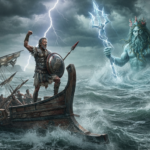
Amid this overwhelming disaster, Adrastus alone among all seven Argive leaders survived the conflict, a remarkable outcome directly attributed to Areion’s extraordinary speed, which allowed the king to successfully outrun the pursuing Theban forces during his desperate retreat from the battlefield. This singular achievement transformed Areion from simply an impressive divine creature into a genuinely essential figure whose speed directly determined whether a significant king lived or died.
This pivotal episode provides the clearest and most historically significant answer to who is Areion, the divine horse of Greek mythology, establishing his single most consequential mythological achievement: the specific, decisive act of saving Adrastus’s life when every other significant leader participating in this same catastrophic military campaign perished during their own desperate attempts to escape.
Areion’s Legacy in Literature
Areion’s mythological significance extends across multiple significant works of ancient literature, with his earliest documented appearance occurring within Homer’s Iliad itself, where the poet specifically references him as “divine Areion,” explicitly describing him as belonging to the race of the gods within a notable simile emphasizing extraordinary equine speed and capability.
The Roman poet Statius later provided additional significant literary treatment of Areion within his own epic Thebaid, specifically describing the horse’s remarkable victory during the very first Nemean Games, a celebrated athletic competition within Greek tradition. This particular episode showcased Areion’s exceptional speed extending beyond military and heroic contexts into formal athletic competition as well.
This sustained literary attention across multiple significant works, spanning from Homer’s foundational Greek epic through later Roman poetic tradition, confirms Areion’s genuine lasting significance within broader classical literature, securing him recognition extending well beyond a single isolated myth into ongoing literary reference across centuries of subsequent ancient composition.
This extensive literary legacy completes a full answer to who is Areion, the divine horse of Greek mythology, confirming that his remarkable story achieved genuine, lasting recognition throughout ancient literary tradition, referenced by poets separated by centuries who each recognized his continued significance as one of Greek mythology’s most remarkable divine creatures.
Frequently Asked Questions
Who were Areion’s parents?
Most commonly, Areion is described as the offspring of Poseidon and Demeter, though alternative traditions credit Gaia or a union involving Zephyrus and a Harpy as his true origin.
What made Areion special?
Areion was immortal and supernaturally fast, and according to some ancient sources, he was also capable of human speech and even prophecy.
How did Areion save Adrastus’s life?
Areion’s extraordinary speed allowed Adrastus to outrun the pursuing Theban forces during his retreat, making him the only one of the seven Argive leaders to survive the disastrous war against Thebes.
Conclusion
Areion stands as a genuinely remarkable figure within Greek mythology, his story extending well beyond his own unusual birth into a long, consequential career serving Oncus, Heracles, and ultimately Adrastus, whose life he directly saved during one of Greek mythology’s most catastrophic military disasters. From Homer’s earliest reference through later Roman poetic tradition, Areion’s enduring literary legacy confirms his lasting significance as one of Greek mythology’s most extraordinary divine creatures, a horse whose speed repeatedly determined the difference between triumph and tragedy for those fortunate enough to ride him.

Orin Vale has spent the better part of two decades tracing the threads that connect the world’s oldest stories — from the halls of Asgard to the banks of the Nile, from Olympus to the jungles of the Maya. What began as a childhood fascination with flood myths and trickster gods grew into years of independent study across comparative mythology and ancient religion, always chasing the same question: what did these stories mean to the people who first told them? Orin writes for readers who want more than trivia — the ones looking for the beliefs, fears, and truths that myths were built to carry.