Eridanos occupies a genuinely distinctive place within Greek mythology, remembered as a river god whose story combines genuine tragedy, the mythological origin of a genuinely precious material, and one of antiquity’s most persistent unsolved geographic mysteries. Anyone asking who is the river god Eridanos in Greek mythology is uncovering a figure whose river carried such significant mythological weight that ancient writers themselves could never definitively agree on where this remarkable waterway actually existed.
Hesiod specifically included Eridanos among the significant offspring of Oceanus, confirming his genuine importance within Greek cosmological genealogy from among the earliest surviving mythological sources documenting Greek river deities. This early literary attestation establishes Eridanos as a genuinely significant figure rather than an obscure, minor addition to later mythological tradition.
Eridanos achieved particular lasting fame through his direct connection to one of Greek mythology’s most poignant tragedies, involving the dramatic fall of Phaethon from his father’s sun chariot, an event that simultaneously explained the mythological origin of amber, a genuinely precious material ancient Mediterranean societies valued considerably. This combination of tragedy and treasure gave Eridanos’s mythology lasting cultural resonance extending well beyond typical river god narratives.
What follows examines Eridanos’s origins as son of Oceanus and Tethys, the tragic fall of Phaethon into his waters, the transformation of the Heliades and the resulting origin of amber, Heracles’s own encounter with the river’s nymphs, the genuine ancient mystery surrounding the river’s actual location, the humble Athenian stream sharing his name, and his lasting legacy as a modern astronomical constellation.
Eridanos’s Origins: Son of Oceanus and Tethys
Eridanos’s parentage connects him directly to Oceanus and Tethys, the significant Titan couple whose union produced numerous river gods and water nymphs collectively representing the various significant waterways ancient Greeks recognized throughout their known world. This parentage positioned Eridanos among a genuinely extensive family of river deities, each governing a specific, significant body of water.
Ancient sources specifically credit Eridanos with the notable title “king of rivers,” a designation reflecting his particular prominence among this extensive family of water deities descended from Oceanus and Tethys. This title suggests ancient Greek tradition regarded Eridanos as holding genuinely elevated status compared to many other, more geographically limited river gods populating Greek mythology.
Beyond this significant parentage, ancient sources additionally identify Eridanos as father to Zeuxippe, connecting his own mythology forward into subsequent generations of Greek mythological genealogy. This paternal role further reinforces Eridanos’s genuine significance within the broader family structure of Greek river deities descended from the primordial Titan generation.
Understanding this substantial origin provides essential context for who is the river god Eridanos in Greek mythology, establishing him as a genuinely prominent figure among Greek river deities before examining the specific dramatic mythology that would eventually secure his lasting fame throughout ancient literary tradition.
The Fall of Phaethon into the Eridanos
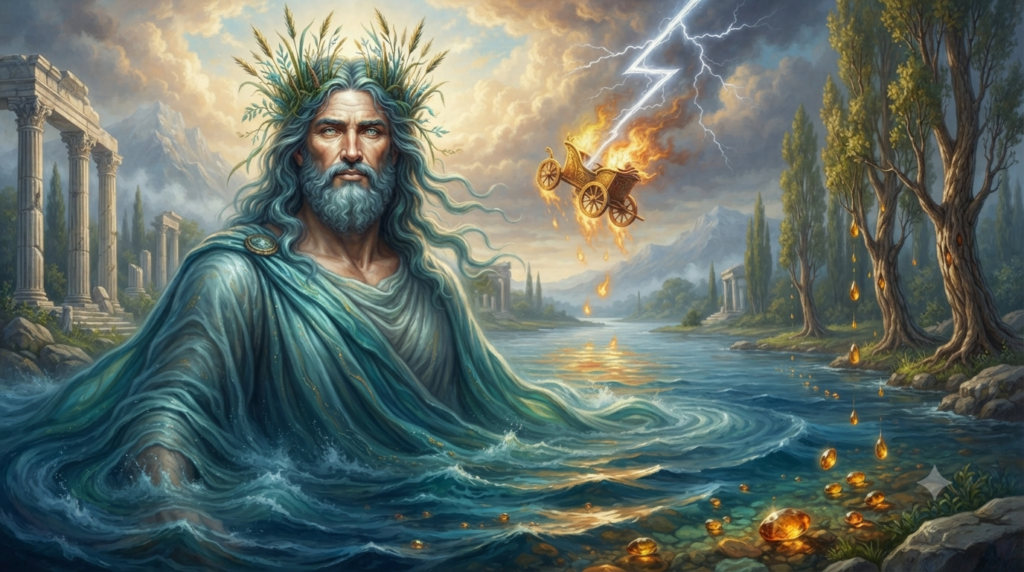
Eridanos’s most significant mythological connection involves the dramatic story of Phaethon, son of the sun god Helios, whose desperate desire to prove his divine parentage led him to attempt driving his father’s sun chariot across the sky, a task requiring skill and control genuinely beyond his own capabilities. This ambitious undertaking would soon produce catastrophic, ultimately fatal consequences.
Unable to properly control the powerful, divine horses pulling this remarkable chariot, Phaethon’s reckless journey threatened genuine cosmic disaster, scorching portions of the earth as the sun chariot veered dangerously off its intended path across the sky. Recognizing the severity of this unfolding catastrophe, Zeus intervened decisively, striking Phaethon with his own thunderbolt specifically to end this dangerous, uncontrolled flight before even greater destruction could occur.
Following this fatal strike, Phaethon’s body fell dramatically from the sky, ultimately landing within the waters of the Eridanos, permanently connecting this particular river to one of Greek mythology’s most memorable tragic deaths. Ancient sources specifically describe the river itself continuing to exhale smoke and vapor from Phaethon’s smoldering remains for a considerable time following this dramatic fall.
This tragic episode provides the clearest and most historically significant answer to who is the river god Eridanos in Greek mythology, establishing the central narrative connection securing his lasting fame throughout ancient literature: the specific river destined to receive Phaethon’s body following his catastrophic, fatal attempt to drive his father’s celestial chariot.
The Heliades and the Origin of Amber
Phaethon’s dramatic death prompted equally significant mythological consequences for his grieving sisters, the Heliades, daughters of Helios who gathered along the Eridanos specifically to mourn their brother’s tragic fate. Their grief proved so genuinely overwhelming and prolonged that the gods eventually transformed these mourning sisters directly into poplar trees lining the riverbank, a permanent memorial to their inconsolable sorrow.
According to this significant myth, the transformed Heliades continued weeping even after their transformation into trees, their tears specifically hardening into amber as they fell, eventually being carried along by the Eridanos’s own flowing waters. This remarkable detail directly explained why ancient Mediterranean societies specifically associated this legendary river with genuine deposits of this valuable, precious material.
This mythological explanation for amber’s origin carried genuine cultural significance given the material’s actual economic importance throughout the ancient world, since amber represented a genuinely valuable trade commodity whose true geographic source, likely originating from Baltic regions considerably north of Greece itself, remained somewhat mysterious to ancient Mediterranean traders and storytellers alike.
Ancient sources additionally connect this same location to Cycnus, a companion or relative of Phaethon who similarly mourned along the Eridanos’s green banks before undergoing his own transformation into a swan. This additional transformation myth further reinforces the Eridanos’s broader mythological significance as a site specifically associated with profound grief and dramatic metamorphosis following Phaethon’s tragic death.
Heracles and the Nymphs of the Eridanos
Beyond the Phaethon myth, Eridanos appears within an entirely separate significant narrative involving Heracles, who specifically sought guidance from the river’s resident nymphs while searching for the location of the Garden of the Hesperides during one of his celebrated labors. This encounter connects Eridanos’s mythology directly into the broader heroic tradition surrounding one of Greek mythology’s most significant figures.
This episode positions the Eridanos’s nymphs as genuinely knowledgeable, helpful figures capable of providing significant guidance to even a hero as celebrated as Heracles, reinforcing the river’s broader mythological significance beyond its more famous association with Phaethon’s tragic death alone. This encounter suggests ancient storytellers imagined the Eridanos as existing within a genuinely mysterious, significant region worth consulting for guidance toward other legendary destinations.
This connection to Heracles’s broader heroic journey adds meaningful context to who is the river god Eridanos in Greek mythology, revealing that this significant river held genuine mythological importance extending beyond its single most famous tragic narrative into broader connections with other significant heroic quests throughout Greek mythological tradition.
Where Was the Real Eridanos? An Ancient Geographic Mystery
Ancient Greek writers themselves genuinely disagreed regarding the Eridanos’s actual physical location, creating one of Greek mythology’s more persistent and fascinating geographic puzzles. Hesiod specifically suggested this significant river ranked among the world’s oldest and greatest waterways, flowing into a sea believed to surround Europe’s northern regions, positioning Eridanos within a genuinely distant, exotic geographic context.
Later ancient tradition frequently connected the Eridanos specifically to the Po River in northern Italy, a connection likely reinforced by this actual river’s genuine historical association with established amber trade routes extending from northern Europe. This identification gave the mythological Eridanos a plausible, if still somewhat speculative, connection to genuine ancient trade geography.
Ancient skepticism regarding this entire tradition appears clearly within Herodotus’s own writing, where he specifically dismissed the very name Eridanos as genuinely “barbarous,” suggesting it represented pure poetic invention rather than any authentic geographic designation. Strabo similarly expressed genuine skepticism, explicitly dismissing the entire mythological tradition surrounding Phaethon, the Heliades, and their connection to any real river near the Po as fundamentally fictional storytelling.
This genuine ancient uncertainty adds significant complexity to who is the river god Eridanos in Greek mythology, confirming that even sophisticated ancient Greek geographers and historians could never establish definitive consensus regarding this significant mythological river’s actual physical location within the real, known world.
The Humble Stream in Athens
Remarkably, ancient Athens itself contained an actual, modest stream specifically named Eridanos, flowing directly through the city and its significant central marketplace, the Agora, though this waterway has since become almost entirely covered by subsequent urban development. This genuine local river offers a fascinating potential connection to the broader, more famous mythological tradition surrounding this same significant name.
Some scholars specifically propose that this modest Athenian stream may represent the genuine original source for the broader Eridanos mythology, suggesting that ancient poets and storytellers gradually transformed this humble local waterway into the considerably more grand, exotic river associated with Phaethon’s tragic death and amber’s mythological origin. This theory offers a genuinely compelling explanation for how such significant mythology might have developed from comparatively modest local geographic origins.
Modern archaeological work has specifically rediscovered portions of this ancient Athenian stream during construction projects associated with the city’s metro system, providing genuine physical confirmation of this waterway’s historical existence beneath the modern urban landscape. This rediscovery adds tangible, physical evidence to the broader scholarly discussion regarding this stream’s potential connection to the larger mythological tradition.
This local Athenian connection provides a genuinely fascinating additional dimension to who is the river god Eridanos in Greek mythology, suggesting that this significant, widely mythologized river may have originated from considerably more modest, local geographic beginnings before ancient storytellers gradually elevated it into one of Greek mythology’s more memorable and geographically mysterious waterways.
Eridanos Among the Stars
Eridanos’s lasting legacy extends directly into modern astronomical tradition through the constellation bearing his name, specifically included among the forty-eight ancient constellations documented by the influential astronomer Ptolemy during the second century. This significant astronomical inclusion secured Eridanos’s name a genuinely permanent place within the broader tradition of naming celestial features after significant mythological figures.
This constellation remains recognized today as one of the eighty-eight modern constellations officially acknowledged by the International Astronomical Union, ensuring that Eridanos’s name continues appearing within contemporary astronomical references and star charts despite the many centuries separating modern astronomy from ancient Greek mythological tradition. This constellation specifically represents an extended, river-like formation stretching across a significant portion of the southern celestial sky.
This lasting astronomical legacy reflects the genuine cultural significance ancient Greek mythology attached to Eridanos, since relatively few mythological rivers achieved this same lasting recognition through direct connection to a permanent astronomical designation continuing into contemporary scientific usage. This connection between ancient mythology and enduring astronomical nomenclature reinforces Eridanos’s broader lasting cultural significance.
This remarkable astronomical legacy completes a full answer to who is the river god Eridanos in Greek mythology, confirming that despite the genuine ancient uncertainty surrounding his actual earthly location, this significant mythological river achieved a genuinely permanent form of lasting recognition through his direct connection to this enduring, still-recognized modern constellation.
Frequently Asked Questions
Who were Eridanos’s parents?
Eridanos was the son of the Titans Oceanus and Tethys, connecting him to the broader family of significant river gods descended from this significant Titan union.
Why is Eridanos associated with amber?
According to myth, the Heliades, Phaethon’s grieving sisters, were transformed into poplar trees along the riverbank, and their continuing tears hardened into amber carried by the river’s waters.
Is there a real Eridanos river?
A small stream historically named Eridanos flowed through ancient Athens, though the grander, amber-associated mythological river’s exact real-world location was never definitively established by ancient writers.
Conclusion
Eridanos stands as a genuinely significant river god within Greek mythology, his story combining Phaethon’s tragic fall, the origin of amber through the transformed Heliades, and one of antiquity’s most persistent unsolved geographic mysteries regarding his actual location. From his substantial Titan parentage to his lasting legacy as a modern astronomical constellation, Eridanos’s mythology reveals how a single river could carry genuine cultural weight extending across mythology, geography, and even contemporary astronomical tradition.

Orin Vale has spent the better part of two decades tracing the threads that connect the world’s oldest stories — from the halls of Asgard to the banks of the Nile, from Olympus to the jungles of the Maya. What began as a childhood fascination with flood myths and trickster gods grew into years of independent study across comparative mythology and ancient religion, always chasing the same question: what did these stories mean to the people who first told them? Orin writes for readers who want more than trivia — the ones looking for the beliefs, fears, and truths that myths were built to carry.