Who Is Banebdjedet? Understanding the Ram of Mendes
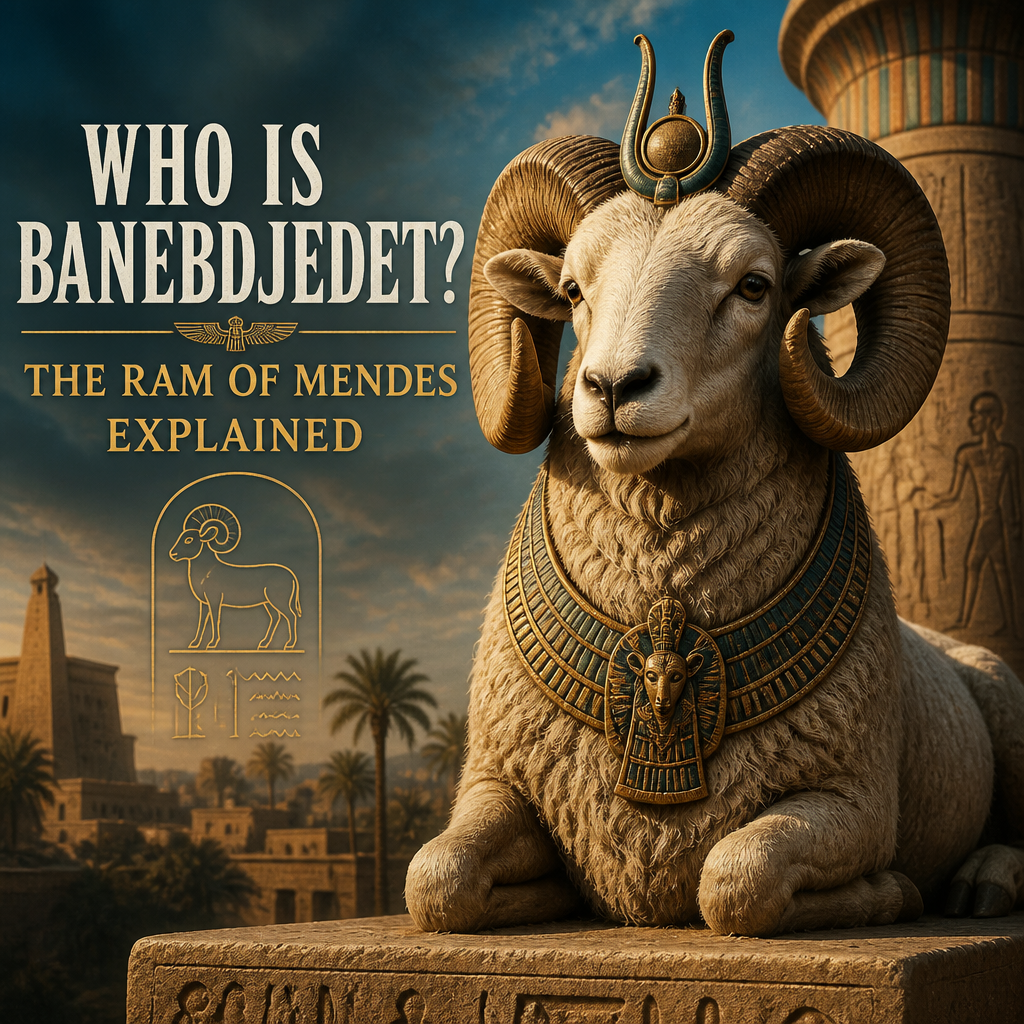
Banebdjedet is one of the more fascinating deities of ancient Egypt, especially because his identity blends ideas of fertility, divine power, kingship, and sacred animals. Known as the ram of Mendes, Banebdjedet was worshipped primarily in the city of Mendes in the Nile Delta, where he became an important local god with wider religious significance.
Although he is not as famous today as Ra, Osiris, or Isis, Banebdjedet played a meaningful role in Egyptian belief. His image as a ram connected him to strength, virility, and creative life force—qualities that made him a powerful symbol in both temple worship and mythology.
The Meaning of Banebdjedet’s Name
The name Banebdjedet is often translated as “Ba of the Lord of Djedet.” Djedet was the Egyptian name for Mendes, the city where his cult was centered. In ancient Egyptian religion, the ba was an aspect of the soul or personality, often associated with mobility, power, and divine presence.
This means Banebdjedet was understood as a living manifestation of divine spirit connected to Mendes. Rather than being simply “a ram god,” he represented a sacred force embodied through the ram, especially through the ram’s associations with fertility and generative power.
Why Was Banebdjedet Called the Ram of Mendes?
Banebdjedet became widely known as the ram of Mendes because he was worshipped in ram form. In Egyptian religion, animals were not usually worshipped as ordinary creatures. Instead, specific animals could represent divine qualities or serve as earthly manifestations of gods.
The ram was an especially powerful symbol because it suggested:
- Fertility and procreation
- Masculine creative energy
- Physical strength
- Leadership and dominance
- Renewal of life
In Mendes, sacred rams were likely kept and honored as living images of the god. These animals were treated with great reverence and may have been involved in rituals connected to abundance, kingship, and divine blessing.
Banebdjedet and Fertility
One of Banebdjedet’s most important roles was as a fertility deity. Ancient Egypt depended heavily on cycles of life: the annual flooding of the Nile, the growth of crops, the birth of animals, and the continuation of family lines. Gods connected to fertility were therefore central to Egyptian religious life.
As the ram of Mendes, Banebdjedet represented the power of generation. His ram form emphasized reproductive strength, making him a natural symbol of life-giving energy. This connection also linked him to broader Egyptian ideas about creation, where divine power brought order and life out of chaos.
Banebdjedet’s Connection to Osiris
Banebdjedet was sometimes associated with Osiris, the god of the afterlife, resurrection, and renewal. This connection makes sense because both gods were tied to cycles of death and rebirth. Osiris represented regeneration after death, while Banebdjedet symbolized fertile life force.
In some traditions, Banebdjedet was considered a form or manifestation of Osiris. His identity as a ba also allowed him to be understood as an expression of another god’s divine essence. Egyptian theology often allowed deities to overlap, merge, or represent aspects of one another, especially in local traditions.
Through this connection, Banebdjedet gained significance beyond fertility alone. He also became part of the larger religious framework of renewal, resurrection, and divine kingship.
Banebdjedet and the Divine Family
Banebdjedet was often linked with the goddess Hatmehit, a fish goddess worshipped in Mendes. Hatmehit was one of the chief deities of the city before Banebdjedet rose to prominence. Together, they formed a divine pair associated with the region.
In later traditions, Banebdjedet and Hatmehit were also connected with Harpocrates, the child form of Horus. This created a local divine family similar to other Egyptian triads, such as Osiris, Isis, and Horus. These family groupings helped organize worship and gave local temples a complete mythological structure.
The Role of Mendes in His Worship
Mendes, located in the eastern Nile Delta, was the heart of Banebdjedet’s cult. The city was an important religious center, and its Greek name, Mendes, became strongly associated with ram worship. Classical writers also mentioned the sacred ram of Mendes, helping preserve the god’s reputation outside Egypt.
The temple at Mendes would have served as a center for offerings, festivals, and rituals. Worshippers likely came seeking blessings related to fertility, prosperity, livestock, agriculture, and protection. Like many Egyptian temples, it was not only a religious site but also a center of local identity and cultural memory.
How Was Banebdjedet Depicted?
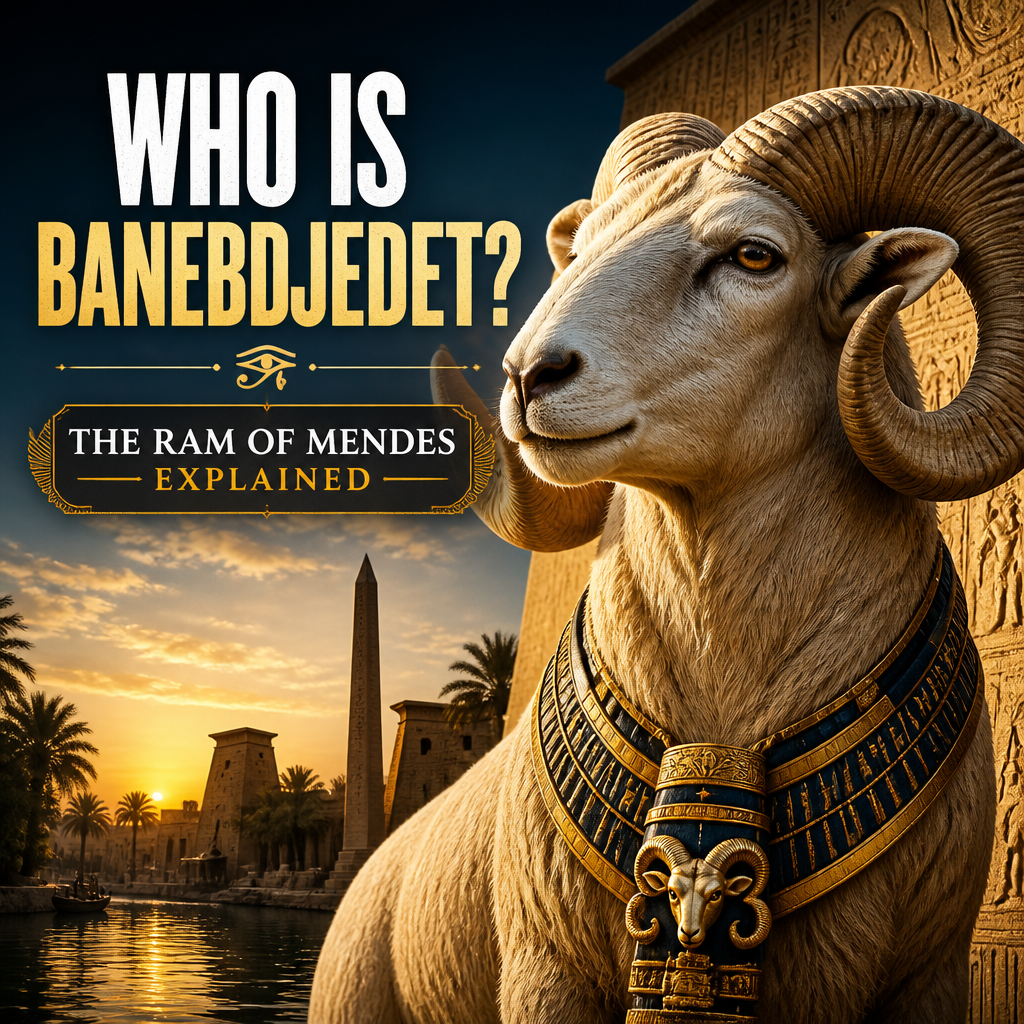
Banebdjedet was most commonly depicted as a ram or as a man with a ram’s head. In some representations, he appears with four ram heads, a striking image that may symbolize a combination of multiple divine powers or aspects of the soul.
The ram imagery is essential to understanding his nature. Egyptian artists used animal features to communicate divine characteristics, so Banebdjedet’s ram head was not decorative—it expressed his sacred role as a being of strength, virility, and creative force.
Banebdjedet in Egyptian Mythology
Banebdjedet appears in some mythological contexts as a wise and authoritative figure. In one tradition, he was involved in judging the conflict between Horus and Set, the famous dispute over who should inherit the throne of Egypt after Osiris. His presence in this myth shows that he was not merely a local fertility god but also a deity with recognized authority.
This role connects him to kingship and divine judgment. In ancient Egypt, political power was deeply religious, and gods were believed to influence or confirm the legitimacy of rulers. Banebdjedet’s wisdom and authority made him relevant to these larger themes.
Why Banebdjedet Matters
Banebdjedet matters because he shows how rich and layered Egyptian religion could be. He was local and cosmic, animal and divine, connected to fertility yet also tied to kingship and resurrection. His worship demonstrates how ancient Egyptians saw the sacred in the natural world, especially in animals that embodied powerful forces of life.
As the ram of Mendes, Banebdjedet represents more than a regional cult. He reflects a worldview in which divine energy could appear in many forms, and where life, death, renewal, and power were all interconnected.
Conclusion
Banebdjedet was the ram god of Mendes, a deity associated with fertility, strength, divine spirit, and renewal. Known as the ram of Mendes, he occupied an important place in the religious life of the Nile Delta and was connected to major themes in Egyptian mythology, including creation, resurrection, and kingship.
Though less famous than many Egyptian gods, Banebdjedet remains an important example of how ancient Egyptian religion blended local worship with universal ideas. His ram form symbolized the generative power of life itself, making him a sacred figure of abundance, authority, and divine presence.

Orin Vale has spent the better part of two decades tracing the threads that connect the world’s oldest stories — from the halls of Asgard to the banks of the Nile, from Olympus to the jungles of the Maya. What began as a childhood fascination with flood myths and trickster gods grew into years of independent study across comparative mythology and ancient religion, always chasing the same question: what did these stories mean to the people who first told them? Orin writes for readers who want more than trivia — the ones looking for the beliefs, fears, and truths that myths were built to carry.