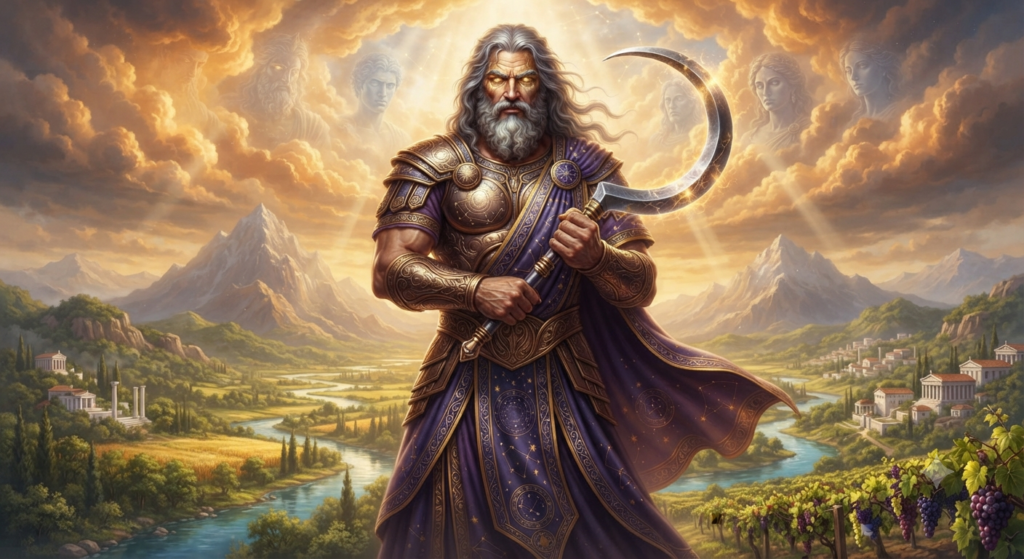
In the pantheon of Greek mythology, few figures are as pivotal and complex as the Titan who ruled during the Golden Age. Who is Cronus (Kronos) in Greek mythology? He is the youngest of the first generation of Titans, the son of Uranus (Sky) and Gaia (Earth), and the father of the Olympian gods. His myth is one of cosmic rebellion, dynastic violence, and the inexorable cycle of time, as he rose to power by overthrowing his own father only to be defeated by his son, Zeus. More than a mere villain, Cronus embodies the savage, primordial forces of nature and the fundamental law of succession that governed the ancient Greek cosmos.
Origins and Genealogy
Cronus was born to Uranus and Gaia, the primordial deities who represented the sky and the earth. He was the youngest of the twelve Titans, a group of powerful divine beings who preceded the Olympian gods. His siblings included Oceanus, Hyperion, Rhea, and Iapetus, among others. According to Hesiod’s Theogony, Uranus was a tyrannical father who imprisoned his monstrous offspring—the Hecatoncheires and the Cyclopes—within the depths of Gaia’s womb, causing her great distress. In response, Gaia crafted a sickle of adamantine and urged her Titan children to rebel against their father. Only Cronus was willing to act. He ambushed Uranus, castrated him with the sickle, and seized dominion over the cosmos. From the blood and severed genitals of Uranus sprang the Erinyes (Furies), the Giants, and Aphrodite. This act of patricide established Cronus as the ruler of the universe and inaugurated the Golden Age.
The Golden Age and the Rule of Cronus
Cronus’s reign was remembered in Greek mythology as the Golden Age, a period of primordial peace and abundance. During this time, humanity lived free from toil, sorrow, and old age. The earth provided bountiful harvests without the need for agriculture, and mortals enjoyed a life of ease and contentment. Cronus ruled as king of the Titans from Mount Othrys, a mountain in Thessaly that served as the stronghold of the Titan dynasty. However, despite the idyllic conditions of his reign, Cronus was plagued by insecurity. A prophecy had foretold that he would be overthrown by his own son, just as he had overthrown his father. Determined to defy fate, Cronus adopted a brutal policy of succession prevention.
The Swallowing of His Children
To prevent the prophecy from being fulfilled, Cronus devised a horrific solution. As his sister-wife Rhea gave birth to their children, Cronus would swallow each infant whole. The children devoured in this manner were Hestia, Demeter, Hera, Hades, and Poseidon. Rhea was heartbroken by the loss of her offspring and grew increasingly resentful of her husband’s cruelty. When she became pregnant with her sixth child, Zeus, she devised a plan to trick Cronus. Acting on the advice of her parents, Uranus and Gaia, Rhea gave birth to Zeus in a cave on Mount Dicte in Crete. She then wrapped a stone in swaddling clothes and presented it to Cronus, who swallowed it in the belief that he had consumed his final child.
The Overthrow of Cronus
Zeus was raised in secrecy on Mount Ida in Crete, tended to by the nymphs Amalthea and the Curetes, who drowned out his infant cries with the clashing of shields and spears to prevent Cronus from hearing him. Upon reaching maturity, Zeus resolved to liberate his siblings and overthrow his father. With the aid of Metis, an Oceanid goddess who served as his first wife, Zeus administered a potion to Cronus that induced vomiting. This caused Cronus to disgorge the stone and the five children he had swallowed. The stone was later placed at Delphi as a sacred monument. Freed from their father’s stomach, the siblings declared war on Cronus and the Titans. This conflict, known as the Titanomachy, was a ten-year war that shook the cosmos. The Olympians ultimately triumphed, aided by the Hecatoncheires and the Cyclopes, whom Zeus liberated from Tartarus.
Punishment and the Myth of the Golden Age Islands
After their defeat, Cronus and the other Titans were banished to Tartarus, the deepest abyss beneath the underworld, where they were imprisoned by the Hecatoncheires. However, later traditions offered a more nuanced conclusion to Cronus’s fate. In some accounts, notably the writings of Pindar and Hesiod, Cronus was released from Tartarus and became the ruler of the Isles of the Blessed, a paradise located at the edge of the world where the heroes of the Golden Age resided. This shift in narrative portrays Cronus not as a permanent villain but as a figure whose reign was ultimately part of a greater cosmic order. He was transformed from a vengeful usurper into a benevolent king of a distant utopia, reflecting the ancient Greek belief that even the most violent forces could be reconciled with the divine plan.
Cronus, Time, and the Harpe
Over time, Cronus became increasingly conflated with Chronos, the personification of time, leading to a profound and enduring confusion that has persisted throughout Western culture. In Renaissance and modern art, Cronus is frequently depicted as the aged, bearded figure wielding a scythe, representing the relentless passage of time that consumes all things. However, in the original Greek tradition, Cronus and Chronos were distinct entities. The connection likely arose from the similarity of their names and Cronus’s association with the harvesting sickle. The harpē, the sickle-like sword used to castrate Uranus, became Cronus’s iconic weapon and a symbol of his role as the god who reaps life as a farmer harvests crops. This iconography was further solidified in later Roman adaptations, where Cronus was identified with Saturn, the agricultural god whose festival, the Saturnalia, was celebrated with feasting and gift-giving.
Frequently Asked Questions About Who is Cronus (Kronos) in Greek mythology?
What is the difference between Cronus and Chronos?
In ancient Greek mythology, Cronus is the Titan ruler and father of Zeus, while Chronos is the personification of time. The two were originally distinct figures. However, they were conflated in later antiquity and Renaissance art, leading to the common depiction of Cronus as an old man with a scythe representing time.
Why did Cronus eat his children?
Cronus swallowed his children because a prophecy foretold that he would be overthrown by one of them, just as he had overthrown his own father. To prevent this fate, he devoured each of his offspring, except for Zeus, who was hidden and later forced Cronus to disgorge them.
How was Cronus overthrown?
Cronus was overthrown by his son Zeus, who led the Olympian gods in a ten-year war against the Titans known as the Titanomachy. Zeus was raised in secret and, upon reaching adulthood, forced Cronus to vomit up his siblings. With the aid of the Cyclopes and the Hecatoncheires, Zeus defeated Cronus and imprisoned him in Tartarus.
What is the Golden Age of Cronus?
The Golden Age refers to the period of Cronus’s rule, during which humanity lived in a state of primordial peace and abundance. People did not need to work, and the earth provided food in abundance. There was no sorrow or old age, and mortals lived long, prosperous lives.
What happened to Cronus after the Titanomachy?
After the Titanomachy, Cronus was imprisoned in Tartarus along with the other Titans. However, later myths, particularly in Pindar and Hesiod, suggest that Cronus was eventually released and became the ruler of the Isles of the Blessed, a paradise for heroes at the edge of the world.
Conclusion
Who is Cronus (Kronos) in Greek mythology? He is the embodiment of cosmic succession, a figure whose violent rise and fall structure the very narrative of the Greek mythological universe. As the youngest Titan, he seized power through patricide, only to be haunted by the same prophecy of usurpation that he sought to escape. His swallowing of his children and his eventual defeat by Zeus represent the inexorable cycle of generational conflict that defines the evolution of divine power in Greek thought. His legacy, however, transcends mere tyranny, as the Golden Age of his rule and his later rehabilitation as king of the Isles of the Blessed offer a more nuanced perspective on his character. He is not merely a defeated god but a necessary antecedent to the Olympian order, a symbol of the cosmic law that each age must give way to the next. His enduring confusion with Chronos, the god of time, has solidified his image as the harvester of life, making him one of the most recognizable and culturally resonant figures in all of Western mythology.

Orin Vale has spent the better part of two decades tracing the threads that connect the world’s oldest stories — from the halls of Asgard to the banks of the Nile, from Olympus to the jungles of the Maya. What began as a childhood fascination with flood myths and trickster gods grew into years of independent study across comparative mythology and ancient religion, always chasing the same question: what did these stories mean to the people who first told them? Orin writes for readers who want more than trivia — the ones looking for the beliefs, fears, and truths that myths were built to carry.