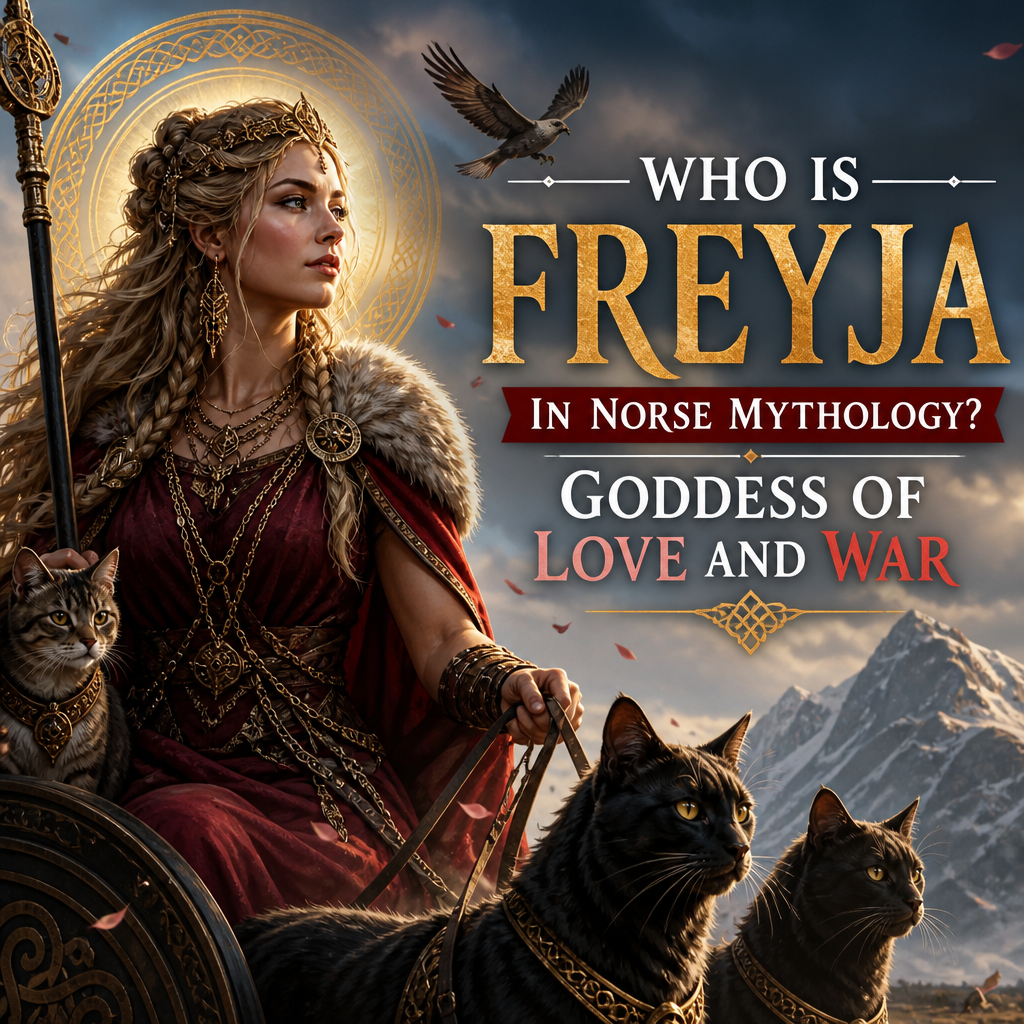
Who Is Freyja in Norse Mythology?
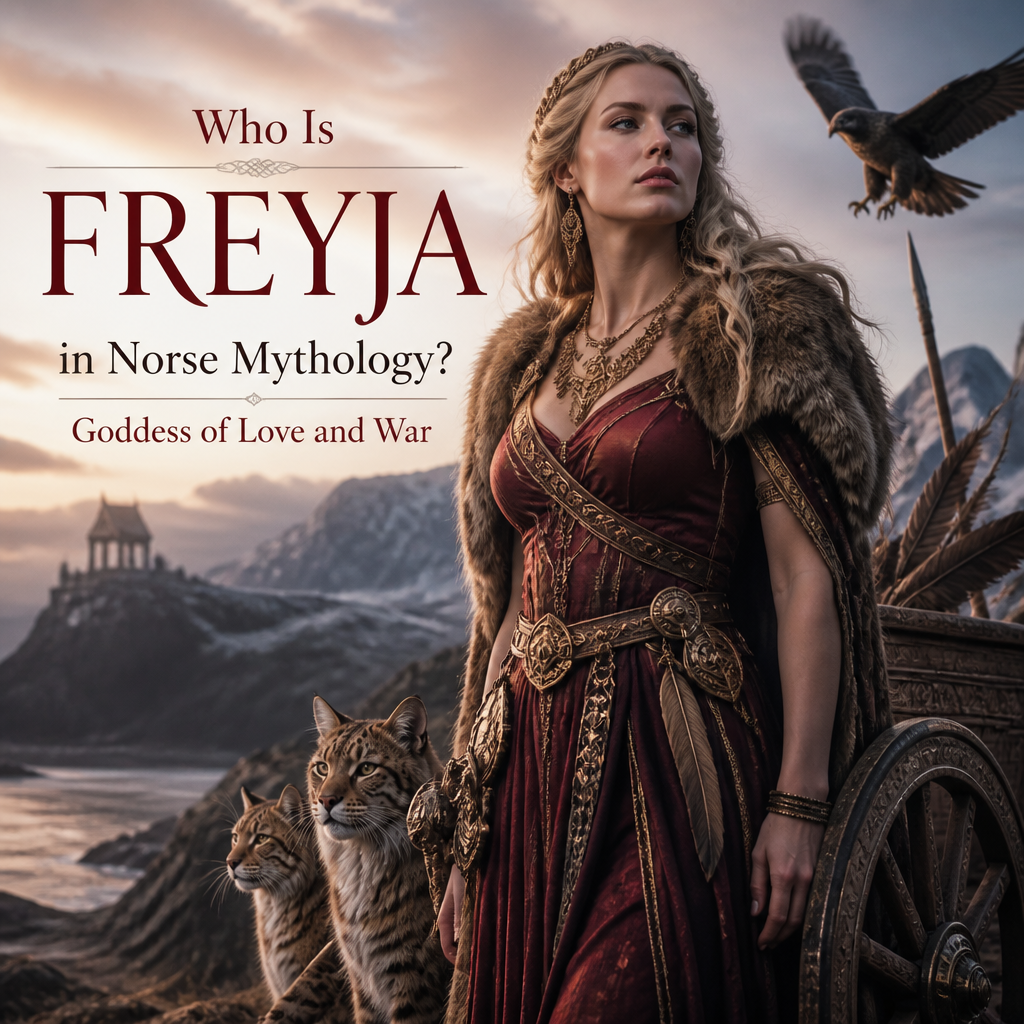
Freyja is one of the most important and fascinating goddesses in Norse mythology. Associated with love, beauty, fertility, magic, war, and death, she is far more than a simple goddess of romance. Her stories reveal a powerful and complex figure who moves between worlds, commands deep respect, and influences both gods and humans.
In Old Norse sources, Freyja belongs to the Vanir, a group of gods connected with fertility, prosperity, and nature. After the war between the Vanir and the Aesir, she comes to live among the Aesir gods in Asgard. There, she becomes one of the central divine figures in the Norse pantheon.
Freyja’s Name and Meaning
The name Freyja means “Lady” in Old Norse. This title reflects her high status among the gods and perhaps suggests that she was once known by many local names across the Norse world.
Freyja is sometimes connected with another goddess named Frigg, the wife of Odin. Scholars have long debated whether Freyja and Frigg may have developed from the same earlier goddess or shared overlapping roles. However, in the surviving myths, they appear as distinct figures.
Freyja as a Goddess of Love and Fertility
One of Freyja’s best-known roles is as a goddess of love, desire, and fertility. She is often described as beautiful, passionate, and deeply connected to attraction and abundance.
In Norse society, fertility was not only about human reproduction. It also referred to fruitful land, healthy animals, wealth, and the continuation of family lines. As a Vanir goddess, Freyja’s power was tied to the prosperity of life itself.
Her influence would have mattered to people seeking:
- Love and marriage
- Children and family growth
- Fertile fields and livestock
- Beauty, charm, and attraction
- Good fortune and abundance
This side of Freyja makes her seem graceful and life-giving, but it is only one part of her nature.
Freyja and Seidr Magic
Freyja is also strongly associated with seidr, a form of Norse magic linked to prophecy, fate, transformation, and spiritual influence. Seidr was powerful but mysterious, and it was often connected with women and female spiritual practitioners.
According to Norse tradition, Freyja taught seidr to Odin, the chief of the Aesir gods. This detail is important because it shows that her wisdom and magical knowledge were extraordinary. Even Odin, who constantly sought hidden knowledge, learned from her.
Seidr could involve seeing the future, shaping events, communicating with spirits, or influencing the minds and fortunes of others. Freyja’s mastery of this magic makes her one of the most spiritually powerful beings in Norse mythology.
Freyja as a Goddess of War and Death
Although Freyja is often remembered for love and beauty, she also has a fierce connection to battle. Like Odin, she receives slain warriors after death.
The myths say that Freyja rules over Folkvangr, a heavenly field or realm where half of those who die in battle go. The other half are chosen by Odin and taken to Valhalla. Within Folkvangr stands her hall, Sessrumnir, a great dwelling that receives the honored dead.
This role shows that Freyja was not only a gentle goddess of affection. She was also a chooser of the slain, a divine figure connected to the battlefield and the fate of warriors. Her power extended from birth and desire all the way to death and the afterlife.
Freyja’s Symbols and Treasures
Freyja is known for several famous symbols and magical possessions. Each one reveals something about her personality and divine power.
Brisingamen
Freyja’s most famous treasure is Brisingamen, a magnificent necklace made by dwarves. It is often seen as a symbol of beauty, wealth, desire, and feminine power. The necklace appears in several stories and is one of the most iconic objects in Norse mythology.
Falcon Feather Cloak
Freyja owns a cloak of falcon feathers that allows its wearer to fly in the form of a bird. This magical garment is sometimes borrowed by other gods when they need to travel quickly or spy across great distances.
The cloak reflects Freyja’s connection with transformation, magic, and movement between worlds.
Cats and Chariot
Freyja is said to ride in a chariot pulled by cats. This unusual image is one of her most memorable features. While the exact meaning is debated, cats may represent independence, sensuality, domestic prosperity, or magical power.
The Boar Hildisvini
Freyja is also associated with a boar named Hildisvini, whose name means “battle swine.” Boars were important symbols in Norse and Germanic cultures, often linked to protection, fertility, and war.
Freyja’s Family
Freyja is the daughter of Njord, a Vanir god associated with the sea, wealth, and seafaring. Her brother is Freyr, another major Vanir deity connected with fertility, kingship, peace, and prosperity.
Freyja is also said to have a husband named Odr, who is often absent. She weeps golden tears for him as she travels in search of him. This image adds a sorrowful and emotional depth to her character.
Her daughters are named Hnoss and Gersemi, both names suggesting treasure or preciousness. This connection reinforces Freyja’s association with beauty, wealth, and value.
Freyja in the Myths
Freyja appears in many Norse myths, often as a figure desired by giants and respected by gods. In one famous story, a giant offers to build a wall around Asgard and demands Freyja, the sun, and the moon as payment. The gods refuse to give her up, showing her immense value.
In another tale, the giant Thrym steals Thor’s hammer and demands Freyja as his bride in exchange for its return. Freyja angrily rejects the idea, and Thor eventually disguises himself as the bride to recover the hammer. Her reaction in this story highlights her independence and unwillingness to be treated as a prize.
Why Freyja Matters
So, who is Freyja in Norse mythology? She is a goddess of love, fertility, magic, war, and death. She is beautiful but formidable, generous but independent, emotional but powerful. Her nature combines forces that modern readers often separate: passion and battle, life and death, beauty and sorcery.
Freyja matters because she represents the richness of Norse mythology itself. She cannot be reduced to one simple role. Instead, she stands at the crossroads of many essential human experiences: desire, grief, courage, wisdom, and fate.
Her stories continue to inspire modern readers because she is not passive or one-dimensional. Freyja is a commanding presence, a mistress of magic, a receiver of warriors, and a symbol of divine feminine strength in the Norse world.

Orin Vale has spent the better part of two decades tracing the threads that connect the world’s oldest stories — from the halls of Asgard to the banks of the Nile, from Olympus to the jungles of the Maya. What began as a childhood fascination with flood myths and trickster gods grew into years of independent study across comparative mythology and ancient religion, always chasing the same question: what did these stories mean to the people who first told them? Orin writes for readers who want more than trivia — the ones looking for the beliefs, fears, and truths that myths were built to carry.