The question “Who is Hypnos, the Greek god of sleep?” introduces one of the most fascinating figures in Greek mythology, a deity who represents one of the most universal experiences of human existence: sleep. Unlike the powerful Olympian gods associated with war, wisdom, love, or the elements, Hypnos represents a quieter but equally significant force. He is the divine personification of sleep itself, a primordial power that affects both mortals and immortals, reminding ancient Greeks that even the greatest beings in the universe must eventually surrender to rest.
In ancient Greek religion, sleep was not viewed simply as a biological necessity but as a mysterious state that connected the conscious world with hidden realms of the mind. The Greeks believed that sleep created a temporary separation between the waking world and the unknown spaces where dreams, visions, and divine messages could appear. Through Hypnos, mythology transformed sleep into a supernatural force with its own personality, abilities, and influence.
Hypnos was the son of Nyx, the goddess of Night, and Erebus, the personification of darkness, placing him among the earliest divine beings in Greek cosmology. His origins reveal an important symbolic connection: sleep emerges naturally from darkness and silence. Alongside his twin brother Thanatos, the god of peaceful death, Hypnos represented one of the fundamental transitions experienced by all living beings—the movement away from ordinary awareness.
Although Hypnos was not one of the twelve Olympian gods, his influence extended even to the highest levels of divine society. Ancient myths describe situations where Hypnos was capable of affecting powerful gods such as Zeus, demonstrating that sleep was considered an unavoidable and universal force. His ability to place beings into a state of unconsciousness gave him a unique type of power that was different from physical strength or authority.
Understanding who Hypnos is in Greek mythology requires looking beyond the simple definition of “Greek god of sleep.” Hypnos represents the mystery of consciousness itself—the moment when the mind leaves the physical world and enters a state where imagination, dreams, and hidden emotions emerge. His mythology reflects ancient Greek curiosity about the relationship between the body, the mind, and the unseen forces that influence human existence.
The legacy of Hypnos continues to influence modern culture, language, psychology, and literature. The modern word “hypnosis” comes from his name, reflecting the long-lasting connection between Hypnos and altered states of consciousness. Even today, sleep remains a subject of scientific research and philosophical reflection, making this ancient Greek deity surprisingly relevant in the modern world.
Who Is Hypnos in Greek Mythology?
Hypnos is the Greek god of sleep, a divine figure who personifies the state of unconscious rest experienced by gods, humans, and all living creatures. In Greek mythology, he was not considered merely a guardian of sleep but the embodiment of sleep itself. This distinction is important because many Greek deities represented specific concepts or forces of nature, and Hypnos represented the universal power that allows beings to temporarily withdraw from the waking world.
The name Hypnos comes from the ancient Greek word ὕπνος (hypnos), meaning “sleep.” His identity is directly connected to his domain, similar to other personified concepts in Greek mythology such as Thanatos (death), Nemesis (retribution), and Eros (love). These figures were not only characters within myths but also symbolic representations of forces that shaped human experience.
Unlike gods such as Apollo or Athena, Hypnos did not rule over a physical territory or human activity. Instead, his influence existed within the invisible realm of consciousness. Every night, when humans entered a state of rest, they were believed to come under the influence of Hypnos. This made him a powerful but subtle deity, one whose presence could be felt universally despite his lack of dramatic myths.
The role of Hypnos in ancient Greek religion demonstrates how Greeks attempted to understand natural and psychological experiences through mythology. Sleep was mysterious because it temporarily removed awareness and control from individuals. A person could be awake one moment and completely disconnected from the external world the next. For ancient cultures, this transformation suggested the presence of a divine force.
Hypnos was often associated with peace, calmness, and restoration. Unlike some supernatural beings connected with fear or destruction, Hypnos represented a necessary pause from the struggles of life. His influence brought relief from physical exhaustion, emotional stress, and the difficulties of daily existence. In this sense, sleep was seen as a gift rather than a weakness.
The mythology surrounding Hypnos also reveals the Greek understanding that some forces could be more powerful than human ambition or even divine authority. No warrior, king, or god could permanently resist the need for sleep. This made Hypnos a symbol of equality, showing that all beings, regardless of status or power, were subject to the same natural rhythms.
When exploring “Who is Hypnos, the Greek god of sleep?”, it becomes clear that he represents far more than a simple mythological character. He embodies the mysterious boundary between consciousness and unconsciousness, the daily transition between activity and rest, and the ancient human fascination with the hidden world of dreams and the sleeping mind.
The Origins of Hypnos: Son of Nyx and Erebus
The origins of Hypnos place him among the oldest divine beings in Greek mythology. According to ancient traditions, Hypnos was born from the union of Nyx, the goddess of Night, and Erebus, the primordial embodiment of darkness. This lineage connects him directly to the earliest stages of Greek creation mythology, before the rise of the Olympian gods.
Nyx was one of the most powerful primordial deities in Greek cosmology. She represented the darkness that existed before the organized world took shape. Ancient writers often described her as a mysterious and respected figure whose power was so great that even Zeus treated her with caution. As the son of Nyx, Hypnos inherited a connection with darkness, silence, and the hidden aspects of existence.
Erebus, Hypnos’ father, represented the deep darkness associated with the space between the world of the living and the realms beyond. Together, Nyx and Erebus created a symbolic environment from which sleep naturally emerged. Darkness creates the conditions for rest, and silence allows the mind to withdraw from external distractions. Through this connection, Hypnos became the natural expression of the transition from awareness into unconsciousness.
The family background of Hypnos reveals an important pattern in Greek primordial mythology. Many early deities represented fundamental forces rather than human-like personalities. They were manifestations of concepts such as night, chaos, time, and natural cycles. Hypnos belongs to this tradition because sleep itself was considered one of the essential forces that shaped life.
His birth from Night and Darkness also explains why ancient Greeks associated sleep with mystery. Dreams were often believed to contain messages, warnings, or symbolic information from divine sources. Since Hypnos controlled the state in which dreams occurred, he became connected with the boundary between the physical world and the supernatural realm.
The origins of Hypnos demonstrate that ancient Greeks did not view sleep as simply the absence of activity. Instead, they understood it as a powerful transformation, a temporary journey away from ordinary consciousness. By creating a divine figure from the forces of night and darkness, Greek mythology gave meaning to one of the most mysterious experiences of human life.
Hypnos and Nyx, the Goddess of Night
The relationship between Hypnos and Nyx is one of the most important aspects of his identity in Greek mythology. As the son of Nyx, the primordial goddess of Night, Hypnos inherited a connection with darkness, silence, and the hidden aspects of existence. In ancient Greek thought, night was not simply the absence of sunlight but a powerful cosmic force that represented mystery, protection, and the unknown.
Nyx was considered one of the oldest and most respected divine beings in Greek cosmology. She emerged during the early formation of the universe and represented the darkness that existed before the world became organized. Unlike many later gods who controlled specific areas of human life, Nyx embodied a fundamental condition of existence itself. Her power was associated with the natural cycle of darkness that allowed the world to rest and renew.
Through Nyx, Hypnos became connected to the idea that sleep is a natural extension of night. When darkness covered the world, humans and animals entered a state of rest, and the mind moved away from the concerns of daily life. In this symbolic interpretation, Hypnos was the force that guided living beings into this temporary separation from reality.
The connection between night and sleep appears in many cultures, but Greek mythology gave this relationship a divine structure. Hypnos was not simply a creature who appeared during nighttime; he represented the invisible power that caused sleep itself. His existence explained why consciousness could disappear temporarily and why humans could enter a state where dreams, memories, and emotions became more active.
The association between Hypnos and Nyx also reveals an important aspect of ancient Greek beliefs: darkness was not always considered negative. Modern interpretations often associate darkness with fear or danger, but in Greek mythology, night also represented rest, healing, and transformation. Without darkness, there could be no sleep, and without sleep, life could not continue.
This connection makes Hypnos a unique figure among Greek deities. He does not represent destruction or chaos but rather the necessary pause that allows renewal. His origins suggest that sleep is not an escape from existence but an essential part of the natural order created by the primordial forces of the universe.
Hypnos and Erebus: The Power of Darkness
The influence of Erebus, the father of Hypnos, further strengthens the connection between sleep and darkness in Greek mythology. Erebus was the personification of deep darkness, especially the shadowy regions associated with the space between the world of the living and the unknown realms beyond. Through Erebus, Hypnos inherited an association with the mysterious spaces that exist outside ordinary human perception.
While Nyx represented the darkness of night, Erebus represented a deeper and more ancient form of darkness. This distinction is important because Greek mythology often separated different aspects of natural and cosmic forces. Night covered the visible world, while Erebus represented the hidden darkness beneath or beyond it.
The combination of Nyx and Erebus created a symbolic foundation for Hypnos. Sleep requires both conditions: the external darkness of night and the internal withdrawal of consciousness. Through this divine lineage, the Greeks expressed the belief that sleep was a bridge between the known world and the hidden dimensions of existence.
The connection between Hypnos and darkness also relates to the ancient Greek understanding of the mind during sleep. When people slept, they entered a state where ordinary awareness disappeared and dreams emerged. These dreams could contain strange images, memories, fears, and even messages from the gods. Because sleep opened access to this mysterious inner world, it was associated with forces beyond normal human understanding.
The mythology of Hypnos demonstrates that ancient Greeks viewed darkness with complexity. Darkness was not merely the opposite of light; it was a necessary counterpart. Just as Theia represented divine illumination, Hypnos represented the sacred stillness that allowed the mind and body to recover. These opposing forces were both necessary elements of cosmic balance.
Through his parents, Hypnos became a representation of one of the most universal human experiences: the daily transition from consciousness into unconsciousness. His mythology transformed an ordinary biological process into a divine phenomenon, showing how Greek culture often searched for spiritual meaning in everyday experiences.
Hypnos and His Twin Brother Thanatos: Sleep and Death
One of the most famous relationships in Greek mythology is the connection between Hypnos, the god of sleep, and his twin brother Thanatos, the god of death. Ancient Greeks often described them as closely connected because both involve a state in which human consciousness separates from ordinary life. This relationship created the powerful symbolic idea that sleep and death are related experiences, with one being temporary and the other permanent.
Hypnos represented sleep, a temporary surrender of awareness that allowed the body and mind to recover. Thanatos represented death, the final departure from earthly existence. Although their domains were different, both figures were associated with stillness, silence, and the unknown journey beyond ordinary consciousness.
The connection between these brothers appears in ancient literature and art, where they are sometimes portrayed together as gentle and peaceful beings rather than frightening figures. Unlike later interpretations of death as a terrifying force, Greek mythology often represented Thanatos as a calm presence who guided individuals toward their final rest.
The similarity between Hypnos and Thanatos explains why ancient Greeks sometimes referred to sleep as the “brother of death.” This phrase was not meant to suggest that sleep was dangerous, but rather that both experiences share a common feature: the temporary absence of normal awareness. When a person sleeps deeply, they appear separated from the outside world, much like someone who has died.
However, Greek mythology also emphasized an important difference between them. Sleep always contains the possibility of awakening, while death represents a permanent transformation. Hypnos restores energy and allows life to continue, whereas Thanatos marks the end of physical existence. Together, they represented two different transitions within the human experience.
The symbolism of Hypnos and Thanatos remains powerful because it reflects a universal human observation. Every person experiences sleep every day, and every person eventually faces mortality. By creating divine figures to represent these forces, Greek mythology explored some of the deepest questions about consciousness, life, and what exists beyond human understanding.
Their relationship also highlights the importance of balance in Greek thought. Life requires periods of rest, and existence itself eventually reaches an endpoint. Hypnos and Thanatos represent two stages of the natural order, reminding humans that both renewal and transformation are unavoidable parts of existence.
What Did Hypnos Look Like?
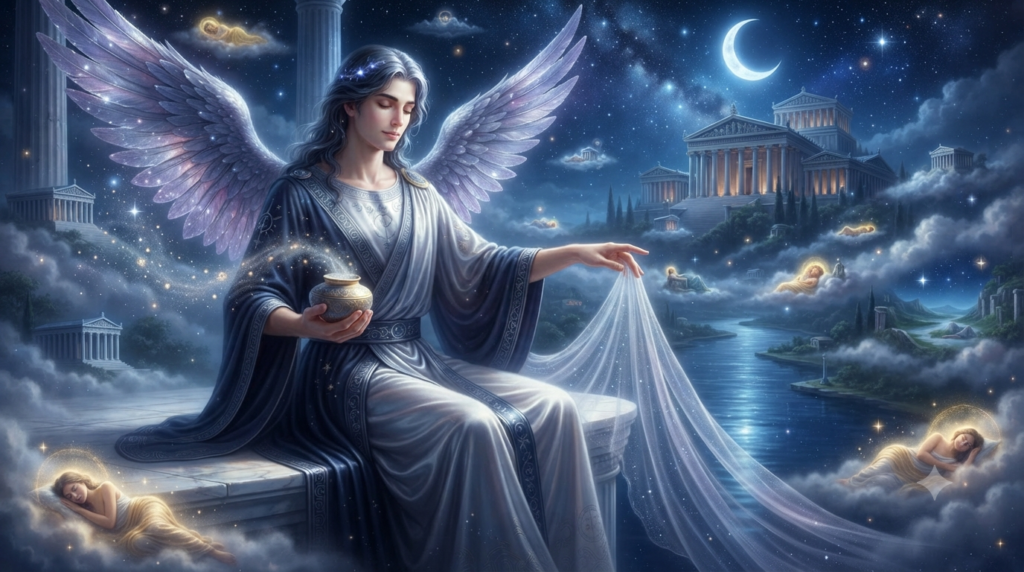
Descriptions of Hypnos, the Greek god of sleep, often present him as a youthful and peaceful figure rather than a frightening supernatural being. Ancient artists and writers commonly portrayed him as a young man with wings, representing his ability to move between the waking world and the realm of unconsciousness. His appearance reflected the gentle and mysterious nature of sleep itself.
The wings of Hypnos carried important symbolic meaning. They represented the speed with which sleep can arrive and the transition from one state of consciousness to another. Just as a person can suddenly fall asleep, Hypnos could quickly spread his influence over humans and gods alike.
Hypnos was also associated with symbols such as poppies, which became connected with sleep because of their calming properties. The poppy represented relaxation, dreams, and the peaceful state that follows exhaustion. In artistic representations, these symbols reinforced his identity as a deity of rest and tranquility.
Unlike gods associated with war or destruction, Hypnos was usually depicted with a calm expression and gentle presence. His power did not come from violence but from the ability to remove awareness temporarily. This made him a unique figure among Greek gods because his influence was subtle but impossible to avoid.
The visual representation of Hypnos reflects the ancient Greek understanding of sleep as both beautiful and mysterious. Sleep could bring comfort, healing, and restoration, but it also opened the door to dreams and unknown experiences. Through his imagery, Hypnos represented the peaceful yet powerful nature of the sleeping state.
What Powers Did Hypnos Have?
The powers of Hypnos, the Greek god of sleep, were directly connected to his ability to control the state of consciousness. Unlike many Greek gods whose abilities involved physical strength, warfare, natural elements, or political authority, Hypnos possessed a quieter but extremely influential power: the ability to make any being surrender to sleep. His domain represented a force that could affect humans, heroes, and even gods, demonstrating that rest was considered one of the unavoidable laws of existence.
The most important ability of Hypnos was his power to induce sleep. According to Greek mythology, Hypnos could cause individuals to lose awareness and enter a state of unconscious rest simply through his presence or divine influence. This ability made him a powerful figure because sleep removes a person’s ability to act, defend themselves, or make decisions. Even the strongest warrior or most powerful deity could become vulnerable when touched by the power of Hypnos.
This aspect of his mythology reveals an important idea in ancient Greek culture: true power was not always associated with force or violence. A god who could control sleep possessed influence over the mind itself. Hypnos represented the power of surrender, showing that every living being, regardless of strength or status, depended on periods of rest and renewal.
One of the most famous examples of Hypnos using his abilities appears in Homer’s Iliad, where he plays a role in the events of the Trojan War. In this story, the goddess Hera asks Hypnos to help her influence Zeus by causing him to fall asleep. Hypnos initially hesitates because Zeus is extremely powerful, but eventually agrees after receiving assistance from Hera.
The episode demonstrates the unique position of Hypnos among Greek deities. Although he was not considered stronger than Zeus in terms of authority or combat ability, his specific power allowed him to affect even the king of the gods. The story emphasizes that sleep was viewed as a universal force that even divine beings could not completely resist.
Hypnos’ abilities also extended beyond simple sleep induction. He was connected with the transition between consciousness and dreams, creating the conditions in which the sleeping mind could experience visions and symbolic images. While Morpheus and other dream spirits were associated specifically with dreams, Hypnos controlled the state that made dreams possible.
Hypnos and the Realm of Dreams
The connection between Hypnos and dreams is one of the most fascinating aspects of his mythology. In ancient Greek belief, dreams were not random experiences but could contain messages, warnings, or symbolic information. Since dreams occurred during sleep, Hypnos became naturally associated with the mysterious world that existed beyond ordinary awareness.
However, it is important to distinguish between Hypnos and the gods or spirits connected specifically with dreams. Hypnos represented sleep itself—the condition that allowed dreams to occur. His role was to guide beings into the sleeping state, while figures such as Morpheus, one of the Oneiroi (dream spirits), were responsible for shaping dream experiences.
This distinction reveals the complexity of Greek mythology. Different divine figures often represented different aspects of the same human experience. Sleep, dreams, visions, and prophecy were connected but separate concepts. Hypnos represented the doorway, while dream deities represented what could be encountered after passing through that doorway.
The ancient Greeks placed great importance on dreams because they believed the sleeping mind could receive information unavailable during waking life. Some dreams were interpreted as messages from gods, signs of future events, or reflections of hidden truths. Because Hypnos controlled access to this mysterious state, he occupied an important position within beliefs about divine communication.
The relationship between Hypnos and dreams also reflects a broader human fascination with consciousness. Sleep creates a temporary separation between the physical world and the inner world of thoughts, memories, and imagination. Greek mythology transformed this psychological experience into a divine process governed by powerful supernatural beings.
Through Hypnos, ancient Greeks expressed the idea that sleep was not simply inactivity but a journey into another form of awareness. His mythology recognized that the sleeping mind possessed mysteries that were just as fascinating as the visible world.
Hypnos in Homer’s Iliad
One of the most significant appearances of Hypnos in ancient literature occurs in Homer’s Iliad, where the Greek god of sleep becomes involved in the conflict between the Olympian gods during the Trojan War. This episode provides valuable insight into how ancient Greeks viewed the power of sleep and its ability to influence even the greatest divine figures.
In the Iliad, Hera seeks to help the Greeks during the Trojan War and decides to deceive Zeus, who supports the Trojans at that moment. To achieve her goal, she asks Hypnos to place Zeus into a deep sleep. This allows Hera and the other gods to influence events without immediate interference from the king of Olympus.
Initially, Hypnos fears accepting Hera’s request because he remembers a previous occasion when he caused Zeus to sleep and faced the consequences afterward. His hesitation shows that even a powerful deity like Hypnos understood the danger of challenging Zeus. However, Hera eventually convinces him by offering rewards and assistance.
The story is significant because it demonstrates that Hypnos possessed a unique type of authority. Zeus was the most powerful Olympian god, ruler of the heavens and master of thunder and lightning, yet even he could be affected by the power of sleep. The episode reinforces the idea that sleep was not a weakness but a natural force that surpassed individual power.
The role of Hypnos in the Iliad also reveals the Greek understanding of balance between control and vulnerability. A being may possess enormous strength and authority, but sleep creates a moment when that power temporarily disappears. This made Hypnos a symbol of one of the few forces capable of placing limits on even the greatest gods.
Hypnos Compared to Other Greek Gods
Understanding who Hypnos is in Greek mythology becomes easier when comparing him with other divine figures connected with related concepts. Greek mythology contained many gods who represented different aspects of existence, and Hypnos occupied a unique position because his domain involved consciousness itself.
| Deity | Domain | Relationship with Hypnos |
|---|---|---|
| Hypnos | Sleep and unconscious rest | Represents the state of sleeping itself |
| Thanatos | Death | His twin brother; represents permanent rest |
| Morpheus | Dreams and dream images | Represents the visions experienced during sleep |
| Apollo | Sun, prophecy, knowledge | Represents clarity and awareness, opposite to sleep |
| Hades | Underworld | Represents the realm of the dead, connected symbolically with Thanatos |
The comparison between Hypnos and Thanatos is especially important because both represent states where ordinary human awareness disappears. However, while Thanatos symbolizes the final end of life, Hypnos represents temporary renewal. Sleep allows a person to return refreshed, making Hypnos a figure associated with restoration rather than finality.
The difference between Hypnos and Morpheus is also essential. Many modern interpretations confuse sleep and dreams, but Greek mythology separated these concepts. Hypnos created the condition of sleep, while Morpheus influenced the content of dreams. One controlled the doorway, while the other shaped what appeared beyond it.
Hypnos also contrasts with Apollo, who represented light, reason, prophecy, and consciousness. Apollo’s domain was associated with clarity and revelation, while Hypnos represented withdrawal from external reality. Together, these figures demonstrate the Greek fascination with opposing forces: light and darkness, awareness and unconsciousness, activity and rest.
The Symbolism of Hypnos in Ancient Greek Culture
The symbolism of Hypnos, the Greek god of sleep, extends far beyond the simple act of resting. For ancient Greeks, sleep represented a powerful transition between different states of existence. It was a moment when the body became still, the conscious mind withdrew, and another form of experience emerged through dreams and imagination.
Hypnos symbolized the importance of balance. Greek culture valued achievement, courage, and action, but mythology also recognized that constant activity was impossible. Even heroes and gods required moments of rest. Through Hypnos, the Greeks acknowledged that recovery and renewal were essential parts of life.
Sleep was also associated with healing. Ancient Greek medical traditions often connected dreams with divine messages and restoration. In healing temples dedicated to Asclepius, patients sometimes slept in sacred spaces hoping to receive guidance or cures through dreams. This connection strengthened the idea that sleep could provide access to hidden knowledge and recovery.
The image of Hypnos reminds humanity that some of the most powerful forces are invisible. Unlike Zeus with his thunderbolts or Poseidon with his storms, Hypnos exercised influence quietly. His power existed in a universal human experience that everyone understands but that remains scientifically and philosophically fascinating.
Through his mythology, Hypnos became a symbol of the mystery of consciousness itself. He represents the moment when humans leave the ordinary world behind and enter a state where memories, emotions, and imagination become active. This is why the Greek god of sleep continues to fascinate modern audiences.
Hypnos in Roman Mythology: Somnus
In Roman mythology, Hypnos was adapted into the figure of Somnus, the Roman god of sleep. The Romans adopted many Greek mythological traditions and often gave Greek deities Latin names while preserving their essential characteristics. Somnus maintained the same connection with sleep, dreams, and the unconscious state.
Like Hypnos, Somnus was associated with peaceful rest and the mysterious world of dreams. Roman writers continued to explore the symbolic relationship between sleep and death, maintaining the connection between Somnus and the Roman equivalent of Thanatos, Mors.
The influence of Hypnos and Somnus continued through European literature, art, and philosophy. Their symbolism helped shape later ideas about sleep, dreams, and altered states of consciousness.
The modern word “hypnosis” comes directly from the name Hypnos, demonstrating the lasting influence of Greek mythology on language and culture. Although hypnosis is not the same as natural sleep, the connection reflects the ancient association between Hypnos and altered states of awareness.
Hypnos in Modern Culture
The legacy of Hypnos continues in modern literature, psychology, fantasy, and popular culture. His name appears in scientific terminology, artistic works, and fictional stories that explore themes related to sleep, dreams, and the unconscious mind.
Modern interpretations often portray Hypnos as a mysterious and elegant figure rather than a traditional warrior-like deity. His symbolism fits naturally into fantasy worlds because sleep and dreams remain connected with imagination, hidden knowledge, and supernatural possibilities.
Psychology has also preserved the influence of Hypnos through concepts related to hypnosis and altered consciousness. Although modern science explains sleep differently from ancient mythology, the fascination with the sleeping mind remains similar: humans continue to study what happens when consciousness changes.
The continued relevance of Hypnos demonstrates the lasting power of Greek mythology. Ancient stories about gods and primordial forces continue because they explore experiences that remain universal. Everyone sleeps, dreams, and experiences the mysterious transition between awareness and unconsciousness.
Conclusion
The question “Who is Hypnos, the Greek god of sleep?” reveals a deity who represents far more than simple rest. Hypnos embodies one of the most fundamental and mysterious aspects of human existence: the transition from consciousness into sleep. In Greek mythology, he was the divine force responsible for allowing gods and mortals alike to surrender temporarily to rest.
As the son of Nyx and Erebus, Hypnos represented the natural connection between darkness, silence, and renewal. His relationship with Thanatos showed the ancient Greek understanding that sleep and death shared similarities while remaining fundamentally different. One restored life, while the other marked its final transformation.
Through his connection with dreams, healing, and altered states of consciousness, Hypnos became a symbol of the hidden world within the human mind. His mythology reminds us that invisible forces can possess extraordinary power and that rest is not a weakness but an essential part of existence.
Although he was not one of the most famous Olympian gods, Hypnos remains one of the most meaningful figures in Greek mythology. His influence survives in modern language, psychology, literature, and culture, proving that the ancient fascination with sleep and dreams continues to resonate thousands of years later.

Orin Vale has spent the better part of two decades tracing the threads that connect the world’s oldest stories — from the halls of Asgard to the banks of the Nile, from Olympus to the jungles of the Maya. What began as a childhood fascination with flood myths and trickster gods grew into years of independent study across comparative mythology and ancient religion, always chasing the same question: what did these stories mean to the people who first told them? Orin writes for readers who want more than trivia — the ones looking for the beliefs, fears, and truths that myths were built to carry.