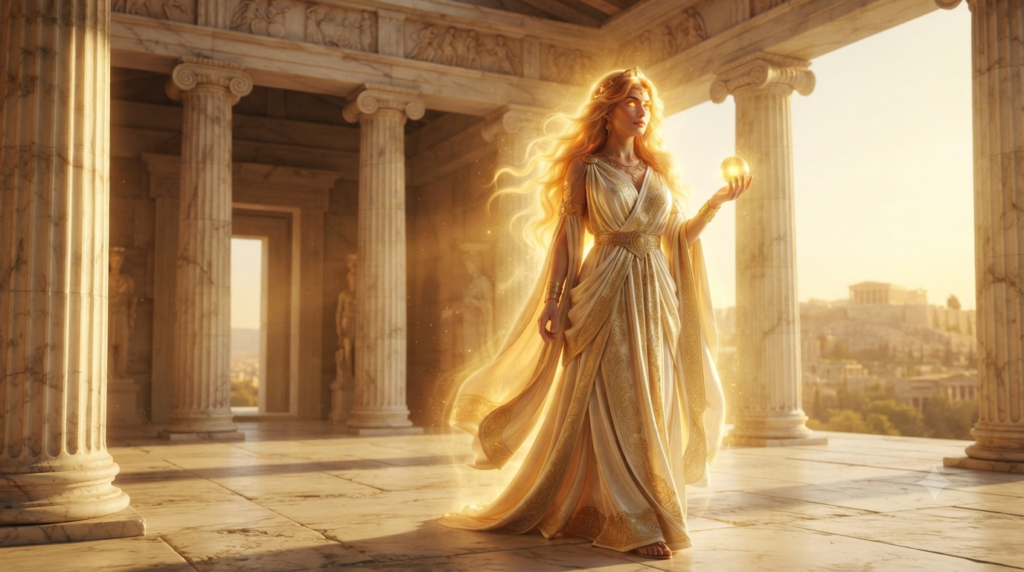
The question “Who is Theia, the Greek goddess associated with gold and light?” introduces one of the most fascinating yet overlooked figures in Greek mythology. While many people are familiar with famous Olympian gods and goddesses such as Zeus, Athena, Apollo, and Aphrodite, Theia belongs to a much older generation of divine beings known as the Titans. She represents the ancient cosmic forces that existed before the Olympian gods established their dominance over the universe.
Theia was a Titan goddess associated with light, sight, brilliance, and precious metals, especially gold. In ancient Greek belief, light was not merely a physical phenomenon but a symbol of knowledge, truth, beauty, and divine presence. Gold, with its natural shine and resistance to decay, represented perfection, immortality, and the splendor of the gods. Through these associations, Theia became a representation of the radiant qualities that reveal and illuminate the world.
Although Theia does not appear in as many famous myths as other Greek deities, her importance within Greek cosmology is profound. She was one of the twelve original Titans, born from Uranus (the Sky) and Gaia (the Earth), making her part of the first divine generation responsible for shaping the structure of the universe. Her role was not centered on heroic battles or dramatic adventures, but on fundamental forces that influenced how ancient Greeks understood existence itself.
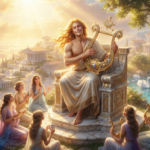
The significance of Theia becomes even clearer through her children. With Hyperion, the Titan associated with heavenly light, Theia became the mother of three powerful celestial deities: Helios, the god of the Sun; Selene, the goddess of the Moon; and Eos, the goddess of the Dawn. Through them, her influence extended across the entire sky, connecting her with the daily cycle of sunlight, moonlight, and the first glow of morning.
Understanding who Theia is in Greek mythology requires looking beyond the simple idea of a goddess connected to gold and light. She represents the deeper symbolic meaning of illumination: the ability to see, understand, and recognize value. In the worldview of ancient Greek religion, light was connected with revelation and order, making Theia a divine embodiment of the forces that allow both gods and humans to perceive the beauty and structure of the cosmos.
Her mythology also reveals an important aspect of Titan mythology: many Titans represented universal principles rather than personal stories. While Olympian gods often interacted directly with humans, Titans like Theia symbolized the fundamental elements that shaped reality. She was not only a goddess of brightness but also a representation of the cosmic harmony between the heavens, the Earth, and the celestial bodies.
Today, Theia remains an important figure for scholars and mythology enthusiasts because she provides a broader understanding of Greek mythology beyond the most famous gods. Her story highlights how ancient civilizations transformed natural concepts—such as sunlight, vision, and precious materials—into divine personalities. Through Theia, the Greeks expressed their fascination with the connection between the physical world and the mysterious forces believed to govern it.
Who Is Theia in Greek Mythology?
Theia is a Titan goddess in Greek mythology known for her connection with divine light, sight, brilliance, and gold. She was one of the twelve Titans, the powerful beings who ruled the cosmos before the rise of the Olympian gods. Her place among the earliest generations of Greek deities gives her a unique position within ancient Greek creation myths, where she represents one of the fundamental forces that shaped the universe.
The name Theia is closely associated with ideas of divinity and radiance. In ancient Greek traditions, names often reflected the essential nature of a deity, and Theia’s name conveys meanings related to the divine, the extraordinary, and the shining. This connection reinforces her role as a goddess linked with everything that possesses brilliance, beauty, and heavenly illumination.
Unlike gods such as Apollo, who became strongly associated with the Sun, or Helios, who represented the solar body itself, Theia represented a more abstract concept: the divine quality of light. She was connected not only with physical brightness but also with the ability to perceive and understand. For this reason, she is often described as a goddess of sight and perception, representing the power that allows beings to recognize truth and beauty.
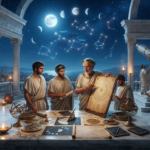
In Greek mythology, sight had a deeper meaning than simple vision. The ability to see was connected with knowledge, awareness, and understanding. Light allowed humans to distinguish the world around them, while darkness represented uncertainty and the unknown. Through this symbolism, Theia became associated with illumination in both a physical and intellectual sense.
Her connection with gold follows the same symbolic pattern. Gold was considered a material with divine qualities because of its brightness, rarity, and permanence. Ancient Greeks associated golden objects with gods, temples, and sacred power. Theia’s relationship with gold therefore represented more than wealth; it reflected purity, perfection, and the brilliance associated with the divine realm.
Within the hierarchy of Greek gods and goddesses, Theia occupies a quieter but essential role. She was not remembered primarily because of dramatic myths or conflicts, but because of the cosmic principles she represented. Her influence can be compared to sunlight itself: often unnoticed in daily life, yet essential for everything that exists and grows.
Theia’s importance also comes from her role as a bridge between generations of Greek deities. As a Titan, she belongs to the older cosmic order, but through her children she became connected to later traditions involving the Sun, Moon, and Dawn. Her lineage demonstrates how the Titans formed the foundation upon which the Olympian world was built.
When exploring who is Theia, the Greek goddess associated with gold and light, it becomes clear that she represents much more than a forgotten Titan figure. She embodies the ancient Greek understanding that light was a sacred force connected with knowledge, beauty, and cosmic balance. Her mythology reminds us that many of the most important forces in Greek religion were not always represented by the most famous gods, but by ancient deities who symbolized the hidden structures of the universe.
The Origins of Theia: Daughter of Uranus and Gaia
The origins of Theia are deeply connected to the earliest chapters of Greek mythology, when the universe was believed to be shaped by primordial forces that existed before the famous Olympian gods. According to the ancient poet Hesiod’s Theogony, Theia was born from the union of Uranus (the Sky) and Gaia (the Earth), two of the most ancient divine beings in Greek cosmology. This lineage places Theia among the first generations of gods, known as the Titans, who represented fundamental aspects of existence.
Gaia represented the foundation of the physical world, while Uranus represented the vast expanse of the heavens above. Their union symbolized the connection between Earth and sky, creating a new generation of divine beings who would shape the structure of the cosmos. Among their children were the twelve Titans, including Cronus, Rhea, Oceanus, Tethys, Hyperion, Themis, Mnemosyne, and Theia. Each Titan embodied a different cosmic principle, and Theia’s domain was connected to brilliance, sight, and heavenly radiance.
As a daughter of Gaia and Uranus, Theia inherited a position of immense importance within ancient Greek religion. The Titans were not simply powerful creatures; they represented the essential forces that allowed the universe to function. Before the Olympian gods became the dominant figures in Greek mythology, the Titans were believed to govern the cosmic order. Theia’s association with light reflects the importance ancient cultures placed on illumination as a force that brought structure, understanding, and harmony to the world.
The story of Theia’s origins also demonstrates how Greek mythology explained natural concepts through divine genealogy. Instead of viewing the sky, the Earth, light, and celestial movements as separate phenomena, the Greeks imagined them as interconnected elements within a divine family. Theia’s existence represented the idea that light itself had a sacred origin, emerging from the union between Earth and heaven.
The Titans occupied a transitional position between the primordial gods and the Olympian generation. The earliest beings, such as Gaia and Uranus, represented the raw forces of creation, while the Olympians represented a more organized divine society with distinct personalities and relationships with humanity. Theia belonged to this middle generation, acting as part of the cosmic foundation that allowed later gods to emerge.
Her connection to Uranus is especially meaningful because light in Greek thought was strongly associated with the heavens. The sky was viewed as a divine realm where the Sun, Moon, and stars moved in perfect patterns. As a Titan goddess connected with radiance, Theia represented one of the qualities that made the celestial world understandable and awe-inspiring to ancient observers.
The mythology surrounding Theia’s birth also reveals the importance of ancestry in Greek religious thought. Divine power was often understood through family relationships, and knowing a deity’s parents helped define their role within the universe. By being the daughter of Gaia and Uranus, Theia was directly connected to the original forces of creation, giving her authority over concepts related to cosmic beauty and illumination.
The Meaning of Theia’s Name and Her Connection to Light
The meaning behind Theia’s name provides important insight into her role as a Greek goddess of light and sight. In ancient Greek culture, names often carried symbolic meanings that reflected the nature, power, or purpose of a deity. Theia’s name is associated with ideas of divinity, brilliance, and something extraordinary or worthy of admiration. This connection reinforces her identity as a goddess representing heavenly radiance and the qualities that make things appear magnificent.
Light held a central position in ancient Greek philosophy, religion, and mythology. It was viewed as more than a physical phenomenon; it represented knowledge, truth, life, and divine presence. The ability to see clearly was connected with understanding the world, while darkness often represented confusion, ignorance, or hidden dangers. Through this perspective, Theia became associated with the power of revelation—the force that allows beings to perceive reality.
Her connection with sight is one of the most important aspects of her mythology. Ancient Greeks believed that vision was closely connected with knowledge and awareness. To see something was not only to observe it but also to understand its nature. A goddess connected with sight therefore represented the ability to recognize beauty, distinguish truth from illusion, and comprehend the order of existence.
This symbolism explains why Theia is sometimes described as a goddess of perception. She was not simply responsible for producing light but represented the deeper meaning behind illumination. Just as sunlight allows humans to see the physical world, divine light was believed to reveal hidden truths and provide understanding. Theia’s power existed in the relationship between brightness and awareness.
The association between Theia and celestial light also connects her with the broader theme of Greek Titan mythology, where many Titans represented universal forces rather than individual human experiences. While Olympian gods often had specific personalities and dramatic myths, Titan deities frequently embodied concepts that shaped the structure of reality itself. Theia represented the brilliance that made the universe visible and meaningful.
Her connection to light can also be understood through an analogy: light is not the object being observed, but the force that allows everything else to be observed. A person may admire a beautiful landscape, a precious jewel, or a magnificent temple, but without light, those qualities remain hidden. In the same way, Theia represents the divine force that reveals beauty and allows value to be recognized.
Theia’s association with light also explains her relationship with gold. Gold was admired in ancient Greece because it captured and reflected light more brilliantly than ordinary materials. Its brightness made it appear almost supernatural, connecting it with immortality and divine perfection. As a goddess of radiance, Theia became linked with this symbolic representation of eternal brilliance.
Through her connection with sight, gold, and celestial illumination, Theia became a representation of the ancient Greek belief that beauty and knowledge were connected. Light revealed the world, sight allowed understanding, and gold symbolized lasting perfection. Together, these concepts formed the foundation of Theia’s identity as one of the most important but often overlooked figures among the Greek Titan gods and goddesses.
Theia and the Power of Gold in Greek Mythology
The association between Theia and gold reveals another important dimension of her symbolism within ancient Greek mythology. Gold was considered one of the most extraordinary materials known to ancient civilizations. Its natural brilliance, rarity, and resistance to deterioration made it a symbol of permanence, purity, wealth, and divine excellence. By connecting Theia with gold, Greek mythology emphasized her relationship with everything that represented brilliance and perfection.
In Greek religious traditions, gold was frequently associated with the gods. Temples contained golden statues, divine objects were described with golden qualities, and mythological figures were often portrayed with golden attributes. The material represented something beyond ordinary human possessions; it suggested a connection with the immortal world. Theia’s association with gold therefore reflects her position as a goddess connected with the splendor of the divine realm.
Gold also carried symbolic meaning because of its relationship with the Sun. Its shining surface reflected the same qualities that ancient Greeks observed in sunlight: warmth, brilliance, and beauty. Since Theia was connected with celestial illumination and later became the mother of solar, lunar, and dawn deities, her relationship with gold naturally reinforced her connection with heavenly radiance.
The concept of golden light appears throughout Greek mythology. Gods and heroes are frequently described using images of shining armor, golden objects, or radiant appearances. These descriptions were not merely decorative; they communicated a sense of superiority, purity, and connection with divine power. Theia represents the underlying principle behind this imagery—the brilliance that makes something appear extraordinary.
Her symbolism also extends beyond material wealth. Gold in Greek mythology represented qualities such as immortality, stability, and excellence. Unlike ordinary metals that could rust or decay, gold remained unchanged, making it a natural symbol for the eternal nature of the gods. Through Theia, the Greeks transformed these physical characteristics into spiritual concepts connected with divine perfection.
Understanding Theia’s connection with gold helps explain why she is considered a goddess of brilliance rather than simply a goddess of wealth. Her role was not about controlling riches or granting material possessions. Instead, she represented the quality that makes something valuable and admired. Gold became a metaphor for divine light, purity, and the eternal beauty associated with the heavens.
Theia’s Family Tree: The Titan Goddess and Her Divine Children
The importance of Theia in Greek mythology becomes even clearer when examining her divine family. As a Titan goddess born from Gaia and Uranus, Theia belonged to one of the oldest generations of Greek deities. However, her influence extended far beyond her own existence because of her children, who became some of the most important celestial figures in ancient Greek religion. Through her descendants, Theia’s connection with light expanded from a symbolic concept into the daily movements of the heavens.
Theia was married to Hyperion, another member of the Titan generation. Hyperion was associated with heavenly observation, the light of the sky, and the movement of celestial bodies. Their union represented a combination of two related cosmic principles: Hyperion represented the presence and movement of heavenly light, while Theia represented brilliance, perception, and the ability to recognize that light. Together, they created a divine lineage connected with the most visible sources of illumination in the ancient world.
The relationship between Theia and Hyperion reflects how ancient Greeks explained natural phenomena through divine genealogy. Instead of seeing the Sun, Moon, and Dawn as isolated events, they imagined them as members of a divine family. This approach allowed mythology to transform the cycles of nature into meaningful stories about relationships, origins, and cosmic order.
Their children became some of the most important celestial deities in Greek mythology. Through them, Theia’s influence reached every part of the sky, connecting her with the three major forms of heavenly light experienced by humans: the intense brightness of the Sun, the reflective glow of the Moon, and the first light that announces the arrival of a new day.
Helios: God of the Sun
Helios was the most famous child of Theia and Hyperion and became the personification of the Sun in ancient Greek mythology. He was traditionally depicted as a powerful god who traveled across the sky in a golden chariot drawn by fiery horses, bringing sunlight to the world each day. His daily journey represented the movement of light from east to west, creating the rhythm of day and night.
The connection between Helios and Theia is especially meaningful because it shows how her symbolism continued through her descendants. As the goddess associated with brilliance and celestial radiance, Theia could be seen as the source of the divine light that Helios embodied. The Sun’s golden appearance, its life-giving energy, and its ability to illuminate the world all reflect qualities associated with his mother.
In ancient Greek culture, the Sun represented far more than physical warmth. It symbolized life, order, clarity, and divine observation. Because Helios saw everything that happened beneath the heavens, he was sometimes associated with knowledge and truth. This connection reinforces Theia’s own association with sight and perception, showing how her symbolic influence continued through her children.
Although Apollo later became strongly associated with solar qualities in Greek and Roman traditions, Helios remained the original solar deity in many ancient sources. This distinction is important when studying Theia, the Greek goddess associated with gold and light, because her son Helios represents one of the clearest expressions of her connection with celestial brilliance.
Selene: Goddess of the Moon
Selene, another daughter of Theia and Hyperion, represented the Moon and its gentle illumination. Unlike the powerful brightness of Helios, Selene’s light was softer and more mysterious. She was often portrayed driving a silver chariot across the night sky, bringing a different form of illumination to the world after sunset.
Through Selene, Theia’s connection with light extended beyond the daytime. Theia was not only associated with the intense brilliance of the Sun but with the broader concept of celestial radiance itself. The Moon’s reflective glow demonstrates another aspect of light: the ability to reveal what exists in darkness without overpowering it.
Ancient Greeks connected the Moon with cycles, transformation, and mystery. The changing phases of the Moon influenced calendars, agricultural activities, and religious traditions. Selene’s role shows how Theia’s influence reached into the rhythms of nature and human life.
The relationship between Theia and Selene also highlights the symbolic connection between light and perception. Even during the darkness of night, the Moon provided enough illumination for humans to navigate and observe the world. In this way, Selene continued her mother’s symbolic role as a bringer of visibility and awareness.
Eos: Goddess of the Dawn
Eos, the third major child of Theia and Hyperion, represented the dawn and the first light that appears before sunrise. She was often described as a beautiful goddess with rosy fingers who opened the gates of the heavens to allow the Sun to begin its daily journey. Her appearance marked the transition between darkness and light.
The connection between Eos and Theia is especially symbolic because dawn represents renewal and the constant return of illumination. Each morning, Eos brought the promise of a new beginning, demonstrating the recurring cycle of nature that ancient Greeks observed and incorporated into their mythology.
As the goddess of dawn, Eos represented hope, awakening, and the restoration of order after darkness. Her role complements the symbolism of Theia because both figures are connected with revelation and visibility. While Theia represents the fundamental principle of divine light, Eos represents the moment when that light returns to the world.
Through Helios, Selene, and Eos, Theia became the ancestral source of the three major celestial lights recognized by the Greeks. The Sun, Moon, and Dawn were not separate concepts but interconnected expressions of the same divine lineage. This connection explains why Theia holds an important place among the Greek Titan gods and goddesses, even though she appears less frequently in surviving myths.
Theia and the Titans: Her Role in the Titan Generation
Theia belonged to the generation of gods known as the Titans, a powerful group of primordial deities who ruled the cosmos before the rise of the Olympians. The Titans represented the fundamental forces that shaped existence, and each possessed a symbolic connection with aspects of the natural and cosmic world. As the goddess of light, sight, and brilliance, Theia represented one of the essential forces that allowed the universe to be perceived and understood.
The Titan generation included twelve major figures born from Gaia and Uranus. Among them were Cronus, who later became the father of Zeus; Rhea, mother of several Olympian gods; Oceanus, associated with the great cosmic waters; and Mnemosyne, the goddess of memory. Together, these beings represented the foundations of the universe according to ancient Greek creation traditions.
Theia’s role among the Titans was unique because her power was not expressed through warfare or political authority. Unlike Cronus, who ruled the Titans, or Atlas, who became associated with carrying the heavens, Theia represented a more subtle cosmic force. Her domain involved the ability to illuminate, reveal, and provide brilliance to the world.
The conflict between the Titans and Olympians, known as the Titanomachy, marked one of the most important events in Greek mythology. During this ten-year war, Zeus and his siblings fought against the older generation of Titans for control of the cosmos. The outcome established the Olympian gods as the dominant divine order.
Ancient sources provide limited information about Theia’s personal involvement in the Titanomachy. Unlike Titans such as Cronus, Atlas, or Prometheus, she does not play a central role in the conflict. This absence suggests that her importance was primarily symbolic rather than political. She represented an enduring cosmic principle rather than a figure defined by battles and power struggles.
After the victory of Zeus and the Olympians, the Titans were generally replaced as the dominant rulers of the universe. However, their influence did not disappear completely. Many Titans continued to represent essential forces within Greek cosmology, and Theia remained significant because her children continued to govern important aspects of the celestial world.
The story of Theia and the Titans reveals an important characteristic of Greek mythology: older gods were not always forgotten after being replaced. Instead, they often became the foundations upon which later myths were built. Theia’s legacy survived through the continued importance of sunlight, moonlight, and dawn, demonstrating that the ancient Titan forces remained present within the world even after the Olympian age began.
Theia as the Goddess of Sight and Perception
One of the most profound aspects of Theia’s mythology is her connection with sight and perception. While many interpretations focus on her association with gold and light, her role as a goddess of vision reveals a deeper philosophical meaning. To the ancient Greeks, seeing was closely connected with understanding. Light allowed humans to perceive reality, distinguish forms, and recognize beauty.
Theia represented the divine force behind this ability to perceive. Her light was not only the brightness that illuminated the physical world but also the symbolic illumination that allowed knowledge and awareness to emerge. In this sense, she represented the connection between the external world and human understanding.
This symbolism made Theia an important figure within ancient Greek thought. Light was often associated with truth because it revealed what was hidden. Darkness could conceal dangers and create uncertainty, while illumination brought clarity. Through this perspective, Theia represented the power that transforms confusion into knowledge.
Her association with sight also connects her with the broader Greek idea that beauty depends on perception. Gold, sunlight, stars, and celestial phenomena were admired because humans could recognize their brilliance. Theia represented the divine quality that allowed these things to be appreciated and understood.
Although Theia does not have as many surviving myths as other Greek goddesses, her symbolic importance remains powerful. She embodies one of humanity’s oldest relationships with the natural world: the fascination with light and the desire to understand what we see. Through her mythology, the Greeks transformed the simple act of seeing into a divine concept connected with wisdom, beauty, and cosmic order.
Conclusion
The question “Who is Theia, the Greek goddess associated with gold and light?” reveals the story of a powerful yet often overlooked figure within Greek mythology. As one of the original Titans, Theia represented fundamental forces that existed before the rise of the Olympian gods. Her connection with light, sight, brilliance, and gold demonstrates how ancient Greeks transformed natural phenomena into divine concepts that explained the relationship between humanity, nature, and the cosmos.
Unlike many famous Greek deities remembered for dramatic battles, heroic adventures, or conflicts with mortals, Theia’s importance lies in the symbolic role she played within the universe. She represented the ability to see, understand, and recognize beauty. Her light was not merely physical illumination but also a metaphor for knowledge, truth, and awareness. Through her, Greek mythology expressed the idea that light is the force that reveals the hidden structure and beauty of existence.
Theia’s legacy became even more significant through her children with Hyperion: Helios, Selene, and Eos. Through the Sun, the Moon, and the Dawn, her influence extended across the heavens and became part of the daily rhythm of the ancient world. Every sunrise, every moonlit night, and every appearance of celestial brilliance reflected the qualities associated with this Titan goddess of radiance.
Her connection with gold also reveals an important aspect of ancient Greek symbolism. Gold represented permanence, purity, divine excellence, and immortality. By associating Theia with golden brilliance, Greek mythology connected her with the qualities humans admired most in the divine: beauty, perfection, and eternal radiance. She was not simply a goddess of wealth but a representation of the brilliance that makes something valuable and extraordinary.
Although Theia is less famous than Olympian figures such as Athena, Aphrodite, or Hera, understanding her role provides a deeper appreciation of Greek Titan mythology and the foundations of ancient Greek religion. She represents the invisible forces that shaped the universe before the stories of heroes and Olympian gods dominated mythology. Her presence reminds us that many important deities were not defined by dramatic events but by the essential principles they embodied.
The enduring fascination with Theia demonstrates why Greek mythology continues to influence modern culture. Her story reflects universal human themes: the search for understanding, the admiration of beauty, and the desire to explain the mysteries of light and existence. As the Titan goddess associated with gold and light, Theia remains a symbol of divine brilliance and the eternal human connection with the wonders of the cosmos.

Orin Vale has spent the better part of two decades tracing the threads that connect the world’s oldest stories — from the halls of Asgard to the banks of the Nile, from Olympus to the jungles of the Maya. What began as a childhood fascination with flood myths and trickster gods grew into years of independent study across comparative mythology and ancient religion, always chasing the same question: what did these stories mean to the people who first told them? Orin writes for readers who want more than trivia — the ones looking for the beliefs, fears, and truths that myths were built to carry.