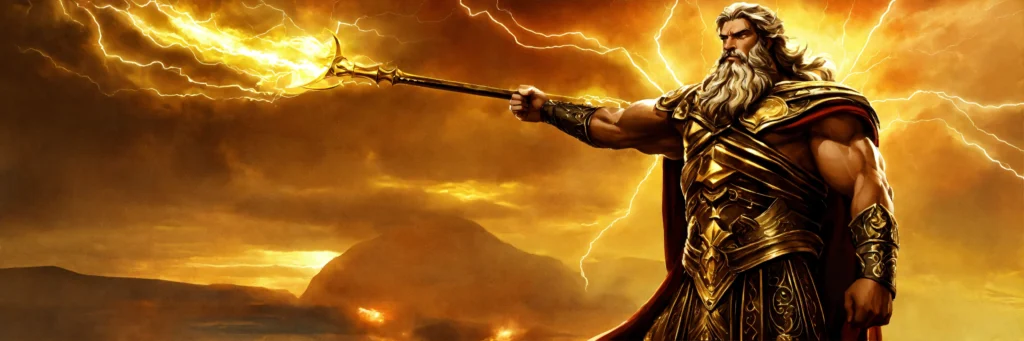
Jupiter is the supreme god of Roman mythology, ruling as king of the gods over the entire Roman pantheon. Regarded as the direct counterpart of the Greek god Zeus, Jupiter held dominion over the sky, thunder, and the fundamental order of the cosmos, making him the most powerful figure in ancient Roman religion.
Within Roman mythology, Jupiter’s authority extended far beyond the heavens. As chief deity of the Roman pantheon, he was seen as the guarantor of law, oaths, and justice among both gods and mortals. His command over lightning and storms symbolized a force that shaped destiny itself, reinforcing his status as the central pillar of the ancient Roman belief system.
Worshipped across the Roman world under the title Jupiter Optimus Maximus, meaning “Jupiter the Best and Greatest,” his cult was inseparable from the identity of Rome itself. The great temple dedicated to him on Capitoline Hill stood as the religious and political heart of the city, where victories were celebrated and solemn vows were made in his name.
Jupiter’s dominance in Roman mythology also rested on his role as father of gods and men, a title that placed him above every other deity in the Roman pantheon in both power and reverence. This paternal authority, combined with his mastery over the sky and thunder, made him the figure through whom Rome understood its own destiny, legitimacy, and divine favor.
Who Is Jupiter in Mythology? Origins and Meaning
The name Jupiter offers the clearest starting point for understanding who is Jupiter in mythology, since it carries the very meaning of his divine role. The word derives from the ancient Latin “Iuppiter,” a compound rooted in the Proto-Indo-European phrase Dyēus Phter, translating roughly to “Sky Father.” This linguistic origin already reveals his primary function within Roman mythology: a celestial ruler whose authority stemmed directly from his command over the heavens.
This etymology places Jupiter within a much older lineage of sky deities found across Indo-European mythology. The same root that produced “Iuppiter” also gave rise to the Greek god Zeus and to Dyaus Pita, a sky father figure honored in early Vedic religion. These parallel forms across separate ancient cultures point to a shared prehistoric belief system, in which a supreme sky father presided over thunder, daylight, and cosmic order long before Rome itself existed.
As this inherited figure took shape within early Italic religion, Jupiter absorbed and centralized the sky-worship traditions of the Latin peoples. Local variations of the sky father cult, once scattered among different Italic tribes, gradually converged into a single, dominant deity recognized throughout the Roman world. This consolidation elevated Jupiter above older regional gods, cementing his position as the chief authority of Roman mythology and the guarantor of divine and civic order alike.
The same name and symbolism extended beyond religion into astronomy, most notably in the naming of the planet Jupiter. As the largest planet in the solar system, its designation reflects the god’s supreme status among the Roman pantheon, reinforcing an association between vastness, dominance, and celestial authority that has persisted from antiquity into the modern understanding of who Jupiter truly was in mythology.
Jupiter’s Role in Roman Religion and Mythology
Jupiter’s role in Roman religion and mythology centered above all on his command over the sky and thunder, powers that made him the most visible and feared presence in the Roman pantheon. As the god of storms and lightning, Jupiter was believed to communicate directly with mortals through natural phenomena, using thunderbolts as both weapons and divine signs. This connection between celestial forces and earthly affairs positioned Jupiter as an ever-present authority, watching over the fate of Rome from the heavens themselves.
Beyond his dominion over weather, Jupiter’s role in Roman mythology extended deeply into the realm of law and civic order. He was regarded as the ultimate guarantor of oaths, treaties, and justice, a function that gave him authority not only over the gods but over the moral and legal fabric of Roman society. This is why so many public agreements, from political alliances to military commands, were sworn in his name, reinforcing his image as the divine source of order and legitimacy.
This civic dimension of Jupiter’s power found its clearest expression in the title Jupiter Optimus Maximus, “Jupiter the Best and Greatest,” under which he served as protector of the Roman state itself. In this capacity, Jupiter was not merely a distant sky father but an active guardian of Rome’s political and military fortunes, invoked before battles and credited with the empire’s victories and expansion.
The physical and spiritual center of this role was the great temple of Jupiter on Capitoline Hill, one of the most important religious sites in ancient Rome. Triumphant generals processed to this temple to offer sacrifices, and the Capitoline itself became synonymous with Roman power and religious authority. Through this temple, Jupiter’s role in Roman religion merged inseparably with the identity and destiny of the city he was believed to protect.
Jupiter vs. Zeus: Are They the Same God?
Jupiter and Zeus stand as the two most recognizable supreme gods of the ancient world, and understanding who Jupiter is in mythology naturally raises the question of how he compares to his Greek counterpart. Both deities descend from the same Proto-Indo-European sky father archetype, ruling as king of the gods over their respective pantheons and wielding the thunderbolt as a symbol of ultimate authority. This shared origin led the Romans to practice what scholars call interpretatio romana, directly equating Jupiter with Zeus as the same divine force expressed through two cultural lenses.
Despite this common root, the cult and worship surrounding each god diverged significantly. Roman religion treated Jupiter primarily as a formal, state-sanctioned authority, worshipped through structured rituals, oaths, and civic ceremonies tied to the functioning of Rome itself. Greek religion, by contrast, engaged with Zeus through a rich mythological tradition centered on Mount Olympus, where narrative and personal myth played a far larger role than institutional ritual. This distinction reflects a broader difference between Roman and Greek approaches to religion: one rooted in law and civic duty, the other in storytelling and divine drama.
The temperament attributed to each god further separates them within their respective mythologies. Zeus is frequently portrayed with a volatile, deeply personal character, involved in romantic pursuits, family rivalries, and conflicts that drive much of Greek mythology’s narrative structure. Jupiter, in contrast, was cultivated as a more restrained and dignified figure, embodying gravitas, order, and impartial justice befitting his role as protector of the Roman state. This cultural reshaping turned a shared archetype into two distinct expressions of supreme divine authority.
While Jupiter and Zeus emerged from the same ancient sky god tradition, their distinct evolution within Roman and Greek mythology produced two rulers with different personalities, priorities, and cultural functions. Exploring Zeus’s own mythology in greater depth reveals just how differently the Greeks shaped their king of the gods compared to Rome’s Jupiter, offering a fuller picture of how these two civilizations understood divine power.
Jupiter’s Family Tree
Jupiter’s family tree forms an essential part of understanding who Jupiter is in mythology, since his position atop the Roman pantheon was defined as much by lineage as by power. He was the youngest son of Saturn and Ops, the primordial ruling deities of the earlier divine generation. According to Roman mythology, Saturn devoured each of his children at birth to prevent a prophesied overthrow, but Ops managed to conceal Jupiter, allowing him to grow in secret until he was strong enough to challenge his father and free his siblings, an act that established his supremacy from the very beginning.
That act of liberation placed Jupiter at the center of a wide network of siblings who would themselves become major figures within Roman mythology. Neptune emerged as god of the sea, Pluto as ruler of the underworld, and Juno, Ceres, and Vesta took their places as powerful goddesses overseeing marriage, agriculture, and the sacred hearth. Together, these siblings formed the core generation of Roman gods, with Jupiter recognized among them not merely as an equal but as their acknowledged king.
Jupiter’s authority within this family structure was reinforced through his marriage to Juno, who served as both his wife and sister, reflecting a common pattern among ancient sky deities of divine unions that mirrored cosmic order. As queen of the Roman gods, Juno complemented Jupiter’s rule, presiding over marriage and the well-being of the Roman state alongside him, their partnership forming the central axis of the Roman pantheon’s hierarchy.
From this union and others, Jupiter fathered several of Rome’s most significant deities, extending his influence across nearly every domain of Roman religion. Mars, god of war, Minerva, goddess of wisdom and strategy, and Vulcan, god of fire and craftsmanship, all descended from Jupiter, each inheriting a portion of his authority while governing their own distinct spheres. Through this extensive lineage, Jupiter’s family tree illustrates how thoroughly his role as father of gods and men shaped the structure and identity of Roman mythology as a whole.
Symbols and Attributes of Jupiter
Jupiter’s identity in Roman mythology was inseparable from a set of powerful symbols that visually communicated his authority as king of the gods. Chief among these was the thunderbolt, the weapon most closely associated with Jupiter, forged as an emblem of his control over storms, lightning, and the sky itself. Depicted in countless statues and reliefs clutching a jagged bolt in his raised hand, Jupiter used this symbol to represent both his destructive power and his role as final judge, capable of striking down mortals or gods who defied divine and civic order.
Alongside the thunderbolt, the eagle stood as Jupiter’s most enduring companion and symbol within Roman religion. Regarded as the king of birds, the eagle mirrored Jupiter’s own status as ruler of the heavens, often shown carrying his thunderbolts or perched beside his throne as a sign of vigilance and supreme authority. This association proved so powerful that the eagle later became a central emblem of Roman military standards, linking Jupiter’s divine sanction directly to the strength and legitimacy of Rome’s legions.
The oak tree formed another essential symbol tied to Jupiter’s mythology, rooted in his earliest identity as a sky and thunder deity. Because oaks were frequently struck by lightning, ancient worshippers regarded them as sacred conduits between Jupiter and the earth, sites where his divine power was believed to manifest directly in nature. Groves of oak trees became places of ritual significance throughout the Roman world, reinforcing the belief that Jupiter’s presence extended beyond temples into the natural landscape itself.
Finally, the scepter completed the core set of attributes defining Jupiter’s iconography, symbolizing his sovereignty over both gods and mortals. Typically shown in his left hand while the thunderbolt occupied his right, the scepter represented Jupiter’s role not as a warrior god but as a supreme ruler governing through law, order, and rightful authority. Together, the thunderbolt, eagle, oak, and scepter formed a visual language that instantly identified Jupiter across Roman art and religion, cementing his image as the undisputed sovereign of the Roman pantheon.
Famous Myths Involving Jupiter
Some of the most defining stories in Roman mythology center on Jupiter, illustrating the scope of his power well beyond his formal role as king of the gods. Among the most significant is the myth of his overthrow of Saturn, in which Jupiter, having survived his father’s attempt to devour him, led a rebellion that freed his siblings and dethroned the previous generation of divine rulers. This foundational myth not only explained Jupiter’s rise to supremacy but also established the mythological precedent for the entire hierarchy of the Roman pantheon that followed.
Beyond this founding narrative, Jupiter appears prominently in myths involving mortal encounters, most famously the story of Europa. In this tale, Jupiter transforms himself into a magnificent white bull to approach and abduct the Phoenician princess Europa, carrying her across the sea to Crete. This myth, adapted directly from earlier Greek tradition, demonstrates Jupiter’s frequent use of transformation and disguise, a recurring motif that distinguished his mortal interventions from his formal, dignified role within Roman state religion.
Jupiter’s mythology also includes his decisive role in the Gigantomachy, the great battle against the Giants who rose up to challenge the authority of the gods. Wielding his thunderbolt alongside the other Roman gods, Jupiter led the divine forces to victory, reaffirming cosmic order against the chaos represented by these earthborn adversaries. This myth reinforced Jupiter’s identity not only as a ruler but as an active protector of the established order against forces that sought to overturn it.
Together, these myths reveal a fuller picture of who Jupiter is in mythology: a god defined not solely by ritual and civic authority, but by a narrative tradition of rebellion, transformation, and conflict. While Roman religion emphasized Jupiter’s formal role as protector of the state, these mythological episodes preserved the older, more dynamic image of a sky father whose power was proven through decisive action rather than institutional worship alone.
Jupiter’s Legacy in Modern Culture
Jupiter’s legacy in modern culture extends far beyond ancient Rome, most visibly through the naming of the planet Jupiter, the largest in the solar system. This astronomical designation reflects the same qualities that defined Jupiter in mythology: immensity, dominance, and supreme authority. Just as Jupiter ruled as king of the gods over the Roman pantheon, the planet bearing his name dwarfs every other body in our solar system, preserving his association with scale and power well into the modern scientific era.
The influence of Jupiter also survives in language and everyday life through the days of the week. In several Romance languages, Thursday derives directly from “Jupiter’s day,” a linguistic remnant of the ancient practice of naming weekdays after major deities. This subtle but persistent presence demonstrates how deeply Jupiter’s mythology became embedded in Western culture, surviving the fall of Rome to shape everyday speech centuries later.
Jupiter’s image has also endured prominently within art and literature, where his depiction as a bearded, authoritative figure wielding a thunderbolt has become one of the most recognizable representations of divine power in Western visual tradition. Renaissance painters and sculptors frequently returned to Jupiter as a subject, using his mythology to explore themes of authority, justice, and cosmic order, while writers across centuries invoked him as a literary symbol of ultimate rule and command.
Even in contemporary contexts, Jupiter continues to appear as a cultural reference point, from astrology, where Jupiter is associated with expansion, luck, and authority, to modern retellings of Roman mythology in books, films, and games. This lasting presence confirms that the question of who Jupiter is in mythology remains relevant far beyond antiquity, with his symbolism of supreme power and cosmic order continuing to resonate across scientific, linguistic, and artistic domains today.
FAQ
Who is Jupiter in mythology?
Jupiter is the supreme god of Roman mythology, ruling as king of the gods over the entire Roman pantheon. He governed the sky, thunder, and cosmic order, serving as the chief deity of ancient Roman religion and the direct counterpart of the Greek god Zeus.
Is Jupiter the same as Zeus?
Jupiter and Zeus share the same divine origin, both descending from the ancient Indo-European sky father archetype and ruling as king of the gods in their respective pantheons. However, Roman mythology shaped Jupiter into a more formal, state-oriented deity, while Greek mythology portrayed Zeus through a richer, more personal narrative tradition.
What is Jupiter the god of?
Jupiter was worshipped as the god of the sky, thunder, and lightning, as well as the divine guarantor of law, justice, and oaths within Roman society. As protector of the Roman state under the title Jupiter Optimus Maximus, he also held authority over the political and military fortunes of Rome.
What are Jupiter’s main symbols?
Jupiter’s most recognizable symbols include the thunderbolt, representing his command over storms and divine judgment, and the eagle, embodying his sovereignty over the heavens. The oak tree, sacred for its association with lightning, and the scepter, symbolizing his rightful rule, complete the core attributes tied to Jupiter throughout Roman mythology.
Conclusion
Jupiter stands as one of the most defining figures in ancient religion, and understanding who Jupiter is in mythology reveals far more than the identity of a single deity. As king of the gods within the Roman pantheon, Jupiter governed the sky, thunder, and cosmic order, while also serving as the ultimate guarantor of law, justice, and the political fortunes of Rome itself. His authority shaped not only religious practice but the very foundations of Roman civic identity.
Across his family lineage, his defining symbols, and the myths that recount his rise to power, Jupiter emerges as a god whose influence extended into nearly every corner of Roman life. From his triumph over Saturn to his role as father of gods and men, and from the thunderbolt in his hand to the great temple raised in his honor on Capitoline Hill, each element of his mythology reinforced the same underlying truth: Jupiter was not merely worshipped, but regarded as the very source of order in the Roman world.
That influence has proven remarkably durable, surviving the collapse of the empire that once venerated him. Jupiter’s name endures in the language of the days of the week, in the identity of the largest planet in the solar system, and in centuries of art and literature that continue to draw on his image as the supreme ruler of the heavens. Few figures from Roman mythology have left so wide and lasting a mark on Western culture.
Ultimately, the story of Jupiter is the story of how Rome understood divine power itself: structured, authoritative, and inseparable from the fate of the state. For readers drawn to this figure, exploring his Greek counterpart Zeus, or the wider family of Roman gods descended from him, offers an even deeper view into how ancient civilizations shaped their gods in their own image.

Orin Vale has spent the better part of two decades tracing the threads that connect the world’s oldest stories — from the halls of Asgard to the banks of the Nile, from Olympus to the jungles of the Maya. What began as a childhood fascination with flood myths and trickster gods grew into years of independent study across comparative mythology and ancient religion, always chasing the same question: what did these stories mean to the people who first told them? Orin writes for readers who want more than trivia — the ones looking for the beliefs, fears, and truths that myths were built to carry.