Anyone asking who is the mother of Zeus arrives at Rhea, a Titaness whose decisive action directly enabled Zeus’s survival and, by extension, the entire subsequent rise of the Olympian gods within Greek mythology. Far from a passive figure defined only by her relationship to her famous son, Rhea played an actively significant role at one of the most pivotal moments within Greek cosmological tradition, making the critical decision that ultimately allowed the Olympian era to begin at all. Understanding who is the mother of Zeus requires examining not just her identity, but the specific, courageous actions that defined her role within one of Greek mythology’s most consequential family narratives.
Rhea — A Titaness Among the Titans
Rhea was one of the original Titans, born to Uranus and Gaia, making her both sister and eventual wife to Cronus, the ruler of the Titans before Zeus’s own eventual rise to power. This dual relationship as both sibling and spouse reflects the broader genealogical patterns common throughout early Greek cosmological mythology.
Before Zeus’s birth, Rhea held a significant position among the Titans as Cronus’s wife and queen, participating in the broader Titan generation that ruled the cosmos following their own earlier overthrow of Uranus, establishing her firmly within the highest tier of divine authority during this specific period of Greek mythological history.
Rhea became closely associated with fertility and motherhood throughout Greek mythological tradition, a connection reinforced significantly by her eventual role as the mother of six of the most significant Olympian deities, making her association with maternal protection and continuity a defining characteristic relevant to who is the mother of Zeus specifically.
This established position among the Titans, combined with her clear connection to motherhood and fertility, provides essential context for understanding who is the mother of Zeus, situating Rhea firmly within the highest ranks of Greek divine authority even before the dramatic events that would define her most significant mythological contribution.
The Threat to Her Children
Cronus, having received a prophecy warning that one of his own children would eventually overthrow him, responded by swallowing each child immediately after birth, creating a genuinely devastating situation directly relevant to understanding who is the mother of Zeus and the significant hardship she endured throughout this period.
Rhea successively lost Hestia, Demeter, Hera, Hades, and Poseidon to this practice, watching each child disappear immediately following birth as Cronus continued acting on his fear of the prophesied overthrow, creating a pattern of loss that makes her eventual decision regarding Zeus all the more mythologically significant.
This repeated loss establishes crucial emotional and narrative context for who is the mother of Zeus, illustrating that Rhea’s eventual action to save her youngest son emerged directly from this sustained, difficult pattern of watching her previous children taken from her immediately upon birth.
Understanding this painful pattern makes clear why Rhea’s eventual decision regarding Zeus represented such a significant departure, transforming her from a mother repeatedly unable to protect her children into the decisive figure whose action ultimately changed the entire trajectory of Greek cosmological history.
How Rhea Saved Zeus
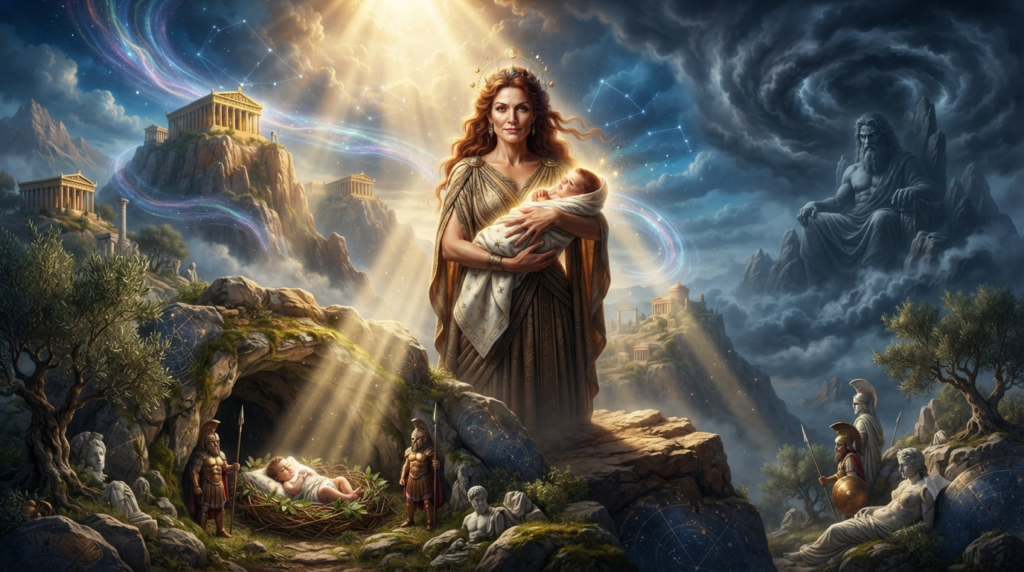
When Rhea became pregnant with Zeus, she made the decisive choice to travel to Crete, giving birth secretly on Mount Ida specifically to hide this final child from Cronus, representing the central action essential to fully understanding who is the mother of Zeus and her direct role in his ultimate survival.
Rhea then deceived Cronus by presenting him with a large stone wrapped in cloth, which he swallowed believing it to be his newest child, successfully protecting Zeus through this specific act of deception that allowed her son to survive completely undetected by his own father throughout his early life.
Various local nymphs and figures connected to Crete subsequently helped raise the young Zeus in secret, reflecting Rhea’s continued involvement in ensuring her son’s protection even after the initial successful deception, extending her protective role well beyond the singular moment of birth itself.
This combination of decisive planning, successful deception, and continued protective involvement establishes Rhea’s action as genuinely essential to who is the mother of Zeus, confirming that without her direct intervention, the entire subsequent narrative of Zeus’s rise to power could never have occurred at all.
Rhea’s Role After Zeus’s Rise to Power
Rhea’s earlier actions indirectly enabled the eventual liberation of her other children, as Zeus, having survived specifically because of her intervention, later returned to free his swallowed siblings, connecting Rhea’s initial protective action directly to the broader chain of events central to understanding who is the mother of Zeus and the Olympian order more broadly.
Following the Titanomachy, Rhea occupied a somewhat unusual position, neither punished alongside the Titans who directly fought against Zeus, nor elevated to the same prominent status held by the Olympian gods themselves, reflecting her complex position as both a Titan and the mother of the new ruling generation.
This relatively restrained presence within later Greek mythology stands in some contrast to other significant maternal figures, with Rhea’s mythology focusing primarily on this pivotal early narrative rather than extensive continued involvement throughout later stories involving her Olympian children and their subsequent adventures.
Understanding this specific narrative arc helps complete the picture of who is the mother of Zeus, confirming that while her most mythologically significant contribution occurred specifically during this early period, her decisive action remained permanently foundational to everything that followed within Greek Olympian mythology.
Rhea’s Connection to Cybele and Later Traditions
Rhea later became associated with Cybele, a mother goddess figure originating from Phrygian religious tradition, reflecting a significant syncretic connection that developed as Greek and Anatolian religious traditions increasingly intersected throughout the broader ancient Mediterranean world over subsequent centuries.
This connection between Rhea and Cybele reinforced and extended her established association with maternal protection and fertility, allowing her mythological significance to continue evolving well beyond her original, specific role within the earlier narrative addressing who is the mother of Zeus and his survival.
This broader syncretic tradition demonstrates how thoroughly Rhea’s core maternal symbolism resonated across different ancient Mediterranean religious traditions, extending her cultural significance considerably beyond the boundaries of strictly Greek mythological tradition alone into wider ancient religious practice.
This continued religious relevance reinforces that who is the mother of Zeus carries significance extending well beyond a single mythological narrative, connecting Rhea to broader, enduring patterns of maternal and protective symbolism found throughout ancient Mediterranean religious history more generally.
Why Rhea Matters Beyond Being “Zeus’s Mother”
Reducing Rhea’s significance purely to her relationship with Zeus understates her genuine mythological importance, since her specific, deliberate decision and decisive action represented an absolutely necessary precondition for the entire subsequent Olympian mythological order that followed her successful protection of her youngest son.
Without Rhea’s specific choice to deceive Cronus and protect Zeus in secret, the broader mythology of the Olympian gods as commonly understood today could never have developed, reinforcing that who is the mother of Zeus deserves recognition as a genuinely consequential, decisive mythological figure in her own right.
This recognition reframes Rhea from a purely relational figure, defined only through her connection to more famous children, into a genuinely significant actor whose specific choices directly shaped the entire subsequent trajectory of Greek mythology’s most central divine narrative and cosmic order.
Understanding who is the mother of Zeus, therefore, means recognizing Rhea’s own genuine mythological significance, appreciating her specific, deliberate actions as essential and foundational rather than incidental to the broader story of how the Olympian gods ultimately came to rule the Greek cosmos.
FAQ — Quick Answers About Zeus’s Mother
Who is the mother of Zeus?
Rhea is the mother of Zeus, a Titaness who saved him from being swallowed by his father, Cronus, by hiding him and deceiving Cronus with a stone.
Who was Rhea’s husband?
Rhea was married to Cronus, her brother among the Titans, before Zeus eventually overthrew his father during the Titanomachy.
How did Rhea save Zeus?
Rhea hid Zeus’s birth on Crete and tricked Cronus into swallowing a stone wrapped in cloth instead of their newborn son.
What happened to Rhea’s other children?
Cronus swallowed Rhea’s other children, Hestia, Demeter, Hera, Hades, and Poseidon, immediately after their births, until Zeus later freed them.
Is Rhea connected to any other goddesses?
Yes, Rhea later became associated with Cybele, a mother goddess from Phrygian religious tradition, reflecting broader ancient syncretic religious practice.
Conclusion
Anyone who sets out to answer who is the mother of Zeus finds Rhea, a Titaness whose decisive, courageous action directly enabled her son’s survival and, by extension, the entire subsequent rise of the Olympian gods. Her deception of Cronus and secret protection of Zeus on Crete represent one of Greek mythology’s most consequential maternal acts.
Beyond this pivotal moment, Rhea’s later association with Cybele and her complex position following the Titanomachy reveal a figure whose significance extends well beyond simply being Zeus’s mother, reflecting genuine, lasting maternal and protective symbolism throughout ancient Mediterranean religious tradition.
Ultimately, who is the mother of Zeus finds its fullest answer not just in identifying Rhea by name, but in recognizing her decisive action as the essential, foundational moment upon which the entire subsequent mythology of the Olympian gods was built.

Orin Vale has spent the better part of two decades tracing the threads that connect the world’s oldest stories — from the halls of Asgard to the banks of the Nile, from Olympus to the jungles of the Maya. What began as a childhood fascination with flood myths and trickster gods grew into years of independent study across comparative mythology and ancient religion, always chasing the same question: what did these stories mean to the people who first told them? Orin writes for readers who want more than trivia — the ones looking for the beliefs, fears, and truths that myths were built to carry.