Asopos, also spelled Asopus, occupies a genuinely distinctive place within Greek mythology as a river god whose personal story directly explains the naming and mythological origin of numerous significant cities and islands scattered across the ancient Greek world. Anyone asking who is the river god Asopos in Greek mythology is uncovering a figure whose remarkable family of daughters left a lasting geographical legacy extending far beyond his own individual mythological narrative.
Ancient Greek geography actually recognized two separate rivers bearing this same name, one flowing through the Peloponnese near Phlius and Sicyon, and another running through Boeotia in central Greece, a duplication that created genuine confusion even among ancient writers themselves attempting to document Asopos’s complete mythology. This geographic doubling directly shaped how different regional traditions developed distinct, sometimes conflicting accounts regarding his family and personal story.
Beyond this geographical complexity, Asopos achieved particular mythological significance through his role as father to numerous daughters, many of whom became the eponymous namesakes for real, historically significant Greek locations after being taken by various Olympian gods. This remarkable pattern connects Asopos’s personal mythology directly to the actual, lived geography ancient Greeks navigated throughout their daily lives.
What follows examines the two distinct rivers both bearing Asopos’s name, his marriage to the nymph Metope and their remarkable daughters, his dramatic confrontation with Zeus following the abduction of his daughter Aegina, the lasting physical consequence of this divine conflict, and the broader significance his many daughters hold for understanding ancient Greek geography.
Two Rivers, One Name: Asopus of the Peloponnese and Boeotia
Ancient Greek geography recognized Asopos as presiding over two genuinely distinct rivers, the first originating near the border between Sicyon, Arcadia, and Argos before flowing north past the towns of Phlius and Sicyon to eventually empty into the Corinthian Gulf. This particular river held considerable regional significance throughout the Peloponnesian landscape it traversed.
A second river bearing this identical name arose separately on Mount Cithaeron, flowing east through southern Boeotia before reaching the Aegean Sea directly opposite the island of Euboea. This entirely separate waterway, despite sharing Asopos’s name with its Peloponnesian counterpart, represented a genuinely distinct geographic feature with its own local traditions and significance.
This duplication created genuine, documented confusion among ancient Greek writers themselves, with the travel writer Pausanias specifically noting ongoing disputes regarding which particular Asopos certain daughters and myths properly belonged to, since the two river traditions frequently became mixed or conflated across different regional accounts. This confusion explains why ancient sources sometimes present notably different lists of Asopos’s daughters or varying details regarding his own parentage and family circumstances.
Understanding this geographic duality provides essential context for who is the river god Asopos in Greek mythology, revealing from the outset that his mythology developed somewhat differently across two separate regional traditions, both contributing to the broader, sometimes inconsistent picture ancient sources preserve regarding this significant river deity.
Asopus’s Marriage to Metope and His Many Daughters
Asopos married Metope, a naiad nymph specifically identified as daughter of Ladon, himself another significant river god within Greek mythological tradition. This union between two river-connected deities produced an extraordinarily large family, with ancient sources documenting anywhere from nine to twenty daughters depending on which particular regional tradition and source is consulted.
These numerous daughters achieved remarkable mythological significance specifically through their subsequent abduction by various Olympian gods, with each daughter typically becoming the eponymous namesake for a real, historically significant Greek location following her divine encounter. Zeus himself abducted several of these daughters, including Aegina, Thebe, and Plataea, each lending her name to locations that would become genuinely important throughout later Greek history.
Poseidon similarly claimed several of Asopos’s daughters, including Corcyra, Salamis, and Euboea, connecting the sea god’s own mythology directly to these significant island locations, while Apollo took Sinope and Thespia, and Hermes claimed Tanagra, distributing Asopos’s remarkable daughters across nearly the entire pantheon of major Olympian gods. This widespread divine interest in Asopos’s daughters reflects their exceptional collective beauty and desirability within ancient Greek mythological tradition.
This extensive family provides essential context for who is the river god Asopos in Greek mythology, establishing him as an unusually significant genealogical source within Greek mythology’s broader explanation of how numerous important cities and islands received their lasting names through these remarkable daughters and their various divine encounters.
The Abduction of Aegina and Asopus’s Pursuit of Zeus
Among Asopos’s many daughters, Aegina’s story provides the central, most consequential myth defining his own personal mythological narrative, beginning when Zeus abducted her and carried her away to a previously unnamed island that would eventually bear her own name. This abduction prompted Asopos to embark on a genuinely desperate search specifically attempting to locate and recover his missing daughter.
During this search, Asopos eventually encountered Sisyphus, the notoriously cunning king of Corinth, who had witnessed Zeus carrying Aegina away and agreed to reveal this crucial information, though only in exchange for a significant favor: Asopos would need to create a permanent, reliable spring specifically on Corinth’s acropolis. Asopos agreed to these terms, successfully producing the requested fountain before Sisyphus revealed Zeus’s identity as Aegina’s abductor.
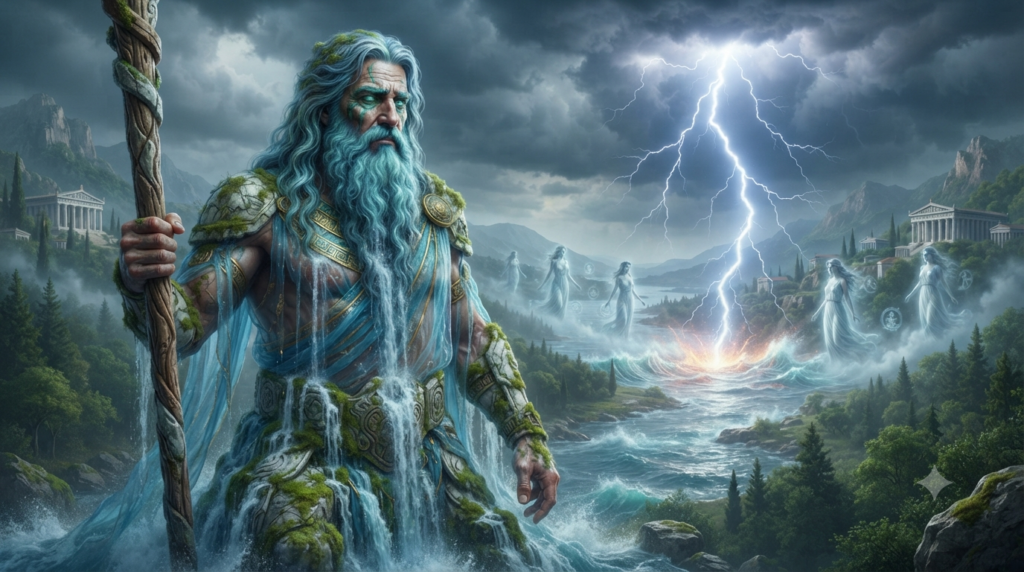
Armed with this knowledge, Asopos pursued Zeus directly, determined to confront the king of the gods and recover his stolen daughter through this direct confrontation. However, Zeus responded to this pursuit with characteristic decisive force, driving Asopos back through the terrifying power of his own thunderbolt, definitively ending any realistic possibility that the river god might successfully reclaim Aegina through direct confrontation with Olympian authority.
This dramatic confrontation provides the clearest and most historically significant answer to who is the river god Asopos in Greek mythology, establishing the central narrative defining his personal story: a father’s genuine, determined effort to protect his daughter, ultimately overwhelmed by the same kind of decisive divine power that shaped so many other mortal and lesser divine encounters with Zeus throughout Greek mythology.
The Lasting Mark of Zeus’s Thunderbolt
Zeus’s thunderbolt strike against Asopos carried genuine, lasting consequences extending well beyond this single dramatic confrontation, with ancient tradition specifically describing the river god as becoming permanently lame and flowing noticeably slower following this decisive divine punishment. This lasting physical transformation connected the mythological confrontation directly to the actual, observable character of the river itself.
This detail reflects a broader pattern common throughout Greek mythology, where significant divine confrontations frequently explained genuine, observable natural phenomena, giving ancient communities a meaningful narrative framework for understanding why particular rivers, landscapes, or natural features possessed their specific observed characteristics. Asopos’s altered flow following his confrontation with Zeus exemplifies this common mythological pattern.
Notably, ancient sources specifically applied this lasting consequence to both the Boeotian and Peloponnesian traditions surrounding Asopos, suggesting that despite the broader confusion between these two distinct rivers, this particular detail regarding the thunderbolt’s lasting physical impact remained consistently associated with Asopos’s mythology regardless of which specific regional tradition a given account followed.
This lasting transformation adds meaningful depth to who is the river god Asopos in Greek mythology, confirming that his confrontation with Zeus carried genuine, permanent consequences extending directly into the actual physical character ancient Greeks observed and experienced when encountering either river bearing his significant name.
Why Asopus’s Daughters Matter to Greek Geography
The remarkable pattern connecting Asopos’s numerous daughters to real, significant Greek locations reveals something genuinely important about how ancient Greek mythology functioned as a broader explanatory framework for understanding regional geography and civic origin. Rather than existing as isolated, disconnected stories, these myths collectively explained how numerous significant cities and islands throughout the Greek world received their lasting names.
This pattern positioned Asopos as an unusually significant genealogical figure within Greek mythology’s broader geographic imagination, since few other mythological figures could claim direct paternal connection to as many historically significant locations as Asopos achieved through his remarkable collection of daughters. This extensive geographic influence distinguished him meaningfully from river gods whose mythology remained more narrowly confined to their own immediate waterway.
This broader significance also illustrates how ancient Greek communities frequently used mythology specifically to explain and legitimize their own city’s origins, with claiming descent from one of Asopos’s daughters providing a meaningful, prestigious mythological foundation connecting a particular location directly to both a significant river deity and, through her subsequent divine abduction, to one of the major Olympian gods as well.
This geographic legacy completes a full answer to who is the river god Asopos in Greek mythology, confirming that his lasting significance rests substantially on this remarkable pattern of paternal connection to numerous real Greek locations, securing him genuine importance within Greek mythology’s broader function as an explanatory framework for regional geography and civic identity.
Frequently Asked Questions
Who were Asopus’s parents?
Ancient sources generally identify Asopos as the son of the Titans Oceanus and Tethys, connecting him to the broader family of river gods descended from this significant Titan union.
How many daughters did Asopus have?
Ancient sources vary considerably, with some accounts documenting nine daughters while others list as many as twenty, depending on which regional tradition is consulted.
What happened when Asopus confronted Zeus?
Zeus struck Asopos with a thunderbolt, forcing him to retreat and leaving him permanently lame with a noticeably slower flow thereafter.
Conclusion
Asopos stands as a genuinely significant river god within Greek mythology, his remarkable family of daughters directly explaining the mythological origins of numerous important cities and islands scattered throughout the ancient Greek world. From his dramatic, ultimately unsuccessful confrontation with Zeus following Aegina’s abduction to the lasting physical transformation this encounter produced, Asopos’s mythology reveals how thoroughly ancient Greek storytelling wove together questions of divine power, paternal devotion, and regional geographic origin within a single, remarkably influential river deity.

Orin Vale has spent the better part of two decades tracing the threads that connect the world’s oldest stories — from the halls of Asgard to the banks of the Nile, from Olympus to the jungles of the Maya. What began as a childhood fascination with flood myths and trickster gods grew into years of independent study across comparative mythology and ancient religion, always chasing the same question: what did these stories mean to the people who first told them? Orin writes for readers who want more than trivia — the ones looking for the beliefs, fears, and truths that myths were built to carry.