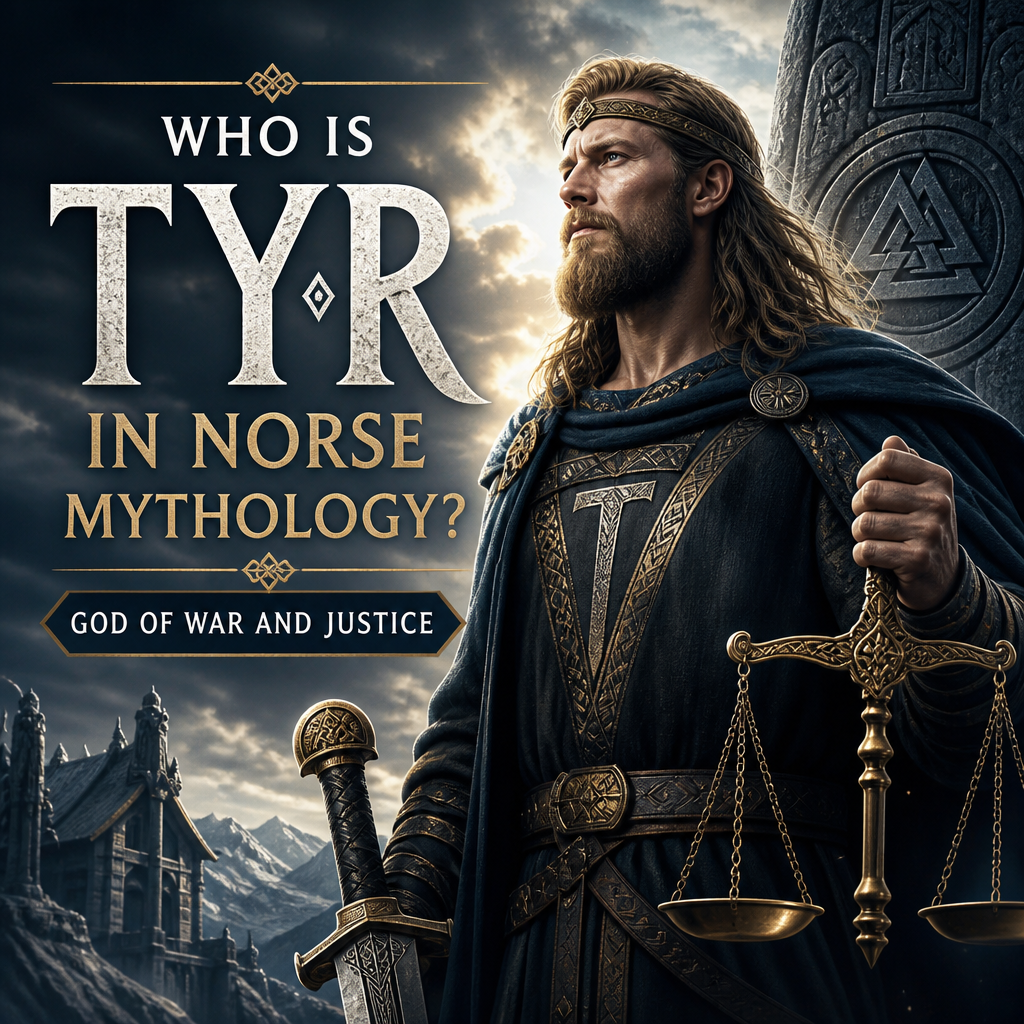
Who Is Tyr in Norse Mythology?
Tyr is one of the most important yet often overlooked gods in Norse mythology. Known for his bravery, honor, and connection to justice, Tyr stands apart from many of the more famous Norse gods such as Odin, Thor, and Loki. While he appears in fewer surviving myths, the stories that do feature him reveal a god deeply associated with sacrifice, courage, law, and the difficult choices required to maintain order.
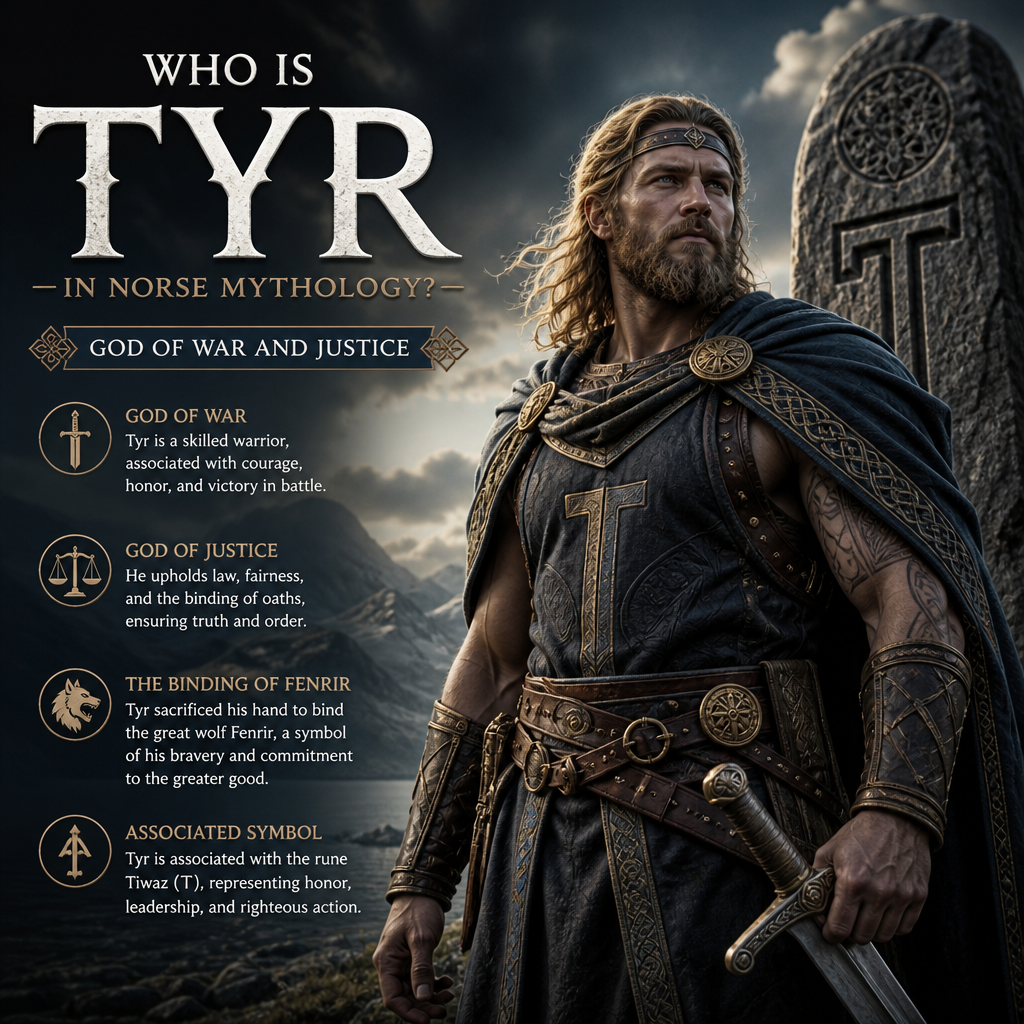
So, who is Tyr in Norse mythology? In simple terms, Tyr is a Norse god of war, justice, and heroic sacrifice. He is best remembered for losing his hand to the monstrous wolf Fenrir, an act that shows his willingness to suffer personal loss for the safety of the gods and the world.
Tyr’s Role Among the Norse Gods
Tyr belongs to the Aesir, the main family of gods in Norse mythology. The Aesir include figures such as Odin, Thor, Frigg, Baldr, and Heimdall. As a member of this divine group, Tyr is connected to war and leadership, but his character is more focused on fairness and duty than simple violence.
In Norse society, war was not only about strength. It was also tied to honor, oaths, laws, and reputation. Tyr seems to represent these more disciplined aspects of conflict. He is not portrayed as a wild or chaotic fighter. Instead, he is a god of order, courage, and responsibility.
Some scholars believe Tyr may once have been a much more prominent deity, possibly even a chief god before Odin became central in later Norse traditions. His name is related to ancient words for “god” and may connect him to older Indo-European sky gods. However, in the surviving Norse myths, Tyr’s role is more limited but still highly meaningful.
The Meaning of Tyr’s Name
Tyr’s name comes from Old Norse Týr, which is linked to the Proto-Germanic word Tiwaz. This older name is connected to ideas of divinity and the sky. The same root appears in the name of the Roman god Jupiter and the Greek god Zeus, suggesting a very ancient origin.
Tyr also gave his name to Tuesday. In Old English, Tuesday was “Tiw’s day,” named after the Germanic god Tiw, who is closely related to Tyr. This connection shows that Tyr was respected not only in Scandinavia but also among other Germanic peoples.
The fact that a weekday bears his name suggests that Tyr once held considerable importance, even if only a few myths about him have survived.
Tyr and the Binding of Fenrir
The most famous story about Tyr in Norse mythology is the binding of Fenrir, the great wolf. Fenrir was one of the terrifying children of Loki and the giantess Angrboda. The gods feared Fenrir because prophecies foretold that he would bring destruction during Ragnarok, the end of the world.
As Fenrir grew larger and stronger, the gods decided they had to restrain him. They tried to bind him with powerful chains, but Fenrir broke them easily. Finally, the dwarves created a magical ribbon called Gleipnir. Though it looked thin and delicate, it was impossible to break.
Fenrir was suspicious when the gods asked him to test the ribbon. He agreed only if one of them placed a hand in his mouth as a sign of good faith. None of the gods wanted to take the risk.
Tyr stepped forward.
He placed his hand in Fenrir’s jaws, knowing the wolf would likely bite it off if he could not escape. When Fenrir found himself trapped, he closed his mouth and severed Tyr’s hand. From that moment on, Tyr was known as the one-handed god.
What Tyr’s Sacrifice Represents
Tyr’s lost hand is one of the strongest symbols in Norse mythology. It represents more than physical bravery. His sacrifice reveals a deep commitment to duty and the greater good.
Tyr knew the gods were deceiving Fenrir. He also knew that someone had to pay the price for that deception. By offering his hand, Tyr accepted responsibility in a situation where no choice was completely pure or easy.
This makes Tyr a complex figure. He is not simply a warrior god who enjoys battle. He is a god who understands the cost of maintaining order. His courage is moral as well as physical.
Tyr’s sacrifice can be understood as a symbol of:
- Honor in the face of danger
- Responsibility for difficult decisions
- The protection of society from chaos
- The cost of justice and law
- Courage without personal reward
Because of this, Tyr remains one of the most respected gods in the Norse pantheon, even with relatively few myths attached to his name.
Tyr as a God of War and Justice
When people ask, “who is Tyr in Norse mythology,” the answer often includes the phrase “god of war.” This is true, but it does not tell the whole story. Tyr’s connection to war is closely tied to law, oaths, and honorable conduct.
Unlike Odin, who is associated with strategy, magic, and sometimes deception in war, Tyr represents a more straightforward and principled form of conflict. He is linked to bravery on the battlefield, but also to the rules that make social order possible.
In some ancient traditions, warriors may have invoked Tyr before battle. His rune, known as Tiwaz, is associated with victory, justice, and sacrifice. The rune resembles an upward-pointing arrow or spear and is often interpreted as a symbol of direction, discipline, and purposeful action.
Tyr at Ragnarok
Ragnarok is the final great battle in Norse mythology, where many gods meet their fate. Tyr plays a role in this apocalyptic event as well.
During Ragnarok, Tyr is said to fight Garm, a monstrous hound associated with the underworld and the forces of chaos. In the battle, Tyr and Garm kill each other. This ending fits Tyr’s character: he faces a deadly enemy directly and fulfills his role even at the cost of his life.
His death at Ragnarok reinforces the same themes found in the Fenrir myth. Tyr stands against chaos, accepts danger, and gives himself fully to the protection of cosmic order.
Why Tyr Still Matters
Tyr may not be as famous as Thor or Odin, but his story continues to resonate. In a mythology filled with powerful weapons, magical tricks, and dramatic conflicts, Tyr’s greatest act is one of quiet courage.
He does not defeat Fenrir in battle. He does not gain glory or treasure. Instead, he places his hand in the wolf’s mouth because someone must do what is necessary.
That is what makes Tyr memorable. He represents the kind of bravery that accepts consequences. He shows that justice and order often require sacrifice. In Norse mythology, Tyr is a reminder that true courage is not the absence of fear, but the willingness to act with honor when the cost is high.

Orin Vale has spent the better part of two decades tracing the threads that connect the world’s oldest stories — from the halls of Asgard to the banks of the Nile, from Olympus to the jungles of the Maya. What began as a childhood fascination with flood myths and trickster gods grew into years of independent study across comparative mythology and ancient religion, always chasing the same question: what did these stories mean to the people who first told them? Orin writes for readers who want more than trivia — the ones looking for the beliefs, fears, and truths that myths were built to carry.