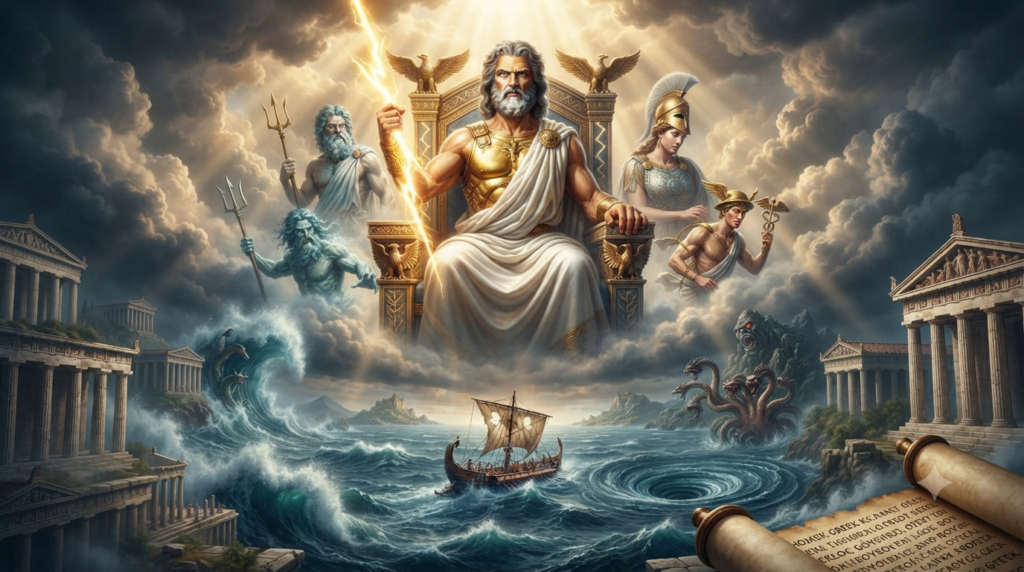
Anyone asking who is Zeus in the Odyssey discovers a figure whose authority pervades the entire epic even though his direct, active involvement in the plot remains comparatively restrained compared to other significant deities such as Athena and Poseidon. Within Homer’s Odyssey, Zeus functions primarily as the ultimate arbiter of divine justice and cosmic order, presiding over the gods’ deliberations and establishing the moral framework within which the entire narrative unfolds, even as more actively involved deities drive much of the story’s specific action and conflict. Understanding who is Zeus in the Odyssey requires examining both his structural authority over the epic’s broader moral universe and the specific, more limited scenes in which he directly appears or acts.
Zeus as the Arbiter of Divine Justice
Zeus’s opening speech within the Odyssey, addressing the fate of Aegisthus, establishes a crucial thematic foundation relevant to who is Zeus in the Odyssey, as he explicitly reflects on human responsibility and free will, arguing that mortals frequently bring suffering upon themselves through their own poor choices rather than purely through divine imposition.
This early speech positions Zeus as a genuinely reflective moral authority within the epic, distinguishing his characterization from a purely arbitrary or capricious divine ruler, instead presenting him as a figure genuinely concerned with justice, consequence, and the appropriate relationship between divine judgment and human moral agency throughout the broader narrative.
Beyond this specific opening reflection, Zeus consistently functions throughout the epic as a balancing figure among the gods, weighing competing divine interests and ultimately determining outcomes when conflicts arise among the Olympians regarding Odysseus’s fate and the broader unfolding of events throughout his long journey home.
This role as moral and judicial authority remains central to who is Zeus in the Odyssey, establishing him as the figure whose judgment ultimately matters most whenever significant questions of justice or cosmic order arise within the epic’s broader narrative structure.
Zeus and the Council of the Gods
Several pivotal moments within the Odyssey occur during councils of the gods, where Zeus presides over discussions determining significant aspects of Odysseus’s fate, providing essential scenes for understanding who is Zeus in the Odyssey through his specific role within these formal divine deliberations.
During these councils, Zeus frequently occupies a position of ultimate authority while still remaining genuinely open to persuasion, particularly from Athena, who consistently advocates on Odysseus’s behalf, illustrating a nuanced dynamic in which Zeus’s supreme power coexists with genuine responsiveness to compelling argument from other significant deities.
This balance between ultimate authority and genuine openness to persuasion distinguishes Zeus’s characterization within the Odyssey, presenting a ruler whose power remains absolute in final decision-making while still reflecting meaningful engagement with the perspectives and arguments offered by other members of the Olympian pantheon.
Understanding this dynamic proves essential to who is Zeus in the Odyssey, revealing a figure who governs through a combination of supreme authority and genuine deliberative engagement, rather than through purely unilateral or unquestioned divine command throughout the epic’s broader narrative.
Zeus, Athena, and Poseidon — A Balance of Power
Athena serves as Odysseus’s primary divine advocate throughout the Odyssey, repeatedly appealing directly to Zeus on his behalf, and understanding this relationship proves essential to who is Zeus in the Odyssey, since his willingness to ultimately grant her requests significantly shapes the epic’s overall narrative direction and outcome.
Poseidon, by contrast, functions as Odysseus’s primary divine antagonist, pursuing him with sustained hostility following Odysseus’s blinding of Poseidon’s son, the Cyclops Polyphemus, yet Poseidon’s power over Odysseus’s fate remains ultimately contained by Zeus’s superior authority throughout the broader epic narrative.
This dynamic between Athena’s advocacy and Poseidon’s antagonism illustrates Zeus’s specific function within the Odyssey: rarely intervening with direct, independent action himself, yet consistently serving as the essential authority whose final permission or judgment determines how these competing divine interests are ultimately resolved.
This positioning reinforces a significant aspect of who is Zeus in the Odyssey, demonstrating that his narrative importance lies less in direct personal action and more in his role as the essential authority whose judgment ultimately governs the outcomes shaped by other, more directly active Olympian gods throughout the story.
Zeus Xenios — Guardian of Hospitality
Zeus held a specific epithet, Xenios, reflecting his particular role as protector of hospitality, the sacred relationship between hosts and guests that carried significant religious and social weight throughout ancient Greek culture, adding an important additional dimension to who is Zeus in the Odyssey specifically.
This aspect of Zeus’s authority holds direct relevance to the Odyssey’s central plot, as Penelope’s suitors repeatedly and egregiously violate these sacred hospitality customs throughout their extended, unwelcome occupation of Odysseus’s household during his prolonged absence, creating significant moral tension addressed throughout the epic.
This connection between Zeus Xenios and the suitors’ behavior reinforces how Zeus’s specific divine authority connects directly to the epic’s broader moral and social commentary, using violations of sacred hospitality customs as a significant marker of the suitors’ moral failure deserving eventual consequence within the narrative.
This role as guardian of hospitality adds meaningful depth to who is Zeus in the Odyssey, demonstrating that his authority extended into specific social and religious customs directly relevant to the epic’s central narrative conflict, rather than remaining limited purely to abstract cosmic oversight alone.
Why Zeus’s Role Feels More Restrained Than Other Gods
Compared to his portrayal in other significant works such as Homer’s Iliad, Zeus’s role within the Odyssey feels notably more restrained, reflecting this epic’s distinct narrative focus on Odysseus’s personal journey rather than the large-scale divine conflict more prominently featured throughout Homer’s earlier epic.
This more restrained portrayal allows other significant deities, particularly Athena and Poseidon, to occupy considerably more active, direct narrative roles throughout the Odyssey, while Zeus maintains his position primarily through overarching authority rather than through frequent, direct personal intervention within specific plot events.
This distinction reflects a deliberate narrative choice relevant to who is Zeus in the Odyssey, positioning him as the essential, foundational authority underlying the entire epic’s moral and cosmic structure, while allowing more narratively active deities to drive the specific unfolding action Odysseus experiences throughout his journey.
Understanding this structural choice provides important final context for who is Zeus in the Odyssey, confirming that his comparatively limited direct action reflects deliberate narrative design rather than diminished significance, since his authority remains essential to the epic’s underlying moral and structural framework throughout.
FAQ — Quick Answers About Zeus in the Odyssey
Who is Zeus in the Odyssey?
Zeus serves as the ultimate authority and arbiter of divine justice throughout the Odyssey, presiding over the gods while remaining less directly active than deities like Athena or Poseidon.
What is Zeus’s opening speech about in the Odyssey?
Zeus’s opening speech addresses Aegisthus’s fate, reflecting on human responsibility and free will rather than purely blaming the gods for mortal suffering.
How does Zeus interact with Athena in the Odyssey?
Athena repeatedly appeals to Zeus on Odysseus’s behalf, and Zeus’s willingness to grant her requests significantly shapes the epic’s narrative direction.
What does “Zeus Xenios” mean?
Zeus Xenios refers to Zeus’s role as protector of hospitality, directly relevant to the suitors’ violation of these customs throughout the Odyssey.
Why does Zeus seem less active than other gods in the Odyssey?
Zeus’s role remains more structural and authoritative, allowing more narratively active deities like Athena and Poseidon to drive specific plot events.
Conclusion
Anyone who sets out to answer who is Zeus in the Odyssey finds a figure whose authority quietly underlies the entire epic, even as his direct involvement remains more limited than that of Athena or Poseidon. Through his opening reflection on justice, his presidency over divine councils, and his role as protector of hospitality, Zeus establishes the moral framework governing Odysseus’s entire journey.
This restrained yet essential portrayal distinguishes Zeus’s role in the Odyssey from his characterization in other significant works, reflecting a deliberate narrative choice that allows other deities to drive the story’s specific action while Zeus maintains ultimate authority over its outcomes.
Ultimately, who is Zeus in the Odyssey finds its clearest answer in recognizing him as the epic’s foundational moral authority, whose judgment, though rarely exercised through direct action, remains essential to understanding the story’s broader themes of justice, consequence, and rightful order.

Orin Vale has spent the better part of two decades tracing the threads that connect the world’s oldest stories — from the halls of Asgard to the banks of the Nile, from Olympus to the jungles of the Maya. What began as a childhood fascination with flood myths and trickster gods grew into years of independent study across comparative mythology and ancient religion, always chasing the same question: what did these stories mean to the people who first told them? Orin writes for readers who want more than trivia — the ones looking for the beliefs, fears, and truths that myths were built to carry.