Anyone asking who is Zeus’s enemy arrives at a single, consistently cited answer within Greek mythology: Typhon, a monstrous being created specifically to challenge Zeus’s authority and, according to several ancient sources, the only adversary who genuinely threatened to overthrow him after his victory over the Titans. While Zeus faced numerous rivals and conflicts throughout Greek mythology, Typhon stands apart as his most direct and dangerous enemy, embodying primordial chaos itself in direct opposition to the cosmic order Zeus had only recently established. Understanding who is Zeus’s enemy requires examining Typhon’s origin, the dramatic battle between these two forces, and why this particular confrontation remains so significant within the broader structure of Greek mythology.
Typhon — Born to Challenge Zeus
Typhon was born specifically as the offspring of Gaia and Tartarus, created deliberately in response to Zeus’s earlier defeat of the Titans, reflecting Gaia’s continued anger and desire for vengeance regarding how Zeus had treated her earlier Titan children following the Titanomachy. This origin story establishes Typhon’s creation as intentional retribution central to who is Zeus’s enemy within Greek mythological tradition.
This motivation reveals that Typhon’s conflict with Zeus was never accidental or incidental, but rather a deliberately orchestrated challenge, born from genuine cosmic grievance and specifically designed to threaten the newly established Olympian order that Zeus had only recently secured through his own prior struggle against Cronus and the Titans.
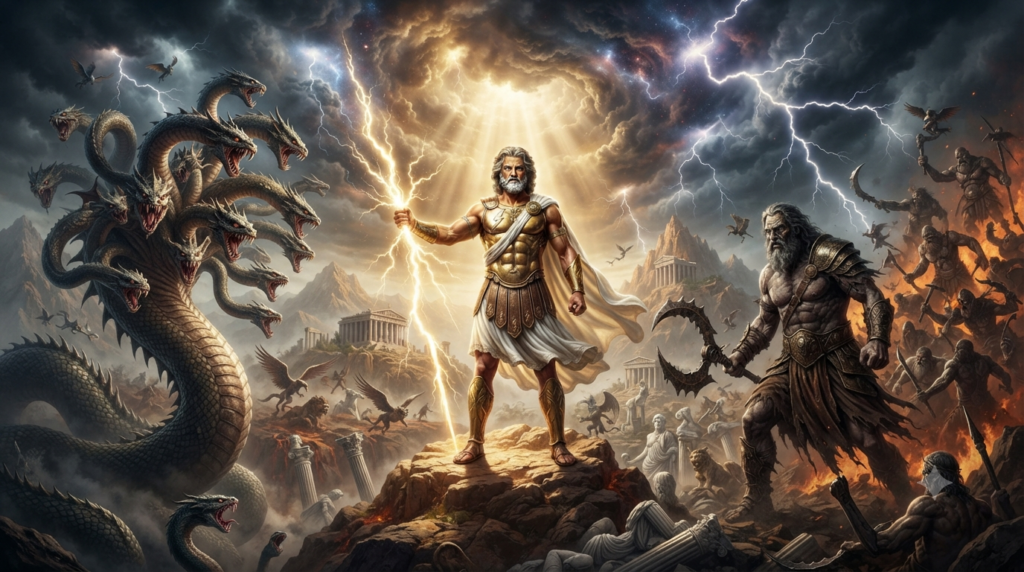
Ancient sources describe Typhon in genuinely monstrous terms, depicting a creature of overwhelming scale, with a hundred serpent heads emerging from his shoulders, breathing fire, and producing terrifying sounds capable of instilling genuine fear throughout the cosmos, reinforcing why Typhon represents such a significant answer to who is Zeus’s enemy specifically.
This combination of deliberate origin and overwhelming physical description establishes Typhon as fundamentally different from Zeus’s earlier conflicts, representing a genuinely personal and existential threat rather than simply another chapter in the broader generational struggle for cosmic authority among the Greek gods.
The Battle Between Zeus and Typhon
According to ancient accounts, Typhon’s overwhelming power initially caused even the Olympian gods to flee in genuine fear, with several deities reportedly transforming into animals and scattering rather than immediately confronting this terrifying new threat, illustrating the genuine severity of danger Typhon posed when addressing who is Zeus’s enemy.
Zeus himself ultimately confronted Typhon directly, and several ancient sources describe moments during this battle when Zeus appeared genuinely close to defeat, including accounts in which Typhon temporarily disabled Zeus, reflecting a level of danger unmatched by any other single adversary Zeus faced throughout the broader scope of Greek mythology.
This battle ultimately turned in Zeus’s favor through his decisive use of the thunderbolt, the same weapon forged by the Cyclopes that had earlier proven essential to his victory in the Titanomachy, reinforcing this weapon’s continued significance as Zeus’s primary tool for overcoming even his most formidable enemies.
This dramatic, genuinely uncertain confrontation reinforces why Typhon remains the clearest answer to who is Zeus’s enemy, representing the one documented conflict in which Zeus’s ultimate victory was not simply assumed, but genuinely contested through a battle ancient sources describe with unusual dramatic intensity.
Typhon’s Defeat and Imprisonment
Following his eventual defeat, Typhon was imprisoned beneath Mount Etna in Sicily, a punishment that permanently restrained this significant threat while providing a lasting, geographically specific consequence tied directly to Zeus’s ultimate victory over the being most consistently identified when addressing who is Zeus’s enemy.
This imprisonment carried significant symbolic and explanatory weight within ancient Greek mythological tradition, as Mount Etna’s ongoing volcanic activity became directly associated with Typhon’s continued struggle and anger beneath the mountain, providing a mythological explanation for observable volcanic phenomena within the surrounding region.
This connection between Typhon’s imprisonment and Mount Etna’s volcanic activity demonstrates how thoroughly this particular myth became integrated into broader ancient Greek understanding of the natural world, transforming who is Zeus’s enemy from a purely narrative question into one with direct, observable connection to genuine geological phenomena.
This lasting imprisonment, rather than complete destruction, reinforces the genuine severity ancient Greek mythology attributed to Typhon’s threat, suggesting that even in defeat, this particular enemy required permanent, ongoing containment rather than simple, final elimination from the broader cosmic order.
Other Notable Rivals of Zeus
Cronus and the broader generation of Titans represent an earlier, significant category of adversaries relevant to any broader discussion of who is Zeus’s enemy, having ruled the cosmos before Zeus’s eventual victory during the Titanomachy established Olympian authority in their place.
The Giants, opponents faced during a separate significant conflict known as the Gigantomachy, represent another notable challenge to Olympian authority, testing Zeus and the broader Olympian pantheon in a conflict distinct from, though thematically related to, his earlier struggles against both the Titans and Typhon specifically.
Despite these additional significant conflicts, Typhon remains the figure most consistently and specifically identified when addressing who is Zeus’s enemy directly, reflecting the uniquely personal and existential nature of this particular confrontation compared to the broader generational conflicts involving the Titans and Giants.
This distinction matters significantly for accurately answering who is Zeus’s enemy, since while Zeus certainly faced multiple significant adversaries throughout Greek mythology, Typhon alone represents a threat specifically and deliberately created to challenge Zeus’s personal authority following his already-established victory over the previous generation of divine rulers.
Why Typhon Remains Zeus’s Defining Enemy
Typhon’s battle against Zeus represents the singular instance within Greek mythology where Zeus’s supremacy was genuinely, seriously threatened after his initial victory over the Titans, distinguishing this conflict from later challenges that never came as close to actually overturning established Olympian authority.
Beyond the immediate narrative danger, Typhon symbolizes primordial chaos directly confronting the cosmic order Zeus had only recently established, reinforcing broader mythological themes regarding the ongoing tension between chaos and order that appears consistently throughout Greek cosmological and mythological tradition more generally.
This combination of genuine narrative danger and powerful symbolic meaning explains why Typhon consistently emerges as the answer to who is Zeus’s enemy, representing far more than a simple obstacle overcome, but rather a genuinely significant test of whether the newly established Olympian order could successfully withstand direct, existential challenge.
Understanding this symbolic dimension enriches why is Zeus’s enemy finds its clearest answer in Typhon specifically, confirming that this particular confrontation carries meaning extending well beyond simple narrative conflict into the broader thematic structure underlying Greek mythology’s exploration of order, chaos, and cosmic authority.
FAQ — Quick Answers About Zeus’s Enemy
Who is Zeus’s enemy?
Typhon is most consistently identified as Zeus’s greatest enemy, a monstrous being created by Gaia specifically to challenge his authority after the Titanomachy.
Why was Typhon created?
Typhon was created by Gaia and Tartarus specifically in response to Zeus’s treatment of the Titans following his earlier victory over them.
Did Zeus almost lose to Typhon?
Yes, several ancient sources describe moments when Typhon nearly defeated Zeus before he ultimately won using his thunderbolt.
What happened to Typhon after his defeat?
Typhon was imprisoned beneath Mount Etna in Sicily, with the mountain’s volcanic activity later associated with his continued struggle.
Are the Titans also considered Zeus’s enemies?
Yes, though the Titans represent an earlier generational conflict, while Typhon represents a more personal, direct challenge to Zeus’s established authority specifically.
Conclusion
Anyone who sets out to answer who is Zeus’s enemy arrives at Typhon, a monstrous being deliberately created to challenge Zeus’s authority following his earlier victory over the Titans. Their battle stands apart as the one confrontation in which Zeus’s supremacy genuinely hung in the balance, ultimately resolved only through the decisive use of his thunderbolt.
Typhon’s imprisonment beneath Mount Etna, connected directly to the mountain’s ongoing volcanic activity, reinforces this myth’s lasting significance within Greek mythological and natural understanding, while other conflicts involving the Titans and Giants remain comparatively less personal and existential in nature.
Ultimately, who is Zeus’s enemy finds its most compelling and consistent answer in Typhon, a figure whose battle against Zeus represents Greek mythology’s most vivid exploration of the ongoing tension between primordial chaos and the cosmic order Zeus fought so decisively to establish and maintain.

Orin Vale has spent the better part of two decades tracing the threads that connect the world’s oldest stories — from the halls of Asgard to the banks of the Nile, from Olympus to the jungles of the Maya. What began as a childhood fascination with flood myths and trickster gods grew into years of independent study across comparative mythology and ancient religion, always chasing the same question: what did these stories mean to the people who first told them? Orin writes for readers who want more than trivia — the ones looking for the beliefs, fears, and truths that myths were built to carry.