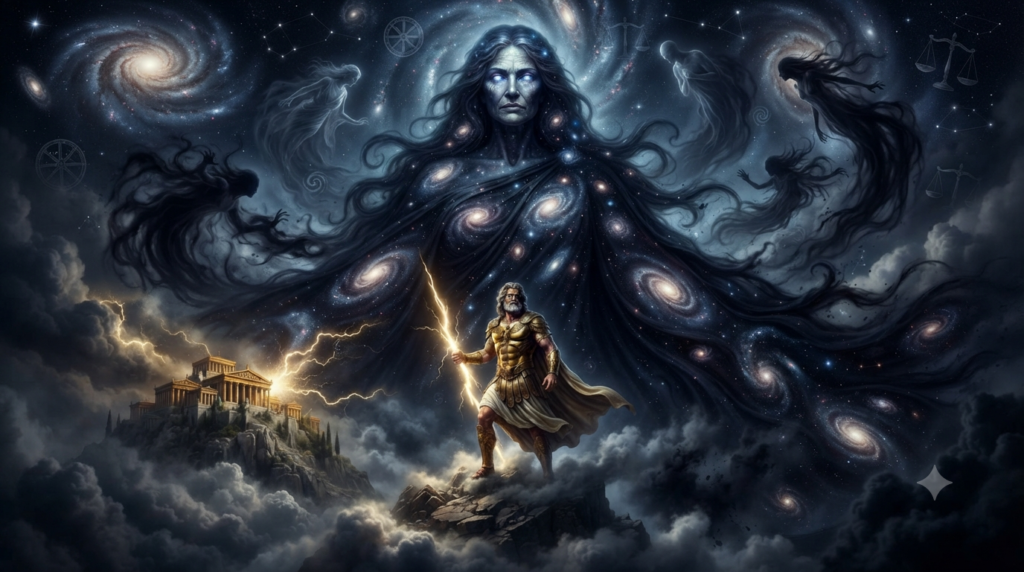
Anyone asking why is Zeus afraid of Nyx encounters one of Greek mythology’s more surprising details, found within a specific episode of Homer’s Iliad, in which Zeus, despite his position as supreme ruler of the gods, deliberately avoided confronting Nyx, the primordial goddess of Night, even while genuinely furious with her son. This moment offers a rare and genuinely striking glimpse into the limits of Zeus’s otherwise near-total authority, revealing that certain primordial forces within Greek cosmology occupied a category of respect and caution that even the king of the gods was unwilling to challenge directly. Understanding why is Zeus afraid of Nyx requires examining both who Nyx actually was within Greek cosmology and the specific narrative episode from the Iliad that gave rise to this particularly revealing moment of divine restraint.
Who Is Nyx?
Nyx represents one of the primordial deities within Greek mythology, personifying Night itself and standing among the very earliest generation of cosmic entities that emerged directly from Chaos, predating even the Titans within the broader structure of Greek cosmological tradition relevant to why is Zeus afraid of Nyx.
This primordial origin distinguishes Nyx significantly from the more commonly discussed Olympian and Titan generations of deities, positioning her within an even older, more fundamental category of cosmic forces that existed before the more personality-driven, narratively active gods that dominate most familiar Greek mythological storytelling.
Nyx occupied a genuinely unique position within Greek cosmology, neither a Titan nor an Olympian, but rather a foundational cosmic force whose significance predated and, in certain specific ways, exceeded the more commonly recognized divine hierarchy that Zeus himself presided over as king of the Olympian gods specifically.
Understanding this primordial status provides essential context for why is Zeus afraid of Nyx, establishing that her position within Greek cosmology existed somewhat outside the conventional divine hierarchy that Zeus otherwise dominated, explaining why even he approached her with a notably different degree of caution.
The Episode — Hypnos, Hera, and the Trick on Zeus
The specific episode addressing why is Zeus afraid of Nyx appears within Homer’s Iliad, occurring during the Trojan War when Hera sought to distract Zeus specifically to allow the Greek forces to gain advantage on the battlefield without his direct divine interference in the ongoing conflict.
To accomplish this distraction, Hera enlisted Hypnos, the god of Sleep and one of Nyx’s own children, specifically tasking him with putting Zeus to sleep, allowing Hera the necessary window to act without Zeus’s watchful attention temporarily focused elsewhere during this crucial moment of the war.
Hypnos initially expressed significant reluctance to fulfill this request, recalling a previous occasion when he had similarly assisted Hera and nearly faced severe consequences from an enraged Zeus, establishing important narrative context for why is Zeus afraid of Nyx through this earlier, closely related incident involving her son specifically.
This reluctance and the surrounding narrative details set the stage for the specific moment addressing why is Zeus afraid of Nyx, establishing the genuine risk Hypnos perceived in potentially angering Zeus once again through this particular request from Hera.
Why Zeus Backed Down
According to this earlier incident referenced within the Iliad, Hypnos had previously escaped Zeus’s anger specifically by fleeing to Nyx for protection, and Zeus, despite his fury, ultimately chose not to pursue the matter further, directly addressing why is Zeus afraid of Nyx through this specific act of divine restraint.
Homer’s text explicitly indicates that Zeus held back specifically because he did not wish to offend swift Night, providing direct textual evidence answering why is Zeus afraid of Nyx: a deliberate, conscious choice to avoid confrontation with this particular primordial goddess despite his otherwise supreme authority among the gods.
This restraint stands in genuine contrast to Zeus’s typical portrayal throughout Greek mythology as an authority rarely constrained by fear of any other figure, making this specific moment addressing why is Zeus afraid of Nyx particularly notable for revealing a genuine, explicitly acknowledged limit to his otherwise dominant divine power.
This textual detail from Homer provides the clearest, most direct answer available to why is Zeus afraid of Nyx, confirming that this restraint reflected genuine, deliberate caution rather than incidental circumstance, reinforcing Nyx’s uniquely respected position within the broader Greek cosmological hierarchy.
What This Reveals About the Limits of Zeus’s Power
This episode significantly complicates the more commonly emphasized image of Zeus as an essentially unquestioned, supreme cosmic authority, revealing instead that certain primordial forces existed largely outside his conventional sphere of dominance, directly relevant to understanding why is Zeus afraid of Nyx within the broader structure of Greek mythology.
This detail reinforces that certain foundational cosmic forces, including Chaos and Night specifically, occupied a genuinely distinct category within Greek cosmology, existing in a position that even Zeus’s otherwise extensive authority did not fully or comfortably extend to challenge directly without hesitation.
Nyx’s example demonstrates that Greek divine hierarchy was not entirely strict or uniformly vertical, with certain primordial figures maintaining a form of respected independence that persisted even after the Olympian gods, led by Zeus, had otherwise established their dominant position throughout the broader Greek cosmological order.
Recognizing this nuance enriches why is Zeus afraid of Nyx as a broader mythological question, illustrating that Greek cosmology contained genuine complexity regarding power and authority, rather than presenting an entirely simple, uniform hierarchy with Zeus positioned unquestionably above every other cosmic force without exception.
Nyx’s Broader Significance in Greek Mythology
Nyx was mother to numerous significant figures within Greek mythology, including Hypnos, Thanatos representing Death, and Eris representing Discord, reflecting her foundational connection to some of the most significant and consequential forces addressed throughout broader Greek mythological tradition.
This extensive and significant family connects directly to why is Zeus afraid of Nyx, since her position as mother to such consequential cosmic forces reinforces her own considerable, foundational significance within Greek cosmology, independent of her specific relationship to the more prominently featured Olympian gods themselves.
Despite this significant mythological weight, Nyx maintains a relatively understated, quiet presence throughout most Greek mythological storytelling, appearing infrequently in direct narrative action while nonetheless retaining consistent, implicit respect from other deities, including Zeus, whenever she does specifically appear within the broader tradition.
This combination of significant underlying importance and relatively restrained direct narrative presence makes why is Zeus afraid of Nyx a particularly interesting detail for those exploring Greek mythology more deeply, revealing meaningful complexity often overlooked within more surface-level engagement with Greek cosmological tradition.
Why This Detail Still Fascinates Readers Today
Modern readers and scholars continue finding genuine fascination in why is Zeus afraid of Nyx, precisely because this detail complicates the more simplified, commonly circulated image of Zeus as an essentially unchallenged, all-powerful cosmic ruler throughout Greek mythology more broadly.
This particular episode offers a compelling entry point for exploring the more nuanced, layered structure of Greek cosmological hierarchy, encouraging readers to look beyond Zeus’s more commonly emphasized dominant role and consider the genuine complexity present within the broader primordial and cosmic structure underlying Greek mythology.
This continued interest reflects a broader pattern in how contemporary audiences engage with Greek mythology, often drawn specifically to these lesser-known but genuinely revealing details that add meaningful depth and complexity to more commonly known mythological narratives and figures.
This lasting fascination confirms that why is Zeus afraid of Nyx remains a genuinely compelling question for modern readers, offering valuable insight into the more nuanced structure of Greek cosmology well beyond Zeus’s more commonly emphasized position as unchallenged supreme ruler.
FAQ — Quick Answers About Zeus and Nyx
Why is Zeus afraid of Nyx?
Zeus avoided angering Nyx because she was a primordial goddess whose cosmic significance predated even the Titans, making her a figure even Zeus approached with caution.
What is the episode involving Zeus and Nyx?
In Homer’s Iliad, Zeus refrains from punishing Hypnos, Nyx’s son, after Hypnos flees to her protection, choosing not to risk offending Night itself.
Who is Nyx in Greek mythology?
Nyx is the primordial goddess personifying Night, born directly from Chaos, predating the Titans and Olympian gods within Greek cosmology.
Who are some of Nyx’s children?
Nyx is the mother of several significant figures, including Hypnos (Sleep), Thanatos (Death), and Eris (Discord).
Does this mean Zeus wasn’t truly the most powerful god?
Not exactly; Zeus remained the dominant Olympian authority, but this episode shows certain primordial forces existed outside his typical sphere of control.
Conclusion
Anyone who sets out to answer why is Zeus afraid of Nyx discovers a genuinely revealing episode from Homer’s Iliad, in which even the king of the gods chose restraint rather than risk offending this primordial goddess of Night. This moment complicates the more familiar image of Zeus as an essentially unchallenged supreme authority throughout Greek mythology.
Nyx’s origin directly from Chaos, her position predating the Titans, and her significant connection to consequential figures like Hypnos and Thanatos together reinforce why this particular restraint carried genuine mythological weight rather than representing simple narrative coincidence within Homer’s broader epic.
Ultimately, why is Zeus afraid of Nyx offers a compelling reminder that Greek cosmology contained genuine complexity and nuance, revealing that even Zeus recognized certain primordial forces as existing meaningfully beyond his otherwise extensive and dominant divine authority.

Orin Vale has spent the better part of two decades tracing the threads that connect the world’s oldest stories — from the halls of Asgard to the banks of the Nile, from Olympus to the jungles of the Maya. What began as a childhood fascination with flood myths and trickster gods grew into years of independent study across comparative mythology and ancient religion, always chasing the same question: what did these stories mean to the people who first told them? Orin writes for readers who want more than trivia — the ones looking for the beliefs, fears, and truths that myths were built to carry.