Few episodes in Greek mythology capture the raw power of a vengeful god as vividly as the storm Poseidon unleashes against Odysseus in Homer’s Odyssey. The question of when did Poseidon almost kill Odysseus has a precise answer within the epic: it happens in Book Five, during the hero’s solitary voyage away from the island of Calypso. This is not a metaphorical brush with danger but a direct, deliberate act of divine violence, aimed squarely at ending Odysseus’s journey home before it truly begins.
To understand this moment, it helps to remember where Odysseus stands at this point in the story. He has already survived the Cyclops Polyphemus, the witch Circe, and the deadly temptations of the Sirens, yet none of these trials compare to the sheer scale of what Poseidon summons against him at sea. The god of the sea does not send a monster or a rival hero; he commands the ocean itself, turning wind and wave into a weapon meant to drown the one man who has escaped his grasp for years.
This episode matters because it is the clearest demonstration in the entire Odyssey of Poseidon’s personal, undisguised hostility toward Odysseus. Earlier setbacks in the hero’s journey are often indirect, filtered through monsters, temptresses, or misfortune. Here, there is no intermediary. Poseidon acts alone, in full view, using his mastery over the sea to bring Odysseus as close to death as he ever comes in the poem.
What follows is a detailed account of exactly when Poseidon almost killed Odysseus, the forces that intervened to save him, and why this single storm stands as the turning point in the long rivalry between a mortal hero and an Olympian god who refuses to forgive him.
Setting the Scene: Odysseus Leaves Ogygia
Before the storm arrives, Odysseus spends seven years trapped on the island of Ogygia, held there by the nymph Calypso, who wishes to keep him as her companion forever. Only the direct intervention of Zeus, delivered through the messenger god Hermes, forces Calypso to release him. Reluctantly, she helps him build a raft from the island’s timber, providing him with tools, supplies, and a favorable wind to begin his voyage home to Ithaca.
For seventeen days, Odysseus sails this modest vessel across open water, guided by the stars and by Calypso’s instructions to keep the constellation of the Great Bear on his left. The sea remains calm throughout this stretch of the journey, and Odysseus manages his small craft with the skill of a man who has spent a lifetime among ships and sailors. There is no indication yet of the danger building far away, beyond his sight, where Poseidon is completing an unrelated visit to the Ethiopians.
By the eighteenth day, Odysseus finally sights land: the shadowy outline of the Phaeacian coastline, known in the poem as Scheria. After nearly two decades away from home, and years stranded on Calypso’s island, this glimpse of land represents his first real proximity to freedom. It is precisely at this moment of hope, just as rescue seems within reach, that the situation turns catastrophic.
This timing is essential to understanding when Poseidon almost killed Odysseus. The god does not strike during the hero’s most vulnerable early days at sea, when a wrecked raft would have left him with nowhere to go. Instead, Poseidon’s fury erupts just as Odysseus draws near safety, transforming a near-triumphant moment into the most dangerous encounter of his entire voyage home.
When Did Poseidon Almost Kill Odysseus? The Storm in Book Five
The exact moment Poseidon almost kills Odysseus occurs as the sea god returns from the land of the Ethiopians, high in the mountains, and happens to look out across the water below. From this vantage point, he spots the raft carrying Odysseus, now visibly close to the Phaeacian shore. Recognizing the man he has hunted since the blinding of his son Polyphemus, Poseidon reacts with immediate and overwhelming fury.
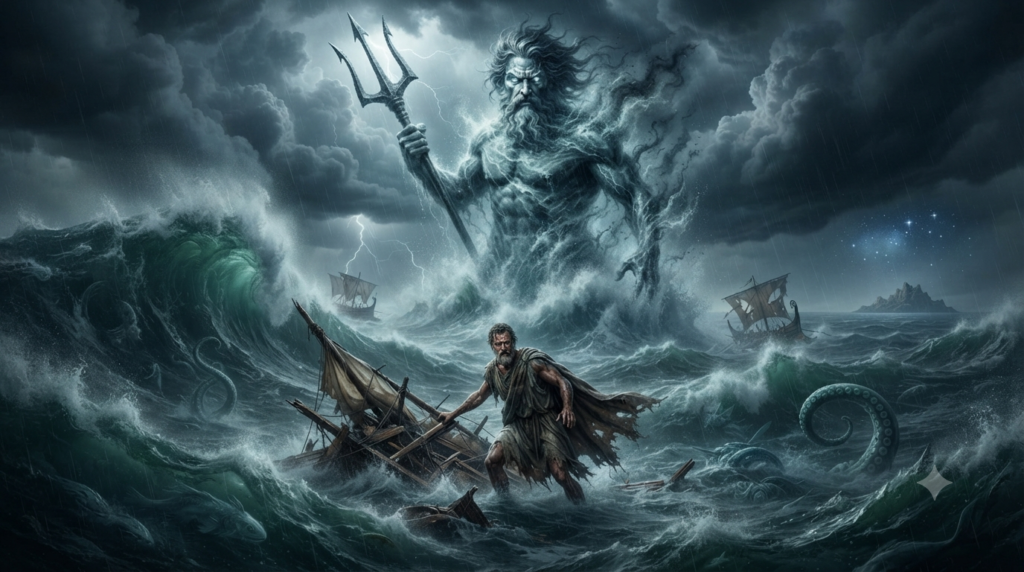
Rather than approaching Odysseus directly, Poseidon channels his anger through the elements themselves. He gathers storm clouds with his trident, darkens the sky, and stirs the sea into chaos, calling forth the winds Boreas, Notos, Zephyros, and Euros to converge on the same point at once. This deliberate combination of opposing winds is what generates the storm’s extraordinary violence, since the winds do not simply blow together but collide, twisting the sea into unpredictable, crushing waves.
Caught directly in the center of this convergence, Odysseus’s raft has no chance of holding together. The mast snaps, the sail tears loose, and the vessel that has carried him safely for seventeen days is shattered within moments, leaving him thrown into the open sea with nothing but broken timber to cling to. Homer describes Odysseus’s own recognition, in this instant, that death may finally be catching up to him after so many years of narrow escapes.
This is the precise scene that answers when did Poseidon almost kill Odysseus: not through a monster, a trap, or a rival’s blade, but through the god’s direct command over wind and wave, deployed with the specific intent of drowning him within sight of the shore that could have saved him. It stands as the most physically dangerous moment Odysseus faces in the entire poem, and the closest Poseidon ever comes to succeeding in ending his life.
Why Poseidon Struck: The Root of His Anger
The fury Poseidon unleashes in Book Five does not appear out of nowhere; it stems from an injury inflicted years earlier, when Odysseus blinded the Cyclops Polyphemus during his escape from the monster’s cave. Polyphemus, revealed in the poem as Poseidon’s own son, calls upon his father immediately after the injury, praying not simply for revenge but for a specific and lasting curse against the man responsible.
In that prayer, Polyphemus asks Poseidon to ensure that if Odysseus is fated to reach home, he does so late, having lost all his companions, arriving on a foreign ship, and finding nothing but trouble waiting for him there. Poseidon, unable to override the fate that guarantees Odysseus will eventually return to Ithaca, instead commits himself to making that return as slow, costly, and painful as possible.
The storm in Book Five represents the most direct expression of this commitment, since Poseidon cannot kill Odysseus outright without violating the boundaries fate has set, yet he can bring him to the very edge of death, strip him of any remaining resources, and prolong his suffering as much as divine law allows. Every shipwreck, delay, and loss Odysseus experiences after Polyphemus’s curse traces back to this single moment of paternal fury.
Understanding this motivation is essential to understanding the storm itself, since it explains why Poseidon’s anger here feels personal rather than incidental. This is not a god acting on a passing whim but one honoring a promise made to his own son, and the near-fatal storm in Book Five is the closest he ever comes to fulfilling that promise in full.
The Goddess Who Saved Him: Ino’s Veil
As Odysseus struggles against the waves, exhausted and on the verge of drowning, an unexpected ally intervenes: the sea goddess Ino, also known by the name Leucothea, a former mortal woman transformed into a divine spirit of the sea. Taking pity on Odysseus in his desperate state, she rises from the water in the form of a seabird and speaks directly to him amid the chaos of the storm.
Ino instructs Odysseus to abandon what remains of his raft entirely, recognizing that clinging to broken timber will only prolong his exposure to Poseidon’s wrath rather than protect him from it. She offers him her own magical veil, instructing him to wrap it around his chest and swim for the Phaeacian shore, promising that the veil will keep him safe from drowning as long as he trusts it and discards it once he reaches land.
This intervention is significant because it introduces a counterforce to Poseidon’s fury at the exact moment Odysseus needs it most. Ino’s status as a sea deity herself gives her particular authority in these waters, allowing her to offer protection within the same domain Poseidon is using as his weapon. Her appearance marks the turning point in the storm sequence, shifting the narrative from certain destruction toward the possibility of survival.
Odysseus, cautious even in crisis, hesitates briefly before accepting her gift, wary of divine tricks after so many years of hardship. Ultimately, he follows her instructions, releasing his grip on the ruined raft and entrusting himself to the veil, a decision that proves critical to his survival through the remainder of the storm.
Athena’s Counter-Intervention
While Ino offers Odysseus a direct means of physical protection, it is Athena, his most consistent divine ally throughout the epic, who works to limit the broader scope of Poseidon’s assault. Watching events unfold, Athena chooses not to confront Poseidon directly, since a direct clash between two Olympians would violate the careful balance the gods maintain among themselves, but she acts within the boundaries available to her.
Athena calms several of the winds Poseidon has summoned, holding back all but one so that Odysseus faces a survivable, if still dangerous, sea rather than the full, unrestrained fury the god of the sea originally intended. This selective intervention does not eliminate the danger Odysseus faces, but it narrows the odds just enough to make his survival possible rather than certain death against impossible conditions.
This pattern reflects the broader relationship between Athena and Poseidon throughout Greek mythology, where the goddess repeatedly works around her uncle’s authority rather than against it outright, protecting her favored mortals through careful, indirect means. Her involvement in this storm reinforces her role as Odysseus’s protector, a role she maintains from the opening lines of the epic through his eventual homecoming.
Together, Ino’s veil and Athena’s restraint of the winds form a dual layer of protection that allows Odysseus to survive an assault that would otherwise have been fatal. Without either intervention, the answer to when did Poseidon almost kill Odysseus might instead have been the answer to when Poseidon succeeded, making this combination of divine aid essential to the outcome of the entire epic.
Two Days and Nights Adrift: The Physical Ordeal
Even with Ino’s veil and Athena’s calming of the winds, Odysseus’s survival is far from guaranteed, and the physical toll of what follows is immense. He spends two full days and two nights swimming through open water, with no raft, no visible shore for long stretches, and no certainty that his strength will hold out long enough to reach land at all.
Homer emphasizes the sheer exhaustion of this ordeal, describing Odysseus’s body wearing down under the strain of continuous swimming against a sea that, even calmed, remains far from gentle. This extended struggle stands in contrast to the swift violence of the storm itself, transforming the danger from a single dramatic moment into a prolonged test of endurance that pushes Odysseus to his physical limits.
Throughout this period, Odysseus’s famed resourcefulness gives way to something closer to pure survival instinct, since there is little strategy available to him beyond continuing to swim and trusting in the protection Ino has offered. This vulnerability marks a rare moment in the epic where Odysseus, usually defined by cunning and calculated action, has nothing left to rely on except sheer physical persistence.
By the time land finally comes into view again, Odysseus is depleted in a way few other episodes in the poem depict so starkly. This drawn-out suffering, arguably as significant as the storm’s initial violence, reinforces just how close Poseidon came to achieving what Polyphemus originally asked of him: not necessarily an instant death, but a return home marked by maximum possible hardship.
Reaching Scheria: Surviving a God’s Wrath
When Odysseus finally spots the coast of Scheria again, his ordeal is not yet over, since the rocky shoreline presents its own immediate danger. The waves threaten to smash him directly against jagged cliffs, and for a moment it seems as though he may survive Poseidon’s storm only to be killed by the very land meant to save him.
Recognizing this new threat, Odysseus swims parallel to the coast rather than directly toward it, searching for a break in the rocks where he might land safely. Eventually, he finds the mouth of a river flowing into the sea, and prays to the river god for safe passage, a request that is granted as the current calms enough to allow him through without being torn apart on the stones.
Once he finally reaches solid ground, Odysseus collapses from exhaustion, his body battered and swollen from the prolonged exposure to salt water and physical strain. Before losing consciousness, he removes Ino’s veil as instructed and releases it back into the sea, honoring his promise to her and marking the formal end of the goddess’s protection now that solid land has been reached.
This arrival on Scheria closes the most physically dangerous chapter of the entire Odyssey, and it does so not with Odysseus triumphing over Poseidon in any direct sense, but simply by surviving him. The distinction matters: Odysseus never defeats the god of the sea in this encounter, he only manages, through divine aid and personal endurance, to escape a storm specifically designed to kill him.
What This Episode Reveals About Poseidon and Odysseus’s Fate
The storm in Book Five illustrates a fundamental limitation on Poseidon’s power, one that shapes the entire remainder of the epic. Bound by the same fate that governs all the Olympians, Poseidon cannot simply kill Odysseus outright, since it has already been determined that the hero will eventually return to Ithaca. What Poseidon can do, and does here with devastating effect, is make that fated return as brutal and prolonged as possible.
This episode also clarifies the layered structure of divine influence at work throughout the Odyssey, where no single god holds unchecked authority over a mortal’s fate. Poseidon’s fury is real and nearly fatal, yet it operates within limits set by higher forces and is actively counterbalanced by other gods, particularly Athena, who intervene not to erase the danger entirely but to keep it survivable.
For Odysseus himself, surviving this storm reinforces the central theme of endurance that defines his character throughout the poem. Where other heroes might rely primarily on strength or cunning, this episode strips those tools away, leaving raw persistence as his only resource, a quality that proves just as essential to his identity as his famous intelligence.
Ultimately, the storm stands as the clearest possible answer to when did Poseidon almost kill Odysseus, and why that moment, rather than any of the hero’s other trials, represents the peak of the sea god’s direct hostility. Everything that follows in the epic, including Odysseus’s eventual homecoming, unfolds in the long shadow of this single, nearly fatal confrontation at sea.
Frequently Asked Questions
When exactly did Poseidon almost kill Odysseus?
This occurs in Book Five of the Odyssey, during Odysseus’s voyage from Calypso’s island, Ogygia, toward the Phaeacian island of Scheria.
Did Poseidon ever succeed in killing Odysseus?
No. Fate guarantees Odysseus’s eventual return to Ithaca, a boundary Poseidon cannot cross, though he prolongs and worsens the journey wherever possible.
Who saved Odysseus from Poseidon’s storm?
The sea goddess Ino, who provides a protective veil, and Athena, who calms several of the winds Poseidon has summoned, together allow Odysseus to survive.
Conclusion
The storm Poseidon raises in Book Five remains the single closest brush with death Odysseus faces in the entire Odyssey, born from a father’s fury over his blinded son and checked only by the intervention of Ino and Athena. Answering when did Poseidon almost kill Odysseus means looking directly at this moment: a god turning the sea itself into a weapon, and a mortal surviving only through borrowed divine protection and sheer endurance.

Orin Vale has spent the better part of two decades tracing the threads that connect the world’s oldest stories — from the halls of Asgard to the banks of the Nile, from Olympus to the jungles of the Maya. What began as a childhood fascination with flood myths and trickster gods grew into years of independent study across comparative mythology and ancient religion, always chasing the same question: what did these stories mean to the people who first told them? Orin writes for readers who want more than trivia — the ones looking for the beliefs, fears, and truths that myths were built to carry.