The Agathodaimones, known individually as the Agathos Daimon or “Good Spirit,” occupy a distinctive place in ancient Greek religion, standing apart from the grand Olympian gods who dominate most popular retellings of Greek mythology. Rather than ruling from Mount Olympus or commanding armies of heroes, the Agathodaimones lived closer to home, functioning as benevolent guardian spirits tied to individual households, personal fortune, and the everyday rhythms of Greek domestic life.
Understanding who are the Agathodaimones in Greek mythology requires shifting attention away from temples and epic narratives and toward the quieter, more intimate corners of ancient religious practice. These spirits received no grand festivals or monumental shrines in most of the Greek world, yet they held a remarkably consistent presence in everyday ritual, honored at nearly every meal through a simple, unbroken tradition of libation.
This distinction between grand mythology and lived religious practice makes the Agathodaimones a particularly rich subject for anyone seeking to understand ancient Greek belief beyond its most famous stories. Their worship reveals how ordinary Greek families related to the divine on a personal, daily basis, offering a window into religious life that operated alongside, rather than instead of, the more familiar Olympian pantheon.
What follows explores the meaning behind the term Agathodaimon, their role as household guardians, their common iconography, their connection to the goddess of fortune, and their surprising elevation to civic prominence in the city of Alexandria.
What Does “Agathodaimon” Mean?
The term Agathodaimon derives directly from two Greek words: agathos, meaning “good,” and daimon, meaning “spirit.” Together, these words describe a benevolent supernatural presence, distinct from the modern English word “demon,” which carries connotations of malevolence entirely absent from the original Greek concept.
In classical Greek religious thought, a daimon referred broadly to a class of divine or semi-divine beings positioned between the great Olympian gods and mortal humans, capable of influencing daily life in ways both significant and subtle. Not every daimon carried positive associations, since Greek belief also recognized more mischievous or dangerous spirits, but the Agathodaimon specifically represented the beneficial end of this spectrum, dedicated entirely to protection, luck, and prosperity.
This linguistic clarity matters significantly for understanding who are the Agathodaimones in Greek mythology, since confusion with later, more negative interpretations of the word “daimon” can obscure the genuinely positive role these spirits played throughout ancient Greek domestic religion. Ancient worshippers understood the Agathodaimon as an unambiguously helpful presence, deserving of gratitude and regular ritual attention rather than fear or caution.
This foundational meaning establishes the framework for everything else associated with the Agathodaimones, positioning them firmly within the protective, benevolent category of Greek supernatural belief rather than among the more feared or ambiguous spirits populating other corners of Greek mythology.
The Agathodaimones as Household Guardian Spirits
At the core of their religious function, the Agathodaimones served as personal guardian spirits attached to individual Greek households, each family maintaining its own dedicated Agathos Daimon believed to watch over its members and their collective fortune. This household-centered role distinguishes the Agathodaimones sharply from the Olympian gods, whose worship typically operated on a much larger, more public scale through civic temples and organized festivals.
Central to this household devotion was the practice of pouring a daily libation of unmixed wine, offered specifically to the Agathodaimon after the evening meal, a ritual so deeply embedded in Greek domestic life that it became a standard element of the symposium tradition as well. This simple act of pouring wine represented an ongoing, intimate form of religious practice, requiring no priest, temple, or elaborate ceremony, only consistent daily attention from the household itself.
The second day of each lunar month held particular significance within this household worship, recognized as a sacred day specifically devoted to honoring the Agathos Daimon alongside other domestic spirits. This monthly observance reinforced the Agathodaimon’s role as an ongoing presence in Greek life, deserving regular acknowledgment rather than occasional or crisis-driven appeals typical of some other religious practices.
This consistent, intimate pattern of household worship offers one of the clearest answers to who are the Agathodaimones in Greek mythology: personal, protective spirits woven directly into the daily and monthly rhythms of ordinary Greek domestic life, honored through simple, recurring ritual rather than grand public ceremony.
Serpent Symbolism and Iconography
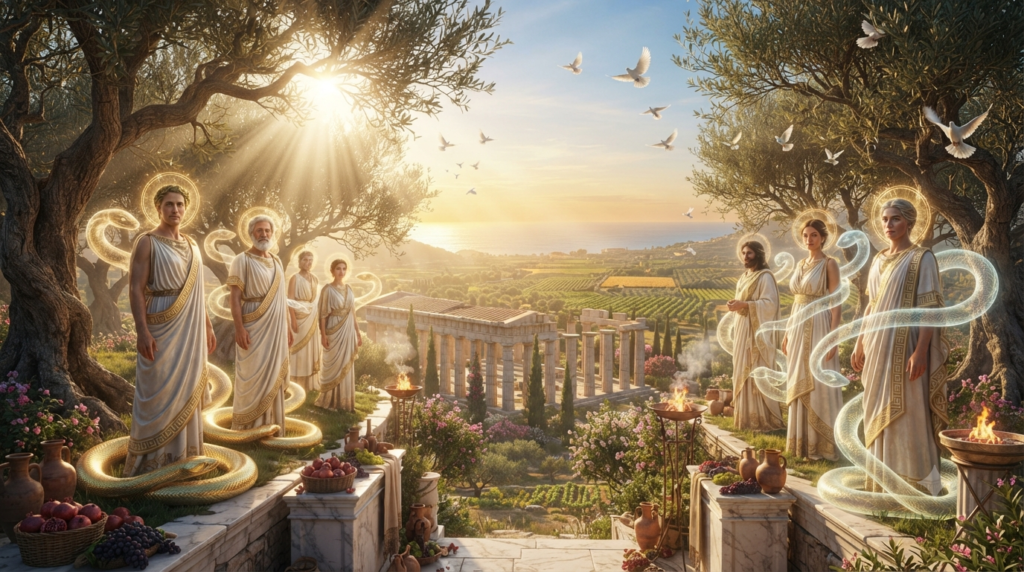
Ancient Greek art and religious tradition most commonly depicted the Agathodaimon in serpent form, reflecting a broader cultural association between snakes and protective household spirits throughout the ancient Mediterranean world. This serpentine imagery appeared frequently in domestic settings, reinforcing the Agathodaimon’s connection to the physical space of the home itself rather than to any distant, abstract divine realm.
Beyond serpent imagery, some depictions instead portrayed the Agathodaimon in human form, represented as a young man carrying a cornucopia, along with a poppy and an ear of grain in his other hand. This alternative iconography emphasized different aspects of the spirit’s protective role, with the cornucopia symbolizing abundance and prosperity, while the poppy and grain connected the Agathodaimon to agricultural fertility and the successful harvest so essential to ancient Greek daily survival.
The choice between serpent and human iconography likely reflected regional variation and evolving religious practice across different periods of Greek and later Greco-Roman history, rather than any strict theological distinction between two separate types of spirit. Both forms consistently reinforced the same underlying message: a benevolent presence dedicated to safeguarding the household’s health, safety, and material wellbeing.
This flexible but consistently protective iconography reinforces the broader answer to who are the Agathodaimones in Greek mythology, showing a spirit whose visual representation prioritized clear symbolic meaning, whether through the ancient protective power of the serpent or the abundance conveyed through agricultural imagery.
Agathos Daimon and Tyche: The Divine Couple of Fortune
Greek religious tradition frequently paired the Agathos Daimon with Tyche Agathe, the goddess of good fortune, presenting the two as a divine couple jointly overseeing prosperity and favorable circumstance within both household and civic life. This pairing reinforced the Agathodaimon’s core function as a bringer of luck, aligning him directly with one of Greek religion’s most significant forces governing chance and fortune.
This partnership between Agathos Daimon and Tyche Agathe extended beyond simple household worship into broader civic contexts, where communities sometimes invoked both figures together when seeking blessings for collective prosperity rather than individual family fortune alone. This dual invocation reflected a broader ancient Greek understanding that personal and communal wellbeing remained deeply interconnected, both subject to the same underlying forces of luck and protection.
The relationship between these two figures also illustrates how ancient Greek religion frequently organized its pantheon through complementary pairings, linking related concepts, such as fortune and protective guardianship, into unified religious narratives rather than treating each divine figure in complete isolation. This pattern helped reinforce theological coherence across otherwise loosely organized folk religious practices.
Recognizing this partnership adds important depth to who are the Agathodaimones in Greek mythology, revealing a spirit whose significance extended beyond solitary household protection into a broader partnership with one of Greek religion’s central forces governing fortune, luck, and prosperity at both personal and communal levels.
The Agathodaimon of Alexandria
The Agathodaimon’s most significant elevation beyond household worship occurred in the Hellenistic city of Alexandria, where the spirit became a prominent civic deity directly tied to the city’s own founding mythology. According to tradition, Alexander the Great encountered and either slew or otherwise revered a serpent at the site chosen for his new city, an event that became permanently woven into Alexandria’s civic religious identity through its association with the Agathodaimon.
This civic elevation transformed the Agathodaimon from a purely domestic guardian spirit into a far more prominent public deity, receiving recognition and reverence extending well beyond individual households into the formal religious life of an entire major city. Alexandria’s identification with the Agathodaimon reflected the city’s broader tendency toward religious syncretism, blending Greek, Egyptian, and later Roman religious traditions into new, hybrid forms of worship.
This Alexandrian version of the Agathodaimon absorbed significant Egyptian influence, becoming associated with Egyptian serpent deities such as Shai and Kematef, while also taking on solar attributes through identification with Helios and other Egyptian sun gods. The Agathodaimon was additionally linked to Serapis, a syncretic deity specifically created to bridge Greek and Egyptian religious traditions, and to Zeus Meilichios, a milder, more protective aspect of Zeus himself associated with household appeasement rituals.
This dramatic expansion of the Agathodaimon’s significance in Alexandria demonstrates an important dimension of who are the Agathodaimones in Greek mythology: spirits capable of evolving from modest household guardians into major civic and even cross-cultural religious figures when historical and political circumstances favored such transformation.
Agathodaimones vs. the Olympian Gods
Comparing the Agathodaimones to the Olympian gods reveals a fundamental difference in scale and religious function that helps clarify their unique place within Greek mythology as a whole. While Zeus, Athena, Apollo, and their fellow Olympians received elaborate temples, citywide festivals, and formal priesthoods dedicated to their worship, the Agathodaimones operated almost entirely within the modest, private sphere of household ritual.
This distinction reflects a broader category within Greek religious thought separating the great gods from the wider class of daimones, lesser divine beings who nonetheless played meaningful roles in everyday Greek spiritual life. Rather than commanding cosmic authority over natural forces or overseeing entire domains like the sea or the sky, the Agathodaimones focused specifically on the immediate, tangible concerns of individual families: health, safety, and material prosperity.
This more intimate scope did not diminish the Agathodaimon’s religious significance among ordinary Greeks, who likely interacted with their household spirit far more frequently and directly than with any distant Olympian deity requiring formal temple visits or elaborate seasonal festivals. The daily libation ritual meant that, for many Greek families, the Agathodaimon represented a far more constant, present divine influence than the grander but more remote gods of Olympus.
This comparison ultimately sharpens the full answer to who are the Agathodaimones in Greek mythology, positioning them as intimate, everyday counterparts to the Olympian pantheon, filling a religious role centered on constant household presence rather than the grand, occasional ceremony associated with Greece’s most famous deities.
Frequently Asked Questions
What does Agathodaimon mean?
Agathodaimon combines the Greek words agathos, meaning “good,” and daimon, meaning “spirit,” translating literally to “Good Spirit.”
Was Agathodaimon a god or a spirit?
The Agathodaimon was considered a daimon, a lesser divine spirit positioned between the major Olympian gods and mortal humans, rather than a formal Olympian deity himself.
Why was Agathodaimon depicted as a snake?
Serpents were closely associated with protection and renewal in ancient Greek religious symbolism, making the snake a fitting visual representation of the Agathodaimon’s guardian role.
Conclusion
The Agathodaimones represent a more intimate, everyday layer of ancient Greek religious life, benevolent household spirits honored through daily libations rather than grand temples or public festivals. From their humble role as personal guardians of family fortune to their remarkable elevation as civic protectors of Alexandria, the Agathodaimones reveal how deeply the sacred was woven into ordinary Greek domestic experience, offering a meaningful counterpart to the more famous, monumental mythology of the Olympian gods.

Orin Vale has spent the better part of two decades tracing the threads that connect the world’s oldest stories — from the halls of Asgard to the banks of the Nile, from Olympus to the jungles of the Maya. What began as a childhood fascination with flood myths and trickster gods grew into years of independent study across comparative mythology and ancient religion, always chasing the same question: what did these stories mean to the people who first told them? Orin writes for readers who want more than trivia — the ones looking for the beliefs, fears, and truths that myths were built to carry.