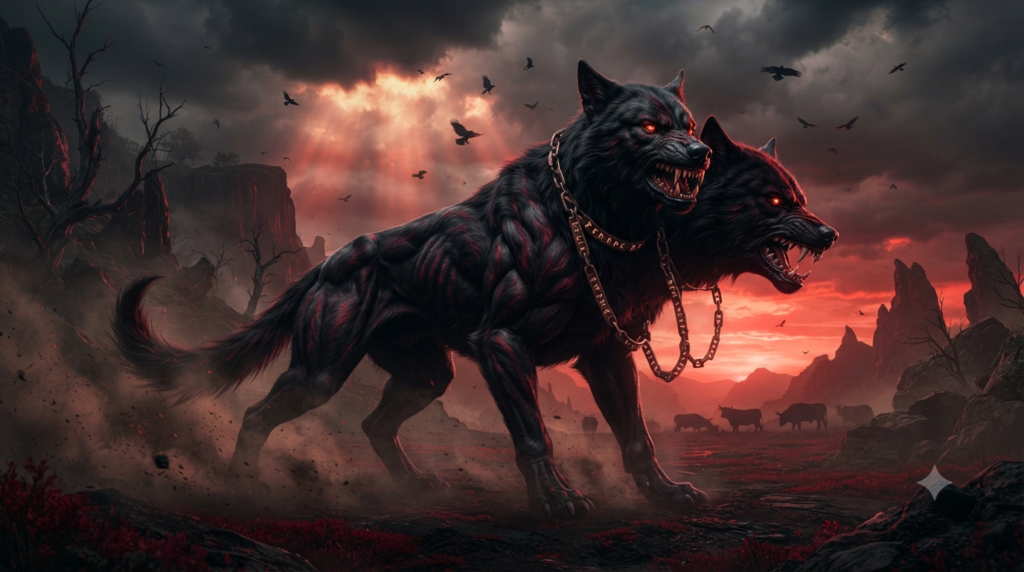
Orthros, also spelled Orthrus, occupies a curious and often overlooked place among Greek mythology’s most famous monsters, remembered primarily as a two-headed dog whose brief but consequential story ties directly into one of Heracles’s most demanding labors. Anyone asking who is Orthros, the two-headed dog of Greek mythology, is uncovering a figure whose fame has been almost entirely overshadowed by more recognizable relatives, despite his own genuinely significant role within ancient Greek monster lore.
Unlike many secondary creatures scattered throughout Greek mythology, Orthros belongs to one of the most feared and prolific monstrous families in the entire tradition, born to parents whose other offspring include some of the most iconic threats faced by Greek heroes. This lineage alone places Orthros firmly within the upper tier of Greek mythological monsters, even though his individual story receives comparatively little attention next to siblings like Cerberus or the Hydra.
Orthros’s most enduring claim to significance rests in his role as guardian of a legendary herd of cattle, a duty that ultimately brought him into direct, fatal conflict with one of Greek mythology’s greatest heroes. This confrontation cemented his place within the broader narrative of Heracles’s twelve labors, ensuring his survival in the mythological record despite his relatively limited independent mythology.
What follows examines Orthros’s fearsome parentage, his close relationship to Cerberus, his guardianship of Geryon’s cattle, the surprising meaning behind his name, his death at Heracles’s hands, and his own possible role as father to additional Greek monsters.
Orthros’s Monstrous Parentage: Typhon and Echidna
Orthros was born to two of the most fearsome figures in all of Greek mythology, Typhon and Echidna, a pairing responsible for producing many of the tradition’s most iconic monsters. Typhon himself stood as the most powerful and terrifying creature ever to challenge the Olympian gods, a being of such immense destructive force that even Zeus required considerable effort to ultimately defeat him.
Echidna, Orthros’s mother, carried the epithet “mother of all monsters” within Greek mythological tradition, reflecting her role as the source of numerous fearsome creatures who would go on to challenge various Greek heroes throughout different myths. This parentage immediately establishes Orthros as part of an extraordinarily significant monstrous lineage, regardless of how much individual attention his own personal story receives in surviving ancient sources.
Among Typhon and Echidna’s other offspring, several creatures achieved far greater lasting fame than Orthros himself, including the Hydra, the Chimera, and Cerberus, each of whom features prominently in some of Greek mythology’s most celebrated hero narratives. Orthros’s position within this fearsome brood places him alongside monsters whose stories shaped entire heroic traditions, even though his own role remained comparatively brief.
Understanding this parentage provides essential context for who is Orthros, the two-headed dog of Greek mythology, since his origins connect him directly to the very source of monstrous threats that Greek heroes like Heracles were repeatedly called upon to confront throughout their legendary careers.
Orthros and Cerberus: Two-Headed Brother of the Underworld’s Guardian
Orthros shares a particularly close mythological relationship with Cerberus, the multi-headed hound famously tasked with guarding the gates of the Underworld, since both creatures descended from the same parents, Typhon and Echidna. This shared parentage positions Orthros and Cerberus as genuine siblings within Greek mythology, both serving remarkably similar functions as guardian dogs despite protecting entirely different domains.
While Orthros consistently appears across ancient sources with exactly two heads, Cerberus’s head count varies considerably depending on which ancient text is consulted, with some of the earliest accounts describing him as possessing fifty or even one hundred heads, though three heads eventually became the more standard literary depiction. This inconsistency surrounding Cerberus stands in notable contrast to the more fixed description consistently applied to Orthros throughout surviving mythological sources.
Classical scholars have specifically noted this close resemblance between the two siblings, with some describing Orthros as essentially a “doublet” of Cerberus, meaning a mythological duplicate serving a nearly identical narrative function within a different context. Both creatures were also frequently depicted with serpent tails in ancient art, reinforcing their shared monstrous heritage and visual similarity despite guarding entirely separate locations within Greek cosmology.
This close sibling relationship adds meaningful depth to who is Orthros, the two-headed dog of Greek mythology, revealing a creature whose story exists in direct conversation with one of Greek mythology’s most famous guardian monsters, even as Orthros himself remained a comparatively minor figure within the broader tradition.
Guardian of Geryon’s Red Cattle
Orthros’s primary mythological function centered on guarding the legendary red cattle belonging to Geryon, a three-bodied giant who kept his prized herd on the remote island of Erytheia, located at the far western edge of the known world according to ancient Greek geography. This distant, almost otherworldly setting reinforced the herd’s status as an exceptionally difficult and dangerous prize, fitting for one of Heracles’s most demanding labors.
Working alongside the herdsman Eurytion, Orthros shared direct responsibility for protecting Geryon’s cattle from any potential threat, forming a defensive partnership between monster and mortal herder that appears repeatedly throughout Greek mythological accounts of guardian creatures protecting valuable or sacred property. This arrangement placed Orthros in an active, functional role rather than simply existing as a passive mythological curiosity.
The remote location of Erytheia itself carried symbolic weight within Greek mythology, representing one of the furthest reaches of the known world, a fitting setting for a task requiring both a monstrous guardian and constant vigilance against intrusion. Orthros’s presence there reinforced the sense that Geryon’s cattle represented a treasure worth protecting through extraordinary, supernatural means rather than ordinary mortal security alone.
This guardianship role provides one of the clearest answers to who is Orthros, the two-headed dog of Greek mythology, establishing him as an active protector whose specific responsibility over Geryon’s cattle directly set the stage for his eventual, fatal confrontation with one of Greek mythology’s most celebrated heroes.
The Meaning Behind Orthros’s Name
The name Orthros carries a surprisingly poetic meaning within ancient Greek, translating roughly to “dawn” or “morning twilight,” a striking contrast to the fearsome, monstrous nature typically associated with this two-headed guardian creature. This linguistic detail adds an unexpected layer of nuance to Orthros’s otherwise straightforwardly monstrous mythological identity.
This naming choice creates a notable tension between the gentle, natural imagery typically associated with dawn and early morning light, and the violent, threatening role Orthros actually plays within Greek mythology as a fearsome guardian beast. Ancient audiences likely appreciated this kind of ironic naming convention, which appears elsewhere throughout Greek mythological tradition when describing creatures whose names carry meanings seemingly at odds with their actual mythological function.
Some scholars have speculated that this etymological connection to dawn may relate to Orthros’s remote, western setting on Erytheia, positioned at the far edge of the world where the sun’s daily cycle held particular symbolic significance within ancient Greek cosmological thinking. Regardless of the exact reasoning behind this specific name, its poetic quality stands in deliberate contrast to Orthros’s genuinely fearsome monstrous identity.
This linguistic detail enriches any complete answer to who is Orthros, the two-headed dog of Greek mythology, revealing a creature whose very name carries unexpected depth and symbolic complexity beyond his straightforward role as a two-headed guardian monster within Heracles’s broader mythological cycle.
The Tenth Labor of Heracles: Orthros’s Death
Orthros’s mythological story reaches its definitive conclusion during Heracles’s tenth labor, a task requiring the hero to travel to the distant island of Erytheia specifically to steal Geryon’s prized red cattle and bring them back to King Eurystheus. This labor placed Heracles in direct confrontation with Orthros, whose entire mythological purpose centered on preventing exactly this kind of intrusion.
Ancient sources describe Orthros detecting Heracles’s presence almost immediately upon his arrival, prompting the two-headed dog to attack the hero without hesitation in defense of Geryon’s cattle. Heracles responded with characteristic decisiveness, killing Orthros with his club, according to the mythographer Apollodorus, though some artistic depictions instead show Orthros pierced by arrows, suggesting some variation existed across different ancient retellings of this encounter.
Following Orthros’s death, Heracles continued his assault on the cattle’s remaining defenders, subsequently killing the herdsman Eurytion and finally Geryon himself before successfully claiming the cattle needed to complete his labor. This sequence of events firmly established Orthros’s death as a necessary, though relatively brief, obstacle within the broader narrative of Heracles’s legendary heroic career.
This decisive confrontation completes the most historically significant answer to who is Orthros, the two-headed dog of Greek mythology, confirming his role as one of several monstrous guardians Heracles was forced to overcome during his twelve labors, even as Orthros’s own individual story remained comparatively brief within this much larger heroic narrative.
Orthros as Father of Other Monsters
Beyond his own death and guardianship duties, ancient sources, particularly Hesiod’s Theogony, suggest that Orthros may have fathered additional significant monsters within Greek mythology, further extending his genealogical importance beyond his own individual story. Hesiod specifically credits Orthros with fathering both the Sphinx, the riddle-posing monster later associated with the city of Thebes, and the Nemean Lion, the fearsome beast eventually slain by Heracles during an entirely separate labor.
The exact identity of the mother in this parentage remains genuinely ambiguous within Hesiod’s original text, with scholars debating whether Echidna, Orthros’s own mother, or the Chimera, his sister, should be understood as the mother of these additional offspring. This uncertainty reflects the broader complexity and occasional inconsistency found throughout ancient Greek genealogical mythology, particularly regarding monstrous family lines.
Regardless of which specific reading proves correct, this potential parentage connects Orthros directly to two additional creatures whose own individual mythologies achieved far greater lasting fame than his, further reinforcing his significance within Greek mythology’s broader monstrous family tree, even as his personal narrative remained comparatively limited.
This genealogical connection adds a final important dimension to who is Orthros, the two-headed dog of Greek mythology, revealing a creature whose influence potentially extended well beyond his own brief appearance in Heracles’s tenth labor into the origins of some of Greek mythology’s other most recognizable monstrous figures.
Frequently Asked Questions
What two Greek monsters did Orthros father?
According to Hesiod, Orthros fathered the Sphinx and the Nemean Lion, though ancient sources disagree on whether Echidna or the Chimera served as the mother.
Who killed Orthros?
Heracles killed Orthros during his tenth labor while attempting to steal Geryon’s cattle from the island of Erytheia.
Is Orthros related to Cerberus?
Yes, Orthros and Cerberus were brothers, both born to the monstrous parents Typhon and Echidna.
Conclusion
Orthros, the two-headed dog of Greek mythology, remains a genuinely significant figure within the tradition’s broader monstrous family, connected through parentage to Cerberus, through guardianship to Geryon’s legendary cattle, and possibly through fatherhood to creatures as famous as the Sphinx and Nemean Lion. Though his death at Heracles’s hands during the tenth labor represents his most defining moment, Orthros’s fearsome lineage and unexpectedly poetic name secure his lasting place among Greek mythology’s most memorable, if often overlooked, monstrous guardians.

Orin Vale has spent the better part of two decades tracing the threads that connect the world’s oldest stories — from the halls of Asgard to the banks of the Nile, from Olympus to the jungles of the Maya. What began as a childhood fascination with flood myths and trickster gods grew into years of independent study across comparative mythology and ancient religion, always chasing the same question: what did these stories mean to the people who first told them? Orin writes for readers who want more than trivia — the ones looking for the beliefs, fears, and truths that myths were built to carry.