In the shadowy and enigmatic world of Greek mystery religions, few figures are as intriguing and elusive as the Arcadian goddess known as Despoine. Who is Despoine in Greek mythology? She is a chthonic fertility goddess, the daughter of Demeter and Poseidon, whose true name was considered so sacred that it was revealed only to initiates of her mysteries and has since been lost to history . Worshipped with profound reverence in the remote region of Arcadia, she was a deity of the earth, animals, and the underworld, whose cult centered around a magnificent sanctuary at Lycosura, the oldest city in the world . Her very title, Despoina, meaning “The Mistress,” reflects her supreme authority and the secrecy that enveloped her worship .
Origins and the Myth of Her Birth
The myth surrounding the birth of Despoine is a dramatic tale of pursuit and transformation that explains her unique parentage and her mother’s sorrow. According to the legend, the sea god Poseidon harbored a powerful desire for Demeter, the goddess of agriculture and grain . To escape his advances, Demeter took the form of a mare and hid amongst the herds of Onkios in Arcadia . However, Poseidon was not to be deterred. He transformed himself into a stallion and mated with the goddess, a union that resulted in the birth of two remarkable offspring: the immortal horse Arion and a daughter, Despoine .
This traumatic event profoundly affected Demeter, who was already grief-stricken by the abduction of her daughter Persephone. In her anger and shame, she took on the epithet Erinys (“the raging one”) and dressed in black, withdrawing into a cave to mourn . This myth explains not only Despoine’s origins but also the distinctive, dark character of her cult, which emphasized the raw, untamed forces of nature and the cycle of life and death.
The Unutterable Name and the Cult of the Mistress
Despoine was worshipped as a paired goddess alongside her mother Demeter, but the two were not identical. Pausanias, the 2nd-century CE travel writer, explicitly noted that while the daughter of Zeus was named Kore (the Maiden) and her true name was Persephone, the true name of Poseidon’s daughter was a secret he dared not write down for the uninitiated . This secrecy was the cornerstone of her cult, which was a mystery religion akin to the more famous Eleusinian Mysteries . The Arcadians held Despoine in such high esteem that they revered her more than any other deity .
Her cult was geographically limited to the region of Arcadia in the central Peloponnese, with its spiritual center located at Lycosura . The sanctuary there, founded by the mythical king Lycaon, was the only known site dedicated to her . The rites performed for Despoine were distinctly local and ancient. In a structure called the Megaron, worshippers conducted unusual sacrifices where the sacrificial animal was hacked rather than having its throat cut, a practice that set her cult apart from mainstream Greek rituals . In addition, participants in the mysteries were prohibited from wearing black or purple, further underscoring the uniqueness of this Arcadian tradition .
Iconography and the Monumental Cult Group
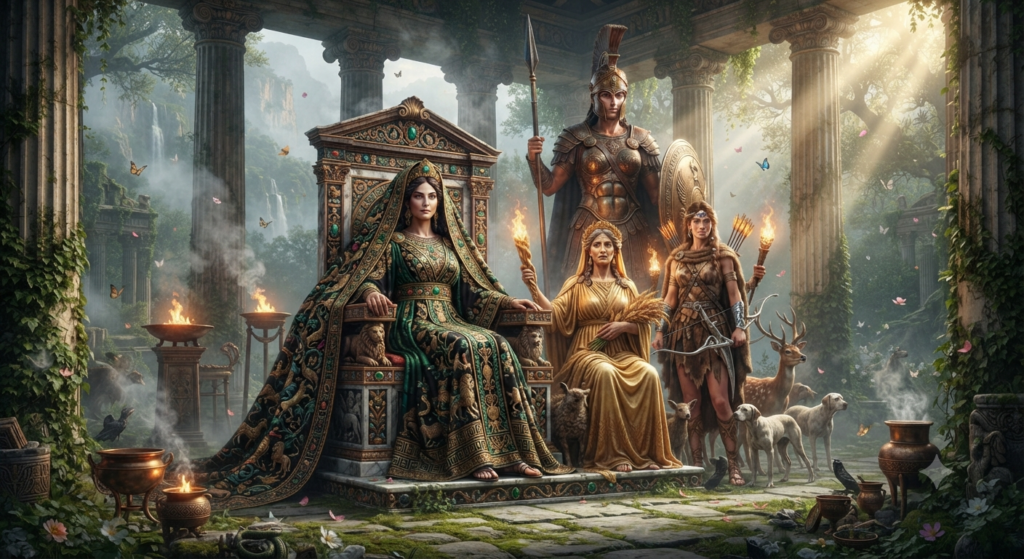
The imagery associated with Despoine provides crucial insight into her nature. The most significant artistic representation of her was the monumental acrolithic cult group created by the sculptor Damophon of Messene in the late 3rd or early 2nd century BCE . This colossal group, housed in the small temple at Lycosura, depicted Despoine and Demeter seated together on an elaborately decorated throne. On either side stood the goddess Artemis, dressed in a deer skin and holding torches and serpents, and the Titan Anytus, shown as a warrior in armor who was considered her foster-father .
The veil of Despoine was a masterpiece of intricate sculpture . The complex decorative program, which included friezes of Nereids riding sea horses, eagles, thunderbolts, and a procession of animal-headed figures dancing, points to her connection with the marine world (through her father Poseidon), the celestial realm, and the wild, chthonic forces of nature . The presence of the animal-headed dancers on her veil may also reflect rituals where cult participants wore animal masks, linking her to the “Mistress of the Animals” aspect of Artemis . This iconography solidifies her role as a powerful goddess of the earth, the underworld, and the untamed wilderness.
Legacy and Conflation with Persephone
The legacy of Despoine in Greek religion is one of profound influence and eventual fusion. Her cult at Lycosura serves as a crucial case study for understanding ancient mystery religions and the survival of older, Mycenaean beliefs. The title “Despoina” itself has deep roots in the Mycenaean period, where a similar term, potnia (mistress), was used for powerful female deities . In many ways, the Arcadian cult is a continuation of a much older, pre-Hellenic tradition centered on a mother goddess and her powerful daughter.
Over time, Despoine was increasingly conflated with Persephone, the daughter of Demeter and Zeus who was the central figure of the Eleusinian Mysteries . The similarities in their roles as chthonic goddesses and the structure of the mother-daughter pair allowed this syncretism to occur. This led to her being referred to as the Arcadian Persephone, although scholars believe that she retained a distinct identity with a stronger focus on the animal world and a more local, archaic character .
Frequently Asked Questions About Who is Despoine in Greek mythology?
What does the name “Despoine” mean?
The name “Despoine” comes from the Greek word déspoina, meaning “The Mistress” or “The Lady” . It is related to the word “despot” and signifies the supreme authority of the goddess to whom it was applied. Her real, personal name was kept a secret from all but the initiates of her mysteries .
Who were the parents of Despoine?
Despoine was the daughter of the sea god Poseidon and the goddess of agriculture Demeter . Their unusual union, in which they took the forms of a stallion and a mare, also resulted in the birth of the immortal horse, Arion .
Where was Despoine worshipped?
Despoine was worshipped primarily in Arcadia, a region in the central Peloponnese of Greece . Her only known sanctuary was located at the ancient city of Lycosura, which Pausanias called the oldest city in the world .
Why was Despoine’s name kept secret?
Her true name was a mystery known only to those who had been initiated into her cult . Revealing it to the uninitiated was strictly forbidden. As a result, the secret name has been lost to history, and she is known only by her title “Despoine” .
How was Despoine related to the goddess Artemis?
Despoine was closely identified with Artemis . In her sanctuary at Lycosura, a statue of Artemis stood beside her, and both were associated with the animal world and the hunt. Some scholars have even suggested that Despoine’s secret identity was that of Artemis, though this is not a consensus .
Conclusion
Who is Despoine in Greek mythology? She is one of ancient Greece’s most enigmatic and fascinating deities, a powerful goddess whose true identity was a closely guarded secret. As the daughter of Poseidon and Demeter, she embodied the raw, untamed forces of nature, presiding over the mysteries of the earth, the underworld, and the wild. Her cult at Lycosura stands as a testament to the enduring power of ancient, localized beliefs that existed alongside the more familiar Olympian pantheon. While her secret name has been lost, her title as “The Mistress” and her powerful iconography remind us of the depth and complexity of Greek religious thought. Her conflation with Persephone and her influence on the study of ancient mystery religions, including the Eleusinian Mysteries, secure her a crucial place in the history of ancient spirituality.

Orin Vale has spent the better part of two decades tracing the threads that connect the world’s oldest stories — from the halls of Asgard to the banks of the Nile, from Olympus to the jungles of the Maya. What began as a childhood fascination with flood myths and trickster gods grew into years of independent study across comparative mythology and ancient religion, always chasing the same question: what did these stories mean to the people who first told them? Orin writes for readers who want more than trivia — the ones looking for the beliefs, fears, and truths that myths were built to carry.