In Greek myth, Orion and Scorpius are not merely patterns of stars but the remains of a dramatic celestial story. Orion is the great hunter of the Greek tradition, a figure known from several ancient sources and later retellings, while Scorpius is the scorpion associated with his fatal end. Their myth explains why the two constellations are set on opposite sides of the sky and why they seem never to rise together for long.
Orion and Scorpius in Greek sky lore
Greek sky lore turned the night sky into a map of memory, where constellations preserved the deeds of gods, heroes, beasts, and monsters. Orion and Scorpius belong to this broader habit of explaining the heavens through mythic narrative. Orion is usually identified with the giant hunter, while Scorpius represents the scorpion that killed him or was sent against him. The story is not told in a single fixed form in early literature, but the opposition between the two figures is ancient and widely recognized.
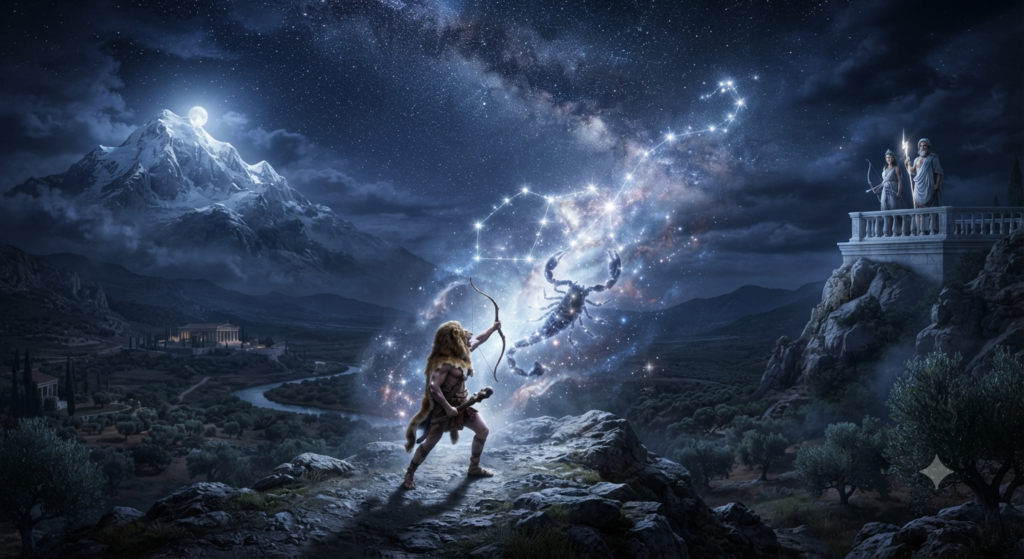
Their placement in the sky became part of the myth itself. Scorpius is seen chasing Orion across the heavens, yet never quite catching him in real time, because the two constellations occupy separate regions of the sky. This visual contrast gave Greek storytellers a powerful way to explain seasonal starlight and to dramatize the ancient idea that heaven preserves the consequences of mortal pride, divine anger, and cosmic order.
The hunter Orion in myth and cult
Orion appears in Greek tradition as a massive, gifted hunter of exceptional strength and beauty. In Homer’s Odyssey, he is already a famous figure of the underworld and the hunt, and later authors expand his story in different directions. Some traditions call him the son of Poseidon, which helps explain his vast stature and his ability to walk upon the sea. Other versions make him a Boeotian or Chian hero linked to local landscapes and hunting customs.
He was not only a mythic personality but also a figure with cultic and regional associations. Pausanias records local traditions and tombs connected with Orion in various places, showing that he was remembered in different communities in different ways. That variety matters, because the sky myth did not grow from a single canonical tale. It drew on a broader legendary image: Orion as the superb hunter whose greatness could shade into dangerous excess.
How Artemis and Apollo shaped his fate
Several Greek sources connect Orion’s death to Artemis, the virgin goddess of the hunt, though the reason changes from one tradition to another. In one familiar version, Orion is her hunting companion and perhaps even her favored partner. In another, Apollo intervenes because he fears Orion’s relationship with Artemis or suspects him of boasting too much. The ancient record does not preserve one agreed account, and that uncertainty is part of the mythic tradition.
Artemis herself is central to the story because Orion belongs to her sphere: the wild, the hunt, the mountains, and the untamed animal world. When the myth frames his death through her, it often highlights the boundary between mortal hunter and divine mistress of the chase. Apollo’s role, where present, adds another layer. He becomes the god who guards divine decorum, or who manipulates events so that Orion’s end comes by Artemis’s hand or by an agent linked to her domain.
The scorpion sent to end Orion’s pride
In the best-known version, Orion’s death comes through the scorpion. Ancient tradition often presents the creature as a divine instrument, sent to punish the hunter after he boasts that he can kill any beast on earth. Such pride would have resonated strongly in Greek moral storytelling, where excessive confidence invites ruin. The scorpion, small compared with Orion’s colossal form, becomes an emblem of how the seemingly minor can destroy the mighty.
This episode is not only about strength but about boundaries. Orion is a hunter, yet he is not allowed to dominate all nature. The scorpion marks the point where human or heroic mastery fails before a divinely ordered world. Even the manner of his death matters: not by the spear of another hunter in fair combat, but by a creature whose sting is hidden, sudden, and difficult to resist. That detail helped make the myth memorable enough to survive in both literature and sky lore.
Zeus places both figures among stars
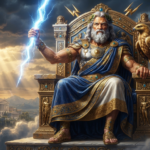
After Orion’s death, the myth moves into the heavens. Zeus, or in some accounts another divine power, places Orion among the stars, while the scorpion is also set in the sky. The result is a kind of eternal memorial and eternal warning. Orion does not vanish completely, and neither does the force that ended him. The stars preserve both the hunter and the creature that stopped him.
This celestial arrangement gave the Greeks an elegant explanatory framework. The two figures are not simply commemorated; they are separated. Their placement ensures that one rises as the other sets, so the drama is written into the night itself. In that sense, the myth is both punitive and poetic. It does not erase Orion’s glory, but it fixes it forever beside the image of his defeat.
Opposing constellations in the night sky
Orion and Scorpius are among the most famous opposing constellations because of the way they occupy the sky in roughly opposite seasons. When Scorpius climbs high in the summer sky, Orion is absent from the night sky; when Orion returns in the colder months, Scorpius has sunk away. This cosmic alternation made the old myth feel visible and immediate, as if the heavens themselves were replaying the hunter’s flight and the scorpion’s pursuit.
Greek observers would have noticed this pattern long before modern astronomy separated myth from science. The constellations offered a natural stage for the story’s symbolism: the hunter and the scorpion can never fully share the same sky. Their opposition became one of the strongest examples of how Greek mythology linked narrative, seasonal change, and celestial observation into a single imaginative system.
Ovid and other sources on Orion’s death
Later literary sources preserve and reshape the myth in different ways. Ovid, in the Fasti and Metamorphoses, refers to Orion within a Roman literary setting and helps keep the constellation story alive for later readers. His versional world often blends inherited Greek material with Roman poetic concerns, so while he is not our earliest witness, he is an important transmitter of the tale. He also preserves the broader ancient sense that Orion’s death was tied to divine will and astral placement.
Earlier and more technical sources are equally valuable. The Bibliotheca attributed to Apollodorus gives one concise mythic account, while Hesiodic fragments, Homeric references, and scholia preserve pieces of the tradition. Pausanias, meanwhile, records local variants and cultic associations rather than a single master narrative. Taken together, these sources show that Orion’s death was not a fixed legend but a family of related traditions, each emphasizing different causes, divine figures, and moral implications.
Variants of the Scorpius creation myth
The scorpion itself also has more than one origin story. In some versions, it is sent by Gaia or by a god to humble Orion after his boast. In others, Artemis or Apollo is involved more directly, using the scorpion as the means by which Orion is checked. The details shift, but the basic structure remains constant: a dangerous hunter is stopped by a creature associated with sting, concealment, and the limits of human confidence.
Some later writers also connect the scorpion to the broader zodiacal order rather than to one fixed narrative. The constellation becomes a mythic symbol of the scorpion’s nature rather than the literal record of a single event. This is typical of Greek sky lore, where an astronomical figure can carry several layers of meaning at once: local tale, poetic emblem, and seasonal marker. The endurance of Scorpius across traditions suggests that the symbol was powerful enough to absorb multiple explanations.
Seasonal rising of Orion and Scorpius
The myth’s staying power owes much to the sky’s annual rhythm. Orion’s prominence in winter and Scorpius’s in summer gave ancient observers a cycle they could recognize year after year. These changes were not only aesthetic. They helped with timing, navigation, agricultural planning, and the marking of sacred seasons. A constellation that appears and disappears with regularity naturally invites story.
That seasonal pattern also intensifies the mythic meaning. Orion is most visible when the nights are long and cold, while Scorpius dominates when the heat of summer is at its peak. The hunter and the scorpion seem to trade the heavens like rival forces. Their mutual exclusion becomes a kind of astronomical law, and the old story translates that law into narrative form. Greek myth often does this: it gives personality to recurring natural phenomena so that the sky feels inhabited rather than abstract.
Enduring meanings of the celestial duel
The myth behind Orion and Scorpius endures because it joins grandeur with restraint. Orion stands for skill, ambition, and heroic scale; Scorpius stands for the sharp correction that follows overreach. Yet the story is not simply a moral lesson. It is also a meditation on how the Greeks imagined the heavens: not as empty distance, but as a living archive of conflict, memory, and divine action.
Today the constellations are still recognized by their ancient names, and the old opposition remains easy to see in the night sky. That survival is part of the myth’s power. Orion and Scorpius continue their endless separation, one rising as the other fades, preserving a story that ancient poets, local cults, and sky-watchers all helped shape. The heavens, in Greek myth, do not forget.

Orin Vale has spent the better part of two decades tracing the threads that connect the world’s oldest stories — from the halls of Asgard to the banks of the Nile, from Olympus to the jungles of the Maya. What began as a childhood fascination with flood myths and trickster gods grew into years of independent study across comparative mythology and ancient religion, always chasing the same question: what did these stories mean to the people who first told them? Orin writes for readers who want more than trivia — the ones looking for the beliefs, fears, and truths that myths were built to carry.