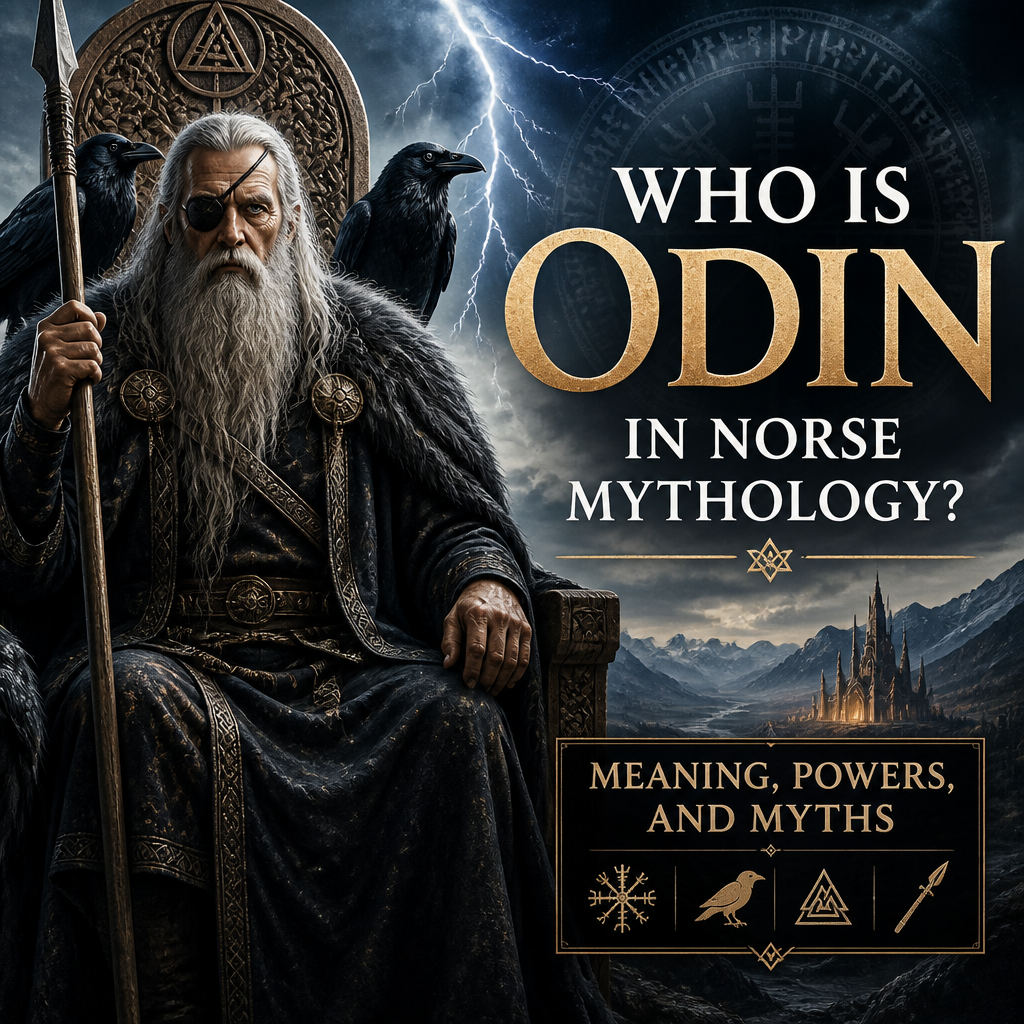
Who Is Odin in Norse Mythology?
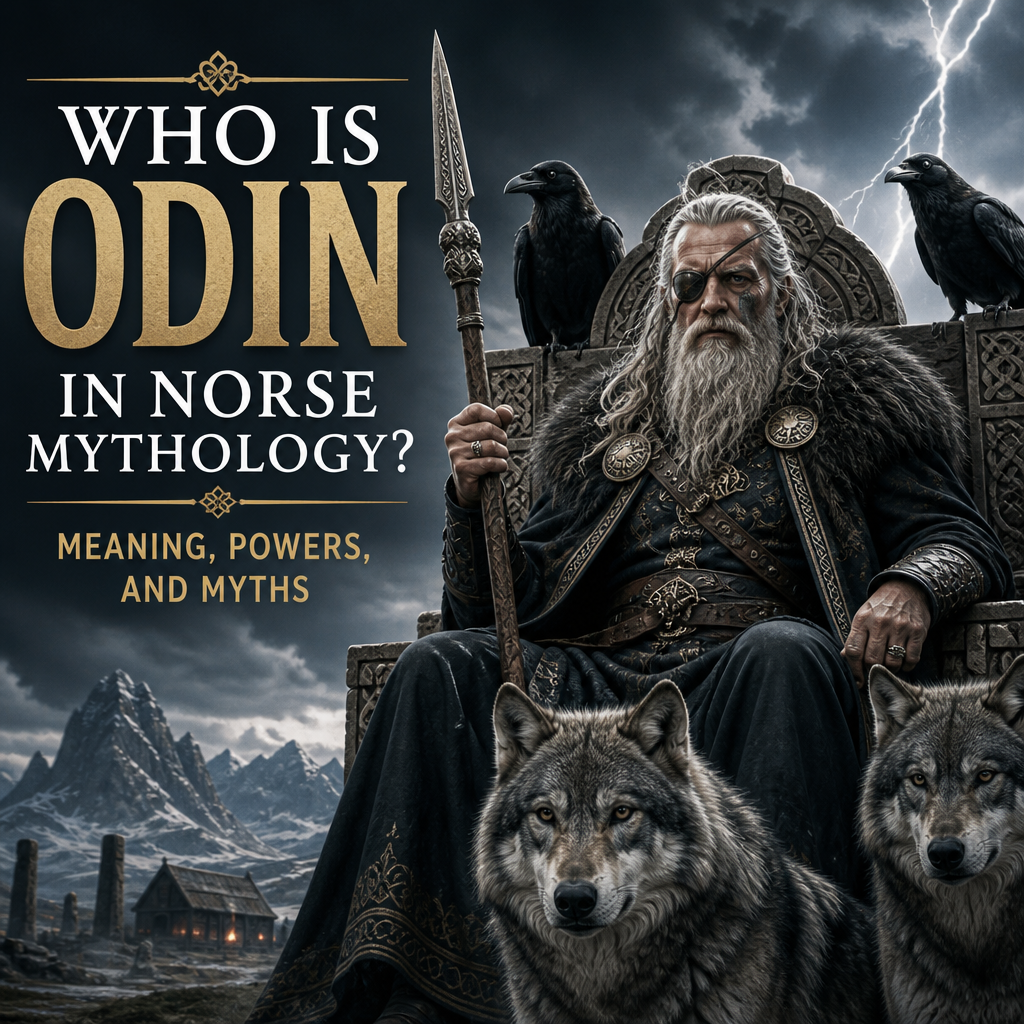
Odin is one of the most important and complex gods in Norse mythology. Known as the All-Father, he is associated with wisdom, war, poetry, magic, death, and kingship. Among the Norse gods, Odin stands at the center of many myths, not only as a powerful ruler but also as a restless seeker of knowledge.
To understand who is Odin in Norse mythology, it helps to see him not as a simple “king of the gods,” but as a mysterious figure with many roles. He is noble and terrifying, generous and cunning, a creator, a wanderer, and a god who is willing to sacrifice almost anything in pursuit of wisdom.
Odin as the All-Father
Odin is often called the All-Father because he is regarded as the father or ancestor of many gods and humans. He rules over Asgard, the realm of the Aesir gods, from his great hall. His throne, Hlidskjalf, allows him to see across all the worlds.
He is the father of several well-known Norse figures, including Thor, the thunder god, and Baldr, the beloved god of light and beauty. Through these connections, Odin is linked to both strength and tragedy, two themes that appear often in Norse mythology.
Unlike some divine rulers in other mythologies, Odin does not simply sit in power. He frequently travels in disguise, testing people, seeking information, and influencing events. He is often described as an old man with a long beard, a wide-brimmed hat, and a cloak, carrying a spear named Gungnir.
The God of Wisdom and Knowledge
One of Odin’s defining traits is his hunger for wisdom. He is not born knowing everything; instead, he gains knowledge through sacrifice and suffering.
In one famous story, Odin seeks a drink from Mimir’s well, a source of deep wisdom. The price is one of his eyes. Odin accepts the bargain and gives up an eye in exchange for knowledge. This is why he is often pictured as one-eyed.
Another important myth tells how Odin discovered the runes, the sacred symbols associated with writing, magic, and fate. To gain this knowledge, Odin hangs himself from the world tree, Yggdrasil, for nine nights. He is wounded by a spear and given no food or drink. At the end of this ordeal, the runes reveal themselves to him.
These stories show that Odin’s wisdom is not easy or comfortable. It comes through pain, sacrifice, and relentless determination.
Odin and War
Odin is also a god of war, but not in the same direct way as Thor. While Thor represents physical strength and protection, Odin is more closely connected with strategy, battle frenzy, victory, and the fate of warriors.
He chooses who will win and who will die in battle. Fallen warriors selected by Odin are taken to Valhalla, his great hall in Asgard. There, they become the Einherjar, warriors who feast and fight until they are called to join Odin at Ragnarok, the final battle of the gods.
Odin’s connection to war can be unsettling. He is not always portrayed as fair or predictable. He may grant victory to one side and abandon another, depending on his larger plans. This makes him a powerful but dangerous figure to worship.
Odin, Magic, and Poetry
Odin is strongly linked with magic, especially a form called seidr. This type of magic involves prophecy, fate, and altering events. In Norse culture, seidr was often associated with women, which makes Odin’s mastery of it especially notable. His willingness to cross social boundaries highlights his desire for power and knowledge above all else.
He is also connected to poetry and inspiration. One myth tells of the Mead of Poetry, a magical drink that gives the gift of poetic skill and wisdom. Odin obtains it through trickery and transformation, then brings it back for gods and humans to use.
Because of this, poets and storytellers looked to Odin as a source of inspiration. He was not only a war god but also a patron of words, memory, and creative power.
Odin’s Companions and Symbols
Odin is surrounded by powerful symbols and companions that reveal his nature.
Huginn and Muninn
Odin has two ravens named Huginn and Muninn, whose names mean “thought” and “memory.” Each day, they fly across the world and bring him news. Their presence shows Odin’s connection to knowledge, observation, and the unseen.
Geri and Freki
Odin also has two wolves, Geri and Freki. Wolves are often connected with battle, death, and wild power in Norse mythology. Their companionship reinforces Odin’s darker and more dangerous side.
Gungnir and Sleipnir
Odin’s spear, Gungnir, never misses its target. It is a symbol of authority, war, and sacred oaths.
His horse, Sleipnir, is an eight-legged steed capable of traveling between worlds. Sleipnir reflects Odin’s role as a wanderer who moves between realms, including the lands of the living and the dead.
Odin and Ragnarok
Ragnarok is the prophesied end of the gods, and Odin plays a central role in it. Despite all his wisdom and efforts to prepare, Odin cannot escape fate.
During Ragnarok, Odin leads the gods and the warriors of Valhalla into battle against the forces of chaos. His destined enemy is Fenrir, the monstrous wolf. According to the myths, Fenrir kills Odin, but Odin’s son Vidar avenges him.
This ending shows one of the most powerful ideas in Norse mythology: even the greatest gods are subject to fate. Odin knows much about the future, yet he cannot prevent his own death.
Why Odin Still Fascinates People
Odin remains fascinating because he is not a simple hero or a perfect god. He is wise, but also deceptive. He is a giver of gifts, but also a bringer of death. He seeks knowledge not for comfort, but because he understands that power, fate, and sacrifice are deeply connected.
For modern readers asking who is Odin in Norse mythology, the answer is layered. Odin is the All-Father, the ruler of Asgard, the one-eyed seeker of wisdom, the god of war and poetry, and the doomed leader at Ragnarok.
His myths continue to endure because they explore timeless questions: What is wisdom worth? How much should one sacrifice for knowledge? Can even the powerful escape fate?
In Odin, Norse mythology gives us a god who is majestic, troubling, and unforgettable.

Orin Vale has spent the better part of two decades tracing the threads that connect the world’s oldest stories — from the halls of Asgard to the banks of the Nile, from Olympus to the jungles of the Maya. What began as a childhood fascination with flood myths and trickster gods grew into years of independent study across comparative mythology and ancient religion, always chasing the same question: what did these stories mean to the people who first told them? Orin writes for readers who want more than trivia — the ones looking for the beliefs, fears, and truths that myths were built to carry.