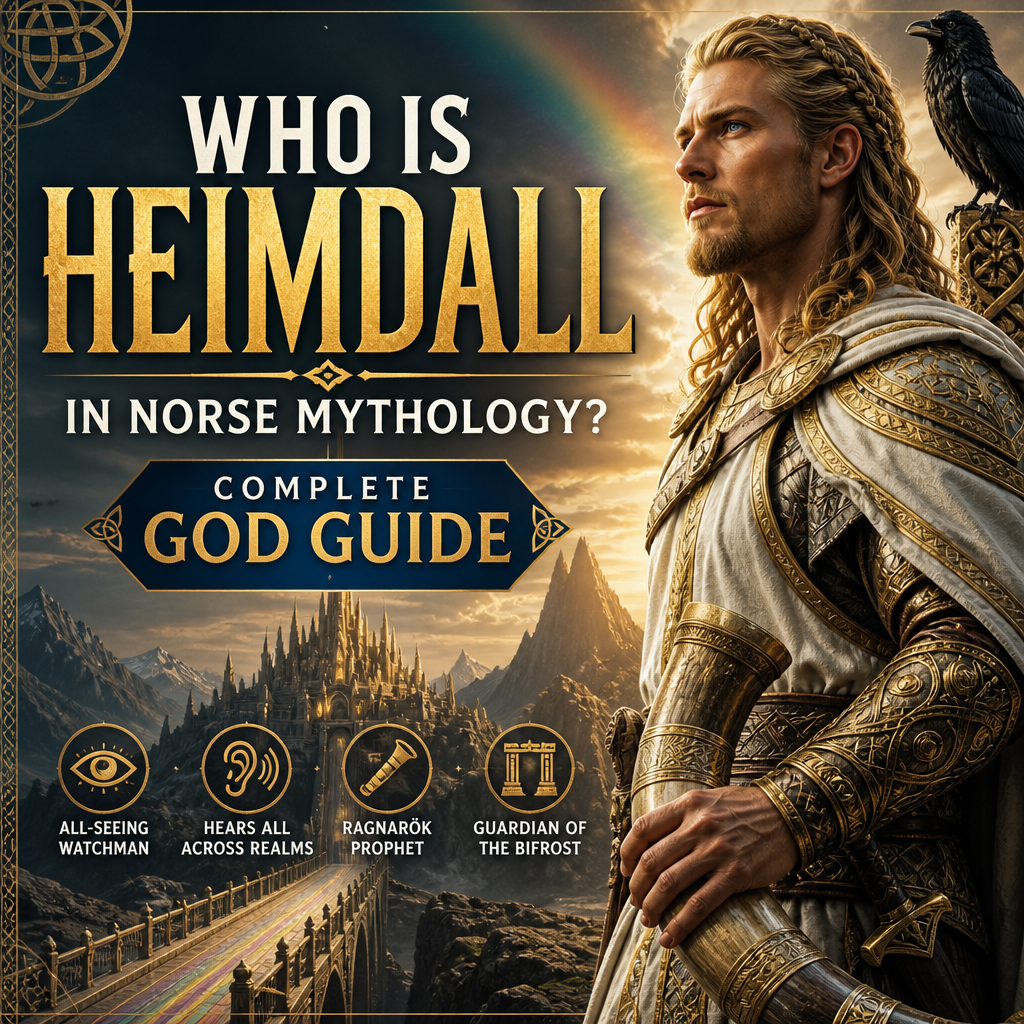
Who Is Heimdall in Norse Mythology?
Heimdall is one of the most mysterious and important gods in Norse mythology. Known as the watchman of the gods, he stands guard at the edge of Asgard, the realm of the Aesir gods, and watches for the coming of Ragnarok, the great end-time battle.
Although he appears in fewer stories than gods like Odin, Thor, or Loki, Heimdall plays a powerful role in the Norse mythic world. He is associated with vigilance, divine order, light, boundaries, and the protection of the gods. His sharp senses, golden imagery, and connection to the rainbow bridge make him one of the most memorable figures in the Norse pantheon.
Heimdall, Guardian of Asgard
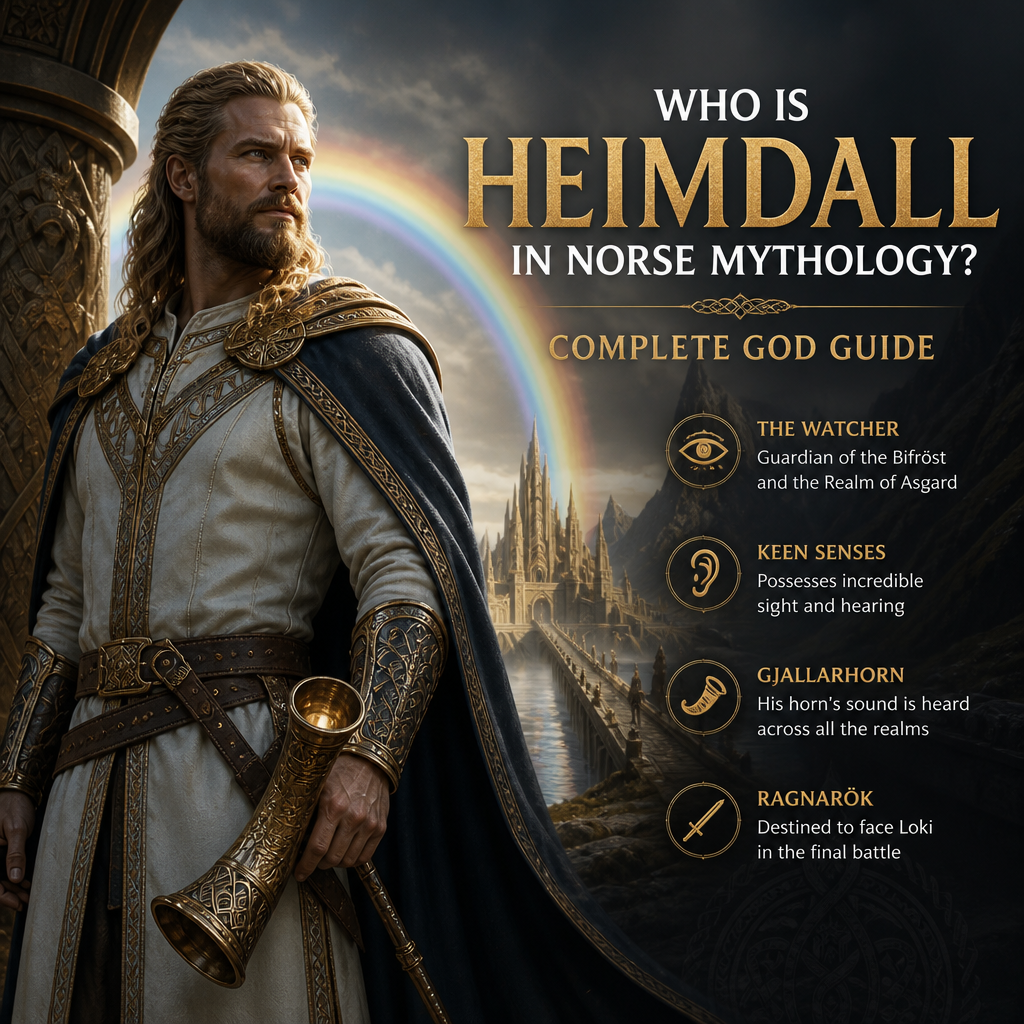
Heimdall’s most famous role is as the guardian of Asgard. He keeps watch over Bifrost, the rainbow bridge that connects Asgard to Midgard, the world of humans. This bridge is a sacred pathway between realms, and Heimdall’s duty is to ensure that enemies of the gods do not cross it unnoticed.
Heimdall lives in a dwelling called Himinbjorg, meaning “heaven cliffs” or “mountain of heaven.” From this high place near Bifrost, he can see across great distances. His position makes him both a protector and a sentinel, always alert for danger.
In Norse mythology, the gods are aware that their world will one day face destruction at Ragnarok. Heimdall’s watch is therefore not just routine guard duty. He is waiting for the signs that the enemies of the gods are approaching.
Heimdall’s Extraordinary Senses
One of the most striking things about Heimdall is his supernatural perception. The old sources describe him as having senses far beyond those of ordinary beings.
Heimdall is said to be able to:
- See for hundreds of miles, by day or night
- Hear grass growing in the earth
- Hear wool growing on sheep
- Need less sleep than a bird
These unusual abilities make him the perfect watchman. Nothing can easily escape his attention. In a mythological world filled with giants, monsters, tricksters, and hidden threats, Heimdall’s awareness is essential to the safety of Asgard.
His keen hearing is especially important because it connects to his role at Ragnarok. When the final battle begins, Heimdall will blow his horn to warn the gods.
Gjallarhorn: Heimdall’s Mighty Horn
Heimdall owns a famous horn called Gjallarhorn, often translated as “the resounding horn” or “yelling horn.” This horn is one of the most important objects in Norse mythology.
At the beginning of Ragnarok, Heimdall will sound Gjallarhorn, and its call will echo through the worlds. This blast alerts the gods that their enemies are advancing and that the final battle has begun.
The horn symbolizes warning, awakening, and the moment when fate can no longer be delayed. Heimdall’s role is not to prevent Ragnarok entirely, since the event is part of destiny. Instead, he is the one who announces its arrival and calls the gods to face their fate.
The Origin of Heimdall
Heimdall’s birth is unusual, even by mythological standards. In the Poetic Edda, he is described as being born of nine mothers. These nine mothers are often interpreted as sea maidens, giantesses, or personifications of waves.
The exact meaning of this strange origin is debated. Some scholars believe it links Heimdall to the sea, the edges of the world, or the primal forces of creation. Others see the nine mothers as symbolic of cosmic power or ancient divine ancestry.
Heimdall is also described as a shining or white god. This may connect him with light, purity, dawn, or brightness. His teeth are said to be made of gold, and he is sometimes associated with the name Gullintanni, meaning “gold-toothed.”
Heimdall and Human Society
One fascinating story connects Heimdall to the origins of human social classes. In the poem Rigsthula, a figure named Rig travels through the human world and visits three households. Many scholars identify Rig with Heimdall.
During these visits, Rig fathers three sons who become the ancestors of different social groups:
- Thralls, or servants and laborers
- Karls, or free farmers and common people
- Jarls, or nobles and rulers
Through this myth, Heimdall is linked not only to the gods but also to human civilization and social order. He becomes a divine figure who helps shape the structure of society.
This side of Heimdall is different from his role as watchman, but it fits his broader association with order, boundaries, and hierarchy.
Heimdall and Loki
Heimdall has a strong connection with Loki, the trickster god. The two are often seen as opposites. Heimdall represents watchfulness, loyalty, and order, while Loki represents deception, chaos, and disruption.
One myth tells of a conflict between Heimdall and Loki over the necklace Brisingamen, a precious treasure belonging to the goddess Freyja. In some versions, Loki steals the necklace, and Heimdall retrieves it. The two gods transform into seals and fight in the sea.
Their rivalry becomes most important at Ragnarok. During the final battle, Heimdall and Loki will face each other in combat. They are destined to kill one another.
This final duel is deeply symbolic. The guardian of divine order and the agent of chaos destroy each other as the old world comes to an end.
Heimdall at Ragnarok
Ragnarok is the doom of the gods, and Heimdall has a central role in its beginning and its violence. When the giants and other enemies advance, Heimdall sees them coming. He raises Gjallarhorn and blows the warning that calls the gods to battle.
During the chaos, Bifrost breaks as the forces of destruction cross into the realm of the gods. Heimdall then fights Loki, and both die.
His death marks the fall of one of Asgard’s greatest protectors. Yet like much of Norse mythology, this ending is not only tragic. Ragnarok clears the way for renewal, and a new world eventually rises from the ruins.
Why Heimdall Matters
Heimdall may not have as many surviving myths as Odin or Thor, but his importance is undeniable. He stands at the boundary between safety and danger, heaven and earth, order and chaos. His constant watch represents the need for awareness in a world shaped by fate.
To understand who is Heimdall in Norse mythology, it helps to see him as more than a guard. He is a cosmic sentinel, a protector of sacred boundaries, a figure connected to human society, and a key player in the final destiny of the gods.
With his golden teeth, powerful horn, unmatched senses, and eternal vigilance, Heimdall remains one of the most compelling figures in the Norse mythological tradition.

Orin Vale has spent the better part of two decades tracing the threads that connect the world’s oldest stories — from the halls of Asgard to the banks of the Nile, from Olympus to the jungles of the Maya. What began as a childhood fascination with flood myths and trickster gods grew into years of independent study across comparative mythology and ancient religion, always chasing the same question: what did these stories mean to the people who first told them? Orin writes for readers who want more than trivia — the ones looking for the beliefs, fears, and truths that myths were built to carry.