Who Is Bragi in Norse Mythology?
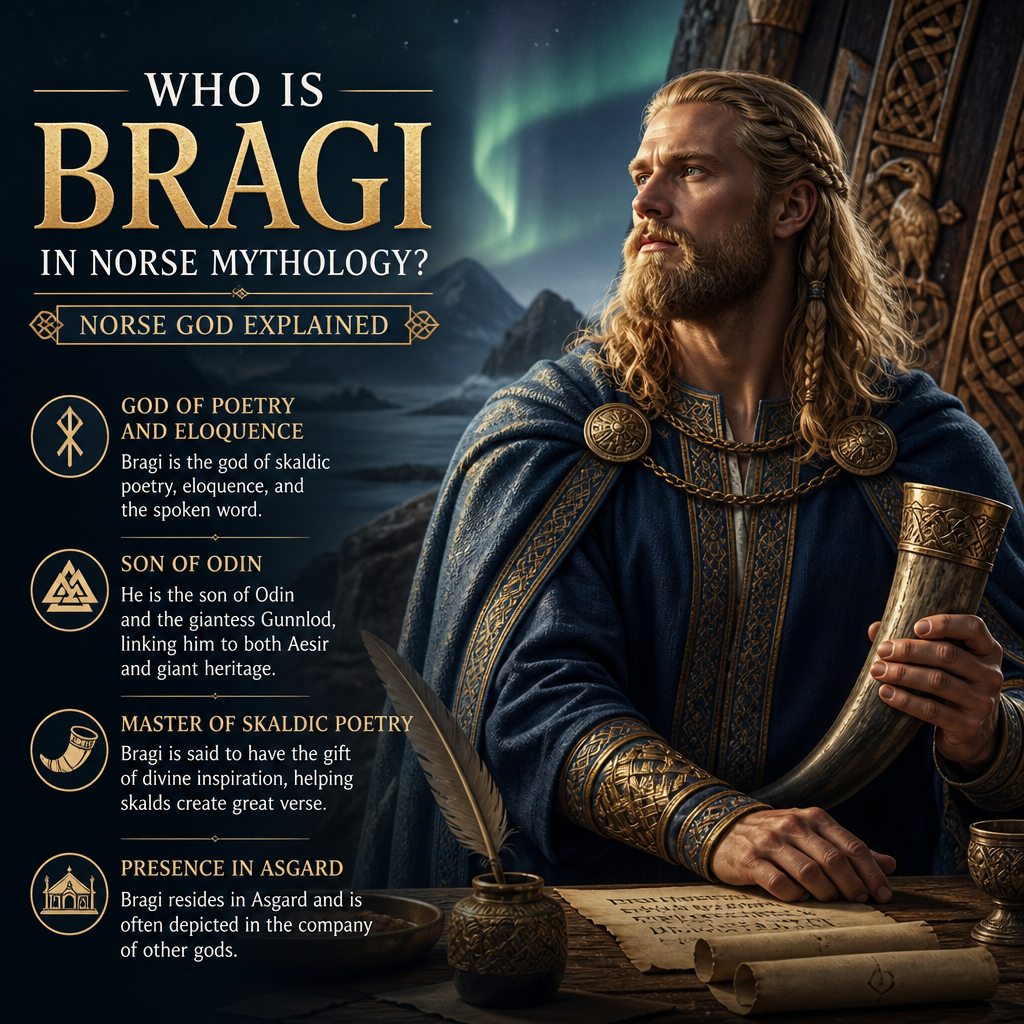
In Norse mythology, Bragi is the god of poetry, eloquence, and storytelling. He is closely associated with wisdom expressed through words, especially the art of composing verse. Among the gods of Asgard, Bragi stands out not as a warrior or trickster, but as a master of language whose gift is the power to preserve memory, honor heroes, and shape meaning through poetry.
When asking who is Bragi in Norse mythology, the simplest answer is that he is the divine poet of the Æsir, the tribe of gods that includes Odin, Thor, Frigg, and Baldr. Yet Bragi is more than just a patron of poets. He represents the importance of speech, tradition, and the spoken word in Norse culture.
Bragi’s Role Among the Norse Gods
Bragi is usually described as a wise and eloquent god. His name is often linked to the Old Norse word bragr, which can mean “poetry” or “the best.” This connection reflects his identity as the god most associated with skaldic verse—the complex and formal poetry practiced in medieval Scandinavia.
In the halls of Asgard, Bragi’s role was not to wield a hammer or command armies. Instead, he used language as his craft. Poetry in Norse society was not simply entertainment. It was a way to record history, praise rulers, honor the dead, and pass down myths. As the god of poetry, Bragi symbolized this sacred function.
Bragi is also portrayed as welcoming fallen heroes to Valhalla. In some sources, he is present when warriors arrive in Odin’s hall, offering words of greeting and recognition. This image reinforces his role as a figure of honor, memory, and ceremonial speech.
Bragi and Idunn
Bragi is married to Idunn, the goddess who guards the golden apples of youth. These apples keep the gods young and strong, making Idunn one of the most important figures in Asgard.
Their marriage is meaningful because it joins two powerful ideas: poetry and renewal. Bragi preserves memory through words, while Idunn preserves life and vitality through her apples. Together, they represent continuity—one through story and song, the other through physical rejuvenation.
Idunn appears in one of the best-known Norse myths, where she is kidnapped by the giant Thjazi after Loki tricks her into leaving Asgard. Without her apples, the gods begin to age. Although Bragi is not the central hero of this story, his connection to Idunn places him near one of the most important myths about the survival of the gods.
Bragi in the Prose Edda
Much of what we know about Bragi comes from the Prose Edda, written in the 13th century by the Icelandic scholar Snorri Sturluson. The Prose Edda preserves many older Norse myths and explains the language of skaldic poetry.
In this work, Bragi is presented as exceptionally wise and skilled in speech. Snorri describes him as famous for eloquence and poetry. Because of this, a particularly skilled poet could be called “bragr,” linking the god’s name with poetic excellence.
Bragi also appears in Skáldskaparmál, a section of the Prose Edda that explains poetic language and kennings. There, he acts as a speaker and storyteller, sharing mythological knowledge. This role suits him perfectly: Bragi is not only a subject of poetry, but also a teacher of poetic tradition.
Bragi in the Poetic Edda
Bragi also appears in the Poetic Edda, a collection of older mythological and heroic poems. One notable appearance is in Lokasenna, a poem in which Loki insults many of the gods during a feast.
In Lokasenna, Bragi tries to restrain Loki and maintain order. Loki responds by mocking him, accusing him of cowardice and boasting without action. Bragi answers with threats, but the scene presents him as more of a verbal figure than a physical fighter.
This episode highlights an important aspect of Bragi’s character. He belongs to the world of speech, honor, and formal exchange. Even when challenged, his power is connected to words. The tension between Bragi and Loki also contrasts two kinds of speech: Bragi’s noble poetry and Loki’s destructive insult.
Was Bragi Based on a Real Poet?
Some scholars have suggested that the god Bragi may be connected to a historical skald named Bragi Boddason, one of the earliest known Norwegian poets. Bragi Boddason likely lived in the 9th century and was famous for his skill in verse.
It is unclear whether the god inspired the poet’s name, or whether stories about the poet influenced later ideas about the god. In Norse tradition, the line between legendary heroes, honored ancestors, and divine figures could sometimes blur over time.
Still, Bragi’s divine role is well established in mythological sources. Whether or not he was influenced by a real poet, he became the personification of poetic mastery in the Norse imagination.
Symbols and Associations of Bragi
Bragi is not as visually iconic as Thor with his hammer or Odin with his spear and ravens. However, several qualities and symbols are commonly associated with him:
- Poetry and song: Bragi represents the sacred power of verse.
- Eloquence: He is the god of graceful, persuasive, and meaningful speech.
- Wisdom: His knowledge is expressed through storytelling and poetic tradition.
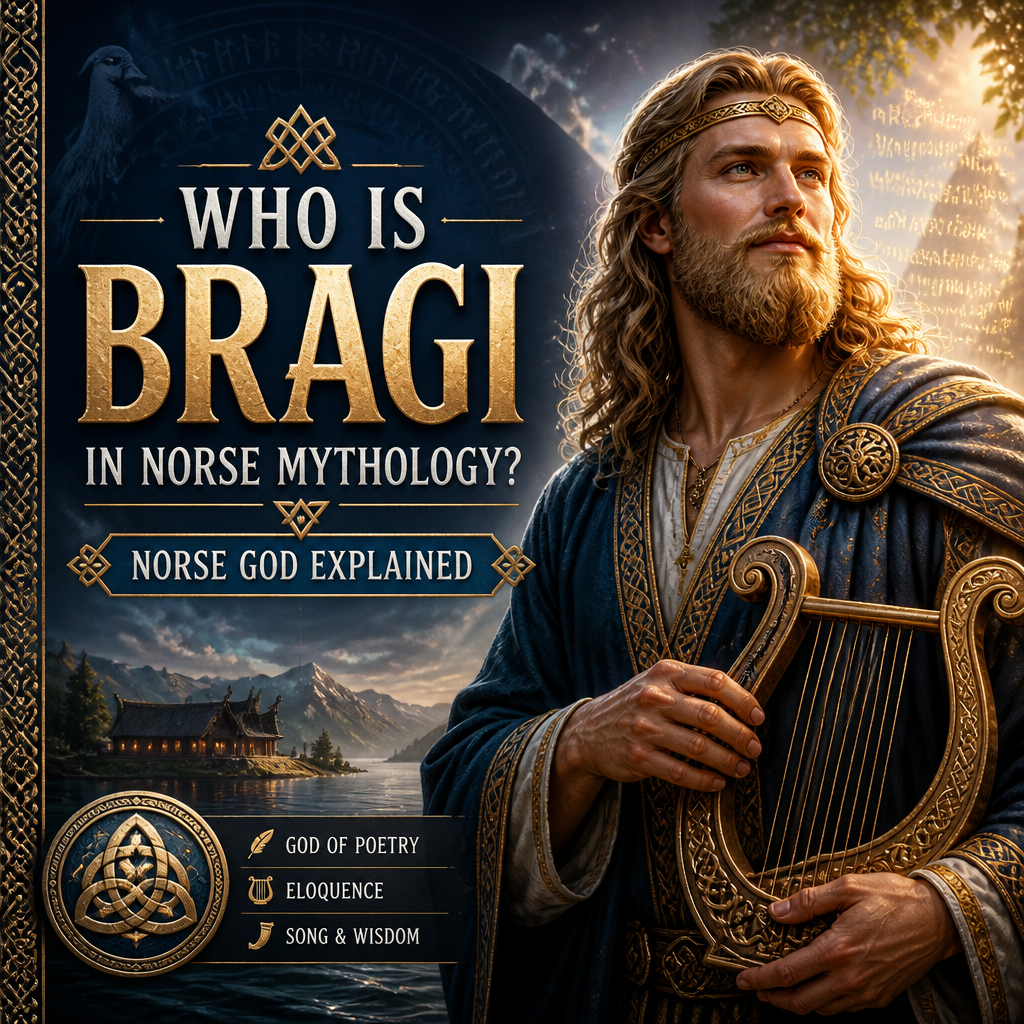
- The harp or lyre: Modern depictions often show him with a musical instrument, though this is more artistic than strictly based on ancient sources.
- A long beard: Some descriptions emphasize his beard, possibly as a sign of age, dignity, and wisdom.
These associations make Bragi a figure of culture rather than battle. He reminds us that Norse mythology was not only about war and fate, but also about art, memory, and language.
Why Bragi Matters in Norse Mythology
Bragi matters because poetry mattered deeply to the Norse world. Before myths were written down, they were spoken, sung, and remembered. Poets were keepers of history and reputation. Their words could make a king famous, preserve a warrior’s deeds, or carry the stories of gods across generations.
As the god of poetry, Bragi embodies this tradition. He shows that words had power in Norse belief—power to honor, teach, preserve, and even challenge. While he may not be as famous today as Odin, Thor, or Loki, Bragi holds an essential place in the mythological world.
Conclusion
So, who is Bragi in Norse mythology? He is the god of poetry, eloquence, and storytelling, a wise figure among the Æsir and the husband of Idunn. Through his association with verse and speech, Bragi represents one of the most important cultural values of the Norse world: the power of words to preserve memory and meaning.
In a mythology filled with battles, monsters, and cosmic fate, Bragi reminds us that stories themselves are sacred. Without poetry, even the greatest deeds of gods and heroes would fade into silence.

Orin Vale has spent the better part of two decades tracing the threads that connect the world’s oldest stories — from the halls of Asgard to the banks of the Nile, from Olympus to the jungles of the Maya. What began as a childhood fascination with flood myths and trickster gods grew into years of independent study across comparative mythology and ancient religion, always chasing the same question: what did these stories mean to the people who first told them? Orin writes for readers who want more than trivia — the ones looking for the beliefs, fears, and truths that myths were built to carry.