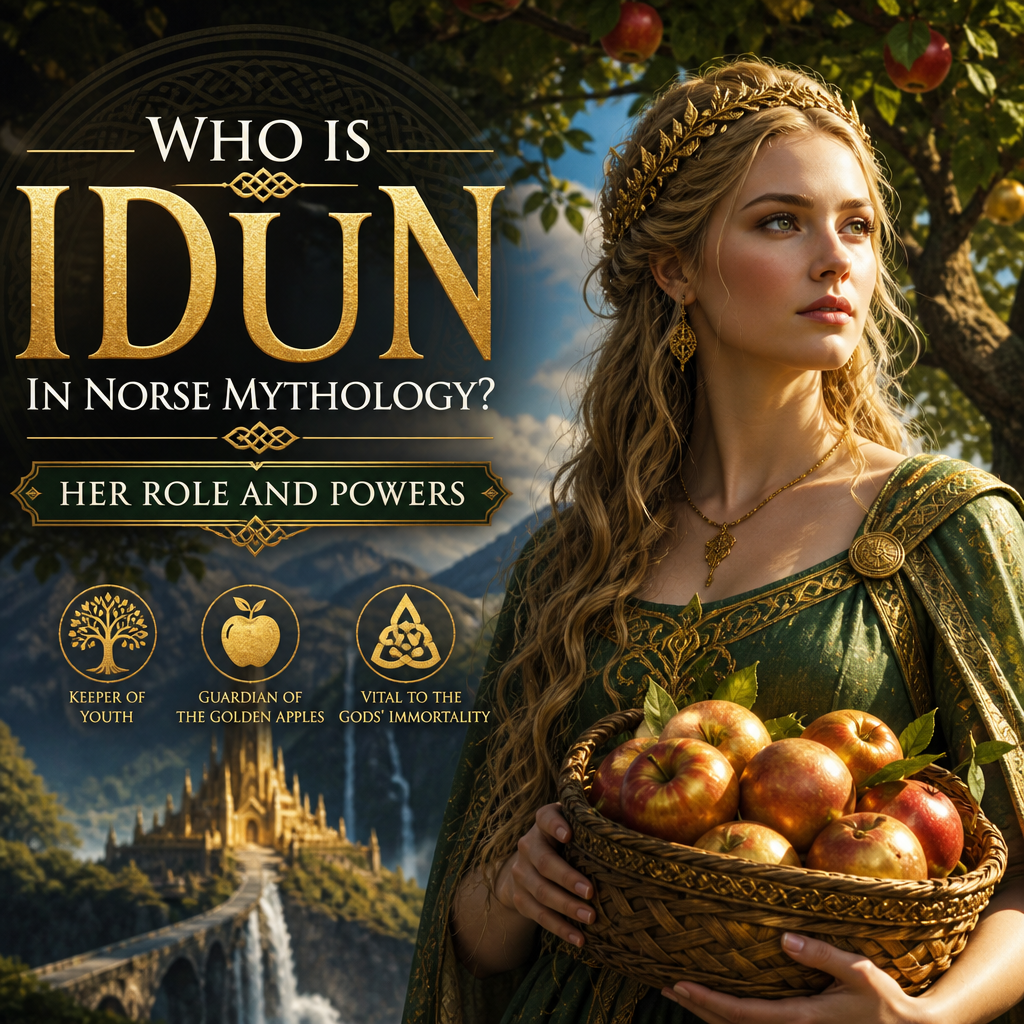
Who Is Idun in Norse Mythology?
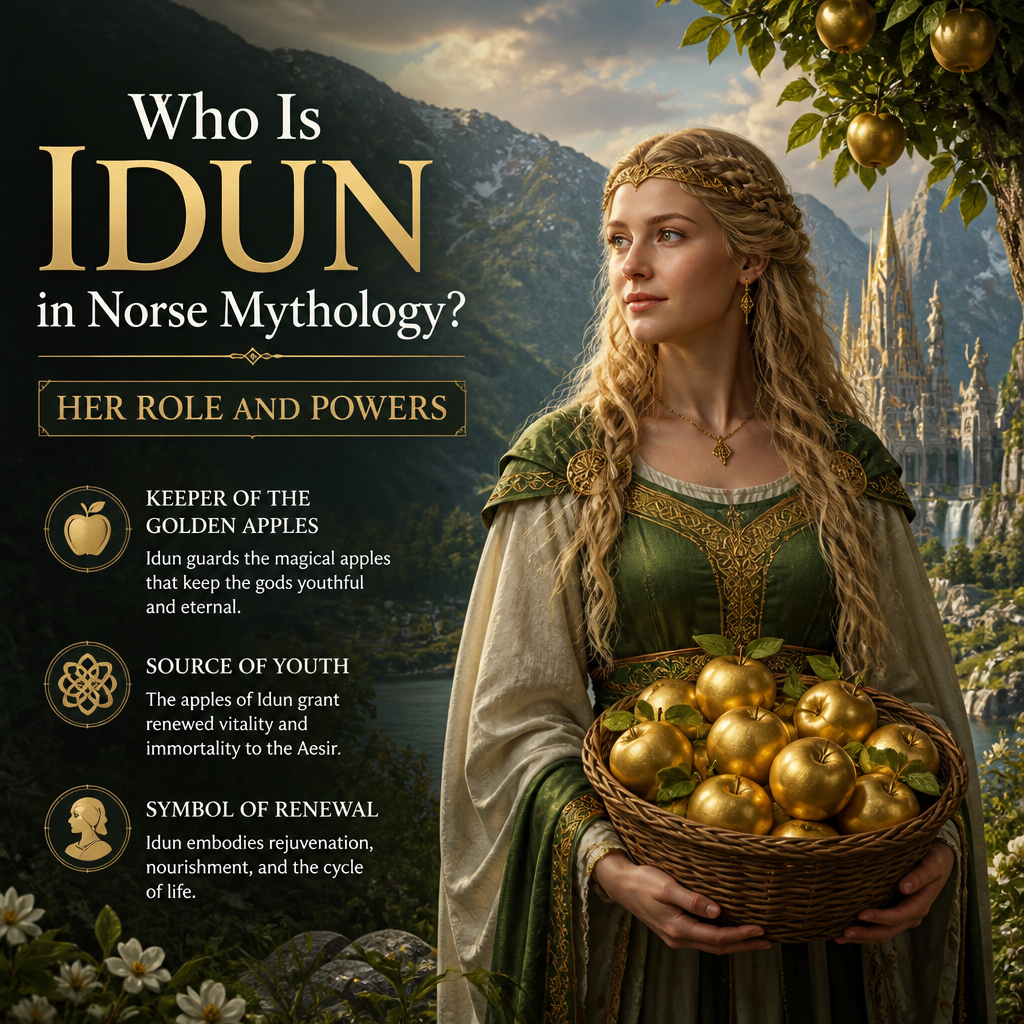
Idun is one of the most important goddesses in Norse mythology, even though she appears in relatively few surviving stories. Best known as the guardian of the magical apples that keep the gods young, Idun plays a vital role in maintaining the strength and vitality of the Aesir, the main tribe of Norse gods.
Her name is often translated as “the rejuvenating one” or “ever young,” which perfectly reflects her mythological role. Without Idun and her apples, even mighty gods like Odin, Thor, and Loki would grow old and weak.
Idun’s Role Among the Norse Gods
Idun belongs to the divine world of Asgard, home of the Aesir gods. She is closely associated with youth, renewal, fertility, and life-giving power. Unlike some Norse deities who are linked to war, wisdom, or thunder, Idun represents preservation and vitality.
Her most famous responsibility is guarding a store of magical apples. These apples are not ordinary fruit. In Norse myth, they allow the gods to retain their youth and avoid the decay of aging.
This makes Idun essential to the survival of the gods. Although the Norse gods are powerful, they are not immortal in the same way many other mythological gods are. They can age, weaken, and eventually die. Idun’s apples help delay that fate.
Idun and the Apples of Youth
The apples of Idun are among the most recognizable symbols connected to her. They represent renewal, beauty, health, and the ongoing cycle of life.
In the myths, the gods eat these apples whenever they begin to feel the effects of age. By doing so, they regain their youth and continue to rule and defend Asgard.
What Do Idun’s Apples Symbolize?
Idun’s apples can be understood in several ways:
- Youth and rejuvenation: They restore the gods’ strength and appearance.
- Fertility and growth: Apples are often linked with abundance and life.
- Divine dependence: Even gods need help to preserve their power.
- The fragility of order: If Idun is lost, Asgard itself becomes vulnerable.
This last point is especially important. Idun may seem gentle compared to warriors like Thor, but her role is central to the balance of the Norse cosmos.
The Kidnapping of Idun
The best-known story about Idun comes from the Prose Edda, written by the Icelandic scholar Snorri Sturluson in the 13th century. In this tale, Idun is kidnapped by the giant Thjazi, and the gods quickly begin to age without her.
The story begins with Odin, Loki, and Hoenir traveling away from Asgard. They try to cook an ox, but the meat will not cook properly. An eagle sitting nearby offers to help, but demands a share of the food.
The eagle is actually the giant Thjazi in disguise. When Loki strikes at him, Thjazi seizes Loki and carries him into the air. To save himself, Loki promises to bring Idun and her apples out of Asgard.
Loki’s Betrayal
Loki returns to Asgard and tricks Idun. He tells her that he has found apples even more wonderful than her own and persuades her to leave the safety of the gods’ realm. Idun brings her apples with her.
Once she is outside Asgard, Thjazi appears in eagle form and carries her away to his home in Jotunheim, the land of the giants.
With Idun gone, the gods begin to age rapidly. Their hair turns gray, their bodies weaken, and they realize that something is terribly wrong. They discover Loki’s role in her disappearance and threaten him with death unless he brings her back.
The Rescue of Idun
Loki borrows Freyja’s falcon cloak, which allows him to fly. He travels to Jotunheim and finds Idun alone while Thjazi is away. To rescue her, Loki transforms Idun into a nut and carries her back toward Asgard in his claws.
When Thjazi returns and sees what has happened, he changes into eagle form and chases Loki. The gods see them approaching and build a fire at the walls of Asgard. Loki flies safely over the flames, but Thjazi cannot stop in time. His feathers catch fire, and he falls, where the gods kill him.
With Idun restored to Asgard, the gods regain their youth and strength.
Idun’s Marriage to Bragi
Idun is married to Bragi, the god of poetry, eloquence, and song. Their pairing is meaningful. Bragi represents the power of words and memory, while Idun represents renewal and the preservation of life.
Together, they reflect themes that were deeply important in Norse culture: the continuation of tradition, the vitality of the community, and the lasting power of story.
Although there are not many myths that focus on their relationship, their marriage places Idun among the respected divine figures of Asgard.
Why Idun Matters in Norse Mythology
Idun may not be as famous as Odin, Thor, or Freyja, but she is indispensable. Her myth shows that the gods are dependent on forces of renewal. Strength alone is not enough. Wisdom, war, and magic all fade without the life-giving power that Idun protects.
Her kidnapping also reveals a recurring theme in Norse mythology: the constant tension between the gods and the giants. The giants often threaten the order of the cosmos, and Idun’s capture nearly causes disaster for Asgard.
Idun as a Symbol of Renewal
Today, Idun is often interpreted as a goddess of youth, spring, and rejuvenation. Her apples remain a powerful image of restored life and divine vitality.
She reminds us that renewal is not a minor force. In Norse mythology, it is what keeps even the gods alive.
Conclusion
So, who is Idun in Norse mythology? She is the goddess who guards the apples of youth, the wife of Bragi, and one of the key figures responsible for preserving the vitality of the gods. Though her stories are few, her importance is enormous.
Without Idun, the gods of Asgard would wither and decline. With her, they remain strong enough to face the dangers of giants, monsters, and even the coming doom of Ragnarok.

Orin Vale has spent the better part of two decades tracing the threads that connect the world’s oldest stories — from the halls of Asgard to the banks of the Nile, from Olympus to the jungles of the Maya. What began as a childhood fascination with flood myths and trickster gods grew into years of independent study across comparative mythology and ancient religion, always chasing the same question: what did these stories mean to the people who first told them? Orin writes for readers who want more than trivia — the ones looking for the beliefs, fears, and truths that myths were built to carry.