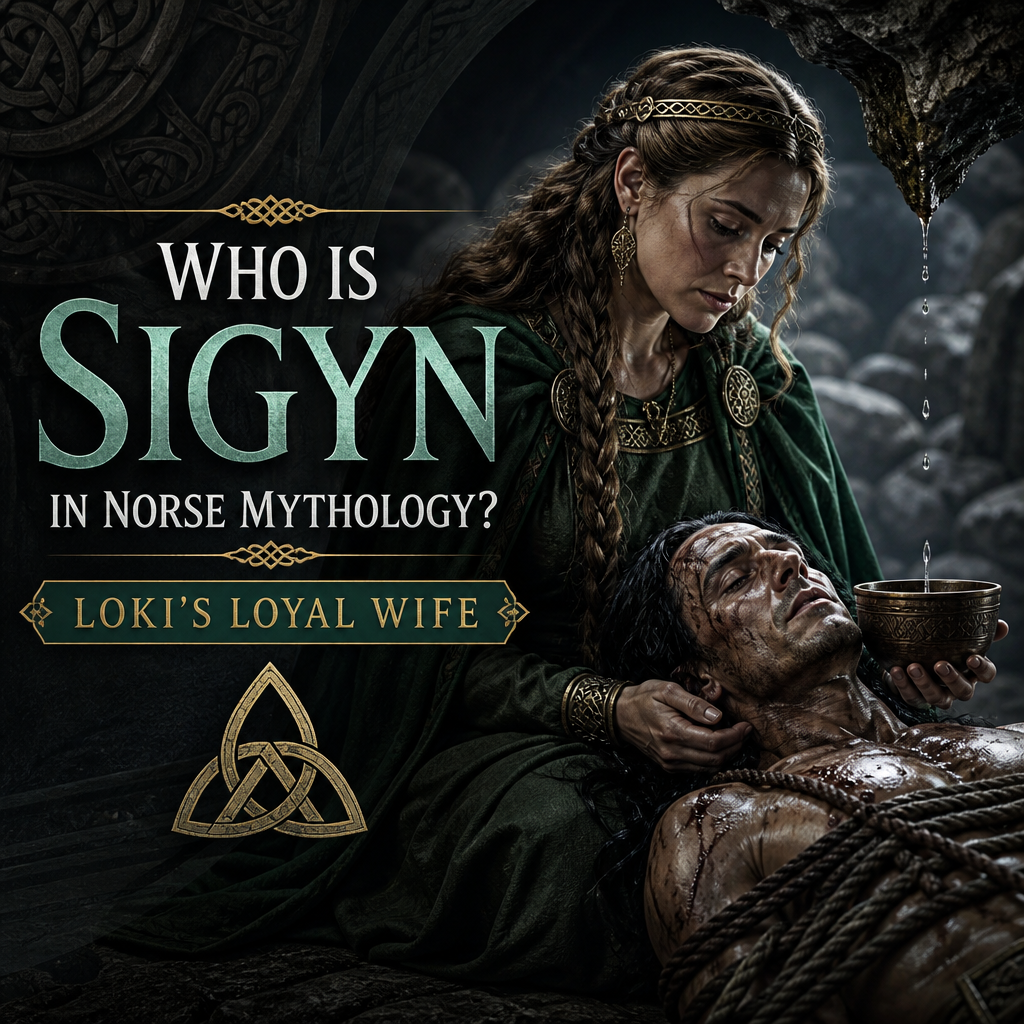
Who Is Sigyn in Norse Mythology?
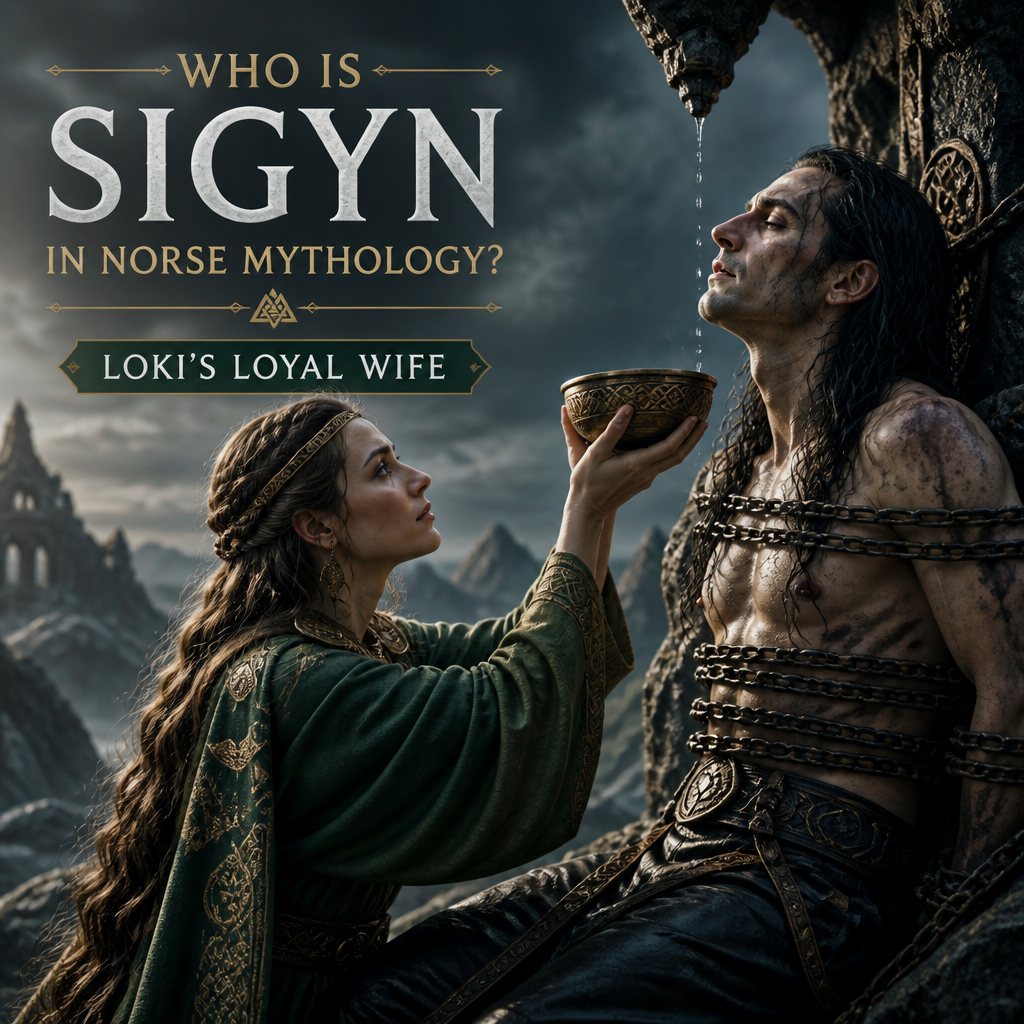
Sigyn is one of the quieter but deeply meaningful figures in Norse mythology. She is best known as the wife of Loki, the trickster god, and as the mother of his sons Narfi and Váli. Unlike many Norse gods and goddesses, Sigyn does not appear in many surviving myths, but her role in Loki’s punishment is unforgettable.
In the myths that mention her, Sigyn represents loyalty, endurance, and sorrow. Her story is brief, yet it has inspired centuries of interpretation because of its emotional power and mystery.
Sigyn’s Place in the Norse Pantheon
Sigyn is usually described as a goddess or divine figure among the Æsir, the main family of Norse gods associated with Asgard. Her name is often interpreted as meaning something like “victorious girlfriend” or “friend of victory,” though the exact meaning is debated by scholars.
Most of what we know about Sigyn comes from two major medieval sources:
- The Poetic Edda, a collection of Old Norse poems
- The Prose Edda, written by Snorri Sturluson in the 13th century
These texts preserve many of the myths of pre-Christian Scandinavia, though they were written down after the Viking Age. Because Sigyn appears only briefly, much about her identity and original significance remains uncertain.
Sigyn and Loki
The most important detail about Sigyn in Norse mythology is her marriage to Loki. Loki is one of the most complex figures in the Norse tradition. He is clever, shape-shifting, unpredictable, and often dangerous. At times, he helps the gods. At other times, he betrays them.
Sigyn’s relationship with Loki is not described in great detail. The myths do not tell us how they met, why they married, or what their marriage was like before Loki’s downfall. However, her actions during his punishment suggest a bond that is intense and enduring.
Loki has several children in Norse mythology. With the giantess Angrboða, he fathers three monstrous offspring: Fenrir the wolf, Jörmungandr the world serpent, and Hel, ruler of the dead. With Sigyn, he has sons named Narfi and Váli, though the details vary between sources.
The Punishment of Loki
Sigyn’s most famous myth comes after Loki causes the death of Baldr, one of the most beloved gods. Baldr’s death is a turning point in Norse mythology and one of the events that leads toward Ragnarök, the doom of the gods.
After Loki’s role is revealed, the gods capture him and devise a terrible punishment. According to the Prose Edda, they bring Loki to a cave and bind him with the entrails of one of his sons. A serpent is placed above him so that venom drips onto his face.
This punishment is meant to last until Ragnarök. Loki cannot escape, and the venom causes him unbearable pain. When the poison touches him, he writhes so violently that the earth shakes. In the myth, this explains the cause of earthquakes.
Sigyn’s Bowl
This is where Sigyn becomes central to the story.
Rather than abandoning Loki, Sigyn stays beside him in the cave. She holds a bowl above his face to catch the serpent’s venom before it can fall on him. Her task is endless and painful. When the bowl fills, she must step away to empty it. During those moments, the venom strikes Loki, and his agony shakes the world.
Sigyn’s image is one of the most haunting in Norse mythology: a wife standing over her bound husband, trying to lessen his suffering even though she cannot free him.
Her act raises many questions. Is she motivated by love? Duty? Desperation? Divine loyalty? The sources do not explain her thoughts. This silence is part of what makes Sigyn so compelling.
What Does Sigyn Symbolize?
Because Sigyn appears in such a limited number of myths, modern interpretations of her vary. Still, several symbolic meanings are often associated with her.
Loyalty
Sigyn is most commonly seen as a figure of loyalty. She remains with Loki after the gods condemn him. Even though Loki has brought disaster upon himself and others, Sigyn does not leave.
Her loyalty is not glamorous or rewarded. It is quiet, painful, and private.
Endurance
Sigyn’s story is also about endurance. She cannot stop Loki’s punishment, but she does what she can. Her bowl does not end his suffering, yet it reduces it for a time.
This makes her a powerful symbol of persistence in the face of impossible circumstances.
Grief
Sigyn is also connected with grief. In some versions of the myth, her children are destroyed as part of Loki’s punishment. If so, she stands in the cave not only as a wife but also as a grieving mother.
Her silence in the myths may reflect the depth of that sorrow. She does not give speeches or seek revenge. She simply remains.
Is Sigyn a Major Goddess?
Sigyn is not a major goddess in the same way as Frigg, Freyja, or Sif. She is not associated with a large number of myths, temples, or clearly defined powers. There is little evidence that she had a widespread cult or major role in Viking Age religious practice.
However, mythological importance is not always measured by the number of stories. Sigyn’s one major scene is emotionally powerful enough to make her memorable. She appears at one of the darkest moments in the Norse mythic cycle, standing beside one of its most controversial figures.
Sigyn in Modern Culture
In modern retellings of Norse mythology, Sigyn is often expanded beyond her brief appearances in the Eddas. Writers, artists, and spiritual practitioners have imagined her inner life, her marriage to Loki, and her experience of loss.
She is sometimes portrayed as:
- A devoted wife
- A tragic goddess
- A symbol of compassion
- A figure of quiet strength
- A witness to the coming of Ragnarök
Because the original sources leave so much unsaid, Sigyn has become a character open to interpretation. Her mystery gives modern audiences room to explore themes of love, suffering, and resilience.
Why Sigyn Still Matters
So, who is Sigyn in Norse mythology? She is the wife of Loki, the mother of his sons, and the goddess who stays beside him during his terrible punishment. Though she appears only briefly in the surviving myths, her role is unforgettable.
Sigyn matters because she represents a kind of strength that is often overlooked. She does not win battles, command armies, or shape-shift like Loki. Instead, she endures. She stays. She offers relief where she cannot offer rescue.
In a mythology filled with warriors, monsters, and cosmic destruction, Sigyn’s quiet presence stands out. Her story reminds us that loyalty and sorrow can be just as powerful as thunder, magic, or war.

Orin Vale has spent the better part of two decades tracing the threads that connect the world’s oldest stories — from the halls of Asgard to the banks of the Nile, from Olympus to the jungles of the Maya. What began as a childhood fascination with flood myths and trickster gods grew into years of independent study across comparative mythology and ancient religion, always chasing the same question: what did these stories mean to the people who first told them? Orin writes for readers who want more than trivia — the ones looking for the beliefs, fears, and truths that myths were built to carry.