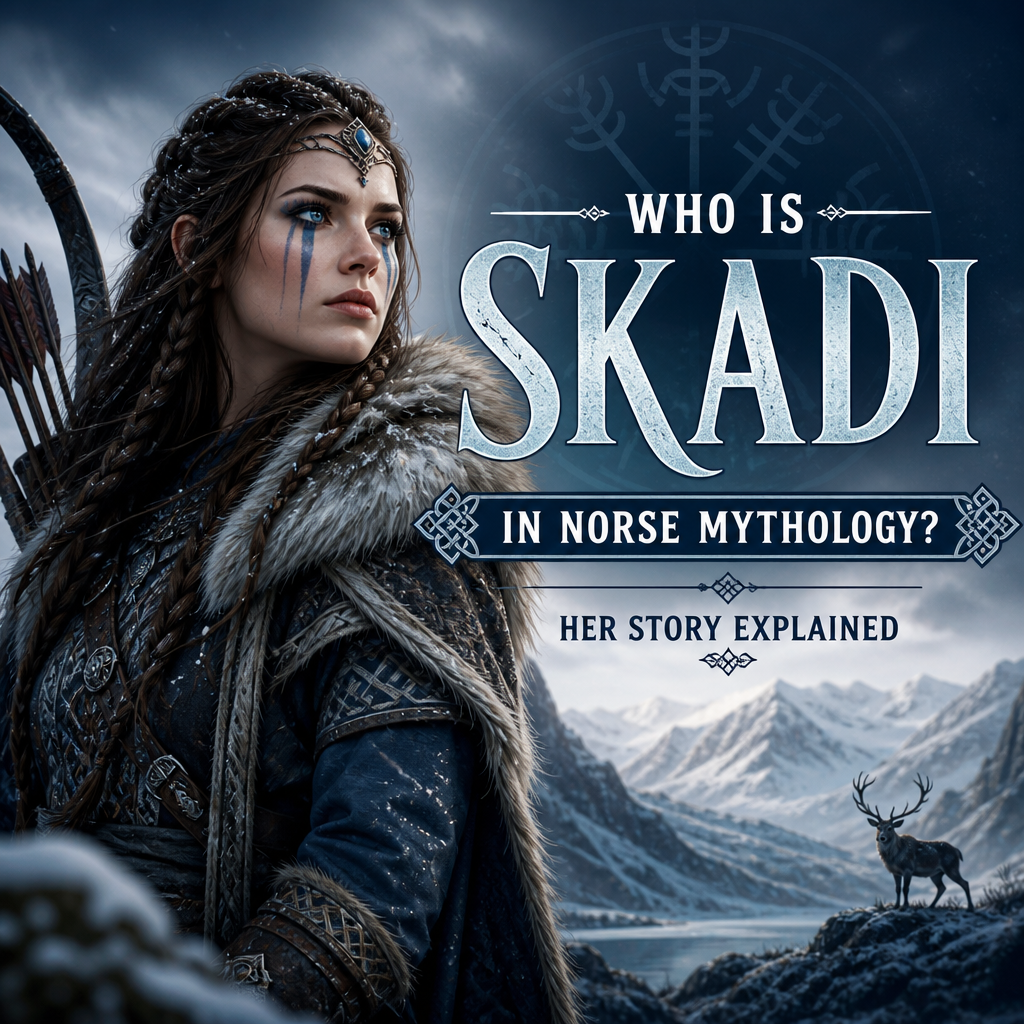
Who Is Skadi in Norse Mythology?
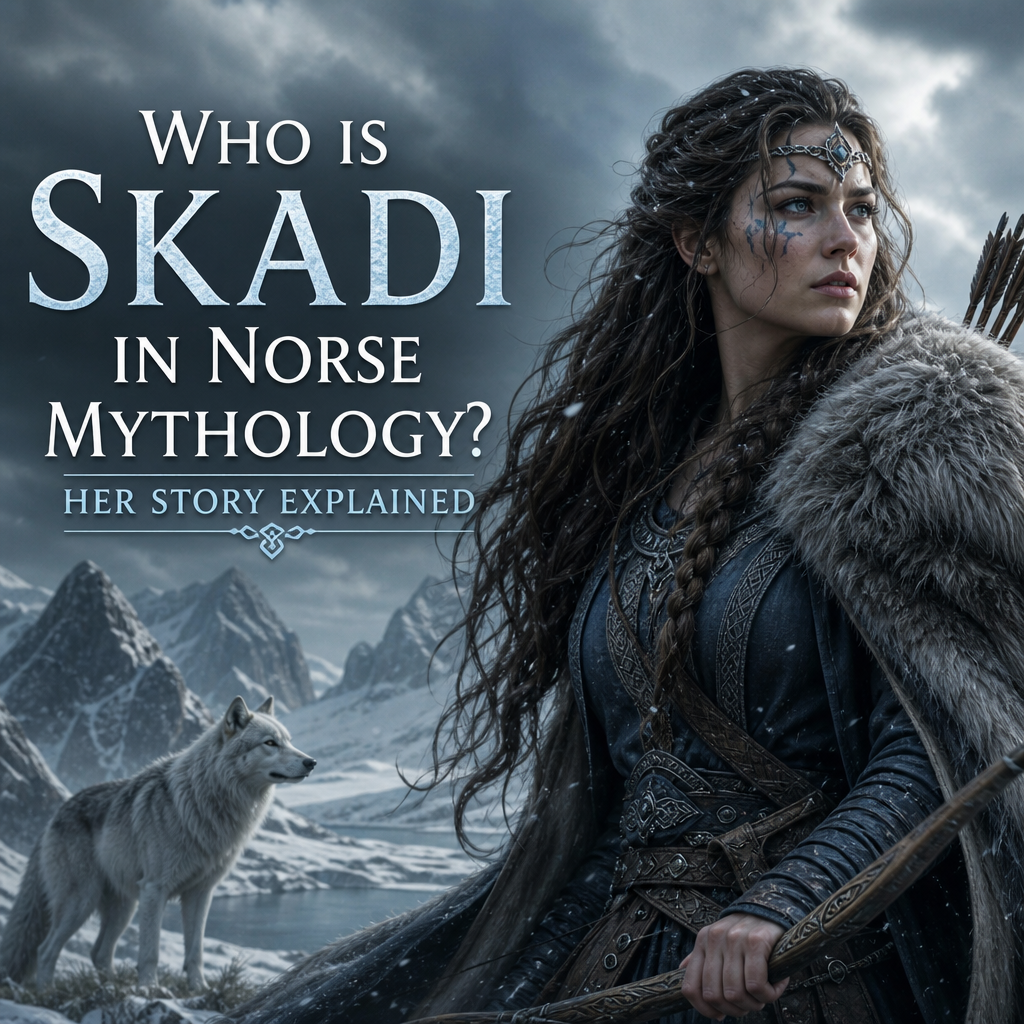
Skadi is one of the most striking figures in Norse mythology: a giantess associated with winter, mountains, skiing, hunting, and independence. Often described as fierce, proud, and self-reliant, she stands at the crossroads between the world of the gods and the world of the giants.
Although she is not as widely known as Odin, Thor, or Loki, Skadi plays an important role in several myths. Her story reveals themes of revenge, marriage, honor, and the uneasy relationship between the Aesir gods and the giants.
Skadi’s Origins
Skadi is the daughter of the giant Thjazi, a powerful figure who appears in the myth of Idunn’s apples. In Norse mythology, giants are not always simple monsters. They are ancient beings, often associated with wild nature, chaos, wisdom, and forces beyond the control of the gods.
Skadi belongs to this world of frost, mountains, and wilderness. Her name is sometimes linked to words connected with “shadow” or “harm,” though scholars debate its exact meaning. What is clear is that Skadi embodies a harsh northern landscape: cold, remote, and dangerous, but also majestic.
She is most often connected with:
- Snowy mountains
- Winter weather
- Skiing and snowshoes
- Bow hunting
- Wolves and wild places
- Strength and independence
In later traditions, she is sometimes seen as a goddess of winter or skiing, though her original role is more complex because she is a giantess who becomes linked to the gods.
The Death of Thjazi
To understand who Skadi is in Norse mythology, it is important to know the story of her father, Thjazi.
Thjazi once forced Loki to help him kidnap Idunn, the goddess who guarded the magical apples that kept the gods youthful. Without Idunn and her apples, the gods began to age. Realizing the danger, they pressured Loki into rescuing her.
Loki transformed Idunn into a nut and carried her away in the form of a falcon. Thjazi chased them as an eagle, but when he reached Asgard, the gods lit a fire that burned his feathers. Thjazi fell and was killed.
When Skadi learned that her father had been slain, she armed herself and traveled to Asgard to demand compensation.
Skadi Comes to Asgard
Skadi’s arrival in Asgard is one of her most memorable moments. Rather than mourning quietly, she puts on armor and goes directly to the home of the gods. This shows her courage and status. She is not afraid to confront the Aesir, even in their own realm.
The gods, recognizing the seriousness of her demand, offer compensation instead of battle. In Norse culture, this kind of settlement was important. A death could be answered through vengeance or through payment and agreement.
Skadi asks for two things.
First, she wants to choose a husband from among the gods. Second, she demands that the gods make her laugh, something she believes is impossible in her grief.
The Strange Marriage Choice
The gods agree that Skadi may choose a husband, but they impose one unusual condition: she can only choose by looking at the men’s feet.
Skadi hopes to marry Baldr, the beautiful and beloved god. When she sees a pair of exceptionally handsome feet, she assumes they must belong to him. Instead, they belong to Njord, the god of the sea, wealth, ships, and coastal prosperity.
So Skadi marries Njord.
This marriage is one of the great mismatches in Norse mythology. Skadi loves the mountains, snow, and howling wolves. Njord loves the sea, ships, and the cries of gulls. They try to live together, but neither can be happy in the other’s home.
Skadi and Njord: Mountains vs. Sea
Skadi and Njord attempt a compromise. They spend part of their time in Njord’s seaside home, Noatun, and part in Skadi’s mountain home, Thrymheim.
But the arrangement fails.
Njord cannot sleep in the mountains because of the wolves. Skadi cannot sleep by the sea because of the seabirds. Their worlds are too different, and eventually they separate.
This myth is often interpreted as a symbolic contrast between two landscapes:
- The cold mountains and snowy wilderness
- The fertile coast and seafaring world
- The life of the hunter
- The life of trade, fishing, and ships
Their failed marriage shows that even among gods and giants, some differences cannot be easily reconciled.
How Loki Made Skadi Laugh
Skadi’s second demand is that the gods make her laugh. This task falls to Loki, the trickster god.
In a strange and comic episode, Loki ties one end of a rope to a goat and the other to himself. The two pull against each other in a ridiculous contest, causing Loki to fall into Skadi’s lap. This absurd scene finally makes her laugh.
The moment is unusual, but it matters. Skadi’s laughter signals that the settlement is complete. Her grief and rage have not vanished, but the gods have honored her demand and restored a kind of balance.
Skadi’s Role in Loki’s Punishment
Skadi appears again in the story of Loki’s punishment. After Loki causes the death of Baldr and insults the gods at a feast, he is captured and bound beneath the earth.
In some accounts, Skadi places a venomous serpent above Loki’s face so that poison drips onto him. Loki’s wife, Sigyn, catches the venom in a bowl, but when she turns away to empty it, the poison strikes Loki and he writhes in pain. His shaking is said to cause earthquakes.
Skadi’s role here reflects her stern and unforgiving nature. Loki once made her laugh, but he is also connected to the events that led to her father’s death. Her part in his punishment suggests a long memory and a commitment to justice or vengeance.
Is Skadi a Goddess or a Giantess?
Skadi is usually described as a giantess, but she becomes closely connected with the gods through marriage and myth. This makes her identity interesting. Norse mythology often blurs the line between gods and giants. Many gods have giant ancestry, and some giants marry into divine families.
Skadi is not simply an enemy of the gods. She is a powerful being who enters Asgard on her own terms, negotiates compensation, marries a god, and remains an important figure.
Because of her associations with winter, hunting, and skiing, modern readers often call her a goddess. In a broad sense, that title fits her mythological importance, but her giant origins are essential to understanding her character.
Why Skadi Matters
Skadi stands out because she is independent, forceful, and deeply tied to nature’s harsher side. She does not represent domestic comfort or gentle fertility. Instead, she represents endurance, cold beauty, and survival in wild places.
Her myths also reveal key ideas in Norse storytelling:
- Honor must be defended
- Grief can demand compensation
- Marriage can symbolize alliances between worlds
- Nature is powerful, divided, and difficult to tame
- Giants and gods are enemies, relatives, and partners all at once
Skadi is a reminder that Norse mythology is not only about heroic battles and famous gods. It is also filled with complex figures who move between worlds.
Final Thoughts
So, who is Skadi in Norse mythology? She is a giantess of winter and the mountains, a hunter, a skier, a grieving daughter, and a powerful figure who confronts the gods themselves. Her story combines tragedy, humor, failed marriage, and revenge.
Skadi’s icy world may be harsh, but it is also one of strength and freedom. That is why she remains one of the most fascinating and memorable women in Norse myth.

Orin Vale has spent the better part of two decades tracing the threads that connect the world’s oldest stories — from the halls of Asgard to the banks of the Nile, from Olympus to the jungles of the Maya. What began as a childhood fascination with flood myths and trickster gods grew into years of independent study across comparative mythology and ancient religion, always chasing the same question: what did these stories mean to the people who first told them? Orin writes for readers who want more than trivia — the ones looking for the beliefs, fears, and truths that myths were built to carry.