Is the Greek Eye (Mati) Part of Greek Mythology?
Introduction
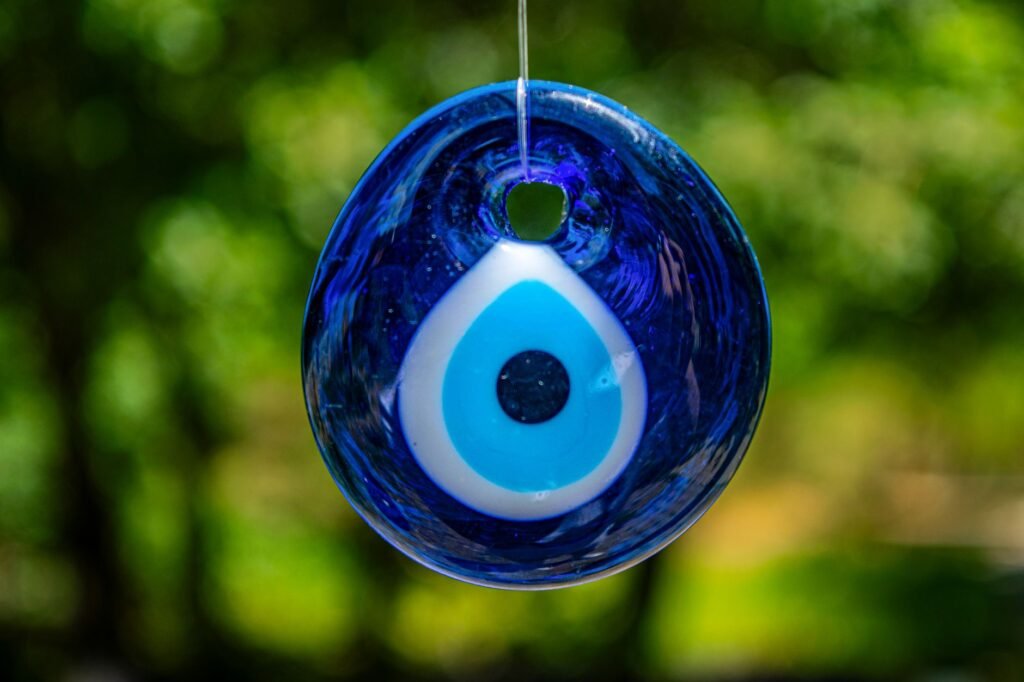
The Greek eye, commonly called the mati or evil eye, is one of the best-known symbols associated with Greek culture. It appears on amulets, jewelry, house decorations, and modern souvenirs, often as a blue eye designed to ward off envy and misfortune. Because it is so widely linked with Greece, many people ask a simple but important question: is the Greek Eye (mati) part of Greek mythology?
The short answer is not exactly. The mati is part of Greek folk belief, popular religion, and Mediterranean protective tradition, but it is not a deity, hero, or classical mythological figure in the way that Zeus, Athena, or Medusa are. Its roots are ancient, and ideas about the harmful gaze appear in Greek literature and broader ancient Mediterranean culture, but the modern “Greek eye” as a recognizable blue charm is mainly a later popular symbol rather than a single myth from the classical canon.
Understanding the mati helps explain how ancient ideas, religious practices, superstition, and modern identity overlap in Greek culture.
Origin and Meaning
The Greek word mati (μάτι) simply means “eye.” In modern Greek, it is also used in the expression to mati, referring to the evil eye or the harmful look believed to bring bad luck, illness, or envy-driven misfortune.
The concept behind the mati is older than the modern amulet itself. Similar beliefs about the destructive power of envious looks are found across:
- ancient Greece
- the Roman world
- the Near East
- the wider Mediterranean
- South Asia and the Balkans
The idea is not unique to Greece. What is specifically Greek is the local tradition, vocabulary, rituals, and modern protective symbol that developed around it.
The modern blue-eye charm, usually called mati, mataki, or nazar in broader regional usage, is most commonly used as a protective talisman. Its purpose is to reflect or absorb harmful jealousy, often through the image of an eye meeting an eye.
Historical Context
Belief in the evil eye is ancient and widespread. In classical Greek society, people strongly valued honor, reputation, and social balance. Envy was feared as a destructive force, and the gaze itself was often thought to carry power.
Ancient Greeks did not necessarily have one unified doctrine about the evil eye. Instead, they had a cluster of beliefs and practices related to:
- envy (phthonos)
- harmful gazes
- witchcraft and curses
- ritual purification
- amuletic protection
These beliefs were expressed in literature, medical thought, magic, and everyday custom. In some sources, the harmful eye was associated with jealousy from humans; in others, it was imagined as a more general supernatural danger.
The evil eye in the ancient world
The idea was especially important because the eye was often understood as an organ linked to intention and influence. A person who looked at another with envy could be seen as causing harm through that gaze.
Ancient writers in Greece and later Rome discussed the evil eye in varying ways. Some treated it as a popular superstition; others recorded it as a real and dangerous force. This diversity matters because it shows that the mati belongs to a living belief tradition, not a fixed mythological story.
Relationship to religion
The mati is not part of the formal Olympian pantheon. It was never a major cult deity. However, protective practices against the evil eye could coexist with:
- prayers
- blessings
- household piety
- saints in later Christian Greece
- amulets and apotropaic symbols
In this sense, the mati sits at the border of religion, magic, and folklore.
Main Characteristics
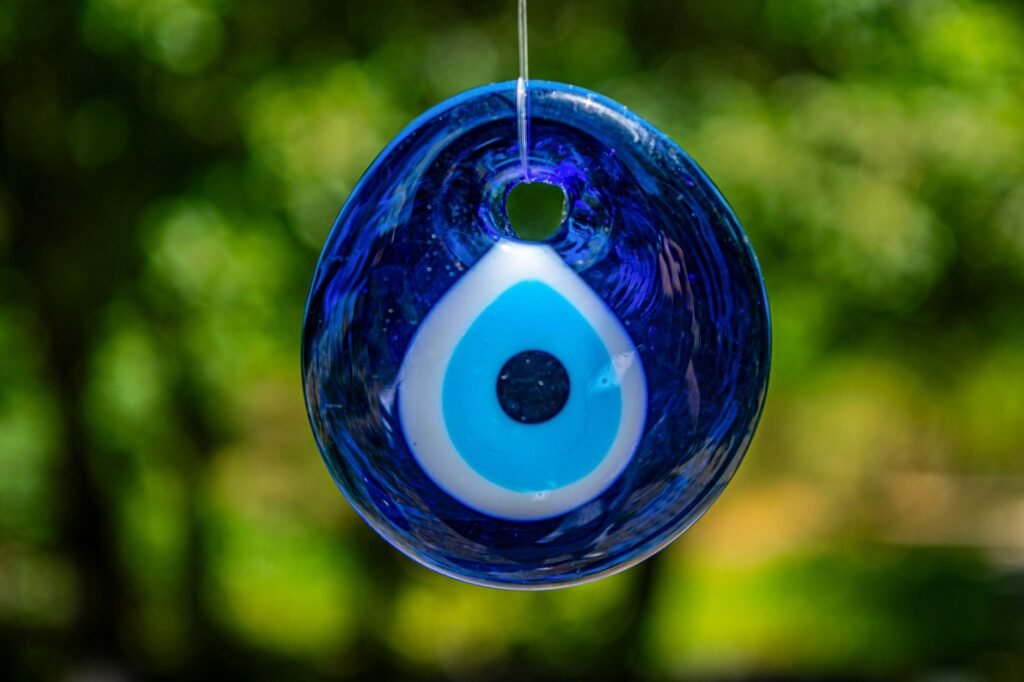
The most familiar form of the Greek eye is a blue-and-white eye-shaped amulet. It is usually circular, with concentric rings, and visually resembles a staring eye.
Typical characteristics of the mati amulet
| Feature | Description | Purpose |
|---|---|---|
| Shape | Eye motif, usually round | Symbolic defense against harmful gaze |
| Color | Often blue, white, black, and sometimes light turquoise | Blue is associated with protection in many Eastern Mediterranean traditions |
| Material | Glass, ceramic, metal, enamel, plastic | Durable everyday use |
| Placement | Worn as jewelry, hung in homes, placed in cars or businesses | Protection of person or property |
| Function | Apotropaic charm | To avert envy, misfortune, and the evil eye |
The amulet is apotropaic, meaning it is designed to turn away harm.
Visual symbolism
The eye works in two ways:
- It mirrors the threat — the harmful gaze is met by another eye.
- It symbolizes vigilance — the charm “watches” for danger.
Because it is so recognizable, the mati has become one of the most enduring visual markers of Greek and Eastern Mediterranean identity.
Family and Genealogy
The Greek eye is not a mythological being, so it does not have parents, children, spouses, or a genealogy in the usual sense.
However, it belongs to a larger family of beliefs and protective symbols.
Related traditions
The mati is connected to:
- the evil eye belief system
- apotropaic charms and amulets
- folk magic
- protective prayers and blessings
- broader Mediterranean protective symbolism
In Greek mythology, there are also figures and beings associated with vision, danger, and enchantment, but they are not the mati itself. The Greek eye should not be confused with mythological eyes or monstrous gaze figures such as the Gorgons, especially Medusa, who belong to a different mythic category.
Symbols
The mati is itself a symbol, so its symbolism is central to its meaning.
Common symbols associated with the mati
- The eye: protection through reflected gaze
- Blue color: often linked with safety, purity, and warding off harm in popular tradition
- Concentric circles: suggest an eye and create visual focus
- Glass or polished surfaces: used because reflective materials are believed to deflect negativity
Symbolic interpretation
The mati is usually interpreted as:
- a guardian symbol
- a defensive charm
- a sign of good fortune
- a warning against envy
In modern usage, it can also function as a cultural emblem, not only a magical object.
Sacred Animals
There are no sacred animals specifically associated with the Greek eye in the way that certain gods have sacred birds, snakes, or bulls.
That said, in broader Greek and Mediterranean symbolism, animals may appear in protective contexts or on amulets. But these are not essential features of the mati tradition.
If any animal symbolism appears in modern decorative versions of the evil eye, it is usually commercial or regional rather than ancient mythological doctrine.
Sacred Plants
There are no specific sacred plants universally tied to the mati.
Some Greek folk traditions use herbs, incense, or plants in cleansing and protective rituals, but these customs vary by region and household. Such practices are better understood as part of folk religion and domestic ritual rather than a mythological plant tradition connected directly to the Greek eye.
Common protective plants in broader Mediterranean tradition may include herbs used for cleansing or blessing, but no single plant is universally canonical for the mati.
Sacred Places
The mati does not have one central sanctuary, temple, or sacred city.
Instead, its “places” are often domestic and everyday spaces:
- homes
- doorways
- workplaces
- shops
- vehicles
- children’s rooms
Regional importance
The belief is especially prominent in:
- Greece
- Cyprus
- parts of the Balkans
- the Aegean
- the broader Eastern Mediterranean
The mati is therefore best understood as a portable protective tradition, not a temple-based cult.
Powers and Attributes
The key power of the mati is protection.
Main attributed functions
- repelling the evil eye
- deflecting envy
- protecting children and infants
- guarding homes and businesses
- bringing good luck
- symbolically preventing spiritual or emotional harm
In traditional belief, the evil eye may be caused by:
- jealousy
- admiration that becomes excessive
- resentment
- a person’s unintentionally harmful gaze
The mati’s role is to interrupt this negative force.
Apotropaic logic
The logic behind the mati is broadly apotropaic: it uses symbolic confrontation to neutralize danger. The eye on the amulet “faces” the dangerous gaze and sends it back or absorbs it.
Main Myths
This is where an important distinction must be made.
There is no single major Greek myth about the mati itself. Unlike the stories of Perseus, Odysseus, or Demeter, the Greek eye is not the subject of a canonical myth in the classical sense.
However, there are myths and stories connected to the wider idea of dangerous sight, envy, and magical protection.
Related mythic themes
The power of the gaze
Greek mythology often grants extraordinary power to sight and vision. The eye can bless, harm, transform, or destroy. This broader theme supports the cultural logic behind the evil eye.
Medusa and petrifying vision
Medusa’s gaze turns viewers to stone. While this is not the same as the mati, it shows that ancient Greek imagination often treated the eye as an instrument of power and danger.
Envy and divine jealousy
Greek stories frequently depict envy or rivalry among mortals and gods. The concept of phthonos helps explain why harmful envy became central to evil-eye belief.
The protective gaze
In some traditions, a powerful counter-gaze or divine protection neutralizes danger. This idea resonates with the mati’s function.
Not a mythological character
Because the mati is not a named deity or heroine, it should be described as a folk-belief symbol rather than a mythological personage.
Relationship with Other Mythological Figures
The mati is not directly genealogically related to classical gods or heroes. Still, it can be compared to several mythological and religious figures because of shared symbolic themes.
Comparable figures and concepts
| Figure or concept | Relation to mati | Similarity |
|---|---|---|
| Medusa | Not the same, but often compared | Dangerous gaze |
| Athena | No direct link | Protective power, wisdom, and sometimes guardianship |
| Apollo | Indirect comparison | Light, healing, and purification |
| Hermes | Indirect comparison | Protection, travel, talismans |
| The Gorgons | Symbolic comparison | Fearsome or protective visual power |
| Phthonos | Conceptual connection | Envy as harmful force |
The strongest relationship is conceptual rather than genealogical. The mati belongs to the same symbolic universe as ancient ideas about vision, power, and envy.
Worship and Cult
The mati is not worshipped as a god or goddess.
Instead, it is used, displayed, and sometimes blessed. Its “cult,” in a broad anthropological sense, is a practice of protection rather than formal worship.
Traditional practices
Depending on region and family custom, practices against the evil eye may include:
- wearing an amulet
- hanging a charm in the house
- reciting prayers
- making the sign of the cross in Christian contexts
- using blessed water or oil
- avoiding excessive praise of a child or success
- performing cleansing rituals after suspected evil-eye influence
Social context
In many Greek communities, the evil eye belief is also social etiquette. People may avoid praising a baby too openly or may add protective phrases when complimenting someone. These customs reduce the risk of attracting envy.
Modern practice
Today, the mati is often worn or displayed as:
- cultural identity
- a souvenir
- a fashion accessory
- a traditional protective object
- a symbol of luck
In some households, the belief remains serious; in others, the charm is treated as cultural heritage or symbolic decoration.
Ancient Sources
Because the mati is a folk belief rather than a single myth, its traces appear in a range of ancient and later sources rather than one definitive text.
Classical and later authors who discuss related ideas
- Hesiod: broader moral and cosmic themes of labor, strife, and human conditions
- Homer: not on the mati specifically, but important for understanding the ancient Greek worldview
- Plato: discussions of perception, gaze, and influence appear in philosophical contexts
- Plutarch: mentions beliefs and customs relevant to the evil eye in later Greek thought
- Pausanias: valuable for descriptions of Greek religious customs and local traditions
- Apollonius of Rhodes and others: useful for mythic settings involving magical or dangerous power
- Ovid: Roman perspective on related beliefs
- Greek magical papyri: later texts showing the practical use of charms and protective formulas
Important caution
No single ancient author “invented” the mati. The belief developed over time across oral tradition, popular religion, and magical practice. Ancient texts provide evidence for the broader concept of harmful vision and protective ritual, but not a neat, unified doctrine.
Roman Equivalent
The Roman world had its own version of the evil eye, commonly known through the Latin term fascinatio and related ideas. Romans also used amulets and protective symbols against envy and harmful gazes.
Comparison with the Roman tradition
| Greek tradition | Roman tradition | Notes |
|---|---|---|
| Mati / evil eye | Fascinatio / envy-based harmful gaze | Similar apotropaic logic |
| Eye amulets | Protective charms, phallic symbols, amulets | Different forms, same purpose |
| Household protection | Domestic religious and magical protection | Widely practiced in both cultures |
The Greek and Roman traditions influenced each other strongly in antiquity, and later Mediterranean cultures inherited elements from both.
Influence on Modern Culture
The Greek eye has become a globally recognized symbol. Its modern popularity goes far beyond classical mythology.
In Greece and the diaspora
Among Greeks at home and abroad, the mati is used as:
- a cultural identifier
- a family tradition
- a protective symbol for children
- a fashionable object with heritage meaning
In art and design
The image appears in:
- jewelry
- ceramics
- textiles
- house decor
- contemporary graphic art
In tourism and popular culture
The blue eye charm is now one of the most common Greek-related souvenirs. It is widely marketed as a symbol of “Greek luck,” even though the belief itself is more accurately Mediterranean and folk-religious than strictly mythological.
In global media
The evil eye motif appears in:
- novels
- films
- television series
- fantasy worlds
- video games
- music videos
- fashion collections
Often, modern creators borrow the visual symbol without fully explaining its cultural history. As a result, the mati can be oversimplified as a “mythological object” when it is better understood as a living folk tradition.
Curiosities
1. The eye is both threat and defense
The mati uses the image of the eye to protect against the eye. This symbolic reversal is one reason the charm is so visually powerful.
2. The blue color is popular, but not universal
Blue is strongly associated with the modern Greek eye charm, but evil-eye protection appears in many colors and forms across different regions and historical periods.
3. It is not uniquely Greek
The Greek mati is part of a much wider network of evil-eye beliefs found around the Mediterranean, the Middle East, South Asia, and beyond.
4. It can be both religious and secular
Some people treat the mati as a spiritual safeguard, while others wear it as a cultural or aesthetic accessory.
5. It is especially associated with children
In many traditions, babies and young children are considered especially vulnerable to the evil eye because of their beauty, health, or perceived innocence.
Frequently Asked Questions
1. Is the Greek Eye (mati) part of Greek mythology?
Not in the strict sense. The mati is better classified as a Greek folk-belief symbol and apotropaic charm. It is related to ancient ideas found in Greek culture, but it is not a classical mythological figure or deity.
2. What does the mati protect against?
It is traditionally believed to protect against the evil eye, envy, jealousy, bad luck, and misfortune caused by a harmful gaze.
3. Is the mati an ancient Greek invention?
The belief in the evil eye is ancient and widespread, but the modern blue eye amulet is a later cultural form shaped by long regional traditions rather than a single invention.
4. Why is the Greek eye usually blue?
Blue is widely used in modern charms because it is traditionally associated with protection in many Eastern Mediterranean cultures. However, the use of blue is conventional, not the only valid form.
5. Is there a god or goddess of the mati?
No. The mati is not a deity and does not have a divine genealogy. It is a protective symbol.
6. Is the evil eye only Greek?
No. Similar beliefs exist in many cultures worldwide. The Greek mati is one regional expression of a much broader tradition.
7. Where is the mati commonly used today?
It is commonly worn as jewelry, displayed in homes, placed in cars, and sold as a cultural or decorative item in Greece and in Greek communities abroad.
8. Does the mati appear in ancient texts?
Ancient authors discuss envy, harmful vision, and protective practices, but the modern blue amulet itself is not described as a single canonical mythological object in classical literature.
Conclusion
The Greek Eye, or mati, is not part of Greek mythology in the strict classical sense, but it is deeply rooted in Greek cultural history, folk religion, and ancient Mediterranean belief. It belongs to a tradition of protecting people from the harmful effects of envy and the imagined power of the gaze.
Its importance lies in what it reveals: the continuity between ancient ideas and modern custom, the blending of religion and everyday life, and the enduring human desire for protection against unseen harm. Whether worn as a charm, displayed as decoration, or understood as a cultural emblem, the mati remains one of the most recognizable symbols connected to Greece.
Its legacy is not that of a god or hero, but of a living tradition that has moved from ancient belief into modern identity.

Orin Vale has spent the better part of two decades tracing the threads that connect the world’s oldest stories — from the halls of Asgard to the banks of the Nile, from Olympus to the jungles of the Maya. What began as a childhood fascination with flood myths and trickster gods grew into years of independent study across comparative mythology and ancient religion, always chasing the same question: what did these stories mean to the people who first told them? Orin writes for readers who want more than trivia — the ones looking for the beliefs, fears, and truths that myths were built to carry.