Sacred Raven
The sacred raven is not a single, universally defined deity or figure but a powerful symbolic and mythological motif found across many cultures. In different traditions, ravens are associated with creation, prophecy, death, transformation, memory, war, wisdom, and the boundary between worlds. Because of this wide range of meanings, the sacred raven occupies a distinctive place in religious history, folklore, and comparative mythology.
Unlike a fixed god or goddess with one standardized genealogy, the sacred raven appears as a ritual animal, divine messenger, trickster, omen-bearer, and ancestral being. In some societies it is honored as a mediator between humans and the supernatural; in others it is feared as a bringer of battle or a guide to the dead. Its importance lies precisely in this flexibility: the raven can symbolize both light and darkness, life and death, authority and rebellion.
Origin and Meaning
The English word raven comes from Old English hrefn, related to Germanic cognates such as German Rabe and Old Norse hrafn. The adjective sacred indicates ritual importance rather than one fixed religious status. In mythology and religious symbolism, the sacred raven refers to raven imagery or raven beings that are treated with reverence, taboo, or spiritual significance.
The raven’s sacred meaning developed independently in several regions:
- Northern Europe, where ravens were linked to gods, battlefields, and prophecy
- The Greco-Roman world, where ravens served as divine messengers and omens
- Siberia and Arctic traditions, where raven figures could be creators or culture heroes
- Indigenous cultures of the Pacific Northwest, where raven often appears as a powerful transformer and trickster
Because these traditions are historically distinct, the sacred raven should be understood as a cross-cultural religious symbol, not as one unified mythological being.
Historical Context
Ravens are highly visible birds with black plumage, intelligence, loud calls, and carrion-feeding habits. These qualities made them easy to associate with ideas of death, war, and liminality. At the same time, their problem-solving abilities and social behavior encouraged associations with wisdom and cunning.
In many ancient societies, birds were believed to carry messages between the human world and the divine. The raven, with its dark color and striking presence, became one of the most potent of these birds. Its appearance near battlefields, cemeteries, or remote landscapes reinforced beliefs that it stood at the threshold between the worlds of the living and the dead.
Historically, the raven’s sacred status often emerged in contexts where:
- Omens were taken seriously
- Animal symbolism played a role in state religion
- Shamanic or visionary practices connected animals to spirit travel
- Oral traditions preserved stories about cultural founders, cosmic events, or divine messengers
In some cultures, the raven was honored. In others, it was ambivalent or feared. The sacred raven therefore reflects the broader human tendency to read meaning into the behavior of birds and to embed that meaning in ritual and myth.
Main Characteristics
Although traditions differ, several recurring traits define the sacred raven.
Common symbolic traits
- Black color: linked with night, mystery, death, and the unseen
- Intelligence: associated with cleverness, memory, and problem-solving
- Voice and call: often interpreted as a warning, omen, or message
- Carrion-feeding: connected with battlefields, funerary imagery, and the dead
- Liminal presence: often placed between worlds, including life and death, human and divine
Mythic roles
The sacred raven commonly appears as:
- A messenger of gods
- A guide of souls
- A trickster or transformer
- A creator or world-shaper
- A sign of war or fate
- A guardian of secret knowledge
Visual identification
In religious art and folklore, sacred ravens are usually shown as:
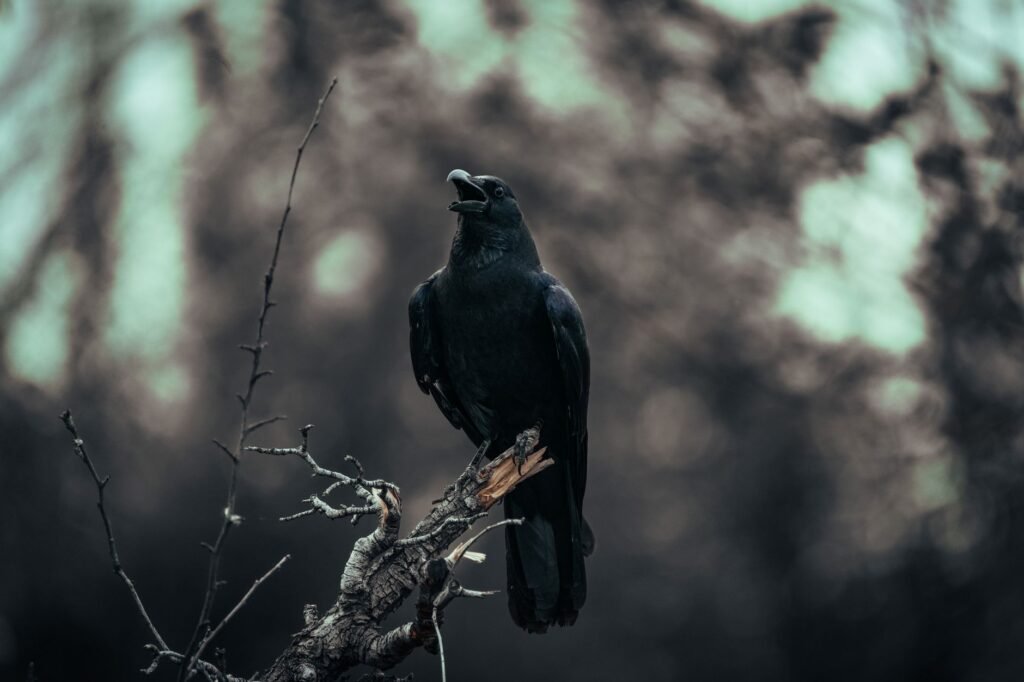
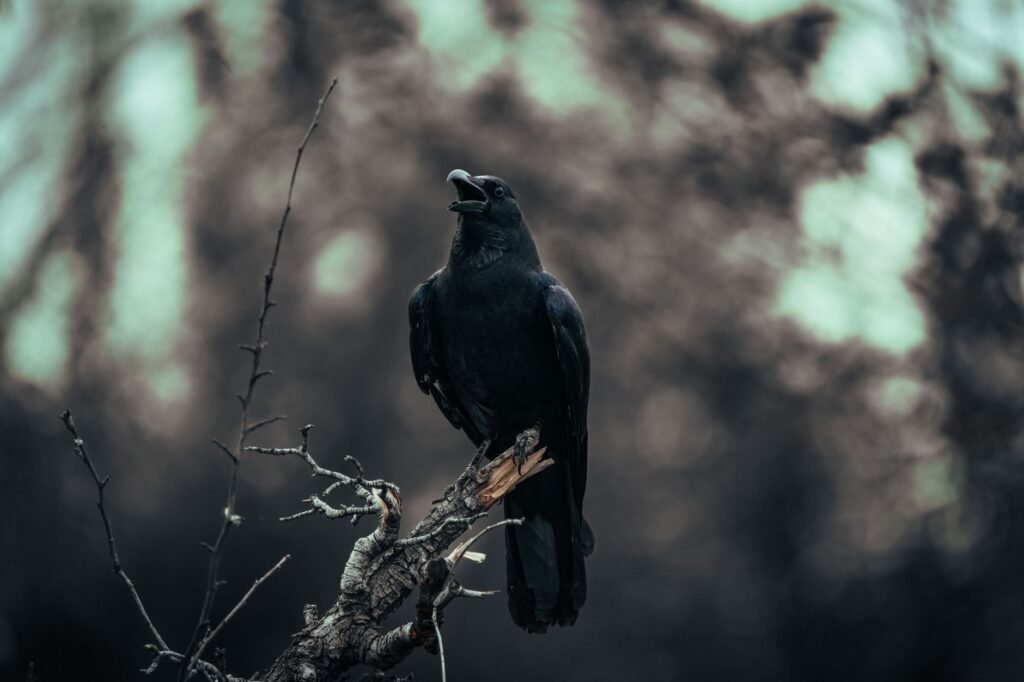
- Large black birds
- Sometimes single-eyed or multiple in number
- Perched near a deity, a battlefield, a tree, or a sacred site
- Associated with shining objects, sun imagery, or death symbols, depending on the tradition
Family and Genealogy
Unlike anthropomorphic deities, the sacred raven does not always have a stable family tree. In some myths it is a divine being in its own right; in others it is one of several raven figures or a transformed ancestor.
In Norse tradition
The best-known raven associated with divinity is linked to Odin, who is accompanied by the ravens Huginn and Muninn. These names are usually understood as meaning “Thought” and “Memory.” They are not children of Odin, but trusted companions or extensions of his power.
In Northwest Coast traditions
Raven may appear as a culture hero whose family relationships vary by nation and narrative. In some stories Raven is a lone being, in others a son, grandson, or descendant of earlier spirit figures. Because these are diverse oral traditions, there is no single genealogy.
In broader mythology
Raven can also function as:
- An ancestor
- A shape-shifter
- A primordial being
- A descended spirit with clan significance
Where genealogy is given, it often serves a symbolic purpose rather than a biological one. It explains Raven’s place in creation, authority, or ritual inheritance.
Symbols
The sacred raven is associated with a rich set of symbols that vary by culture.
| Symbol | Meaning | Common Context |
|---|---|---|
| Black feathers | Mystery, death, hidden knowledge | Ritual and myth |
| Beak and call | Warning, prophecy, divine message | Omens and storytelling |
| Pair of ravens | Thought and memory, dual power, balance | Norse symbolism |
| Carrion imagery | Death, battle, transformation | War and funerary culture |
| Sun or light | Revelation, cosmic order, creation | Some creator myths |
| Tree or branch | World axis, wisdom, liminal space | Northern and shamanic traditions |
Colors
The raven is most often linked to black, but some traditions connect it with white contrast, solar brilliance, or iridescent sheen. The contrast between black plumage and symbolic light often expresses Raven’s dual nature: both dark and illuminating.
Objects
Objects associated with sacred raven traditions may include:
- Feathers, used in ritual or regalia
- Masks, especially in Pacific Northwest ceremonial art
- Staffs or scepters, in divine or royal contexts
- Sun, moon, or stars, in creation myths
- Bones or skulls, in death-related symbolism
Sacred Animals
Because the topic itself is a sacred animal motif, the raven is central, but it is often linked with other creatures.
Associated animals
- Crows: frequently confused with ravens but symbolically similar
- Wolves: shared associations with wilderness, death, and hunting
- Eagles: contrasting birds of sky, power, and kingship
- Bears: linked to strength and spirit power in some northern traditions
- Salmon or fish: important in Northwest Coast raven stories tied to subsistence and creation
Symbolic significance
The raven’s animal companions or rivals can sharpen its meaning:
- With eagles, raven may represent cunning versus nobility
- With wolves, raven can reflect wilderness and predation
- With humans, raven often acts as teacher, thief, or mediator
In some traditions, the raven is not simply one animal among many but a being that crosses categories, changing shape and role. This makes it a classic symbol of transformation.
Sacred Plants
There is no single plant universally tied to the sacred raven across all traditions. However, certain plants recur in stories or ritual contexts where raven symbolism appears.
Commonly associated plants
- Sacred trees such as the ash, oak, cedar, or spruce, depending on region and tradition
- Mistletoe in some European symbolic systems, especially where birds and tree lore intersect
- Medicinal and ceremonial plants in Indigenous traditions, where raven may appear in origin stories connected to land and subsistence
Importance of plant associations
Plants linked to raven traditions often represent:
- Cosmic structure through world trees
- Healing or ritual knowledge
- Seasonal cycles
- Connection between earth and sky
Because plant associations are highly local, they should not be generalized beyond specific traditions. In many cases, the raven is more closely connected to landscape and food sources than to any single botanical symbol.
Sacred Places
The sacred raven is associated with places where boundaries feel visible: cliffs, forests, battlefields, burial grounds, and mythic landscapes.
Notable locations by tradition
Norse and Germanic world
Ravens were linked symbolically to the hall, battlefield, and high places where Odin’s power was imagined to operate. Sacred landscape in Norse tradition often included trees, stones, and burial mounds rather than formal temples alone.
Greek and Roman world
In classical antiquity, ravens were associated with oracle sites and divine communication. Delphi and other prophetic settings are relevant to bird divination broadly, though ravens are only one part of that wider system.
Northwest Coast of North America
Raven stories are strongly tied to specific coastal territories, islands, rivers, and forests. In many Indigenous traditions, sacred landscape is inseparable from origin narratives.
Arctic and Siberian traditions
Raven figures often appear in vast, elemental landscapes: ice, tundra, sea, and sky. These places emphasize Raven’s role as a transformer and survival figure.
Spatial meaning
The raven often belongs to spaces that are:
- Elevated
- Remote
- Transitional
- Associated with death or revelation
This geographical symbolism reinforces Raven’s reputation as a being who moves between realms.
Powers and Attributes
The sacred raven is credited with a wide range of powers depending on tradition.
Common attributes
- Prophecy: foretells events or reveals hidden truths
- Messenger function: carries words between gods and humans
- Transformation: changes shape, identity, or the world itself
- Creation: brings light, land, or life into being in some myths
- Psychopomp role: guides souls or accompanies the dead
- Trickster intelligence: uses wit, deception, and improvisation
Domains of influence
| Domain | Meaning |
|---|---|
| War | Omens, battlefields, death |
| Wisdom | Memory, thought, secret knowledge |
| Creation | World-making, discovery, first institutions |
| Death | Funerary symbolism, soul passage |
| Sovereignty | Divine authority and kingship |
| Trickery | Theft, disguise, reversal of expectations |
The sacred raven’s power lies in ambiguity. It is often helpful, but not always benevolent. It may bring knowledge through theft, order through chaos, or life through disruption.
Main Myths
The most famous raven myths differ by region, but several themes recur.
Raven as a divine messenger
In the Greek world, ravens were associated with Apollo and prophetic communication. Classical sources describe birds as signs interpreted by gods or seers, and in some traditions the raven’s color is explained through mythic stories of divine punishment or transformation. Details vary between sources.
Odin and the ravens
In Norse mythology, Odin’s ravens Huginn and Muninn fly across the world and return with information. They symbolize thought and memory, making the raven an emblem of intelligence, surveillance, and wisdom. This image is one of the most enduring in European myth.
Raven as creator and transformer
Among many Indigenous peoples of the Pacific Northwest, Raven is a central mythic figure who may release the sun, bring fire, create features of the world, or obtain resources for humanity. The details differ significantly from nation to nation, and no single version should be treated as standard.
Raven and the origin of light
A widespread motif in several northern traditions is the raven’s role in bringing light to the world, whether by stealing the sun, revealing daylight, or opening access to hidden brightness. This theme underlines Raven’s function as a bringer of revelation.
Raven and death
Because ravens gather near corpses, they often appear in myths about war, burial, and the soul. In some stories they serve as guides to the afterlife or as signs that fate has been fulfilled.
Trickster stories
Raven often appears in humorous or morally complex tales. He may steal, deceive, boast, or fail, yet his actions still produce essential outcomes. This ambiguity makes Raven a classic trickster figure in comparative mythology.
Relationship with Other Mythological Figures
The sacred raven frequently interacts with gods, heroes, spirits, and culture heroes.
With Odin
Odin’s ravens are among the clearest and most famous examples of raven symbolism in religion. They are not independent rivals but extensions of divine knowledge.
With Apollo
In Greek tradition, raven imagery can be linked to Apollo, especially in stories involving prophecy, truth, and divine punishment. The exact details depend on the author and period.
With creator and trickster figures
In Indigenous mythologies of the Northwest Coast and the Arctic, Raven may coexist with or oppose other supernatural figures, including:
- The Sun
- The Moon
- Sea beings
- Transformer figures
- Animal people
With the dead
Ravens often interact symbolically with ancestors, ghosts, or spirits. Their presence may indicate that the dead are near or that a spiritual message is being delivered.
Because these traditions are diverse, relationships with other figures should be understood as tradition-specific rather than universal.
Worship and Cult
The sacred raven has not always been worshiped in the manner of a formal deity, but it has been honored through ritual, narrative, and taboo.
Forms of devotion or respect
- Bird omens and augury
- Feather use in ceremonial dress
- Offerings in sacred spaces
- Storytelling and oral transmission
- Dance, mask, and song traditions
- Respectful taboos regarding raven behavior or remains
Ritual contexts
In some cultures, ravens were treated as signs from the gods. Observing their flight, calls, and numbers could inform decision-making. In others, raven representations appeared in ceremonial art, masking traditions, or initiatory performances.
Festivals and communal memory
Where raven is part of seasonal or origin mythology, community ceremonies may retell Raven’s actions, sometimes through dramatic performance. These rituals often reinforce identity, ecology, and social memory.
It is important to note that many Indigenous raven traditions are living cultural heritage. Their ritual forms are not merely historical curiosities but continuing expressions of community knowledge.
Ancient Sources
The sacred raven is documented across a wide range of sources, though the type of evidence varies.
Greco-Roman sources
- Homer: birds and omens appear in the epic tradition
- Hesiod: contributes to the wider mythic background of divine order
- Apollodorus: offers myth summaries that help preserve later traditions
- Pausanias: records local cults, sanctuaries, and regional beliefs
- Ovid: preserves transformation myths, including bird-related stories
- Aristotle and later natural historians: discuss raven behavior and its symbolic interpretation in antiquity
Norse sources
- Poetic Edda
- Prose Edda
- Saga literature and skaldic poetry
These texts preserve the best-known raven association with Odin, though they were written down after the conversion to Christianity and therefore reflect both older tradition and later literary shaping.
Indigenous oral traditions
For Pacific Northwest, Arctic, and Siberian raven traditions, the primary sources are often oral narratives, ceremonial texts, ethnographic records, and community knowledge. These should be handled carefully, since many were recorded under colonial conditions and may not fully capture indigenous meaning.
Roman Equivalent
There is no single Roman god who exactly corresponds to the sacred raven. However, several Roman traditions overlap with raven symbolism.
Relevant Roman associations
- Apollo: prophecy, birds, divine communication
- Augury: official interpretation of bird behavior
- Mars: battle, death, and battlefield omens
- Corvus as a Latin word for raven, appearing in literature and symbolic language
Roman religion used birds extensively for divination, making raven behavior especially significant even without a specific “raven god.” In this sense, the Roman equivalent is better understood as a ritual and symbolic adaptation rather than a direct one-to-one counterpart.
Influence on Modern Culture
The sacred raven has remained highly influential in modern literature, visual art, music, film, and games.
Literature
Ravens often appear as symbols of:
- Memory and mourning
- Gothic atmosphere
- Supernatural intelligence
- Prophecy and doom
Poets and novelists frequently use the raven to evoke mystery or psychological depth. The bird’s symbolic power in modern literature owes much to both classical myth and later literary works.
Visual art and design
Raven imagery appears in:
- Tattoo art
- Fantasy illustration
- Heraldic and emblematic design
- Indigenous contemporary art
- Museum and heritage interpretation
Film, television, and games
Ravens and raven-like beings are common in fantasy worlds as:
- Messengers
- Familiars
- Ominous guides
- Shape-shifters
- Symbols of ancient magic
Popular culture
The sacred raven influences branding, symbolism, and identity in ways that range from serious cultural reference to commercial adaptation. In some cases, this use is respectful and informed; in others, it simplifies or appropriates complex traditions.
Curiosities
- Ravens are often mistaken for crows, but in myth they are not always interchangeable.
- In many cultures, the number of ravens matters; a single bird, a pair, or a group can have different meanings.
- The raven is one of the few animals that can symbolize both intelligence and death with equal force.
- In Norse-inspired symbolism, the ravens of Odin are among the most famous bird companions in world mythology.
- Some raven myths explain not only natural features but also the origin of fire, light, or social customs.
- Raven figures can be both heroic and comic, combining sacred authority with trickster behavior.
- The raven’s black feathers have sometimes been interpreted as evidence of a hidden solar connection in creation myths, though this varies by culture.
- In modern environmental interpretation, the raven is often seen as a sign of wilderness resilience and ecological adaptation.
Frequently Asked Questions
What is the sacred raven?
The sacred raven is a mythological and symbolic figure centered on the raven as a creature of spiritual importance. It may act as a messenger, creator, trickster, omen-bearer, or guide of souls depending on the culture.
Is the sacred raven a god?
Not always. In some traditions, Raven is a divine being or culture hero. In others, it is an animal symbol connected to gods such as Odin or Apollo. The term covers both deified and symbolic uses.
Why is the raven considered sacred?
Ravens are considered sacred because of their intelligence, striking appearance, dark color, and behavior near battlefields, settlements, and sacred places. These features made them powerful symbols of prophecy, death, and transformation.
What does a raven symbolize in mythology?
Ravens commonly symbolize wisdom, memory, death, war, creation, and hidden knowledge. In some traditions they also represent mischief, change, and the crossing between worlds.
Are ravens associated with Odin?
Yes. In Norse mythology, Odin is famously accompanied by two ravens, Huginn and Muninn, who represent thought and memory. They are among the best-known sacred raven figures in world mythology.
Did all ancient cultures worship ravens?
No. Different cultures treated ravens differently. Some revered them, some feared them, and others used them mainly as omens or narrative figures. There is no single universal raven cult.
What is the difference between a raven and a crow in symbolism?
Crow and raven symbolism often overlaps, but ravens are usually associated with larger scale mythic themes such as prophecy, creation, and death. Crow symbolism may lean more toward adaptability, social behavior, or local folklore, depending on the tradition.
Is the sacred raven still important today?
Yes. The raven remains important in Indigenous cultural traditions, comparative mythology, literature, visual arts, and popular culture. It continues to symbolize intelligence, mystery, and transformation.
Conclusion
The sacred raven is one of the most enduring figures in world mythology because it unites opposites: life and death, wisdom and deception, darkness and revelation. Across cultures, ravens appear as divine messengers, creators, tricksters, and guardians of hidden knowledge. Their sacred status reflects both the bird’s natural behavior and the human impulse to interpret the natural world symbolically.
Although traditions differ widely, the raven consistently stands at the boundary between realms. It belongs to the sky and the earth, the living and the dead, the human and the divine. For that reason, the sacred raven remains a powerful emblem in religious history, mythology, and modern cultural imagination.

Orin Vale has spent the better part of two decades tracing the threads that connect the world’s oldest stories — from the halls of Asgard to the banks of the Nile, from Olympus to the jungles of the Maya. What began as a childhood fascination with flood myths and trickster gods grew into years of independent study across comparative mythology and ancient religion, always chasing the same question: what did these stories mean to the people who first told them? Orin writes for readers who want more than trivia — the ones looking for the beliefs, fears, and truths that myths were built to carry.