Donn
Donn is a prominent figure in Irish mythology, usually identified as a primordial ancestor and ruler of the dead in the Gaelic imagination. In many traditions, he is linked with the island of Tech Duinn, “the House of Donn,” where the souls of the dead are believed to gather before passing onward. Although the surviving medieval sources are not always consistent, Donn occupies an important place in Irish mythological genealogy, cosmology, and beliefs about death, ancestry, and the otherworld.
As a mythic ancestor associated with both kingship and mortality, Donn stands at the intersection of dynastic legend and religious symbolism. He is especially significant because he reflects how early Irish tradition understood the dead not simply as vanished, but as continuing into a sacred ancestral realm.
Origin and Meaning
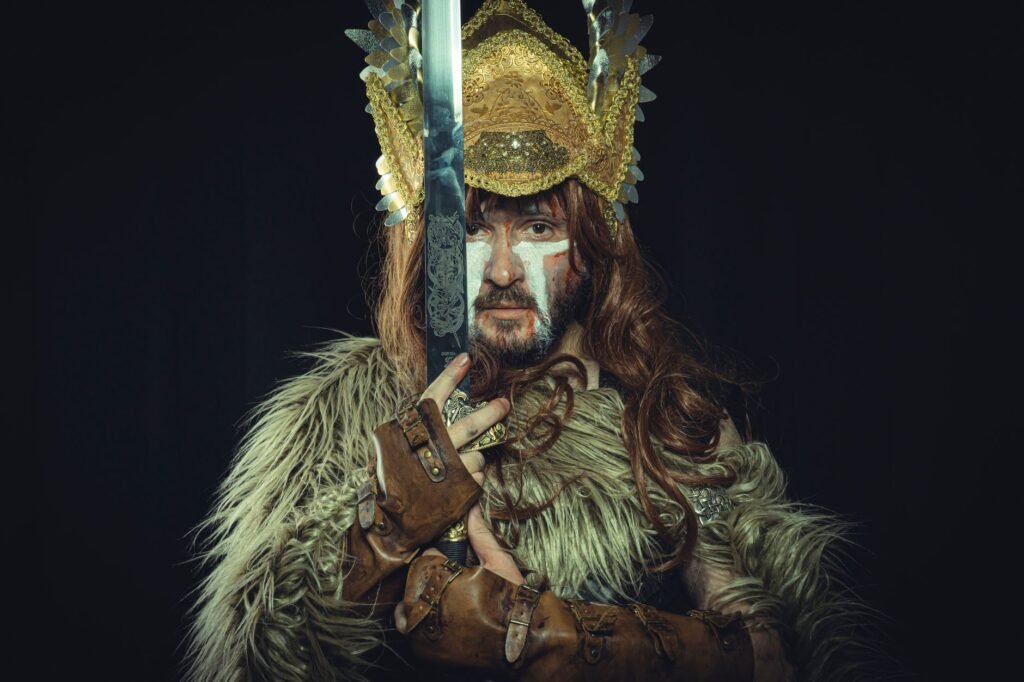
The name Donn is an Old Irish word meaning “brown,” “dark,” or “dusky.” As a personal name, it may originally have referred to hair color, complexion, or symbolic qualities associated with darkness and the earth. In Irish mythological language, names often carry descriptive and ritual weight, and Donn’s name is usually understood as more than a simple physical nickname.
The etymology of Donn has encouraged a close association with:
- the color brown or dark red,
- the earth and burial,
- night, death, and the underworld,
- ancient ancestral power.
In some contexts, Donn appears less as a fully individualized god than as a mythic personification of death and ancestral sovereignty. The historical origin of the figure is difficult to determine precisely, because the surviving evidence comes from medieval Irish manuscripts that preserve older traditions alongside Christian reinterpretation.
Historical Context
Donn belongs to the rich body of Irish mythology, especially the cycles of origin stories and ancestral legends compiled in medieval Ireland. These narratives were written down by Christian scribes, but they preserve older pre-Christian ideas about the dead, sacred geography, and descent from legendary ancestors.
In early Irish thought, the boundary between myth, genealogy, and sacred kingship was fluid. A figure such as Donn could function simultaneously as:
- a forebear of important lineages,
- a supernatural dead king,
- a guardian of the dead,
- a symbolic embodiment of the land’s ancient sovereignty.
This reflects a broader Celtic pattern in which the otherworld is not a distant heaven or hell, but a nearby sacred realm connected with hills, islands, burial places, and the sea.
Donn is also relevant to the cultural history of Ireland because he helps explain how medieval Irish writers organized the past. Genealogies were not merely records of descent; they were also ideological tools linking communities, kings, and territory to a sacred origin.
Main Characteristics
Donn is usually characterized by several overlapping traits:
- Ancestral figure: He is commonly presented as a progenitor of the Irish.
- Lord of the dead: Later tradition places his abode at Tech Duinn, where the dead assemble.
- Association with the sea and islands: Some traditions place his dwelling on or near a western island.
- Dark coloration: His name links him to brownness, dusk, and earthiness.
- Sovereign or royal aspect: He often appears in genealogical traditions as a king or noble ancestor.
- Threshold figure: He mediates between the world of the living and the world of the dead.
Donn is not a deity with a single standardized cult in the way some classical gods are. Rather, he is a mythic personality whose significance is distributed across several medieval texts and folk traditions.
Family and Genealogy
The genealogical traditions surrounding Donn vary. Different medieval sources preserve different lineages, and scholars generally treat these accounts with caution because Irish genealogies were often reshaped for political and literary purposes.
Common genealogical themes
In several traditions, Donn is:
- connected to the Milesians or their legendary ancestors,
- presented as one of the sons of Míl Espáine in some accounts,
- linked to the ancestry of the Irish people as a whole.
One notable tradition names Donn among the sons of Míl Espáine who came to Ireland. In this telling, he dies before fully taking possession of the island and becomes associated with the place of the dead. Other sources present slightly different family relationships or emphasize different ancestor figures.
Family relationships in tradition
| Relationship | Typical tradition | Notes |
|---|---|---|
| Parents | Varies by source | Genealogical details are not stable across texts |
| Siblings | Often among the sons of Míl Espáine | Accounts differ in naming and emphasis |
| Children | Not consistently emphasized | Donn is more often important as ancestor than as father in extant sources |
| Spouse | Not securely attested | No widely accepted spouse tradition dominates the sources |
Because the sources are inconsistent, it is safer to speak of Donn as a genealogical ancestor rather than as a figure with a fixed family tree.
Symbols
Donn’s symbolism is strongly tied to death, ancestry, and the western edge of the world. His symbols are not always listed explicitly in surviving texts, but several recurring motifs appear.
Common symbolic associations
- Brown and dark colors: linked to his name and to the earth
- The western sea: the direction of sunset and the dead
- Islands: especially the island destination of souls
- The grave or burial earth: as a place of return
- A house or hall: Tech Duinn as a symbolic gathering place
Symbolic meanings
| Symbol | Meaning |
|---|---|
| Brown/dark color | Earth, age, death, ancestral depth |
| West | Sunset, departure, otherworld journey |
| Island | Separation from ordinary life, sacred distance |
| House/hall | Community of the dead, ancestral gathering |
| Sea crossing | Transition from life to the afterlife |
These symbols do not necessarily reflect a single organized cult, but they are important for understanding Donn’s place in Irish mythic imagination.
Sacred Animals
The surviving sources do not establish a standard sacred animal for Donn in the way that some other mythological figures are closely linked with specific creatures. However, certain animals are associated indirectly with his realm and symbolism.
Animals connected by tradition and symbolism
- Horses: often associated in Indo-European traditions with sovereignty, funerary passage, and the otherworld.
- Cattle: central in Irish heroic culture and sometimes present in mythic ancestral settings.
- Birds, especially sea birds: may symbolize the island or coastal otherworld.
- Wolves or dogs: in broader Celtic contexts, these can be linked with death, liminality, or guardianship, though direct evidence for Donn is limited.
Because direct textual evidence is limited, any animal associations should be treated as symbolic rather than canonical.
Sacred Plants
No plant is securely established as a specific sacred plant of Donn in the surviving medieval corpus. Still, in a wider Irish mythological context, certain plants may be relevant to his atmosphere of death and ancestry.
Plants often associated with death and otherworld themes
- Yew: commonly linked in European traditions with burial grounds and longevity
- Oak: often associated with sacred kingship and endurance
- Hawthorn: tied in Irish folklore to fairy places and liminality
- Ash: a tree of protective or mythic importance in Celtic tradition
These associations are interpretive rather than explicit. Unlike a deity whose cult includes clearly named plant offerings, Donn is better understood through the landscape imagery surrounding Tech Duinn and the otherworld journey.
Sacred Places
Donn is most famously connected with Tech Duinn or Teach Duinn, meaning “the House of Donn.” This is the central sacred location in traditions about him.
Tech Duinn
Tech Duinn is described in Irish tradition as a place where the dead gather after death. It is often situated on or near the western coast of Ireland, sometimes identified with a specific island or offshore location depending on the text and later interpretation.
Its importance lies in several features:
- it is a threshold place between the living world and the dead,
- it is linked to the west, the direction of sunset,
- it functions as a destination for souls,
- it represents ancestral return.
Other associated locations
Because the sources vary, Donn may also be connected broadly to:
- western seascapes,
- island settings,
- coastal departure points,
- burial and liminal landscapes.
| Place | Association with Donn |
|---|---|
| Tech Duinn | Principal dwelling of the dead |
| Western coast | Symbolic direction of the afterlife |
| Island locations | Possible physical manifestations of the otherworld abode |
| Burial grounds | Thematic association with death and return |
The exact geographic identification of Tech Duinn remains debated, and the mythic significance of the place is more secure than any one modern location.
Powers and Attributes
Donn’s powers are not usually listed in the same explicit way as those of classical gods, but his attributes can be reconstructed from the tradition.
Main domains
- Death and the dead
- Ancestry and descent
- Crossing into the otherworld
- Sovereignty in a mythic or ancestral sense
- Liminality, especially the boundary between life and death
Functional role
Donn’s most important role is as a receiver of the dead. He is often envisioned not as a punitive ruler but as an ancestral host. This differs from later Christian models of judgment and reward. In Donn’s mythic sphere, death is less about moral verdict than about returning to a primordial kin-community.
Attributes in summary
- ancient
- dark
- ancestral
- western
- funerary
- liminal
- sovereign
Main Myths
The mythic narratives involving Donn are limited in number but highly significant.
Donn and the Milesian tradition
One of the best-known stories places Donn among the Milesian ancestors who came to Ireland. In some versions, he opposes the arrival or settlement of the expedition, or dies before he can fully enter into possession of the land. After his death, he becomes associated with the place where the dead are gathered.
Different sources handle this story differently, and not every text gives the same cause or details of his death. However, the general pattern is consistent: Donn dies in relation to the founding movement of the Irish people and becomes an otherworld ancestor.
Donn as lord of the dead
Later tradition develops the idea that the souls of the dead travel to Tech Duinn, where Donn receives them. This is one of the most distinctive beliefs associated with him. It implies that death is a homecoming to an ancestral host rather than a journey to a distant judgment throne.
Mythic meaning of the stories
These legends perform several functions:
- explain a sacred place at the edge of Ireland,
- integrate death into ancestry,
- connect the Irish people to a mythic founder,
- present the dead as part of the community of origin.
Relationship with Other Mythological Figures
Donn’s relationships with other figures are best understood in terms of genealogy, ancestral succession, and mythic opposition.
Connection with the Milesians
Donn is strongly associated with the Milesian legendary invasion or settlement narrative, which is central to Irish mythological history. In these accounts, he is one of the ancestors whose death shapes the spiritual geography of Ireland.
Relationship with the Tuatha Dé Danann
Donn is not usually depicted as a direct enemy or ally of the Tuatha Dé Danann in a detailed narrative sense, but his role as an ancestral dead king places him in the broader mythic world that also includes these other supernatural beings. The two traditions belong to different narrative strata, yet both are important to Irish otherworld thought.
Relationship with the dead and ancestors
Donn’s main relationship is with the dead as a collective. He functions as:
- guardian,
- host,
- ancestral authority,
- boundary figure.
This makes him one of the most important names in Irish reflections on mortality and memory.
Worship and Cult
No large organized temple cult of Donn is securely documented. The evidence suggests a mythic and perhaps local or ritualized reverence rather than a formal pan-Irish religion centered on him.
Possible forms of veneration
Based on the surviving tradition, reverence for Donn may have included:
- prayers or invocations connected with death,
- respect for burial and ancestral places,
- ritual attention to the westward journey of the dead,
- storytelling and genealogical remembrance.
Funerary significance
The belief that the dead travel to Tech Duinn suggests a funerary worldview in which Donn had a role in death rites or in the imaginative structure behind them. However, the medieval texts do not preserve a full liturgy or set of offerings dedicated to him.
Important caution
Because the evidence is indirect, it is not possible to reconstruct a precise pre-Christian cult of Donn with certainty. The safest conclusion is that he belongs to a mythic funerary tradition rather than to a clearly documented temple religion.
Ancient Sources
Donn is known primarily through medieval Irish literature rather than through Greek or Roman-style classical texts. Important sources include:
- Lebor Gabála Érenn (The Book of the Taking of Ireland): a key source for the Milesian tradition and for Donn’s role among the ancestors of the Irish.
- Dindshenchas texts: place-lore traditions that help explain sacred geography and may preserve references to Tech Duinn.
- Other medieval Irish manuscripts: genealogical and mythological material in which Donn appears in varying forms.
Source characteristics
These texts are valuable but complex:
- they were compiled in Christian Ireland,
- they often combine older myth with Christian learning,
- they may preserve local traditions alongside literary invention,
- they are not always internally consistent.
For this reason, modern scholarship treats them as crucial but not straightforward historical records.
Roman Equivalent
Donn does not have a single exact Roman equivalent. However, certain Roman figures may appear superficially comparable in function.
Partial analogies
- Dis Pater: a ruler associated with the underworld and the dead
- Pluto/Dis: a classical lord of the dead
- Sacer ancestral spirits traditions: in a broad comparative sense, ancestor guardianship
These are only rough comparisons. Donn is not a direct Irish version of a Roman god. His role is more specifically tied to ancestral return and the western otherworld, which makes him distinct from the Roman underworld gods.
Influence on Modern Culture
Donn remains a notable figure in modern retellings of Celtic myth, Irish folklore studies, and neo-mythological writing.
Areas of modern influence
- Literature: Donn appears in retellings of Irish myth and scholarly-inspired fantasy.
- Folklore studies: he is often discussed in work on Irish death beliefs and sacred geography.
- Fantasy fiction and games: authors and designers sometimes draw on Donn as a mythic lord of the dead or ancestral figure.
- Neo-pagan and revival traditions: some modern spiritual movements reference Donn as an ancestral or underworld presence.
- Cultural identity: Donn contributes to broader interest in Ireland’s mythological past.
His influence is strongest not as a mass-culture icon, but as a meaningful figure in the modern revival of Irish mythological heritage.
Curiosities
- Donn is often described less as a “god” in the classical sense and more as a mythic ancestor who became associated with the dead.
- The place Tech Duinn has been interpreted as both a literal location and a symbolic destination.
- The westward direction of Donn’s realm reflects a common mythic pattern in which the setting sun marks the land of the dead.
- His name means “brown” or “dark,” which may explain why he is associated with earth, burial, and dusk.
- Medieval Irish tradition often blends genealogy and cosmology, and Donn is a strong example of that fusion.
- Different manuscripts do not always agree on his exact genealogy, showing how fluid Irish mythic tradition can be.
- Donn’s importance lies as much in what he represents—the dead becoming ancestors—as in any single story about him.
Frequently Asked Questions
Who is Donn in Irish mythology?
Donn is a mythic Irish ancestral figure associated with the dead, the west, and the otherworld gathering place known as Tech Duinn.
Is Donn a god or a mortal ancestor?
Sources vary in emphasis. He is sometimes treated like a supernatural ruler of the dead and sometimes like a mortal ancestor who became mythologized after death.
What does the name Donn mean?
The name generally means “brown” or “dark” in Old Irish.
Where is Tech Duinn?
Tech Duinn is traditionally placed in the west, often near the coast or on an island. Its exact location is debated and may be symbolic as well as geographic.
Is Donn the Irish god of death?
He is often described that way in modern summaries, but the medieval sources present him more specifically as an ancestral figure linked to the dead rather than as a fully systematized death god.
What sources mention Donn?
He appears in medieval Irish texts such as the Lebor Gabála Érenn and related place-lore and genealogical traditions.
Does Donn have a Roman equivalent?
No exact Roman counterpart exists, though he can be loosely compared to underworld deities such as Dis Pater or Pluto.
Conclusion
Donn is one of the most evocative figures in Irish mythology because he embodies the meeting point of ancestry, death, and sacred geography. As a dark ancestral lord associated with Tech Duinn, he reflects a worldview in which the dead do not disappear but return to a primordial community at the edge of the world. His significance lies not only in individual stories, but also in the wider cultural meaning of death, genealogy, and the otherworld in early Irish tradition.
Although the sources are uneven and sometimes contradictory, Donn remains an enduring symbol of Ireland’s mythological memory: a figure whose name, place, and legacy continue to illuminate how the medieval Irish imagined the passage from life into the ancestral realm.

Orin Vale has spent the better part of two decades tracing the threads that connect the world’s oldest stories — from the halls of Asgard to the banks of the Nile, from Olympus to the jungles of the Maya. What began as a childhood fascination with flood myths and trickster gods grew into years of independent study across comparative mythology and ancient religion, always chasing the same question: what did these stories mean to the people who first told them? Orin writes for readers who want more than trivia — the ones looking for the beliefs, fears, and truths that myths were built to carry.