Egyptian mythology is not only a collection of gods and symbols; it is, at its core, a body of stories the ancient Egyptians told to explain the deepest questions of existence: why the sun rises and sets, why the dead can hope for another life, and why the throne of Egypt belonged to the pharaoh alone. Where a profile of a single god explains who that deity was, an Egyptian myth shows what that god actually did, tracing a complete story from its beginning to its consequences. These legends were not treated as simple entertainment. Egyptian priests preserved them in temple libraries, painted them on tomb walls, and recited them during festivals precisely because each myth carried real religious and political weight.
This guide brings together the essential myths and legends of Egyptian mythology, grouped by theme: the Osiris cycle at the heart of Egyptian kingship, myths of divine power and judgment, stories of creation and cosmic order, and Egypt’s most important sacred texts and folk legends. Each entry introduces one myth and sets the stage for a deeper, dedicated telling elsewhere on the site.
The Osiris Cycle: How Egypt’s First King Died and Rose Again
How Osiris Died and Became King of the Underworld
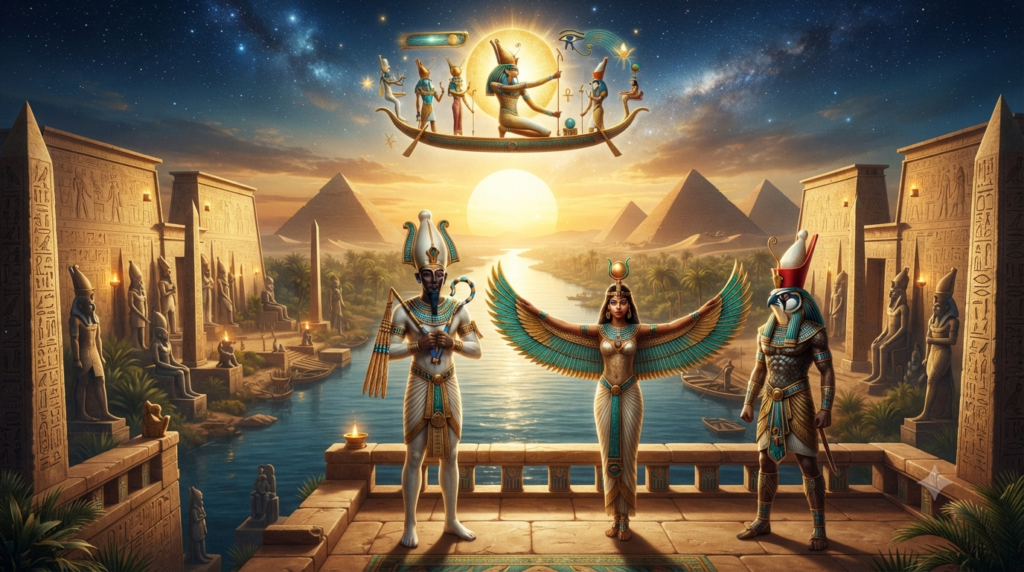
The myth of Osiris begins with Egypt’s most beloved mythical king, murdered by his own jealous brother Set, who tricks Osiris into lying inside a custom-built chest before sealing it shut and casting it into the Nile. Egyptian mythology follows Isis as she recovers her husband’s body, only for Set to discover it again and cut it into pieces scattered across Egypt, forcing Isis and Nephthys to search the land a second time to reassemble him. Though Osiris cannot return to rule the living, the magic used to restore his body grants him a new, greater role as king and judge of the dead, transforming a murder story into the foundation of the entire Egyptian promise of life after death.
How Horus Defeated Set to Become Ruler of Egypt
Once Osiris’s son Horus reaches adulthood, Egyptian mythology turns to a long legal and physical struggle known as the Contendings of Horus and Set, in which the two rivals battle for the right to rule Egypt before a tribunal of the gods. The contest includes dramatic episodes of trickery, physical combat, and even a boat race in stone vessels, with Isis repeatedly intervening using magic to protect her son’s claim. After decades of dispute, the gods ultimately rule in favor of Horus, cementing the principle at the heart of Egyptian kingship: that the rightful heir, not merely the physically strongest claimant, deserves the throne.
How Isis Hid and Raised Horus in the Marshes of Chemmis
Before Horus was old enough to claim his father’s throne, Egyptian mythology describes a vulnerable period in which Isis hides her infant son among the reeds of the marshes of Chemmis, protecting him from Set’s ongoing attempts to eliminate any threat to his rule. During this time, Isis is forced to draw on her full magical skill to heal Horus from serious dangers, including a venomous scorpion sting that nearly kills the child, described in detail in several surviving Egyptian magical texts. This period of hidden, dangerous childhood gave ordinary Egyptians a deeply relatable image of a mother’s protective devotion layered on top of a story about royal legitimacy.
Myths of Divine Power and Judgment
Why Ra Sent Sekhmet to Destroy Humanity
In one of Egyptian mythology’s darkest stories, the aging sun god Ra grows convinced that humanity is plotting against him and sends the fierce Eye of Ra, embodied as the lioness goddess Sekhmet, to punish the rebellious human race. Sekhmet’s rampage grows so violent and uncontrollable that Ra himself becomes alarmed at the scale of destruction, and the other gods must trick her into drinking an enormous quantity of beer dyed red to resemble blood, calming her murderous fury before she can wipe out humanity entirely. This myth, known as the Destruction of Mankind, offered ancient Egyptians a mythological explanation for both divine anger and divine mercy existing within the same story.
What Happens During the Weighing of the Heart Ceremony
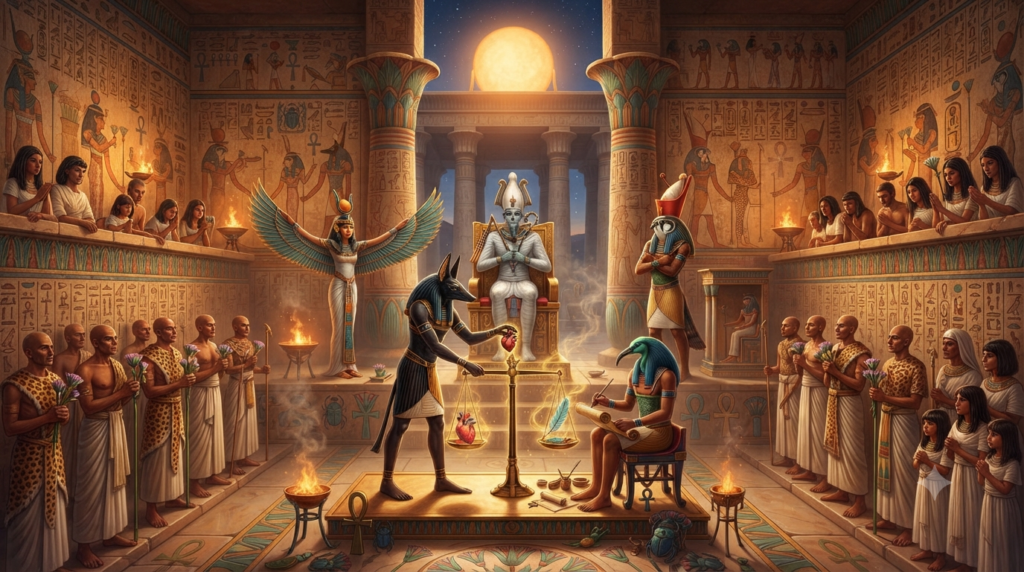
At the climax of the Egyptian afterlife journey, the deceased stands before Osiris and a panel of divine judges while their heart is placed on one side of a great scale, balanced against the single feather of the goddess Ma’at on the other. Egyptian mythology treats this weighing of the heart ceremony as the ultimate test of a person’s earthly conduct, with the god Thoth recording the result and the monstrous Ammit waiting nearby to devour any heart found too heavy with wrongdoing. Surviving this judgment successfully granted the deceased entry into the Field of Reeds, the peaceful, fertile paradise Egyptian mythology promised to the righteous dead.
How Isis Learned the Secret Name of Ra
In a myth prized for showing Isis’s cunning rather than her compassion, the goddess creates a magical serpent from the sun god’s own saliva mixed with earth and sets it in Ra’s path, causing a venomous bite that no other magic can cure. Egyptian mythology describes Ra suffering in agony until he finally agrees to whisper his true, secret name to Isis in exchange for healing, unknowingly handing her one of the greatest sources of magical power in the entire cosmos. This story explains, within Egyptian religious thought, why Isis became renowned as the most powerful magician among all the gods, her authority now equal in certain respects to Ra’s own.
Creation and the Cosmic Order
How the Ancient Egyptians Believed the World Was Created
Egyptian mythology never settled on a single creation story, and instead preserved several competing accounts tied to different cult centers: Heliopolis credited the self-created god Atum with generating the first divine family, Hermopolis described eight primeval deities called the Ogdoad raising the first mound of land from chaotic waters, and Memphis taught that the god Ptah created the world simply by speaking it into existence through thought and word. Rather than treating these versions as contradictory, Egyptian priests generally allowed each city’s creation myth to coexist, reflecting the same city-based religious identity that shaped so much of Egyptian mythology as a whole.
What Was Zep Tepi, the First Time
Zep Tepi, meaning “the First Time” or “the First Occasion,” refers to the golden mythological age described in Egyptian mythology when the gods themselves ruled directly over Egypt before handing kingship down to human pharaohs. Egyptian religious and royal texts frequently looked back to Zep Tepi as the ideal standard against which the current, living pharaoh’s reign was measured, framing each new king’s rule as an active attempt to restore the perfect order that existed at the world’s beginning. This concept of a lost golden age gave Egyptian mythology a built-in sense of both nostalgia and ongoing religious duty.
What Happens When Ra Travels Through the Underworld at Night
Each night, Egyptian mythology describes the sun god Ra boarding his solar barque and sailing through the twelve dark hours of the underworld, encountering transformed souls of the dead, hostile demons, and above all the great chaos serpent Apep, who attempts to swallow the sun and prevent its return. Ra’s underworld journey, recorded in detail in funerary texts like the Amduat and the Book of Gates, required the combined magical protection of gods such as Set, who fought off Apep directly, ensuring the sun’s safe passage and its triumphant rebirth at dawn. This nightly cycle mirrored the exact journey Egyptian mythology promised every properly prepared soul: a dangerous passage through darkness followed by rebirth into light.
How Horus of Behdet Defeated Ra’s Enemies
In a lesser-known but symbolically important myth, Ra faces a rebellion from enemies within his own divine court and calls on Horus of Behdet, a specific warrior form of the falcon god, to defend him. Egyptian mythology describes Horus transforming into a great winged sun disk, flanked by rearing cobras, and sweeping down to strike Ra’s enemies from the sky before pursuing the surviving rebels into the waters where crocodiles and hippopotami were said to have first emerged as their transformed, defeated forms. This myth directly explains the origin of the winged sun disk placed above nearly every Egyptian temple doorway, turning a piece of common religious architecture into a permanent reminder of Ra’s protected victory.
Sacred Texts and Folk Legends
What Is the Book of the Dead
The Book of the Dead is not a single fixed book but a large collection of magical spells, prayers, and instructions that ancient Egyptians had copied onto papyrus and placed with their mummified dead to guide and protect them through the dangers of the underworld journey. Egyptian mythology’s most vivid funerary scenes, including detailed depictions of the weighing of the heart ceremony, survive largely because of these Book of the Dead papyri, which combined practical instructions with illustrated vignettes showing exactly what the deceased could expect to encounter. Wealthier Egyptians commissioned longer, more elaborately illustrated versions, while more modest burials often included only a handful of the most essential protective spells.
What Is the Egyptian Myth of the Two Brothers
The Tale of Two Brothers is one of ancient Egypt’s most complete surviving works of mythological fiction, following two brothers, Anubis and Bata, through a story of false accusation, self-mutilation, magical transformation, and eventual restoration and revenge. Though its two central characters share names with major Egyptian gods, Egyptian mythology treats this tale more as an entertaining moral legend than as sacred religious doctrine, exploring themes of loyalty, betrayal, and justice through a narrative closer in spirit to a folk tale than a temple hymn. The story’s survival on a well-preserved New Kingdom papyrus offers modern readers a rare, direct look at the kind of imaginative storytelling that existed alongside Egypt’s more formal religious mythology.
Frequently Asked Questions About Egyptian Myths and Legends
What is the most important myth in Egyptian mythology?
The Osiris myth, covering his death, resurrection, and establishment as ruler of the underworld, is generally considered the single most important story in Egyptian mythology, since it directly shaped Egyptian beliefs about kingship, justice, and the promise of life after death.
Are Egyptian myths written down in one central text like a bible?
No. Egyptian mythology survives across many separate sources, including tomb inscriptions, temple reliefs, funerary papyri like the Book of the Dead, and literary tales, rather than in a single authoritative sacred book.
Why do different Egyptian cities tell different creation myths?
Each major Egyptian city built its religious identity around its own local god, so priesthoods at Heliopolis, Hermopolis, and Memphis each developed creation accounts that placed their own patron deity at the very beginning of existence.
What happened to a soul that passed the weighing of the heart ceremony?
A soul whose heart balanced successfully against the feather of Ma’at was granted entry into the Field of Reeds, a fertile, peaceful paradise where Egyptian mythology promised the righteous dead could continue farming, socializing, and living much as they had on earth.
Is the Tale of Two Brothers considered a true religious myth?
Egyptologists generally treat the Tale of Two Brothers as a work of literary fiction rather than core religious doctrine, despite borrowing the names of real gods, placing it closer to a moral folk tale than to myths like the Osiris cycle.
How did Isis become one of the most powerful goddesses in Egyptian mythology?
Isis’s power grew through her own cunning and magical skill, most dramatically in the myth where she tricks the sun god Ra into revealing his secret name, giving her authority that rivaled even the king of the gods himself.
What is the difference between the Amduat and the Book of the Dead?
The Amduat specifically describes Ra’s nightly journey through the twelve hours of the underworld, while the Book of the Dead is a broader collection of protective spells meant for the journey of any deceased person, not the sun god specifically.
Why was the winged sun disk placed above Egyptian temple doorways?
The winged sun disk represented Horus of Behdet’s mythological victory over Ra’s enemies, and Egyptian mythology held that placing this image above a doorway would extend the same protective, victorious power over the sacred space beneath it.

Orin Vale has spent the better part of two decades tracing the threads that connect the world’s oldest stories — from the halls of Asgard to the banks of the Nile, from Olympus to the jungles of the Maya. What began as a childhood fascination with flood myths and trickster gods grew into years of independent study across comparative mythology and ancient religion, always chasing the same question: what did these stories mean to the people who first told them? Orin writes for readers who want more than trivia — the ones looking for the beliefs, fears, and truths that myths were built to carry.