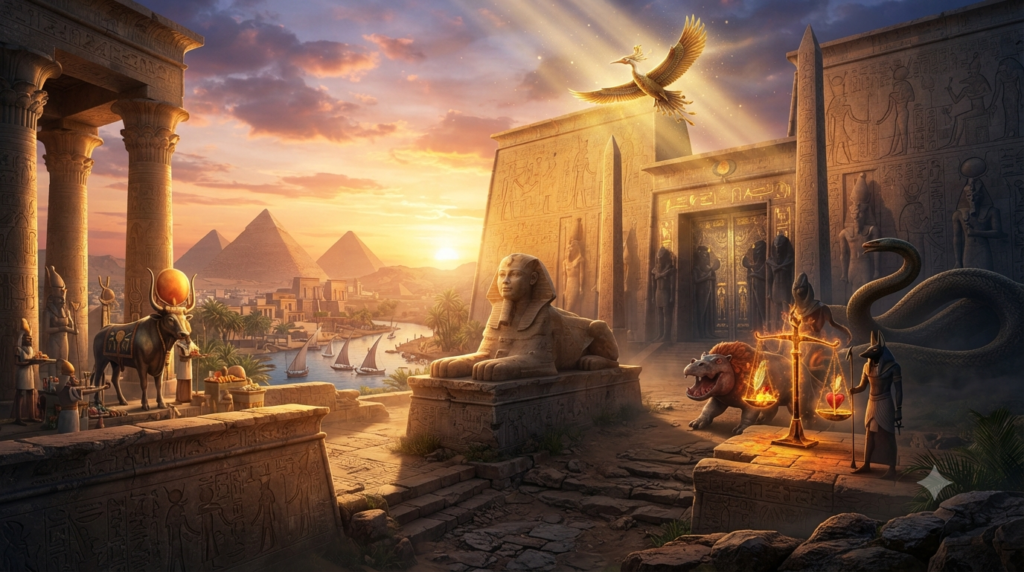
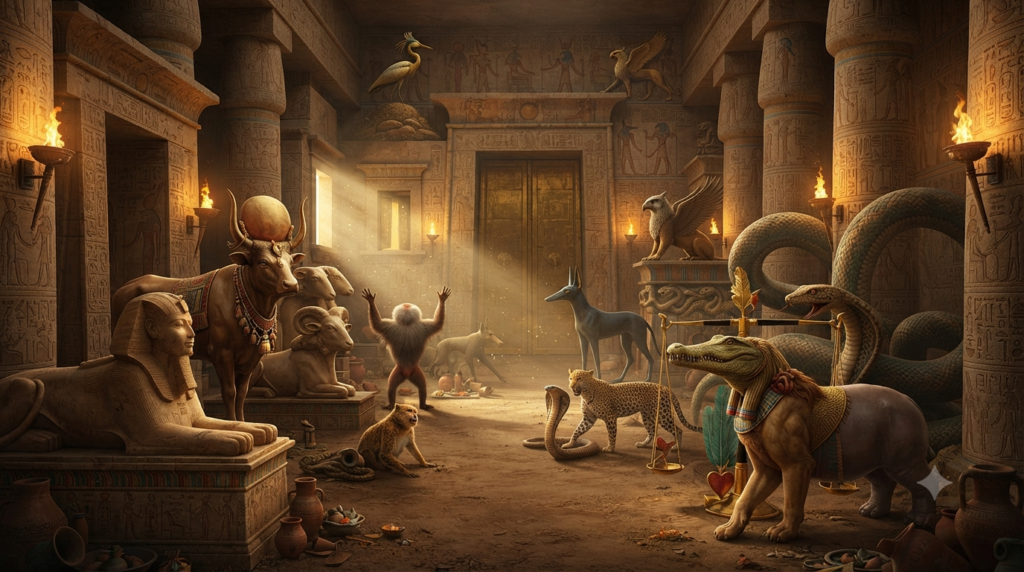
Egyptian mythology populated the space between gods and mortals with a distinct cast of creatures: monstrous guardians who judged and devoured the unworthy, hybrid beasts that embodied chaos itself, and living sacred animals believed to house divine spirits inside real, breathing bodies. Unlike the gods, these creatures were rarely worshipped as independent powers in their own right. Instead, each one played a specific functional role in Egyptian mythology, standing guard, testing the dead, or serving as a god’s chosen vessel on earth.
This guide brings together the essential creatures and sacred animals of Egyptian mythology, grouped by the role each one played: guardians of the underworld, composite creatures born from chaos, sacred animals believed to embody the living gods, and rare beings tied to creation and renewal. Each entry introduces one creature and sets the stage for a deeper, dedicated profile elsewhere on the site.
Guardians and Devourers of the Underworld
Ammit
Ammit is the fearsome hybrid creature who waits beside the scales in the underworld’s judgment hall, combining the head of a crocodile, the front body of a lion, and the hindquarters of a hippopotamus, three of the most dangerous animals known to the ancient Egyptians. When a deceased person’s heart is weighed against the feather of Ma’at and found too heavy with wrongdoing, Egyptian mythology holds that Ammit devours the heart on the spot, causing a second, final death with no hope of an afterlife. Unlike most creatures in Egyptian religion, Ammit received no cult or temple of her own; she existed purely as a threat, never as a deity anyone would want to attract.
Nehebkau
Nehebkau is a primeval serpent, sometimes shown with human arms and legs, associated with the binding together of the Ka, or life force, to the physical body at the moment of death. Egyptian mythology places Nehebkau among the very first beings to exist, powerful enough that even the sun god Ra is said to have needed to tame him, and afterward Nehebkau served as a guardian figure at the entrance to the underworld. Despite his fearsome serpent form, Nehebkau’s presence in funerary texts is generally protective, helping secure a person’s identity intact for the journey ahead.
The Gatekeepers of the Duat
Egyptian funerary texts such as the Book of the Dead and the Book of Gates describe the underworld, or Duat, as divided into a series of gates, caverns, and mounds, each one guarded by a named demon-like gatekeeper who had to be addressed correctly by the deceased to pass safely. These gatekeepers of the Duat were often shown with animal heads and carried titles describing their function, such as “blood-drinker” or “bone-breaker,” reflecting the genuine danger Egyptian mythology attributed to the underworld journey. Knowing each gatekeeper’s true name and the correct spell to calm them was considered essential magical knowledge, recorded carefully on tomb walls and funerary papyri to guide the dead safely through.
Composite and Chaos Creatures
The Sphinx
The sphinx, combining a human head with the body of a lion, represented royal power and protective watchfulness in Egyptian mythology, most famously embodied by the Great Sphinx of Giza, believed by many Egyptologists to bear the face of the pharaoh Khafre. Unlike the riddling, dangerous sphinx of later Greek mythology, the Egyptian sphinx was overwhelmingly a benevolent guardian figure, placed at temple and tomb entrances to project the pharaoh’s strength and to ward off hostile forces. Egyptian sphinxes also appeared with other animal heads, including the ram-headed criosphinx associated with Amun and the falcon-headed hieracosphinx associated with Horus.
The Serpopard
The serpopard is a composite creature with the body of a leopard and an impossibly long, snake-like neck, appearing in some of the very earliest surviving examples of Egyptian art, including the famous Narmer Palette from the dawn of Egyptian civilization. Egyptian mythology used the serpopard’s tangled, intertwined neck as a powerful visual symbol of controlled chaos, frequently shown crossed with another serpopard to represent the unification of Upper and Lower Egypt under a single ruler. The creature’s exact mythological role remains debated among Egyptologists, but its consistent appearance in royal, unification-themed art marks it as an important early symbol of Egyptian order asserting control over disorder.
The Set Animal (Sha)
The Set animal, sometimes called Sha, is the mysterious composite creature used to represent the god Set, combining features that do not match any single real animal: a curved, forked tail, tall rectangular ears, and an elongated, downward-curving snout. Egyptologists have never definitively identified a real-world animal behind Set’s strange form, and Egyptian mythology itself seems to have treated this ambiguity as fitting for a god associated with chaos, the desert, and the unknown. Because of Set’s connection to disorder, the Set animal was sometimes seen as inherently threatening, and its image was occasionally deliberately damaged in later periods when Set’s reputation had darkened.
The Akhekh
The Akhekh is a rare, griffin-like chaos creature described in Egyptian funerary and religious texts, combining features of a serpent and a bird of prey into a single dangerous hybrid. Egyptian mythology associated the Akhekh with dangerous, uncontrolled cosmic forces similar to those represented by the great chaos serpent Apep, and spells against the Akhekh appear alongside other protective magic meant to guard both the living and the dead from hostile supernatural attack. Though far less prominent than Egypt’s major deities, the Akhekh reflects how thoroughly Egyptian religious imagination populated the boundary between order and chaos with distinct, named threats.
Sacred Animals of the Living Gods
Apis
Apis is the sacred bull of Memphis, a single living animal chosen through a strict set of physical markings believed to identify the bull as the earthly vessel of the god Ptah, and later closely associated with Osiris after death. Egyptian mythology treated the Apis bull as a genuine living deity, housed in dedicated temple stables, paraded through the streets for public veneration, and mummified with full royal honors upon its death before a new Apis bull was located and installed. The cult of Apis lasted for well over a thousand years, making it one of the longest continuously practiced forms of animal worship in Egyptian religious history.
Banebdjedet
Banebdjedet, the Ram of Mendes, was worshipped as the living embodiment of several major gods combined, including Ra, Osiris, Shu, and Geb, housed in sacred ram form at the city of Mendes in the Nile Delta. Egyptian mythology credited Banebdjedet with a role in resolving the succession dispute between Horus and Set, consulted as a wise oracle figure by the divine tribunal judging the case. Like the Apis bull, a living ram was kept, honored, and ceremonially buried at Banebdjedet’s cult center, reflecting the same Egyptian practice of housing a god’s spirit inside a real, living animal body.
Sacred Baboons
Sacred baboons were closely associated with the god Thoth and, by extension, with the god Ra, based on the ancient Egyptian observation that baboons chatter loudly and raise their arms toward the sun each morning, behavior the Egyptians interpreted as a form of worship greeting the sunrise. Temple complexes dedicated to Thoth kept live sacred baboons, and mummified baboon remains have been found in significant numbers at sites associated with his cult. Egyptian mythology’s fascination with the baboon’s apparent sun-greeting ritual made it one of the clearest examples of the Egyptians reading direct religious meaning into ordinary animal behavior.
Mafdet
Mafdet is a protective goddess-creature shown with the body of a cat-like animal, sometimes identified as a mongoose or a genet, credited in Egyptian mythology with killing venomous snakes and scorpions to protect both the pharaoh and the sun god Ra. Among the very oldest deities recorded in Egyptian history, Mafdet was invoked specifically against the kind of animal dangers that threatened ordinary Egyptian households, making her an early and important protective figure even as later goddesses like Serqet absorbed similar protective roles. Mafdet’s swift, precise method of killing venomous creatures was sometimes symbolically applied to the punishment of criminals as well, linking her protective role to Egyptian justice.
Creatures of Creation and Renewal
Bennu
Bennu is the sacred bird of Heliopolis, closely associated with the sun, creation, and rebirth, and widely regarded as the mythological ancestor of the Greek phoenix. Egyptian mythology described Bennu as a self-created being, present at the very beginning of the world, perched on the first mound of land to rise from the primeval waters, and later associated with the human soul’s own capacity for renewal after death. Depicted as a heron rather than the fiery eagle-like bird of later Greek tradition, Bennu’s cult at Heliopolis linked this singular creature directly to the daily rebirth of the sun god Ra himself.
Frequently Asked Questions About Egyptian Creatures and Monsters
Are Egyptian mythological creatures based on real animals?
Most Egyptian creatures combine features from multiple real animals, such as Ammit’s crocodile, lion, and hippopotamus parts, chosen specifically because each animal was considered genuinely dangerous or powerful in the Nile valley, while a few, like the Set animal, do not clearly match any known real species.
What is the most famous Egyptian creature?
The sphinx, especially the Great Sphinx of Giza, is by far the most globally recognized creature from Egyptian mythology, though within ancient Egyptian religion itself, Ammit held far greater emotional weight as the feared devourer of the unworthy dead.
Why did the Egyptians combine human and animal forms in their creatures?
Combining human and animal features allowed Egyptian mythology to communicate a creature’s specific power or danger instantly through familiar animal traits, while the human elements often signaled a connection to intelligence, judgment, or divine authority rather than raw instinct alone.
Did ancient Egyptians worship animals themselves?
The Egyptians did not worship ordinary animals in general, but they did believe that specific, individually chosen animals, such as the Apis bull, could serve as the living vessel of a particular god, making that one animal genuinely sacred rather than its entire species.
What happened to a soul that failed the underworld’s judgment?
According to Egyptian mythology, a heart found heavier than the feather of Ma’at during the weighing of the heart ceremony was devoured on the spot by Ammit, resulting in permanent nonexistence rather than punishment in a traditional afterlife realm.
Is the Egyptian sphinx the same as the Greek sphinx?
No. The Egyptian sphinx was almost always a protective, benevolent guardian associated with royal power, while the Greek sphinx was a dangerous, riddling monster that killed travelers unable to answer its question, a significant difference in character despite the shared human-lion form.
How was a sacred animal like the Apis bull chosen?
Egyptian priests searched for a bull displaying a very specific set of physical markings believed to identify the presence of the god within it, and once located, the chosen animal was brought to a dedicated temple and formally installed as the living Apis.
Were any Egyptian creatures considered purely evil?
Creatures directly tied to chaos, such as the Akhekh and the greater serpent Apep, came closest to a purely hostile role in Egyptian mythology, while most other creatures, including fearsome ones like Ammit, served a necessary function within the wider system of cosmic order rather than existing simply to cause harm.

Orin Vale has spent the better part of two decades tracing the threads that connect the world’s oldest stories — from the halls of Asgard to the banks of the Nile, from Olympus to the jungles of the Maya. What began as a childhood fascination with flood myths and trickster gods grew into years of independent study across comparative mythology and ancient religion, always chasing the same question: what did these stories mean to the people who first told them? Orin writes for readers who want more than trivia — the ones looking for the beliefs, fears, and truths that myths were built to carry.