What Does the Ankh Mean in Egyptian Mythology?
Introduction

The ankh is one of the most recognizable symbols of ancient Egypt and one of the most enduring images associated with Egyptian mythology. Often described as the “key of life” or “cross of life,” the ankh appears in tomb paintings, temple reliefs, amulets, and divine iconography across many centuries of Egyptian history. It is strongly linked to ideas of life, vitality, divine power, immortality, and the continuation of existence after death.
Because the ankh is so visually distinctive, it has become a modern shorthand for “ancient Egypt” itself. Yet its meaning in Egyptian mythology is more specific and more nuanced than a simple symbol of life. In religious art, gods and goddesses frequently hold the ankh, offer it to pharaohs, or present it to the deceased. In these scenes, it often represents the gift of life sustained by the gods, sometimes extending into eternal life in the afterworld.
The exact origin of the ankh remains uncertain, and scholars have proposed several explanations. What is clear is that the symbol held deep religious significance in ancient Egyptian thought and was used over a very long period. It was never just decorative: it belonged to a complex symbolic world in which life, breath, power, divine authority, and rebirth were closely connected.
Origin and Meaning
The ankh is written in Egyptian as ꜥnḫ and is usually transliterated as ankh. The word itself means “life” or “to live.” In religious and royal contexts, it can also carry the sense of living power, vital force, or the state of being alive in a sacred, enduring way.
Etymology and linguistic meaning
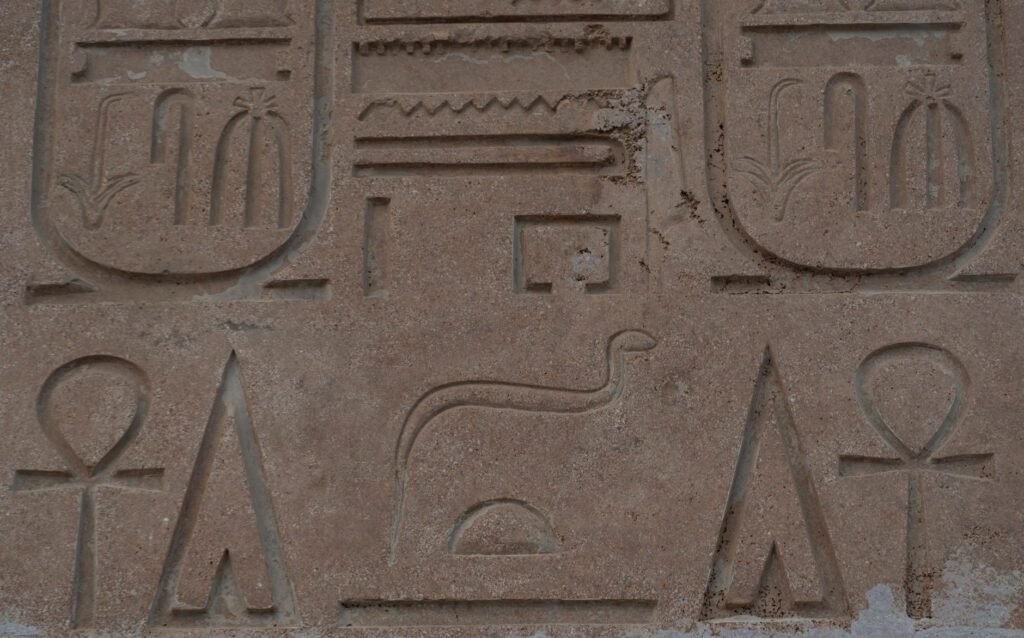
The Egyptian root ꜥnḫ appears widely in ancient texts. It is not merely a symbolic term but a common word in the language. This has made the ankh especially important: the symbol and the word reinforce one another. In inscriptions, the hieroglyphic sign for the ankh can function both as:
- a logogram for the word “life”
- a determinative associated with life and related concepts
- a symbolic object in art and religious contexts
Historical origin
The exact pictorial origin of the ankh shape is not definitively known. Over time, scholars have proposed several theories, including that it may have originated as a stylized representation of:
- a sandals strap
- a knot or tie
- a mirror handle
- a combination of male and female symbols
- a union of elements representing life or fertility
These theories remain debated, and no single explanation has been universally accepted. What is certain is that the symbol was already established in early Egyptian civilization and became deeply embedded in religious and artistic tradition.
Historical Context
The ankh belongs to the religious and cultural world of ancient Egypt, where life was understood as a divine gift and death as a transition rather than an absolute end. Egyptian mythology and funerary religion placed strong emphasis on the preservation of existence, bodily integrity, ritual order, and the hope of rebirth.
Use in ancient Egyptian religion
The ankh appears in:
- temple reliefs
- funerary inscriptions
- amulets
- statues of gods
- royal iconography
- coffin decorations
- papyrus texts
In many scenes, gods hold the ankh by the loop and present it to the nose of a king or dead person, symbolically granting the breath of life. This image reflects a basic Egyptian idea: life was not self-sustaining but came from divine sources.
Connection to kingship
Pharaohs were seen as intermediaries between gods and humans. The ankh often appears in royal contexts because the king depended on divine favor to maintain order, prosperity, and continuity. It also signaled the king’s role in upholding maat, the Egyptian principle of cosmic order, truth, and balance.
Funerary significance
In tomb scenes, the ankh was especially important because Egyptian religion aimed to ensure survival after death. It did not merely symbolize earthly life; it also represented the promise that life could continue in transformed form in the afterlife.
Main Characteristics
The ankh is usually drawn as a cross with a loop at the top and a vertical stem extending downward, often with a crossbar between the upper loop and the stem.
Visual features
| Feature | Description | Common interpretation |
|---|---|---|
| Upper loop | Oval or teardrop-shaped opening | Life, eternity, or a symbolic container of vital force |
| Vertical stem | Long central line | Stability, continuity, or the life path |
| Crossbar | Horizontal line beneath the loop | Structural balance; part of the sign’s identity |
| Overall shape | Cross-like form | Often called the “key of life” in modern usage |
Important identifying features
- It is not a Christian cross, though it resembles one in simplified form.
- It is often shown held by gods or carried in religious ritual.
- It may appear alone or in combination with other hieroglyphic and symbolic signs.
- In some artistic representations, it is associated with breath, power, and renewal, especially when placed near the mouth or nose.
Meaning in context
The meaning of the ankh can change slightly depending on context. In general, it signifies:
- life
- divine life
- protection of life
- eternal existence
- rebirth or regeneration
- the sustaining power of the gods
Family and Genealogy
Unlike a deity or mythological hero, the ankh is not a personified being and therefore has no parents, spouses, children, or genealogical lineage in the usual mythological sense.
However, it does have relationships within the symbolic and religious system of ancient Egypt.
Symbolic relationships
The ankh often appears alongside other important signs:
- the djed pillar, associated with stability and endurance
- the was scepter, associated with power and dominion
- the scarab, associated with rebirth and transformation
- the shen ring, associated with eternity and protection
These symbols sometimes work together to express a broader religious idea: life, stability, power, and eternity are interconnected.
Symbols
The ankh itself is a symbol, but it also belongs to a wider symbolic vocabulary in Egyptian religion.
Primary meanings
The most widely accepted symbolic meanings of the ankh are:
- life
- living power
- divine breath
- eternal life
- regeneration
- protection
In divine imagery
Gods are frequently shown holding the ankh as a sign that they control and bestow life. Sometimes it is offered directly to a king or to the deceased. In this context, the ankh is not merely a sign of existence; it is a sacred instrument of divine gift-giving.
Associated symbols
| Symbol | Meaning | Relationship to the ankh |
|---|---|---|
| Djed pillar | Stability, endurance | Complements the ankh’s life-giving power |
| Was scepter | Authority, strength | Represents divine and royal power |
| Shen ring | Eternity, protection | Reinforces ideas of continuity and protection |
| Scarab | Transformation, rebirth | Shares afterlife associations |
| Udjat eye | Healing, wholeness, protection | Often part of wider funerary symbolism |
Sacred Animals
The ankh is not itself an animal-associated deity, but it appears in relation to many sacred animals because Egyptian gods were often represented in animal or hybrid form.
Common animal associations in ankh imagery
- Falcon: linked to Horus and royal authority
- Lion: associated with strength, solar power, and protective force
- Ibis: linked to Thoth, wisdom, and ritual knowledge
- Cow: associated with maternal protection and nourishment, especially in the cult of Hathor
- Cat: associated with protection and domestic sacredness, especially in later traditions
Symbolic significance
These animals matter because they embody divine qualities. When a god in animal or animal-headed form holds an ankh, the image emphasizes that life is not random or purely biological; it is guided by sacred powers embedded in nature and kingship.
Sacred Plants
No single plant is universally and exclusively tied to the ankh. However, several plants in Egyptian symbolism often appear in the same religious world and may share themes of life, renewal, and regeneration.
Plants linked to life and rebirth
- Lotus: strongly associated with rebirth, creation, and the rising sun
- Papyrus: linked with Lower Egypt, vitality, and flourishing life
- Date palm: associated with fertility, abundance, and time
- Sycamore fig: connected with nourishment, protection, and the afterlife
Importance in context
These plants were meaningful because they reflected the natural cycles central to Egyptian belief: flooding, growth, decay, and renewal. The ankh’s meaning as life and continuation fits naturally into this wider symbolic landscape.
Sacred Places
The ankh is not tied to one specific sacred place. Instead, it appears throughout Egypt in temples, tombs, and cult centers.
Important settings
- Temples: gods grant life to kings and worshippers through ritual imagery
- Royal tombs: the ankh supports the deceased’s hoped-for rebirth
- Funerary chapels: it appears in offerings and protective scenes
- Major cult centers: such as Thebes, Memphis, Heliopolis, Abydos, and others where theology and royal ideology were prominent
Meaning of place in Egyptian religion
For ancient Egyptians, sacred space was not abstract. Temples and tombs were carefully constructed environments in which divine power could be accessed. The ankh was especially powerful in these spaces because it marked the boundary between mortal life and sacred continuity.
Powers and Attributes
Because the ankh is a symbol rather than a deity, it does not possess “powers” in the mythological sense of a god’s magical abilities. Nevertheless, it represents important religious functions and attributes.
Core attributes
The ankh is associated with:
- the gift of life
- divine protection
- vital force
- breath and renewal
- afterlife continuity
- royal legitimacy
Religious function
In Egyptian art, when a god offers the ankh to someone, the act symbolizes the transfer of divine life. This may be understood as a blessing, a sustaining force, or a guarantee of continued existence.
Conceptual importance
The symbol bridges several key Egyptian ideas:
- life on earth
- ritual maintenance of order
- divine favor
- resurrection or rebirth
- immortal life in the afterworld
Main Myths
The ankh is not central to a single mythological narrative in the way that some gods are. Instead, it appears across many myths and religious scenes as a recurring emblem of life and divine authority.
Creation and life
In creation traditions, Egyptian gods are often associated with bringing life into being. The ankh fits this larger theme as a sign of the life-giving power of the gods. It is often visual shorthand for divine animation and vitality.
Afterlife myths
The ankh is especially relevant in funerary mythology. Egyptians believed the deceased could continue existence if properly prepared through mummification, ritual, and divine favor. The ankh appears in this context as a sign of restoration and continued being.
Divine bestowal scenes
A common artistic motif shows a god presenting the ankh to a pharaoh. Such scenes do not describe a myth in narrative form but convey a theological message: the ruler’s life and authority depend on the gods.
Relationship with Other Mythological Figures
The ankh is closely connected with nearly all major Egyptian deities because it is a symbol of life they grant or preserve.
Common divine associations
- Ra: solar life, daily renewal, cosmic vitality
- Osiris: death, resurrection, and afterlife
- Isis: magic, protection, restoration, and maternal care
- Horus: kingship and legitimate rule
- Anubis: funerary rites and protection of the dead
- Amun: hidden divine power and royal blessing
- Hathor: nourishment, joy, femininity, and rebirth
- Ptah: creation and craftsmanship, especially in Memphite theology
Nature of the relationship
These figures do not “own” the ankh, but the symbol often serves as their attribute. The ankh helps express what these gods do:
- Ra gives life through the sun
- Osiris ensures life after death
- Isis restores life through magic
- Horus sustains kingship
- Anubis protects the dead on their journey
Worship and Cult
The ankh was not worshipped as a god, but it played a major role in ritual and devotional life.
Ritual use
The symbol appears in:
- temple reliefs showing divine blessing
- amulets worn for protection
- funerary objects placed with the dead
- inscriptions invoking life and well-being
- royal ceremonies emphasizing divine favor
Offerings and blessings
In some temple scenes, gods offer the ankh, the was scepter, and the djed pillar together. This combination expresses a complete ideal of divine support: life, power, and stability.
Amulets
Ankh-shaped amulets were worn for protective and religious purposes. Their use reflects the Egyptian belief that sacred symbols could mediate divine force in daily life and in burial.
Popular and funerary use
The ankh was not restricted to elites. Although it appeared prominently in royal and temple art, smaller-scale objects show that ordinary Egyptians also valued its protective and life-giving meaning.
Ancient Sources
Because the ankh is a symbol rather than a character, it does not appear in ancient literary sources in the same way a god or hero does. Its evidence comes primarily from archaeology, inscriptions, temple art, and funerary texts.
Primary Egyptian evidence
Important sources include:
- Temple reliefs and wall scenes
- Tomb paintings
- Hieroglyphic inscriptions
- Pyramid Texts
- Coffin Texts
- Book of the Dead
- Amulets and funerary objects
Classical authors
Greek and Roman writers such as Herodotus commented on Egyptian customs, but they did not provide a systematic explanation of the ankh’s meaning. Later classical and Greco-Roman sources are more useful for general descriptions of Egyptian religion than for direct interpretation of the symbol.
Scholarly caution
Modern understanding of the ankh relies mainly on material culture and philological study. Because the symbol’s origin is not explicitly explained in surviving ancient texts, some aspects remain uncertain.
Roman Equivalent
There is no exact Roman equivalent to the ankh.
Approximate parallels
Roman religion had symbols of life, health, and continuity, but none matched the ankh’s Egyptian combination of divine life, afterlife, and royal blessing. In later Greco-Roman Egypt, the symbol continued to be used in Egyptian religious contexts rather than being replaced by a Roman counterpart.
Cultural adaptation
In the Roman period, Egyptians and Greco-Romans living in Egypt sometimes blended traditions. Even then, the ankh remained recognizably Egyptian in meaning and form.
Influence on Modern Culture
The ankh has become a major modern emblem of Egypt, spirituality, and identity. Its meaning has expanded far beyond its ancient religious context.
In modern art and design
The ankh appears in:
- jewelry
- tattoos
- fashion
- graphic design
- museum branding
- decorative art
In literature and media
The symbol is frequently used in:
- historical fiction set in Egypt
- fantasy literature
- films about ancient Egypt
- video games featuring Egyptian themes
- occult and esoteric imagery
In contemporary identity and spirituality
For some modern communities, especially in African diasporic and Afrocentric contexts, the ankh has become a symbol of:
- cultural heritage
- Black identity
- life and resilience
- connection to ancient African civilization
Important note
Modern uses of the ankh sometimes combine ancient meanings with newer spiritual, political, or aesthetic interpretations. These modern meanings should not be confused with the full historical context of the ancient symbol.
Curiosities
Here are some lesser-known facts about the ankh:
- The ankh is often called the “key of life,” but that title is modern and not a direct ancient Egyptian name.
- Gods are sometimes shown holding the ankh to a person’s nose, symbolizing the gift of breath and life.
- The ankh appears in both royal and non-royal contexts, though it is especially common in sacred and elite art.
- It was used for centuries, with continuity across changing dynasties and religious developments.
- Its exact visual origin remains debated, which makes it one of the more intriguing symbols in Egyptology.
- The ankh was part of a larger symbolic system that included the djed, was, and shen, all of which reinforced stability, power, and eternity.
- In Coptic Christianity, a related symbol called the crux ansata appears in some contexts, showing how the form persisted into later periods, though its meaning changed.
Frequently Asked Questions
1. What does the ankh mean in Egyptian mythology?
The ankh most commonly means life. In mythological and religious contexts, it also represents divine life, breath, protection, rebirth, and eternal existence.
2. Is the ankh a god or goddess?
No. The ankh is a symbol, not a deity. It is often associated with gods because they are depicted holding or granting it.
3. Why do Egyptian gods hold the ankh?
They hold the ankh to show that they give life and sustain the living or the dead with divine power.
4. Does the ankh represent eternal life?
Yes, in many funerary and religious contexts it does. Ancient Egyptians associated the ankh with life beyond death and with ongoing existence in the afterlife.
5. Where did the ankh come from?
Its exact origin is unknown. Scholars have proposed several theories, but no explanation is universally accepted.
6. Is the ankh only linked to death and the afterlife?
No. It also symbolizes ordinary life, vitality, divine blessing, and royal power. Its meaning is broader than funerary symbolism alone.
7. Was the ankh used in everyday life?
Yes, in the form of amulets and personal objects. It was not limited to temples and tombs, though those are the places where it appears most visibly.
8. Is the ankh still important today?
Yes. It remains a powerful symbol in modern culture, especially in art, fashion, identity, and representations of ancient Egypt.
Conclusion
The ankh is one of the most important symbols in Egyptian mythology because it captures a central ancient Egyptian conviction: life is sacred, divinely sustained, and capable of continuing beyond death. As both a word and an image, the ankh united language, religion, and art. It appeared in royal scenes, funerary texts, temple reliefs, and amulets, always carrying associations of life, breath, protection, and rebirth.
Although its precise origin remains uncertain, its meaning is clear in historical context. The ankh was not merely decorative or mystical in a vague sense. It was part of a sophisticated religious system in which gods, kings, and the dead were bound together by the hope of renewed life. For that reason, the ankh continues to resonate as one of the most enduring and recognizable emblems of ancient Egypt.

Orin Vale has spent the better part of two decades tracing the threads that connect the world’s oldest stories — from the halls of Asgard to the banks of the Nile, from Olympus to the jungles of the Maya. What began as a childhood fascination with flood myths and trickster gods grew into years of independent study across comparative mythology and ancient religion, always chasing the same question: what did these stories mean to the people who first told them? Orin writes for readers who want more than trivia — the ones looking for the beliefs, fears, and truths that myths were built to carry.