Gorgoneion
Introduction
The Gorgoneion is the image or representation of a Gorgon’s head, most famously the face of Medusa in Greek mythology. In ancient Greece and later Rome, it appeared as a powerful apotropaic symbol, meaning it was believed to repel evil, ward off danger, and protect people, buildings, and objects from harm. The Gorgoneion is one of the most recognizable motifs in ancient art, appearing on shields, armor, temple pediments, coins, pottery, jewelry, and architectural decoration.
Its significance extends beyond mythology. The Gorgoneion offers a window into ancient ideas about fear, protection, divine power, and the boundary between the human and the monstrous. It also illustrates how a terrifying image could be transformed into a sacred emblem.
Origin and Meaning
The word Gorgoneion comes from the Greek Γοργόνειον (Gorgóneion), meaning “a Gorgon head” or “the image of a Gorgon.” It is derived from Gorgon, the name of the monstrous female figures in Greek myth, most often described as terrifying beings with snakes for hair and a gaze that could turn people to stone.
The Gorgoneion is not a single mythological creature but a visual form: the head of the Gorgon, cut off from the body or shown independently as a mask-like image. In art and ritual, the head was often used more as a protective emblem than as a narrative figure.
Although later mythology focused mainly on Medusa, the Gorgoneion has older roots in Greek visual culture and may preserve elements of earlier Near Eastern and pre-Greek protective imagery. Similar apotropaic faces and monstrous masks appear in several ancient cultures, suggesting that the Gorgoneion belongs to a wider ancient tradition of frightening images used for defense.
Historical Context
In Greek Religion and Art
The Gorgoneion was widespread in ancient Greek culture from at least the Archaic period onward. It appears prominently in the 7th and 6th centuries BCE on pottery, temple decoration, shields, and clothing accessories. Its use reflects a common ancient belief: a terrifying image could protect by frightening away evil.
This function is known as apotropaic protection. The Gorgoneion was not meant simply to depict horror. It served as a visual deterrent against hostile forces, bad luck, the evil eye, and possibly spiritual impurity.
Public and Private Use
The image was used in both public and private contexts:
- on temples and sacred buildings
- on war shields and armor
- on coins
- on jewelry
- on drinking vessels and tableware
- as architectural ornament on roofs, pediments, and simas
This broad distribution shows that the Gorgoneion was not limited to religion in the narrow sense. It was also a social and artistic emblem of protection, authority, and controlled fear.
Relationship to Medusa Myth
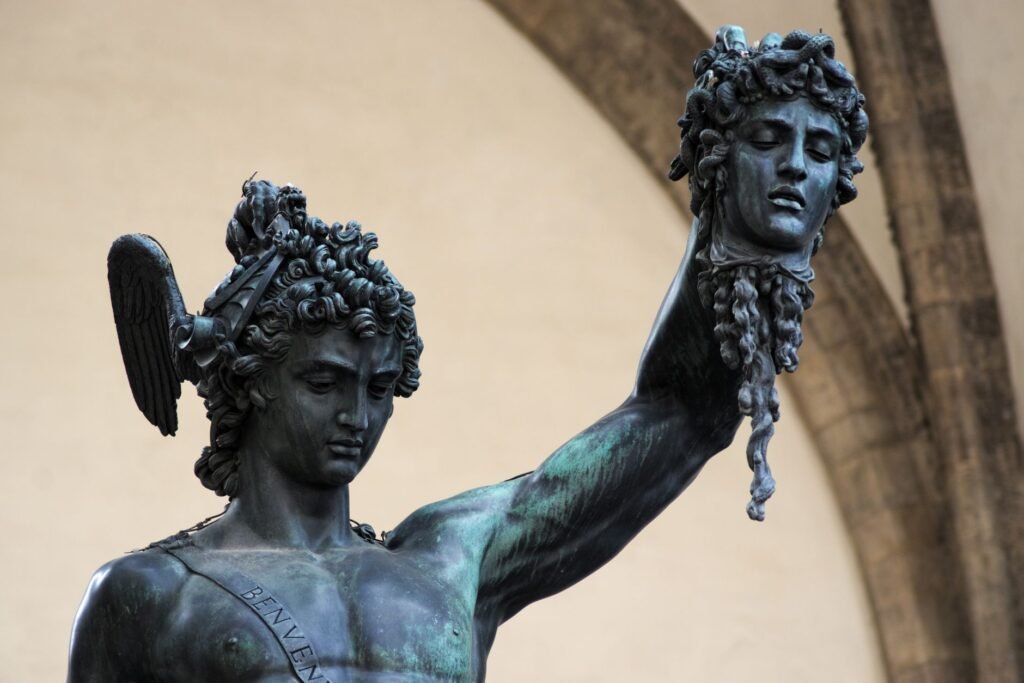
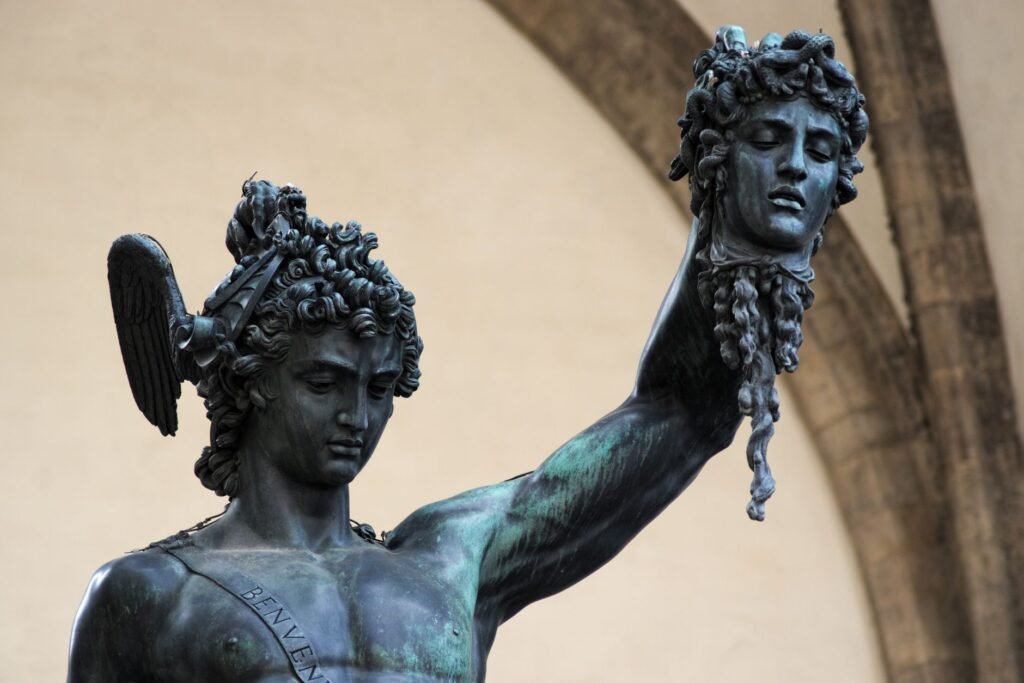
The myth of Perseus and Medusa became the most influential narrative associated with the Gorgoneion. In that story, Perseus beheads Medusa, and her severed head retains its deadly power. The resulting head, often called the Gorgoneion, becomes a divine and protective object. In later art, the head is sometimes shown in a more beautiful or stylized form, especially in Hellenistic and Roman works.
Main Characteristics
The Gorgoneion is usually identified by a set of striking visual features. These may vary by period and region, but commonly include:
- a broad, staring face
- large, round or glaring eyes
- a wide mouth or bared teeth
- a protruding tongue
- snakes or serpentine hair
- tusks or fangs in some early depictions
- sometimes wings, beard, or an exaggerated grimace
Artistic Development
The image changed significantly over time:
| Period | Typical Features |
|---|---|
| Archaic Greek | Highly frontal face, grotesque expression, tongue out, tusks, snakes, wide eyes |
| Classical Greek | More restrained and stylized, still recognizable as a protective head |
| Hellenistic | More naturalistic, sometimes with softer facial features |
| Roman | Often decorative and elegant, used widely in mosaics, jewelry, and architecture |
The frontal gaze is one of the most important features. It gives the Gorgoneion a confrontational presence, as if the image itself watches the viewer. This intense directness helped it function as a protective emblem.
Family and Genealogy
Because the Gorgoneion is an image rather than a person, it does not have a genealogy in the strict sense. However, the Gorgon figures have mythological family relationships.
The Gorgons in Myth
In many ancient sources, the Gorgons are three sisters:
- Stheno
- Euryale
- Medusa
Of these, Medusa is the mortal Gorgon, and the only one whose head is severed by Perseus. Other traditions vary, and ancient authors do not always agree on details.
Parents and Origins
Common ancient accounts name the Gorgons as daughters of the primordial sea deities Phorcys and Ceto. Some later authors and artistic traditions emphasize Medusa’s association with the sea, monsters, and divine forces of the ancient cosmos.
Descendants of Medusa
In myth, when Perseus cuts off Medusa’s head, two beings are born from her blood:
- Pegasus, the winged horse
- Chrysaor, a warrior or golden-sworded figure
These figures are part of the larger mythic context surrounding the Gorgoneion, though they are not part of the image itself.
Symbols
The Gorgoneion is itself a symbol, but it is associated with a wider network of symbolic elements.
Core Symbolic Meanings
- Protection: wards off evil and hostile forces
- Terrifying power: frightens enemies or supernatural threats
- Divine authority: associated with gods and heroes
- Boundary crossing: connects life and death, beauty and horror, sacred and dangerous
Common Visual Symbols
| Symbol | Meaning |
|---|---|
| Snakes | Chthonic power, danger, transformation, renewal |
| Wide eyes | Vigilance, supernatural awareness, direct confrontation |
| Open mouth / tongue | Frenzy, threat, aggressive force |
| Wings | Speed, divine or liminal power |
| Frontal face | Direct defensive gaze and apotropaic effect |
The Gorgoneion often blurs the line between mask, portrait, and monstrous emblem. This ambiguity is central to its meaning.
Sacred Animals
The Gorgoneion is strongly associated with snakes, which are by far its most important animal symbol.
Snakes
Snakes in the Gorgoneion’s hair or around the face may symbolize:
- danger and poison
- chthonic or underworld powers
- transformation and renewal
- protective force against evil
In ancient Mediterranean religion, snakes could be both feared and revered. Their association with the Gorgoneion helps explain the image’s power as both a threat and a guardian.
Other Associated Animals
Depending on the artistic tradition, the Gorgoneion may also be linked with:
- birds or wings, especially in more stylized versions
- lions or leonine features in some early monstrous masks
- horses, indirectly through Pegasus, though this is connected to Medusa’s myth rather than the head motif itself
Sacred Plants
There are no universally established sacred plants specifically tied to the Gorgoneion in the way that some deities have clear botanical associations. Ancient sources do not consistently present a plant cult for the Gorgoneion.
However, in broader symbolic interpretation, the Gorgoneion may be connected with vegetation motifs in art, especially when used in decorative borders or temple ornament. Any such associations are artistic rather than firmly cultic.
If plant symbolism is discussed in relation to Medusa or Gorgons, it is generally secondary and varies by context. No single plant can be identified as canonical for the Gorgoneion.
Sacred Places
The Gorgoneion was not tied to one exclusive sacred place. Instead, it appeared across the Greek world and in later Roman settings.
Notable Contexts of Use
- Temples and sanctuaries: placed on pediments, simas, and protective elements of sacred architecture
- Athens: the Gorgon head is especially associated with Athena’s protective imagery
- Argos, Corinth, and other Greek city-states: where Gorgon motifs appear in art and civic iconography
- Panhellenic and local sanctuaries: used as part of decorative and protective schemes
- Etruria and Rome: where the motif was adopted and adapted widely
The Aegis and Sacred Space
One of the most important mythic associations is with Athena’s aegis, a protective goatskin or shield-like object often decorated with the Gorgoneion. This links the image to divine protection in battle and to the sacred authority of Athena herself.
Powers and Attributes
The Gorgoneion does not possess powers in the same way a deity does, but in mythic and symbolic terms it is deeply associated with several functions.
Main Powers and Functions
- Apotropaic power: repels evil and danger
- Petrifying gaze: in the myth of Medusa, the gaze turns living beings to stone
- Protective force: guards temples, people, and objects
- War-like intimidation: frightens enemies in battle
- Sacred mediation: marks objects or places as under divine protection
Attributes in Myth and Ritual
The Gorgoneion is both feared and revered. It is a paradoxical symbol: ugly yet powerful, monstrous yet protective, dangerous yet beneficial. That dual nature is one reason it remained popular for so long.
Main Myths
Perseus and Medusa
The central myth associated with the Gorgoneion is the story of Perseus. In the best-known versions, Perseus receives help from the gods in his quest to kill Medusa. He approaches the Gorgon while avoiding her direct gaze, often using a reflective shield or polished surface. After beheading her, he carries the head as a weapon and protective talisman.
Different ancient sources vary in details, but the story consistently emphasizes the head’s dangerous power even after death.
Athena and the Gorgoneion
In some traditions, Athena receives or incorporates the Gorgon head onto her aegis or shield. The image becomes a sign of her warrior power and protective authority. On many later representations, Athena herself is shown with the Gorgoneion on her chest or shield.
The Gorgon as Origin of Protective Imagery
Some scholars interpret the Gorgoneion as a transformed monster-mask from earlier visual traditions, later integrated into myth. Ancient narratives and artistic forms may have developed together, producing a symbol that is both mythical and functional.
Relationship with Other Mythological Figures
Athena
The most important divine association of the Gorgoneion is with Athena, goddess of wisdom, warfare, and protection. The Gorgoneion appears on her aegis and is strongly linked to her ability to defend cities and warriors.
Perseus
Perseus is the hero most directly connected with Medusa’s severed head. He uses the Gorgoneion as a weapon and carries it after the slaying of Medusa. Through Perseus, the head becomes part of heroic myth and divine favor.
Medusa
Medusa is the figure most commonly identified with the Gorgoneion. Later tradition often collapses the two into one, although in older mythological frameworks the Gorgons are plural beings and the Gorgoneion is specifically the head-image.
Apollo, Heracles, and Others
In some artistic and literary contexts, the Gorgoneion appears in scenes involving other heroes or gods, usually as a protective or decorative sign rather than as an active character. Its widespread use means it can appear in many mythological environments even when not central to the narrative.
Worship and Cult
The Gorgoneion itself was not worshipped as a deity in the normal sense. However, it had a strong ritual and protective function.
Apotropaic Use in Practice
Ancient people likely used the Gorgoneion to:
- protect homes and sanctuaries
- guard military equipment
- avert the evil eye
- sanctify public architecture
- signal divine favor and protection
Ritual and Material Contexts
The Gorgoneion appears on:
- votive offerings
- amulets
- furniture
- textiles
- ceramics
- funerary objects
These uses suggest that it operated in everyday religious life as a protective sign. In this sense, the cult of the Gorgoneion was not a formal temple cult but a widespread visual and ritual practice.
Ancient Sources
Several ancient authors are important for understanding the Gorgoneion and the myths connected with it.
Key Classical Sources
- Homer: refers to the Gorgon as a terrifying figure associated with the divine and with war; the Gorgon’s image appears in shield and divine contexts.
- Hesiod (Theogony): gives an early account of the Gorgons as daughters of Phorcys and Ceto and describes Medusa’s death and the birth of Pegasus and Chrysaor.
- Apollodorus (Bibliotheca): offers a concise mythological summary of Perseus and Medusa.
- Pausanias: describes monuments and artworks in Greece, including images with Gorgon motifs.
- Ovid (Metamorphoses): provides a Roman-era retelling of Medusa’s story, influential for later reception.
- Pindar and other lyric poets: preserve references to heroic and divine uses of Gorgon imagery.
Important Caveat
Ancient sources do not always agree. The number of Gorgons, the nature of Medusa, and the origin of the Gorgon head vary from one tradition to another. A careful reading should avoid assuming a single fixed version.
Roman Equivalent
There is no exact Roman deity equivalent to the Gorgoneion because it is an image rather than a god. However, the Romans adopted the motif extensively and continued its apotropaic use.
Roman Adaptation
In Roman art, the Gorgoneion appears:
- in domestic decoration
- on mosaics and floor designs
- on armor and military insignia
- on jewelry and cameos
- in architectural ornamentation
Roman culture retained the Greek association of the Gorgon head with protection and power. The image was also integrated into imperial and decorative art, sometimes becoming more elegant and less grotesque than early Greek examples.
Influence on Modern Culture
The Gorgoneion has remained influential because it combines myth, terror, and visual power.
In Art and Design
Modern artists have repeatedly drawn on the Gorgoneion’s frontal stare and serpentine hair. It appears in:
- painting and sculpture
- fashion and decorative arts
- logos and branding
- jewelry design
- tattoo art
In Literature and Popular Culture
The Medusa head, and by extension the Gorgoneion, is common in:
- fantasy literature
- mythological retellings
- children’s books on Greek myth
- poetry and symbolism studies
In Film, Television, and Games
The image often appears in:
- films about Greek mythology
- television adaptations of classical legends
- video games featuring ancient monsters or divine artifacts
Its modern use typically emphasizes either fear or empowerment, sometimes reinterpreting Medusa as a tragic or symbolic figure rather than only a monster.
In Contemporary Symbolism
The Gorgoneion continues to represent:
- female power
- protection
- monstrous beauty
- the gaze as a form of power
- the ancient world’s fascination with transformation and fear
Curiosities
- The Gorgoneion was one of the most effective ancient apotropaic images, because it was designed to repel harm by being frightening itself.
- Early versions are often far more grotesque than later ones, with the tongue out and exaggerated facial features.
- The image was used not only in temples but also on everyday objects, showing that ancient religion was embedded in daily life.
- The Gorgoneion is one of the few mythic motifs that moved easily between religious art, warfare, domestic space, and personal adornment.
- In some modern readings, Medusa’s head has been reinterpreted as a symbol of survival and reclaimed power, though this is a contemporary interpretation rather than an ancient one.
- The frontal stare of the Gorgoneion is visually powerful because it seems to confront the viewer directly, unlike most ancient profile portraits.
- Some scholars see the Gorgoneion as part of a broader Mediterranean tradition of mask-like protective faces.
Frequently Asked Questions
1. What is a Gorgoneion?
A Gorgoneion is the head or face of a Gorgon, especially Medusa, used as a protective symbol in ancient Greek and Roman art.
2. Why was the Gorgoneion used?
It was believed to have apotropaic power, meaning it could ward off evil, danger, and bad luck.
3. Is the Gorgoneion the same as Medusa?
Not exactly. Medusa is the mythological figure, while the Gorgoneion is the image of her head. In practice, the two are often closely linked.
4. Where was the Gorgoneion found in antiquity?
It appeared on temples, shields, jewelry, coins, pottery, and other objects throughout the Greek and Roman worlds.
5. What does the Gorgoneion symbolize?
It symbolizes protection, terror, divine power, vigilance, and the ability to repel harmful forces.
6. Which ancient authors mention the Gorgon or Medusa?
Important sources include Homer, Hesiod, Apollodorus, Pausanias, and Ovid.
7. Did the Romans use the Gorgoneion?
Yes. The Romans adopted it widely in art, architecture, and personal items, preserving its protective meaning.
8. Why is the Gorgoneion important today?
It remains important as a major symbol of classical mythology, ancient religious practice, and the power of visual imagery.
Conclusion
The Gorgoneion is one of the most enduring symbols of the ancient Mediterranean world. Emerging from Greek myth and art, it combined the terrifying face of the Gorgon with the protective logic of ancient apotropaic belief. Its power lay in paradox: it was monstrous yet sacred, frightening yet beneficial, a symbol of death that also defended life.
Through its connection to Medusa, Perseus, Athena, and the wider world of Greek and Roman art, the Gorgoneion became far more than a mythological detail. It became a lasting image of divine protection and visual authority. Its continued presence in modern culture shows that the ancient fascination with the frightening face has not disappeared. The Gorgoneion still speaks to enduring human ideas about fear, defense, and the power of images.

Orin Vale has spent the better part of two decades tracing the threads that connect the world’s oldest stories — from the halls of Asgard to the banks of the Nile, from Olympus to the jungles of the Maya. What began as a childhood fascination with flood myths and trickster gods grew into years of independent study across comparative mythology and ancient religion, always chasing the same question: what did these stories mean to the people who first told them? Orin writes for readers who want more than trivia — the ones looking for the beliefs, fears, and truths that myths were built to carry.