Greek Sphinx vs Egyptian Sphinx
Introduction
The comparison between the Greek sphinx and the Egyptian sphinx reveals two closely related but fundamentally different cultural ideas. Both combine a human and animal form, and both are powerful symbols in the art and mythology of the ancient Mediterranean world. Yet their meanings, genders, functions, and religious contexts differ sharply.
In Egyptian civilization, the sphinx was primarily a protective and royal image, often represented as a lion-bodied creature with a human head, associated with kingship, divine power, and sacred space. In Greek mythology, the sphinx became a dangerous, riddle-speaking monster, usually imagined with a woman’s head, a lion’s body, wings, and sometimes the tail of a serpent. Its most famous story is the riddle of Thebes.
Understanding the Greek sphinx vs Egyptian sphinx is important not only for mythology but also for art history, archaeology, and the history of cultural exchange. The two figures share a name through later classical transmission, but they belong to very different symbolic worlds.
Origin and Meaning
The word sphinx comes into English through Latin and Greek. The Greek term sphinx likely referred to a “strangler” or “binder,” though the exact etymology remains debated. Ancient Greek authors connected the creature to its deadly function in myth, especially its attack on travelers.
The Egyptian sphinx is older than the Greek literary sphinx. In Egypt, the creature was not originally called by a word equivalent to the Greek term; rather, modern scholars use “sphinx” as a convenient label for lion-bodied statues with human or animal heads. The most famous Egyptian example is the Great Sphinx of Giza, a monumental royal sculpture from the Old Kingdom period.
Etymological and cultural distinction
- Greek sphinx: a mythological monster in Greek literature.
- Egyptian sphinx: a monumental sacred sculpture and royal image in Egyptian art.
- The same English word is used for both, but they represent different traditions.
Historical Context
Egyptian context
The Egyptian sphinx emerged in a culture where animal imagery and divine kingship were deeply connected. Lions symbolized strength, protection, and solar power. A sphinx placed at a temple entrance or along a processional route functioned as a guardian, visually expressing the authority of the ruler and the sacredness of the site.
Egyptian sphinxes appear in multiple periods and forms, including:
- recumbent lions with human heads
- human-headed lion statues
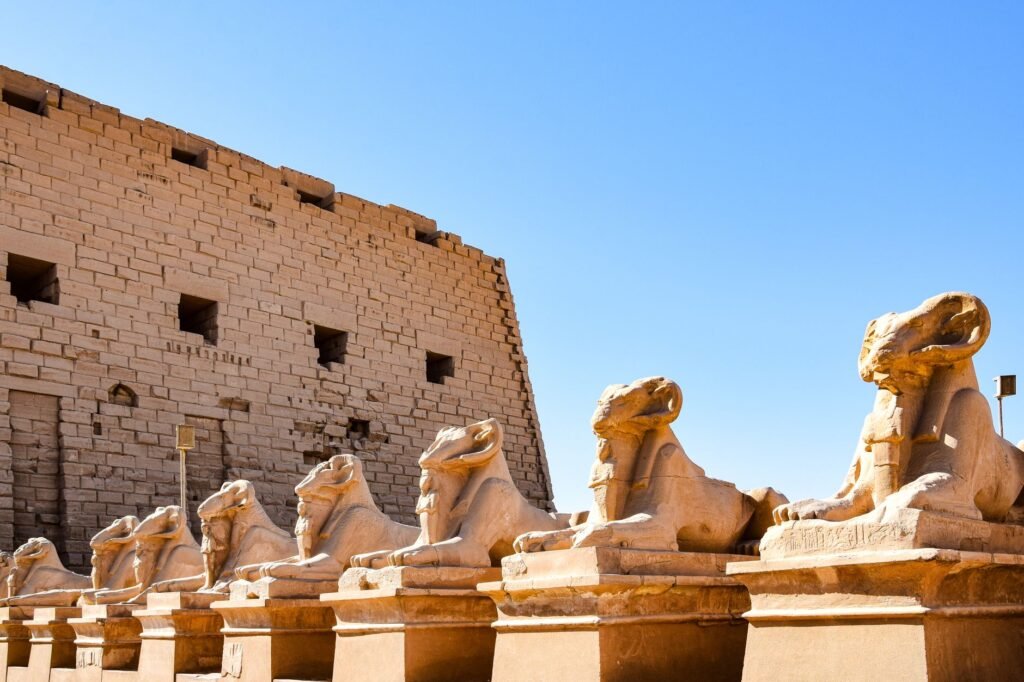
- ram-headed sphinxes
- occasionally falcon-headed or other animal-headed variants
These figures were linked to royal ideology and temple architecture.
Greek context
The Greek sphinx appears later in surviving literature and art than Egyptian sphinxes. In Greek mythology, she belongs to the world of monsters and heroes, alongside figures such as the Hydra, the Chimera, and the Minotaur. Her role is not protective but destructive. She blocks passage, kills those who cannot answer her riddle, and is ultimately defeated by Oedipus.
Greek artists adopted and adapted foreign artistic motifs, including sphinx imagery, especially through contact with Egypt and the Near East. However, the Greek mythological sphinx developed into a distinctly Hellenic monster.
Main Characteristics
Greek Sphinx
The Greek sphinx is usually described with the following features:
- a woman’s head or face
- a lion’s body
- wings, often eagle-like
- a serpentine tail in some depictions
- a perilous, enigmatic character
- association with riddles, death, and liminality
In Greek art, the figure is often elegant rather than grotesque, especially in vase painting and funerary sculpture.
Egyptian Sphinx
The Egyptian sphinx is usually characterized by:
- a lion’s body
- a human head, commonly that of a pharaoh
- sometimes a ram or falcon head in variant forms
- a calm, recumbent posture
- protective and royal symbolism
- placement in temples, avenues, and tomb complexes
Unlike the Greek monster, the Egyptian sphinx is generally not a narrative character in myth. It is a sacred image and architectural guardian.
Key differences at a glance
| Feature | Greek Sphinx | Egyptian Sphinx |
|---|---|---|
| Primary role | Monster, challenger, destroyer | Guardian, royal symbol, protective image |
| Typical head | Female human head | Human head, usually a king |
| Body | Lion body, usually winged | Lion body, usually unwinged |
| Mythological behavior | Asks riddles, kills the unsuccessful | Silent, emblematic, protective |
| Cultural setting | Greek myth and literature | Egyptian religion, kingship, and monumental art |
| Emotional tone | Threatening, enigmatic | Majestic, calm, authoritative |
Family and Genealogy
Greek Sphinx
Ancient sources offer different genealogies for the Greek sphinx. The most common traditions name her as the daughter of:
- Typhon and Echidna, a frequent parentage for many monsters
- or, in some accounts, Orthrus and Chimera
- or other monstrous pairings, depending on source and local tradition
Her family background places her among the great monstrous offspring of Greek myth.
She is sometimes described as the mother of the Nemean Lion or other beings in later traditions, but such claims are not universal and vary by author. In mainstream mythographic traditions, her main identity is that of a single monster rather than a generative ancestor.
Relationships in Greek myth
The Greek sphinx’s central relationship is with Oedipus, the hero who solves her riddle. Her defeat leads to her death, often by self-destruction or by falling from a height, depending on the version.
Egyptian Sphinx
The Egyptian sphinx is not typically treated as a mythological individual with a family tree. Instead, it is an artistic and religious form. When the sphinx bears a royal head, it symbolically identifies the ruler with lion-like power and divine guardianship.
The Great Sphinx of Giza is associated with the reign of Khafre in many scholarly reconstructions, though aspects of its exact dating and attribution have been debated. That discussion concerns archaeology and royal iconography rather than mythic genealogy.
Symbols
Greek Sphinx
Symbolism in the Greek tradition includes:
- riddles and intelligence
- danger at thresholds
- female ambiguity
- death and funerary imagery
- the failure of human knowledge without insight
The sphinx often symbolizes a test that separates the wise from the doomed. Her hybrid body reflects disorder, liminality, and the unsettling crossing of categories.
Egyptian Sphinx
Egyptian sphinx symbolism includes:
- royal authority
- solar power
- protection
- strength and vigilance
- the sacred order of kingship
- the union of human intelligence and leonine force
The lion was closely associated with the sun and with protective deities. The sphinx’s still, frontal or recumbent form conveys control rather than menace.
Common symbolic contrast
- Greek sphinx: hidden meaning, threat, and intellectual trial
- Egyptian sphinx: visible power, protection, and sacred legitimacy
Sacred Animals
Greek Sphinx
The Greek sphinx is itself a composite creature rather than an animal associated with a cultic animal list. Its animal components are symbolically important:
- lion: strength, danger, dominance
- bird wings: mobility, otherworldly presence, liminality
- serpent elements in some imagery: death, danger, chthonic associations
Egyptian Sphinx
The Egyptian sphinx is also a composite, but its animal identity is more stable and culturally rooted.
Associated animals
- lion: the primary sacred animal, representing power and protection
- falcon: in some sphinx variations, linked to Horus and kingship
- ram: in ram-headed sphinxes, associated with certain gods, especially Amun
The prominence of the lion in Egyptian symbolism explains why the sphinx became such a strong royal and temple guardian.
Sacred Plants
Neither the Greek sphinx nor the Egyptian sphinx has a universally recognized sacred plant strongly associated with the figure in the way some gods do. Still, certain broader symbolic associations can be noted cautiously.
Greek tradition
In funerary and ritual contexts, Greek sphinx imagery may appear on grave monuments, where plants such as ivy, laurel, or acanthus can occur in the surrounding artistic language. These are not exclusive sacred plants of the sphinx itself.
Egyptian tradition
Egyptian sphinxes often appear in temple settings linked to broader sacred vegetation motifs, such as:
- papyrus
- lotus
- palm
These plants symbolize life, rebirth, Upper and Lower Egypt, and sacred order, but they are not specific to the sphinx figure alone.
Sacred Places
Greek Sphinx
The Greek sphinx is strongly associated with Thebes, where she confronts Oedipus. In Greek cultural memory, Thebes becomes the central location of the myth.
Other connections include:
- tombs and funerary art
- temple sculpture and decorative motifs
- sanctuaries where sphinxes appear as ornaments or guardians
The Greek sphinx is more a narrative being than a place-bound cult figure, yet her myth is anchored in a particular city.
Egyptian Sphinx
The Egyptian sphinx is linked to many sacred and royal sites.
Important locations
- Giza: home of the Great Sphinx
- temple avenues in Thebes and elsewhere
- processional routes
- royal mortuary complexes
- entrances to sanctuaries
Egyptian sphinxes frequently lined avenues leading to temples, forming protective rows. Their placement was functional as well as symbolic, guiding movement into sacred spaces.
Powers and Attributes
Greek Sphinx
The Greek sphinx’s powers are mainly destructive and intellectual:
- she poses a deadly riddle
- she kills those who fail to answer
- she represents a challenge to human knowledge
- she guards access to Thebes until she is defeated
Her authority is negative and temporary. She is powerful because she blocks passage, not because she rules.
Egyptian Sphinx
The Egyptian sphinx has a very different set of attributes:
- protection of sacred and royal spaces
- embodiment of royal strength
- association with divine kingship
- symbolic guardianship against disorder
- permanence and stability
The Egyptian sphinx does not test travelers with riddles. It stands as an enduring emblem of control, order, and legitimacy.
Comparative summary
| Aspect | Greek Sphinx | Egyptian Sphinx |
|---|---|---|
| Core function | Challenge and destroy | Guard and protect |
| Intellectual role | Riddler, tester | Symbol, not a riddle-maker |
| Moral tone | Menacing, fatal | Majestic, protective |
| Spatial role | Blocks a city or road | Protects temples and tombs |
Main Myths
The Greek sphinx and Oedipus
The most famous Greek myth involving the sphinx is the story of Oedipus. The sphinx terrorizes Thebes and asks a riddle to travelers. The best-known version of the riddle is:
What creature walks on four legs in the morning, two at midday, and three in the evening?
Oedipus answers correctly: a human being, who crawls as an infant, walks upright in adulthood, and uses a cane in old age. Defeated, the sphinx dies.
Different ancient sources vary on details such as the exact wording of the riddle and the manner of the sphinx’s death. The core narrative, however, is consistent.
Meaning of the myth
The myth dramatizes:
- the victory of intelligence over brute menace
- the transition from ignorance to knowledge
- the restoration of order in Thebes
- the tragic irony of Oedipus’s rise to power
Egyptian sphinx traditions
Unlike the Greek version, the Egyptian sphinx is not centered on a single mythic episode. Its “story” is primarily visual and architectural. The Great Sphinx of Giza later became the subject of folklore, legends, and interpretive traditions, some from antiquity and many from later periods, but these do not form a unified ancient myth comparable to Oedipus.
In Egypt, sphinxes were part of a long tradition of sacred kingship rather than characters in mythic narrative.
Relationship with Other Mythological Figures
Greek sphinx
The Greek sphinx belongs to a wider network of monstrous beings. She is related in type, if not always by family, to:
- the Chimera
- the Hydra
- Typhon
- Echidna
- the Harpies
- other hybrid creatures that challenge heroes
She also contrasts with heroic figures such as Oedipus, Heracles, and Perseus, who restore order through intelligence or strength.
Egyptian sphinx
The Egyptian sphinx is connected more to gods and kings than to monsters. It resonates especially with:
- Ra or solar theology
- Horus, through royal ideology
- Amun, in ram-headed forms
- pharaohs who adopt lion-like attributes
The sphinx can be viewed as a visual extension of divine kingship rather than an independent mythological actor.
Worship and Cult
Greek sphinx
The Greek sphinx was not worshipped as a deity in the usual sense. She appears in:
- myths
- vase paintings
- funerary monuments
- literary works
- some sculptural or decorative contexts
Her role is symbolic rather than cultic. There is no major evidence for a formal sphinx cult comparable to that of gods or heroes.
Egyptian sphinx
The Egyptian sphinx belonged to religious and royal practice, though not usually as a god to be worshipped independently.
Forms of use
- guarding temples and tombs
- marking sacred avenues
- expressing royal presence
- participating in processional symbolism
Ritual life in Egypt may have included offerings and temple ceremonies near sphinx-lined spaces, but the sphinx itself was usually part of a larger sacred environment rather than the sole recipient of cult.
Ancient Sources
Greek sources
Important ancient authors and texts for the Greek sphinx include:
- Homeric tradition: the sphinx is not central in Homer, but later Greek myth builds on broader monster traditions.
- Hesiod: monster genealogies in works attributed to Hesiod help contextualize creatures like the sphinx.
- Apollodorus, Bibliotheca: gives mythographic accounts of the sphinx and Oedipus.
- Sophocles, Oedipus Tyrannus: the most famous literary treatment of the Oedipus story, though the sphinx appears only in remembered narrative.
- Euripides and later tragedians: relevant for Theban myth cycles.
- Pausanias: provides valuable antiquarian observations on Greek sites and traditions.
- Ovid: transmits Greek myths in Roman poetic form, including related monster themes.
Egyptian sources and evidence
For the Egyptian sphinx, the evidence is primarily archaeological and iconographic rather than literary mythic narrative. Important sources include:
- temple reliefs and inscriptions
- royal statuary
- funerary architecture
- the Great Sphinx itself
- later classical observations by Greek and Roman visitors, including Herodotus in a broader Egyptian context
Because Egyptian sphinxes are physical monuments, their “sources” are often objects rather than stories.
Roman Equivalent
The Roman world largely adopted the Greek sphinx rather than creating a separate equivalent. In Roman literature, art, and decoration, the sphinx appears as a mythological and ornamental figure inherited from Greek culture.
The Egyptian sphinx also influenced Roman art, especially after Rome’s expansion into Egypt. Roman villas, gardens, and imperial settings sometimes incorporated sphinx imagery inspired by Egyptian models.
Roman adaptation
- Greek sphinx: retained as a literary and artistic monster
- Egyptian sphinx: admired as an exotic and imperial symbol
- Roman art often blended Greek and Egyptian motifs, making distinctions less clear in later visual culture
Influence on Modern Culture
Both sphinx traditions have had a major impact on modern culture, though in different ways.
Greek sphinx in modern culture
The Greek sphinx appears in:
- classical literature studies
- psychoanalytic and symbolic interpretation
- novels and plays based on Oedipus
- fantasy art and role-playing games
- symbolic use as a figure of mystery and intellectual challenge
It often represents the idea of a riddle or an unsolved problem.
Egyptian sphinx in modern culture
The Egyptian sphinx is widely recognized through:
- the Great Sphinx of Giza
- museum collections and archaeology
- travel literature and documentaries
- films and popular depictions of ancient Egypt
- architecture and decorative motifs
It often represents antiquity, mystery, and royal grandeur.
Modern confusion and blending
Modern usage sometimes blurs the two figures. A winged female sphinx is usually Greek in origin, while a lion-bodied human-headed statue without wings is usually Egyptian. However, popular media often mixes these features for dramatic effect.
Curiosities
- The Greek sphinx is usually female, while the Egyptian sphinx is typically male or royal in appearance.
- In Greek art, sphinxes could appear as decorative guardians on funerary monuments, even though the mythological creature was dangerous.
- The Great Sphinx of Giza is one of the largest and oldest monumental sculptures in the world.
- Egyptian sphinxes are not all human-headed; some have ram heads or other variations.
- The Greek sphinx’s riddle is one of the most famous puzzles in Western literature.
- The word “sphinx” in modern languages often causes people to imagine a single universal creature, but historically the Greek and Egyptian versions are distinct.
- Sphinx imagery traveled widely in the ancient Mediterranean, showing that artistic borrowing and mythological reinterpretation often went hand in hand.
Frequently Asked Questions
1. What is the main difference between the Greek sphinx and the Egyptian sphinx?
The main difference is function. The Greek sphinx is a mythological monster that asks riddles and kills those who fail. The Egyptian sphinx is a protective royal and sacred image, usually a lion-bodied statue with a human head.
2. Was the Greek sphinx inspired by the Egyptian sphinx?
Many scholars think Greek sphinx imagery was influenced by contact with Egypt and the Near East, especially in art. However, the Greek mythological sphinx developed into a distinct figure with her own narrative role.
3. Is the Egyptian sphinx a god?
No, not usually. The Egyptian sphinx is best understood as a symbolic and monumental form associated with kingship, protection, and divine power, rather than as an independent deity.
4. Why is the Greek sphinx usually female?
Ancient Greek depictions and stories commonly give the sphinx a female head, though artistic details vary. This may reflect the creature’s role as an alluring yet dangerous tester of men, especially in the Oedipus myth.
5. What does the Great Sphinx of Giza represent?
The Great Sphinx of Giza is generally understood as a royal and protective monument from ancient Egypt. Many scholars associate it with Khafre, though aspects of its dating and attribution have been debated.
6. Did the sphinx have a cult in ancient Greece or Egypt?
The Greek sphinx was not worshipped like a deity. In Egypt, sphinxes were part of sacred and royal spaces, but they were usually images within a cultic environment, not the central object of worship.
7. Why are sphinxes used in architecture?
Sphinxes functioned as guardians. In Egypt, they protected temples, tombs, and avenues. In Greek and later Western art, they could also serve decorative or symbolic roles, especially in funerary settings.
8. Why do people often confuse Greek and Egyptian sphinxes?
They are confused because both are hybrid creatures combining human and lion features, and both became famous in later classical and modern culture. But their meanings and historical contexts are very different.
Conclusion
The Greek sphinx vs Egyptian sphinx comparison shows how a similar hybrid image can develop into two very different cultural symbols. In Egypt, the sphinx was a majestic guardian of kingship and sacred space, rooted in monumental art and religious authority. In Greece, the sphinx became a mythic monster of riddles, death, and heroic triumph.
Both figures reflect the ancient world’s fascination with combining human intelligence and animal power. Both also reveal how symbols travel across cultures and change meaning in new settings. For this reason, the sphinx remains one of the most enduring and recognizable creatures of antiquity, not as a single universal being, but as two powerful traditions with their own histories, functions, and legacy.

Orin Vale has spent the better part of two decades tracing the threads that connect the world’s oldest stories — from the halls of Asgard to the banks of the Nile, from Olympus to the jungles of the Maya. What began as a childhood fascination with flood myths and trickster gods grew into years of independent study across comparative mythology and ancient religion, always chasing the same question: what did these stories mean to the people who first told them? Orin writes for readers who want more than trivia — the ones looking for the beliefs, fears, and truths that myths were built to carry.