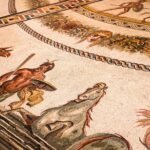
Io and Her Wanderings
Introduction

Io and her wanderings is one of the best-known myths of Greek antiquity. The story tells of Io, a mortal woman transformed and driven across the world by divine jealousy, suffering, and long displacement before reaching safety. In ancient literature, her journey links Greece, the eastern Mediterranean, Egypt, and the origins of dynastic myth. Because of this wide geographic sweep, Io’s wanderings became more than a personal tragedy: they served as a mythic explanation for far-flung places, peoples, and cults.
The tale is significant in Greek and Roman tradition for several reasons. It is a dramatic example of the conflict between gods and mortals, especially Zeus and Hera. It also illustrates the ancient practice of connecting myths to geography, turning travel routes and foreign lands into meaningful landscapes of memory. In later literature and art, Io’s suffering made her a powerful symbol of exile, endurance, and transformation.
Origin and Meaning
The name Io (Greek: Ἰώ) is ancient, but its etymology is not fully secure. Ancient and modern scholars have proposed different explanations, and no single derivation is universally accepted. In Greek literature, her name is already established as that of a mortal woman associated with Argos and with a long, divinely imposed journey.
The myth likely developed within the broader fabric of early Greek religious storytelling, especially in regions connected with Hera worship, such as Argos. Some aspects of Io’s story may preserve pre-classical local traditions later elaborated by poets and dramatists. Her role as both a local Argive figure and a world-traveling heroine made her useful for linking Greek myth to distant places, including Egypt.
Historical Context
Io’s story belongs to the mythic world of archaic and classical Greece, where divine action was often understood as direct and immediate. Myths were not only stories for entertainment; they also explained cult practice, genealogy, place names, and foreign contacts.
Several historical and cultural contexts shaped the Io tradition:
- Argive religion: Io is strongly associated with Argos and with Hera’s sphere.
- Mythic geography: Greek authors often mapped myths onto real landscapes.
- Greek knowledge of Egypt and the Near East: As Greeks interacted more with eastern civilizations, myths were increasingly linked to routes, migrations, and foreign kingdoms.
- Female suffering in myth: Io’s story is part of a larger pattern in which mortal women suffer because of divine conflict or desire.
The myth also reflects ancient ideas about metamorphosis and contamination. Io’s transformation into a cow, whether literal or symbolic depending on the source, is one of the most memorable episodes in Greek mythology.
Main Characteristics
Io is usually presented as a beautiful mortal woman, often described as a priestess or a maiden associated with Hera’s cult. Her defining characteristics in myth include:
- Transformation: She is changed into a cow or appears in bovine form.
- Persecution: She is pursued by Hera and tormented by the gadfly sent against her.
- Wandering: Her journey takes her through many lands, making her a mythic traveler.
- Endurance: Despite suffering, she survives and ultimately reaches Egypt.
- Ancestral importance: Her descendants become central to later heroic genealogies.
Different ancient accounts vary in emphasis. Some focus on Io as a victim of Zeus’s desire; others stress Hera’s wrath; still others treat her travels as a foundation myth for later peoples and rulers.
Family and Genealogy
The family relations of Io vary somewhat between sources, but the following outline is common.
| Figure | Relationship to Io | Notes |
|---|---|---|
| Inachus | Often her father | River god or early king of Argos, depending on tradition |
| Iasus / Iasion | Sometimes named as father | Source traditions differ |
| Zeus | Lover of Io | Central divine figure in the myth |
| Hera | Divine persecutor | Zeus’s wife, who sends the gadfly |
| Epaphus | Son of Io and Zeus | Born in Egypt in many versions |
| Libye | Descendant | In some genealogies, a descendant of Io through Epaphus |
| Belus / Agenor line traditions | Later descendants | Genealogies vary widely |
Parentage
Io is most commonly said to be the daughter of Inachus, the river god or king of Argos. Other sources assign different fathers, showing that genealogical traditions were not fixed across ancient Greece.
Children
Her best-known child is Epaphus, born after her arrival in Egypt. Epaphus later becomes an important ancestor in mythic genealogies. Through him, Io is linked to various lineages that Greek writers used to connect Greece with Libya, Egypt, and other regions.
Spouse or Partner
Io is not normally represented as having a mortal husband in the core myth. Her essential relationship is with Zeus, who fathers her child. Some versions imply no consensual union in a modern sense; the myth often presents Zeus’s pursuit in ambiguous terms, but the power imbalance is clear.
Symbols
Io is associated with several powerful symbols, especially those linked to her bovine transformation.
Major Symbols
- Cow or heifer: The central symbol of Io’s metamorphosis and suffering.
- Gadfly: The insect sent by Hera to drive her onward.
- Moon-like or pale imagery: In some artistic traditions, cow imagery is linked to whiteness or brightness.
- Journey or road: Her wandering itself becomes symbolic of exile and passage.
Meaning of the Symbols
| Symbol | Meaning |
|---|---|
| Cow | Transformation, vulnerability, sacred animal status, divine punishment |
| Gadfly | Torment, relentless pursuit, instability |
| Chainless travel | Exile, dislocation, wandering under divine command |
| Egypt | Refuge, foreignness, rebirth, dynastic continuity |
The cow symbol is especially important because it connects Io to pastoral life, fertility, and also sacrificial or cultic associations in ancient religion.
Sacred Animals
Io herself is not a deity with a formal sacred animal cult in the usual sense, but animals are central to her myth.
The Cow
The cow is Io’s most important animal form. In some versions, Zeus transforms her into a cow to hide her from Hera; in others, her transformation is imposed or is part of the mythic logic of disguise and pursuit. The cow signifies both beauty and helplessness, and later Greek audiences would have recognized the animal’s strong association with Hera.
The Gadfly or Horsefly
The insect that drives Io onward is also highly symbolic. It represents:
- divine punishment,
- agitation,
- inescapable movement,
- suffering that cannot be paused.
While not a “sacred animal” in the positive sense, the gadfly is essential to understanding the myth’s momentum.
Sacred Plants
Ancient sources do not consistently associate Io with a specific sacred plant in the way that some gods or heroes are linked to laurel, oak, ivy, or grain. There is no universally recognized plant sacred to Io.
That said, later interpretations sometimes connect her myth with the vegetation of lands through which she travels, especially in literary and symbolic readings. These are interpretive rather than firmly cultic associations.
Sacred Places
Io’s myth spans a remarkable number of sacred and meaningful locations. Her wanderings are geographical as well as symbolic.
Argos
Argos is the starting point in many versions of the myth. It is the principal Greek city associated with Io and with Hera worship. In Argive tradition, Io may have been a priestess or a maiden linked to Hera’s sanctuary.
The Isthmus and the Aegean Route
Some versions place stages of Io’s flight through regions of Greece and beyond. The exact itinerary differs across authors, but her path usually implies a movement from the Greek mainland toward the east.
The Bosporus
One of the most famous place-name connections in Greek myth is the Bosporus, often explained as “cow crossing.” Ancient writers linked Io’s wandering to this strait. This etymology became a powerful mythic way to explain geography.
Scythia and the North
Some accounts send Io through northern or Eurasian regions, although these routes vary considerably and often reflect Greek imagination more than precise geography.
Egypt
Egypt is the final major destination in the best-known tradition. There Io finds relief from her wandering, gives birth to Epaphus, and becomes connected to local religious and royal myth. The Egyptian setting also allowed Greek writers to link her story to ancient foreign wisdom and kingship.
Powers and Attributes
Io is not a goddess and does not have divine powers in the strict sense. Nevertheless, her mythic role gives her a distinctive set of attributes.
Key Attributes
- Transformation victim and survivor
- Bearer of dynastic continuity
- Mythic traveler across continents
- Bridge between Greek and foreign worlds
- Figure of lament and endurance
In some interpretations, Io’s journey reflects the force of divine will acting on a mortal life. Her “power,” so to speak, lies not in control but in survival and in the fertility of her lineage. Through Epaphus, she becomes an ancestor of later heroes and ruling lines.
Main Myths
The story of Io appears in several important forms, and the details vary from author to author.
Zeus and Io
A common version begins with Zeus’s attraction to Io. To conceal his liaison from Hera, Zeus transforms Io into a cow or allows her to be hidden in bovine form. Hera, suspicious, asks for the cow as a gift or otherwise takes possession of her, after which Io suffers confinement and torment.
The Hundred-Eyed Argus
One of the best-known episodes involves Argus Panoptes, the many-eyed guardian set to watch Io. Zeus sends Hermes to free her. Hermes kills Argus, and from this act comes another layer of divine conflict: Hera then sends the gadfly to torment Io.
The Wanderings
The heart of the myth is Io’s long journey. Driven by the gadfly, she crosses lands and waters in a frenzied flight. Ancient authors differ on the exact route, but the wandering itself matters more than cartographic precision.
A simplified sequence often includes:
- Io is transformed or concealed as a cow.
- Hera places Argus to watch over her.
- Hermes kills Argus and Io escapes.
- Hera sends the gadfly.
- Io wanders across the world, suffering continuously.
- She reaches Egypt.
- There she is restored to human form in many versions.
- She gives birth to Epaphus.
Birth of Epaphus
After arriving in Egypt, Io gives birth to Epaphus, whose name is often connected with touch or contact in Greek etymological speculation. Epaphus becomes a crucial figure in later mythic genealogies.
The Return Motif in Later Traditions
Some traditions extend Io’s story by tracing her descendants or linking her to other mythic houses. These later developments show how a single figure could serve as the starting point for multiple genealogical systems.
Relationship with Other Mythological Figures
Io’s story is defined by her interactions with major Olympian and heroic figures.
Zeus
Zeus is the central male figure in Io’s myth. He is the source of her relationship, her transformation, and the conflict that follows. His actions set the entire wandering in motion.
Hera
Hera is Io’s principal antagonist in the mythic narrative. As Zeus’s wife, she represents divine jealousy, surveillance, and punishment. Yet in some readings, Hera’s role also reflects the protection of marital order within mythic logic.
Hermes
Hermes appears as the rescuer who kills Argus and helps Io escape. This makes him a figure of movement, cunning, and mediation.
Argus Panoptes
Argus is the guardian assigned to watch over Io. His death is a major turning point in the story.
Epaphus
Io’s son becomes a figure of continuity, linking her suffering to later heroic and royal traditions.
Prometheus
In Aeschylus’s Prometheus Bound, Prometheus foretells aspects of Io’s journey and its future significance. This dramatic encounter connects two suffering figures: one chained on a rock, the other driven across the earth.
Worship and Cult
Io’s worship is less clearly documented than that of major Olympian gods, and scholars are cautious here. She was not one of the great pan-Hellenic deities with a large and standardized cult, but she does appear in local and genealogical religious contexts.
Possible Cultic Associations
- Argos: Strong local connection, especially with Hera’s cult.
- Priestly tradition: Some ancient accounts describe Io as a maiden or priestess associated with Hera.
- Ancestral heroization: Her myth may have supported local identity and lineage memory.
Because ancient evidence is uneven, it is safest to say that Io’s role was more prominent in myth and genealogy than in a widely attested independent cult.
Ancient Sources
The myth of Io appears in numerous ancient authors. The most important sources include:
| Author | Work | Contribution |
|---|---|---|
| Homer | Iliad and Odyssey | Indirect mythic background; Io is not central but belongs to the broader tradition |
| Hesiod | Fragments and related traditions | Genealogical importance |
| Aeschylus | Prometheus Bound | One of the most powerful literary treatments of Io’s wanderings |
| Apollodorus | Bibliotheca | Concise mythographical summary |
| Herodotus | Histories | Mythic ethnography and cross-cultural narrative context |
| Ovid | Metamorphoses | Roman literary retelling with strong emphasis on transformation and suffering |
| Pausanias | Description of Greece | Local traditions and regional memory |
| Strabo | Geography | Geographic and mythic associations |
Aeschylus
Aeschylus gives Io one of her most vivid appearances. Her suffering is dramatized as a prophetic, world-spanning ordeal. The play emphasizes pain, exile, and the scale of divine power.
Apollodorus
Apollodorus presents a concise mythological account that is useful for reconstructing the sequence of events, though it is a later compilatory source.
Ovid
Ovid’s version in the Metamorphoses shaped much later reception. His treatment foregrounds transformation, pathos, and visual imagery, making Io one of the emblematic figures of metamorphosis literature.
Herodotus
Herodotus is important because his historical curiosity often intersects with myth. He records Greek and non-Greek traditions and helps show how myths like Io’s could be used in discussions of the past.
Roman Equivalent
Io does not have a fully separate Roman equivalent in the way that some Greek deities do under Roman names. Instead, she is adopted into Roman literature, especially by Ovid, who preserves and reshapes her myth for a Latin audience.
In Roman culture, Io’s story remained fundamentally Greek in origin, but it gained new literary life through:
- Ovid’s Metamorphoses
- Roman interest in Greek myth as a reservoir of moral and artistic themes
- The broader Roman fascination with transformation stories and imperial geography
Thus, Io is best understood as a Greek mythological figure transmitted and reinterpreted in Roman literature rather than as a Roman goddess or hero with a distinct cult identity.
Influence on Modern Culture
Io and her wanderings have continued to influence modern art, literature, and scholarship. Her story remains compelling because it combines travel, metamorphosis, persecution, and survival.
Literature
Modern writers have frequently drawn on Io as a symbol of:
- exile,
- female suffering,
- loss of identity,
- endurance under pressure.
Her journey is often reimagined in feminist and psychological readings, where the myth becomes a story about bodily control and forced displacement.
Visual Art
Io appears in paintings, sculpture, and decorative arts, especially in scenes showing:
- the cow transformation,
- Argus watching her,
- Hermes or Mercury slaying Argus,
- Io’s journey as a chained or driven figure.
Music and Stage
Io’s name and myth have appeared in opera, lyrical poetry, and dramatic adaptations. She is especially attractive to artists interested in emotional intensity and dramatic motion.
Scholarship and Popular Culture
In academic studies, Io is often discussed in relation to:
- metamorphosis myths,
- the politics of divine power,
- mythic geography,
- women in ancient narrative.
Her name also survives in astronomy and science through the moon of Jupiter named Io, a choice that reflects the long tradition of naming celestial bodies after mythic figures.
Curiosities
- Io’s route is not fixed: Ancient authors do not agree on every stop in her journey.
- Her myth explains geography: Some place names and routes were mythically interpreted through her travels.
- She is a bridge figure: Io connects Greece with Egypt in a way few mythic mortals do.
- Her suffering is central: Unlike many heroes, Io is defined more by endurance than by victory.
- She is linked to royal genealogies: Her descendants become important in several mythic family trees.
- Aeschylus makes her prophetic: In drama, Io is not only suffering but also a bearer of future knowledge.
- The myth has a strong visual identity: Cow, gadfly, and wandering are instantly recognizable symbols.
Frequently Asked Questions
1. Who was Io in Greek mythology?
Io was a mortal woman from Greek myth, commonly associated with Argos. She is best known for being transformed into a cow and driven across the world by Hera’s persecution.
2. Why did Io wander?
In the usual myth, Io wandered because Hera sent a gadfly to torment her after Zeus’s involvement with her. The endless pursuit forced her to travel through many lands until she reached Egypt.
3. Was Io really turned into a cow?
Different ancient sources vary. Many versions say Zeus changed her into a cow, while others imply she was hidden or transformed in another way. The bovine form is the key feature in all the main traditions.
4. Where did Io end her journey?
In the best-known versions, Io ended her wanderings in Egypt, where she gave birth to her son Epaphus and was eventually restored to human form.
5. What is the significance of Io’s son Epaphus?
Epaphus is important because he connects Io to later mythic genealogies. Through him, Io becomes an ancestor figure in several traditions.
6. Which ancient author tells Io’s story most dramatically?
Aeschylus, especially in Prometheus Bound, offers one of the most vivid and emotionally powerful versions of Io’s suffering and journey.
7. Is Io a goddess?
No. Io is generally a mortal woman, though her mythic importance is very high. She is sometimes treated as a heroine or ancestral figure, but not as a goddess in the usual sense.
Conclusion
Io and her wanderings occupy a distinctive place in Greek and Roman mythology. Her story combines transformation, divine jealousy, geographical imagination, and ancestral significance. As a mortal woman driven across the world by forces beyond her control, Io became a lasting symbol of endurance, displacement, and the human cost of divine conflict.
Her myth also reveals how ancient cultures used storytelling to connect local landscapes with distant regions, turning travel into sacred memory. From Argos to Egypt, from tragedy to genealogy, Io’s journey remains one of the most enduring and influential narratives in classical mythology.

Orin Vale has spent the better part of two decades tracing the threads that connect the world’s oldest stories — from the halls of Asgard to the banks of the Nile, from Olympus to the jungles of the Maya. What began as a childhood fascination with flood myths and trickster gods grew into years of independent study across comparative mythology and ancient religion, always chasing the same question: what did these stories mean to the people who first told them? Orin writes for readers who want more than trivia — the ones looking for the beliefs, fears, and truths that myths were built to carry.