Theseus and the Minotaur
Introduction
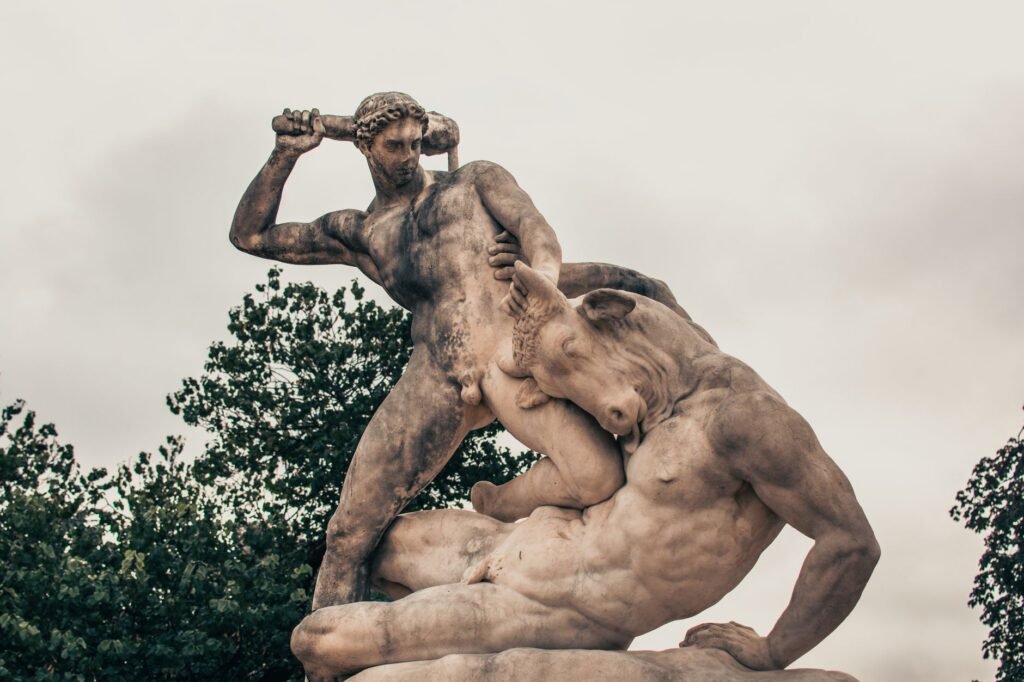
The story of Theseus and the Minotaur is one of the best-known myths of ancient Greece. It combines royal politics, human sacrifice, heroic adventure, and the struggle between civilization and monstrosity. At its center is Theseus, the legendary Athenian hero, and the Minotaur, a creature described as half-man and half-bull, confined within the Labyrinth on Crete.
The myth was important in antiquity because it helped explain relations between Athens and Crete, expressed ideas about leadership and heroism, and offered a dramatic account of overcoming chaos through intelligence and courage. In later centuries, the story became a lasting symbol of triumph over danger, the search for identity, and the complexity of human nature.
Origin and Meaning
The name Theseus is traditionally associated with the Greek hero whose exact etymology is uncertain. Ancient authors did not preserve a single agreed explanation, and modern scholars continue to debate its linguistic origin.
The name Minotaur comes from Greek elements meaning “Bull of Minos”:
- Minos: the legendary king of Crete
- tauros: “bull”
The Greek name is Minōtaurós. It identifies the creature as belonging to Minos, either by origin, ownership, or association.
The myth itself appears to preserve older layers of Greek religious and cultural memory. It is often linked to the Bronze Age world of Crete and to the symbolic importance of bulls in Minoan civilization, though the myth in its literary form is later than any historical Minoan religion.
Historical Context
The Theseus and the Minotaur myth belongs to the broader corpus of Greek heroic legend. It was shaped over centuries by oral tradition, local cult practice, and literary retelling.
Cretan and Athenian Background
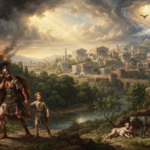
The story reflects a conflict between Athens and Crete. In the myth, Athens is compelled to send young men and women to Crete as tribute, where they are devoured by the Minotaur. This narrative may preserve distant memories of a time when Crete was a dominant maritime power in the Aegean, although the myth should not be read as a direct historical record.
Religious and Cultural Meaning
The myth connects to several major themes in Greek thought:
- the danger posed by uncontrolled violence
- the need for order over chaos
- the power of royal authority, whether just or unjust
- the idea of the hero as a civilizing force
- the use of intelligence, not only strength, to achieve victory
The labyrinth, the bull, and the sacrificial tribute are all elements with strong symbolic resonance. They also suggest ritual and ceremonial practices whose exact historical background remains uncertain.
Main Characteristics
Because the topic refers to both a hero and a monster, the “main characteristics” are best understood by separating them.
Theseus
Theseus is portrayed as:
- a prince or future king of Athens
- brave, resourceful, and physically capable
- a civilizing hero who clears roads, defeats bandits, and restores order
- in some versions, guided by divine support, especially from Athena
He is especially known for combining strength and intelligence. In the Minotaur story, his success depends not only on combat but on the thread given by Ariadne, which allows him to navigate the Labyrinth.
The Minotaur
The Minotaur is described as:
- a monstrous being with the body of a man and the head of a bull, or in some artistic traditions the opposite arrangement of human and bull features
- confined in the Labyrinth
- associated with Minos and Crete
- a product of divine punishment and unnatural union in many retellings
The creature is not usually given a full personality in surviving myths. It functions primarily as a fearsome adversary and a symbol of disorder, violence, and entrapment.
Family and Genealogy
Theseus’ Family
Theseus’ genealogy varies somewhat across ancient traditions, but the most common version makes him the son of:
- Aegeus, king of Athens, or in some traditions Poseidon
- Aethra, daughter of Pittheus of Troezen
This dual paternity is common in Greek heroic myth, where a hero may be said to have both a mortal father and a divine father. Theseus is later recognized as heir to Athens.
The Minotaur’s Family
The Minotaur’s parentage is one of the most famous episodes in Greek myth.
According to the best-known tradition:
- Minos prayed to Poseidon for a sign confirming his kingship.
- Poseidon sent a magnificent bull from the sea.
- Minos was expected to sacrifice the bull but kept it instead.
- As punishment, Poseidon caused Pasiphaë, wife of Minos, to develop an unnatural passion for the bull.
- With the help of the craftsman Daedalus, Pasiphaë joined with the bull.
- Their offspring was the Minotaur.
This story appears in several ancient sources, though details vary. Some traditions emphasize divine punishment; others focus more on the curse attached to Minos’ refusal to sacrifice the bull.
Table: Principal Family Relationships
| Figure | Relationship |
|---|---|
| Theseus | Son of Aegeus and Aethra; in some traditions, Poseidon also claimed as father |
| Aegeus | King of Athens; father of Theseus |
| Aethra | Mother of Theseus |
| Minos | King of Crete; husband of Pasiphaë |
| Pasiphaë | Wife of Minos; mother of the Minotaur |
| Daedalus | Artisan who helped construct the cow-shaped device used by Pasiphaë and later the Labyrinth |
| Ariadne | Daughter of Minos; aided Theseus with the thread |
| Phaedra | Another daughter of Minos; later connected to Theseus in a separate myth cycle |
Symbols
The story is rich in symbolic objects and images.
The Labyrinth
The Labyrinth is the most famous symbol associated with the Minotaur myth. It represents:
- confusion and inescapability
- hidden complexity
- dangerous spaces that require intelligence to navigate
- the boundary between civilization and monstrosity
The Thread of Ariadne
The thread is one of the most enduring symbols in classical mythology. It signifies:
- guidance
- memory
- strategy
- the possibility of finding a way through complexity
The Bull
The bull symbolizes:
- power
- fertility
- danger
- royal and religious prestige in Crete
In the myth, the bull is both sacred and destructive, reflecting the ambiguous place of animal symbolism in ancient religion.
Common Symbolic Associations
| Symbol | Meaning |
|---|---|
| Labyrinth | Confusion, entrapment, ordeal |
| Thread | Guidance, knowledge, escape |
| Bull | Strength, fertility, sacred power |
| Sword | Heroic action and combat |
| Ship sails | Fate, memory, and loss in Theseus’ return |
Sacred Animals
The myth is especially associated with the bull.
The Bull
Bulls were significant in the ancient Aegean world, especially in Crete. Archaeological evidence from Bronze Age Crete shows bull-leaping and bull imagery, though these practices cannot be directly equated with the later myth of the Minotaur.
In the story, the bull symbolizes:
- divine force
- kingship
- sacrificial obligation
- dangerous vitality
The Minotaur itself is a hybrid bull-man, intensifying the bull’s symbolic importance.
Other Animals
No other animal is as central, though the sea-borne bull sent by Poseidon, the sacrificial animals of Cretan and Greek cult, and the bull imagery in later art all reinforce the myth’s animal symbolism.
Sacred Plants
No plant is uniquely sacred to Theseus and the Minotaur in the way that laurel is associated with Apollo or ivy with Dionysus. However, one plant appears indirectly in later representations:
Ivy and Vine Imagery
In some broader Greek and Roman artistic contexts, scenes of Theseus and Ariadne are placed near Dionysiac imagery, including vines and ivy. This connection is especially relevant because Ariadne is sometimes linked in later traditions with Dionysus after Theseus abandons her.
That said, no single plant is universally or originally tied to the Theseus-Minotaur myth itself.
Sacred Places
Crete
Crete is the central setting of the myth. It is the island of Minos, the Labyrinth, and the Minotaur. In Greek imagination, Crete was a place of wealth, maritime power, and ancient kingship.
Knossos
The city of Knossos is often associated with the Labyrinth in modern interpretation, especially because of the discovery of the large palace complex there. Ancient sources do not explicitly identify the Labyrinth with the archaeological palace, but the association became influential in later thought.
Athens
Athens is the home of Theseus and the city that, in the myth, suffers under Cretan tribute before being liberated.
The Labyrinth
The Labyrinth is a mythical place rather than a securely historical one. It is described as a complex underground or enclosed structure designed so that no one could escape without guidance. Its architectural reality is uncertain, but it remains one of the most famous imagined spaces in Western literature.
Powers and Attributes
The Theseus and Minotaur story does not concern gods with supernatural “powers” in a narrow sense, but rather heroism, divine intervention, and symbolic force.
Theseus’ Attributes
Theseus is associated with:
- bravery
- intelligence
- royal legitimacy
- endurance
- civic order
He is a hero who defeats dangers that threaten society. His most important attribute in this myth is not brute strength alone, but the ability to act decisively with help from others.
The Minotaur’s Attributes
The Minotaur represents:
- savage hunger
- confinement
- unnatural birth
- the failure of order
- the need to destroy or contain what cannot be integrated into society
In many readings, the monster embodies what is excluded from the human community.
Main Myths
The Birth of the Minotaur
The myth begins with Minos’ request to Poseidon for support in obtaining kingship. Poseidon sends a bull from the sea, but Minos fails to sacrifice it. As punishment, the god causes Pasiphaë to desire the bull. Daedalus helps her construct a device that enables the union, and the Minotaur is born.
This origin story is a strongly moralized example of divine punishment for impiety or disobedience.
The Labyrinth and the Tribute
Minos orders Daedalus to build the Labyrinth to imprison the Minotaur. Meanwhile, Athens is said to have fallen under Cretan domination and must send tribute of seven young men and seven young women at fixed intervals. The exact number varies in some traditions, but this is the most familiar form.
The tribute story may reflect themes of political submission and ritual sacrifice. It also sets up Theseus as the champion of Athens.
Theseus Volunteers
Theseus enters the tribute either as a volunteer or as a hero determined to end the suffering of Athens. Some versions stress his initiative; others emphasize the distress of the city and his royal duty.
He sails to Crete with the doomed youths. Before departing, he promises his father Aegeus that he will change the ship’s sails from black to white if he returns safely. In some accounts, this is a pledge; in others, a practical sign of victory.
Ariadne’s Help
Ariadne, daughter of Minos, falls in love with Theseus and gives him aid. The most famous element is the thread or ball of thread that allows him to retrace his path through the Labyrinth.
Different ancient versions include other gifts as well, such as a sword. The thread remains the most enduring detail. It turns the hero’s victory into an act of intelligence and cooperation rather than solitary violence.
Slaying the Minotaur
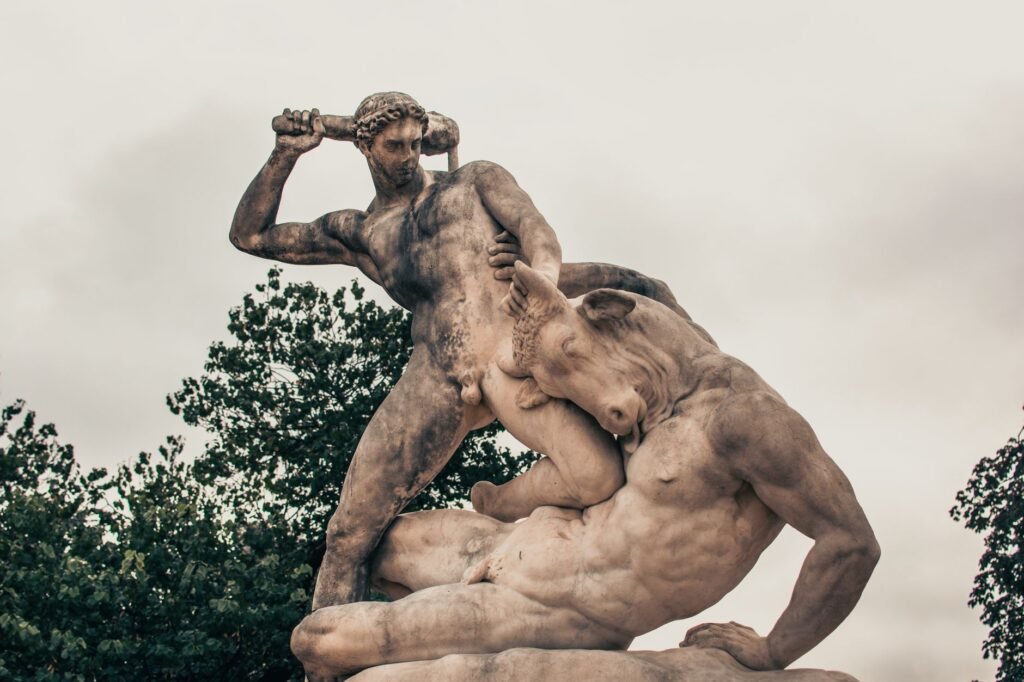
Theseus enters the Labyrinth, finds the Minotaur, and kills it. Ancient sources vary on the manner of the combat, but the essential point is that Theseus defeats the creature and escapes with the help of Ariadne’s thread.
The act symbolizes the destruction of the monstrous and the restoration of civic order.
Escape and Return
After leaving Crete, Theseus and Ariadne travel away from the island. Their story continues in different ways depending on the source:
- In some accounts, Theseus abandons Ariadne on the island of Naxos.
- In others, the gods intervene, and Ariadne becomes the wife of Dionysus.
- In some versions, Theseus forgets to raise the white sails on his return, causing Aegeus to believe he has died and to throw himself into the sea, which then takes his name, the Aegean Sea.
This final episode reinforces the tragic dimension of the myth.
Relationship with Other Mythological Figures
Ariadne
Ariadne is the most important supporting figure in the story. She helps Theseus escape the Labyrinth, but her role is ambiguous in later tradition because Theseus often abandons her. She is at once helper, lover, and tragic victim of heroic incompletion.
Minos
Minos is both king and judge. In the myth, he represents Cretan authority and divine favor, but also the consequences of refusing the gods. His political power frames the conflict.
Pasiphaë
Pasiphaë’s role is essential to the origin of the Minotaur. She is often treated as a tragic figure caught in divine punishment, though ancient storytelling sometimes emphasizes the strange and unsettling nature of her desire.
Daedalus
Daedalus is the master craftsman who creates both the artificial cow for Pasiphaë and the Labyrinth. He is a figure of intelligence and technical skill, but also of ethical ambiguity, since his inventions serve both ingenuity and concealment.
Dionysus
Dionysus enters the story in later traditions concerning Ariadne. This creates an important contrast between Theseus, the civic hero, and Dionysus, the god of ecstasy, transformation, and renewal.
Poseidon
Poseidon is central to the myth’s background. The bull he sends, and the punishment that follows, give the story its divine dimension. Poseidon’s role also links the myth to the sea and to the maritime identity of Crete.
Worship and Cult
There was no single cult devoted specifically to “Theseus and the Minotaur” as a pair. However, Theseus became an important heroic figure in Athens and was honored in local cult and civic memory.
Theseus in Athenian Civic Tradition
Theseus was treated as a foundational hero of Athens, associated with:
- the unification of Attica
- civic identity
- heroic virtue
- the defense of the city
His Labyrinth adventure was part of the broader image of Theseus as liberator and organizer.
Festivals and Hero Cult
Athenians celebrated Theseus in ways that linked him to hero cult, public memory, and political identity. Specific rituals varied over time. The exact extent to which the Minotaur episode was ritually enacted is uncertain, but the myth itself clearly served civic purposes.
Ancient Sources
The story survives in many classical texts, though no single author provides the only authoritative version.
Major Ancient Authors
- Homer: mentions Ariadne in the Iliad in connection with dance and Crete, though not the full Minotaur story.
- Hesiod: references to Theseus and related myths appear in the broader Hesiodic tradition.
- Apollodorus (Bibliotheca): gives one of the clearest summary accounts of the Minotaur myth.
- Plutarch (Life of Theseus): discusses Theseus at length and compares different traditions.
- Pausanias (Description of Greece): records local legends and monuments associated with Theseus.
- Ovid: retells related material, especially the Ariadne episode, in the Metamorphoses and Heroides.
- Euripides and other tragedians: explored parts of the Theseus cycle, though much is now lost.
Source Variation
Ancient versions differ in important details:
- the number of Athenian youths sent as tribute
- whether Theseus volunteered or was chosen
- whether Ariadne died, was abandoned, or married Dionysus
- the exact nature of the Minotaur’s conception
- the final fate of the monster’s body and the Labyrinth
Such variation is normal in Greek mythology and reflects the oral and literary transmission of the stories.
Roman Equivalent
There is no exact Roman equivalent to Theseus and the Minotaur as a single fixed myth. Roman writers adopted and retold the Greek story, especially through Ovid, Virgilian-era literary culture, and later mythographic tradition.
In Roman literature and art, Theseus appears as a model of heroic virtue, while the Minotaur remains a symbol of defeat by reason and courage. The myth was absorbed into the Greco-Roman literary world rather than replaced by a separate Roman counterpart.
Influence on Modern Culture
The Theseus and the Minotaur myth has had enormous influence on modern literature, art, philosophy, and popular culture.
Literature
The story appears in:
- retellings of Greek myth for children and adults
- psychological and symbolic interpretations of the Labyrinth
- novels and poems exploring identity, fate, and the monster within
The myth is often used as a metaphor for difficult decision-making or a complex problem with a hidden center.
Art
Artists have long depicted:
- Theseus fighting the Minotaur
- Ariadne with the thread
- the escape from the Labyrinth
Classical vase painting, Renaissance art, and modern sculpture all feature the scene. The image of the heroic struggle is especially enduring.
Cinema and Television
The myth has been adapted in films, documentaries, and television dramas, often emphasizing either fantasy adventure or psychological symbolism. It also appears indirectly in works inspired by labyrinths, monsters, and heroic quests.
Games and Popular Culture
The Minotaur is a common figure in:
- fantasy role-playing games
- video games
- graphic novels
- modern board games
The Labyrinth remains a powerful design motif for puzzles and adventure narratives.
Philosophy and Psychology
The Labyrinth and Minotaur have also become metaphors for:
- inner conflict
- hidden fear
- the search for self-knowledge
- the need for guidance through complexity
Curiosities
- The phrase “thread of Ariadne” has become a common expression for a clue or method that helps solve a complex problem.
- The myth is often connected to the archaeological palace at Knossos, though this link is interpretive rather than proven by ancient evidence.
- Theseus is one of the few Greek heroes whose story combines monster-slaying with state formation and civic identity.
- The Minotaur is not merely a beast in the myth; it is also the tragic result of divine punishment and human error.
- Later traditions sometimes portray Ariadne as favored by Dionysus, turning her story into one of abandonment followed by divine elevation.
- The return voyage of Theseus is tied to the origin legend of the Aegean Sea in some versions.
Frequently Asked Questions
1. Who was Theseus?
Theseus was a legendary Greek hero and later king of Athens. He is associated with many adventures, including the defeat of the Minotaur in Crete.
2. What was the Minotaur?
The Minotaur was a mythical creature with human and bull features. It lived in the Labyrinth on Crete and was eventually killed by Theseus.
3. Why was the Minotaur in the Labyrinth?
According to myth, Minos had Daedalus build the Labyrinth to imprison the Minotaur so it could not escape and harm others.
4. How did Theseus escape the Labyrinth?
Ariadne gave Theseus a thread, which he used to mark his path through the Labyrinth and find his way back out.
5. Did Theseus kill the Minotaur alone?
In the myth, Theseus is the one who kills the Minotaur, but he succeeds with Ariadne’s help. Some versions also mention a sword or other aid.
6. Is the story historically true?
There is no historical proof that the myth happened as told. It is a legendary narrative shaped by ancient Greek religion, culture, and political memory.
7. Why is the story still famous today?
It remains famous because it combines a compelling hero, a terrifying monster, a complex maze, and themes of courage, intelligence, and escape.
8. What does the Labyrinth symbolize?
The Labyrinth commonly symbolizes confusion, danger, hidden knowledge, and the challenge of finding a path through complexity.
Conclusion
The myth of Theseus and the Minotaur is one of the most influential stories from ancient Greece. It brings together heroism, divine punishment, royal politics, and symbolic imagery in a form that has remained powerful for more than two millennia. Theseus represents the civilizing hero, while the Minotaur embodies the terrifying consequences of disorder, violence, and transgression.
Because the story has been told in many versions, it should be understood not as a fixed historical event but as a living myth shaped by different ancient authors and later cultural traditions. Its enduring appeal lies in its dramatic structure and its symbolic depth. The hero, the monster, the Labyrinth, and the thread continue to speak to fundamental human concerns: how to confront fear, how to find one’s way, and how to bring order out of confusion.

Orin Vale has spent the better part of two decades tracing the threads that connect the world’s oldest stories — from the halls of Asgard to the banks of the Nile, from Olympus to the jungles of the Maya. What began as a childhood fascination with flood myths and trickster gods grew into years of independent study across comparative mythology and ancient religion, always chasing the same question: what did these stories mean to the people who first told them? Orin writes for readers who want more than trivia — the ones looking for the beliefs, fears, and truths that myths were built to carry.