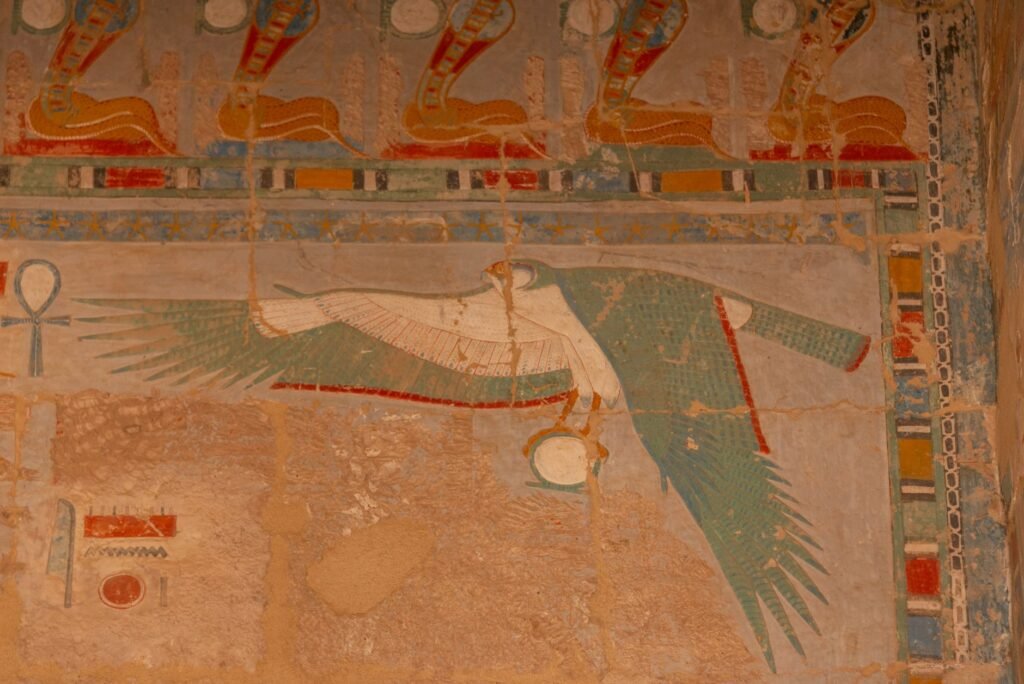
Introduction
Anuket is a goddess from ancient Egyptian mythology, best known as a deity associated with the Nile River, especially the southern reaches of the river near the First Cataract and the island region of Elephantine at Aswan. For anyone asking who is Anuket in Egyptian mythology, the short answer is that she is a protective river goddess, deeply connected with fertility, water, and the life-giving inundation of the Nile.
Like many Egyptian deities, Anuket is not a single fixed figure. Her role changes somewhat across time, region, and religious context. In some traditions she appears as a nurturing goddess of the river’s flow; in others she is a local protector of the Aswan area or part of a divine triad with Khnum and Satet. Her worship reflects the practical and spiritual importance of the Nile in ancient Egyptian civilization.
Anuket matters because she illustrates how the Egyptians understood nature as sacred. The river was not only a physical source of water and agriculture, but also a divine force requiring reverence, ritual, and balance. Anuket therefore stands at the intersection of geography, religion, and daily life.
Origin and Meaning
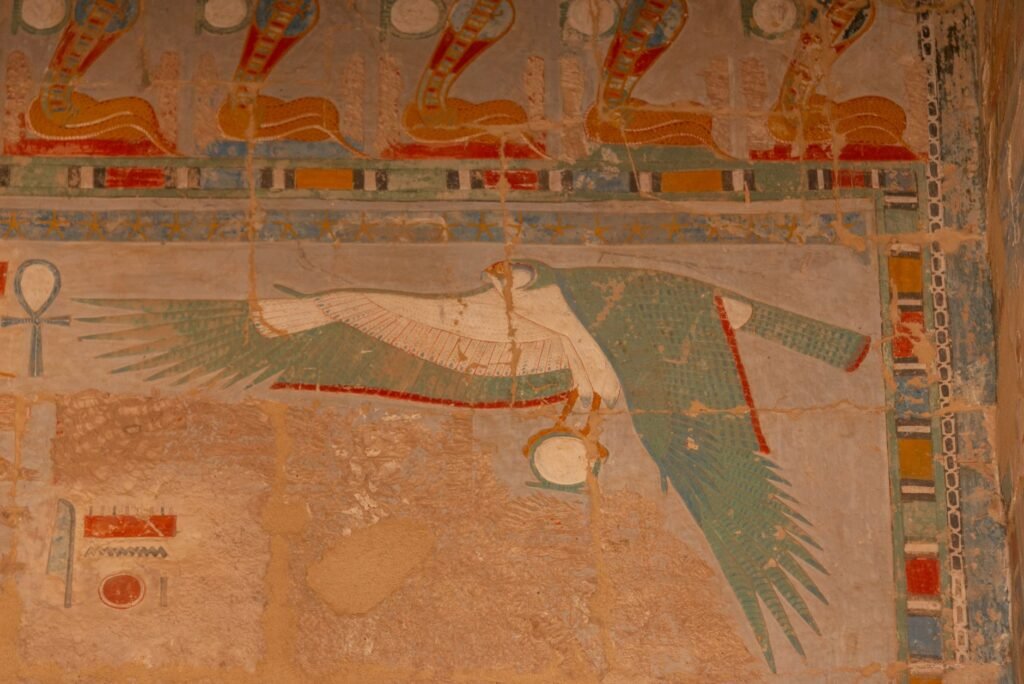
The name Anuket is usually written in English transliteration as Anuket, though older scholarly forms may vary. The ancient Egyptian writing of her name is not fully standardized in modern usage because Egyptian vowels were not written in the same way as in alphabetic languages.
Her name is commonly connected with the idea of “embracing” or “the embracer,” though the exact etymology is not completely certain. Ancient Egyptian names often carried layered religious meanings, and in the case of Anuket, scholars generally associate the name with protection, enclosure, or the encompassing movement of the river.
The goddess likely originated as a local deity of the southern Nile region, especially around the First Cataract, where the river narrows and rushes among rocks and islands. This area had great religious significance because it marked a powerful transition point in the Nile’s geography. Over time, Anuket became integrated into broader Egyptian religion.
Historical Context
Anuket belongs to the long religious history of ancient Egypt, a civilization that tied divine power to landscape, kingship, and seasonal cycles. The Nile was central to agriculture, transport, settlement, and political unity. Because the annual inundation made farming possible, many Egyptian gods and goddesses were associated with the river and its fertility.
Anuket is most strongly linked to Elephantine Island and the city of Aswan in southern Egypt. This region was important because it formed a frontier zone near Nubia and a key point of contact between Egypt and neighboring lands to the south. Religious traditions from this area often reflected both Egyptian and Nubian influences.
She is frequently associated with:
- Water and the Nile
- Fertility and nourishment
- Protection of the river’s borders
- The annual inundation
- Local cults in Upper Egypt
In the religious landscape of ancient Egypt, local deities could remain important for centuries while also being absorbed into larger theological systems. Anuket is a good example of this pattern.
Main Characteristics
Anuket is typically understood as a river goddess, and her most important characteristic is her connection to the Nile’s flow. She is not usually one of the most universal gods of Egypt, such as Ra or Osiris, but she held major regional significance.
Her attributes include:
- Nurturing and life-giving power
- Connection to the river’s currents
- Association with fertility and abundance
- Protective role in the Aswan region
- Possible connection to speed, movement, or rushing water
In artistic representations, Anuket is commonly shown as a woman wearing a headdress of tall reeds or feathers, or sometimes with elements that identify her as a goddess of the river and marshy landscape. Egyptian iconography is often symbolic rather than literal, so her exact appearance can vary.
In some depictions, Anuket appears together with Khnum and Satet, forming a divine family or triad centered on the Nile’s southern region. This association strengthens her identity as part of a sacred river complex rather than as a solitary goddess.
Family and Genealogy
The family relationships of Egyptian gods are often fluid and vary by tradition. In the case of Anuket, the best-known relationships are tied to the Elephantine triad.
Commonly associated divine family
| Figure | Relationship to Anuket | Notes |
|---|---|---|
| Khnum | Often considered her husband or partner | Pottery and creation god linked to the Nile’s source and the shaping of life |
| Satet | Sometimes presented as mother or companion depending on tradition | Another deity of the Elephantine region |
| Ra | In some theological contexts, part of broader divine connections | Not a direct family relation in most myths |
The exact genealogy is not always consistent. Some sources emphasize Anuket as a daughter of Khnum and Satet, while others treat her as a counterpart or member of the same regional cult rather than a clearly defined child. Egyptian religion did not always enforce one authoritative family tree for the gods.
Because of this, it is best to describe Anuket’s family relationships as tradition-dependent rather than fixed.
Symbols
Anuket’s symbols are linked to water, vegetation, and the religious landscape of southern Egypt. Her iconography is not as standardized as that of major gods like Isis or Hathor, but several motifs recur.
Common symbols associated with Anuket
- River reeds
- Tall feathered headdress
- Waterfowl or marsh imagery
- The Nile’s flowing waters
- Possibly the ankh in broader Egyptian contexts of life
The reed crown is especially significant because it evokes the Nile banks, marshes, and river-edge vegetation. Feathers may also symbolize lightness, movement, or divine elevation.
Her symbols reflect her role as a goddess of life-giving water and the ecological environment that sustained Egyptian civilization.
Sacred Animals
Ancient Egyptian deities were often linked with sacred animals, though not every god had one dominant animal form. For Anuket, the animal associations are less universal and more regional or symbolic.
Animal associations
- Fish and water creatures: These reflect her connection to the Nile.
- Birds, especially water birds: Often associated with marshes and riverbanks.
- Gazelle or antelope imagery: In some local or artistic contexts, feminine divine figures of Upper Egypt could be connected to graceful desert or river-edge animals, though this is not uniquely definitive for Anuket.
Because surviving evidence is limited and regional, scholars are cautious about assigning a single sacred animal to Anuket. Unlike Bastet with cats or Sobek with crocodiles, Anuket is defined more by place and element than by one specific creature.
Sacred Plants
Anuket’s plant associations are similarly tied to the ecology of the Nile.
Plants linked with Anuket
- Reeds
- Papyrus
- Aquatic vegetation
- River grasses
These plants were important in Egyptian symbolism because they represented growth, fertility, and the fertile “green” world created by the Nile. Reeds and papyrus also had practical uses in daily life, including construction, writing materials, and boat-making.
For a goddess like Anuket, plant symbolism underscored her role as a guardian of abundance. The river nourished the plants, and the plants in turn signaled the blessing of the river.
Sacred Places
Anuket is strongly associated with Elephantine Island, Aswan, and the First Cataract region.
Key sacred locations
| Place | Significance |
|---|---|
| Elephantine Island | Major cult center for Anuket and related deities |
| Aswan | Regional religious center near the Nile’s southern frontier |
| First Cataract | Symbolic boundary and powerful river landscape |
| Nubian borderlands | Area of cultural interaction and religious exchange |
Elephantine was especially important because it was a strategic and sacred location. The island stood near the boundary between Egypt and Nubia and was closely connected to Nile-based religious ideas. Temples in this region honored river deities responsible for the land’s survival.
Anuket’s sacred geography also helps explain her broader meaning: she is a goddess of transition, flow, and boundary, ruling over a place where the Nile becomes especially dramatic and spiritually charged.
Powers and Attributes
Anuket’s powers are those of a river goddess and protector of fertility. Her influence is practical, environmental, and symbolic.
Main domains
- The Nile River
- The annual inundation
- Fertility of fields and people
- Protection of the southern river region
- Life-giving waters
- Local prosperity
Her most important attribute is the ability to sustain life through water. In ancient Egypt, this was not an abstract idea but a necessity. The success of crops depended on the river’s annual flood, and deities connected to this process were highly valued.
Anuket may also have been associated with speed and the rushing movement of water, especially in the cataract region where the Nile’s flow was broken by rocks. This makes her a goddess of both gentle nourishment and powerful natural force.
Main Myths
Unlike some major Egyptian deities, Anuket is not central to a large body of widely preserved myths. Her importance is more visible in cult, regional worship, and theological association than in surviving narrative literature.
Themes in the myths and traditions surrounding Anuket
1. Guardian of the Nile’s life-giving power
Anuket was connected to the river’s blessing, especially the flood that renewed the land each year. This was one of the most important religious ideas in Egypt.
2. Member of the Elephantine divine group
She appears in traditions associated with the triad of Khnum, Satet, and Anuket. In such contexts, she participates in the sacred order governing the river and the local landscape.
3. Protector of the frontier
As a goddess of the First Cataract, Anuket also belongs to the religious imagination of Egypt’s southern border. The border was not only political but cosmological, marking a zone where divine power was intensely felt.
Because surviving myths about Anuket are limited, it is more accurate to speak of religious functions and regional traditions than of a single canonical myth cycle.
Relationship with Other Mythological Figures
Anuket’s relationships are shaped by geography and local theology.
Khnum
Khnum is the god most often linked with Anuket. He was a creator god associated with the source of the Nile and with shaping human beings on a potter’s wheel in later theological imagination. In the Elephantine cult system, Khnum and Anuket are closely connected.
Satet
Satet is another deity of the Elephantine region. Depending on the tradition, Satet may be treated as a mother figure, a companion, or simply a fellow member of the same sacred complex.
Hapi
Hapi, the god of the Nile inundation, shares thematic space with Anuket. Hapi is more directly linked with flood abundance across Egypt, while Anuket is more localized to the southern river region.
Isis and other major goddesses
Anuket may be compared with Isis, Hathor, and other female deities associated with fertility, protection, and nourishment. However, she remains distinct in being more specifically a river and frontier goddess.
Nubian and local deities
Because her cult center lay near Egypt’s southern border, Anuket also belongs to a broader world of contact between Egyptian and Nubian religious traditions. Some aspects of her worship may reflect this intercultural environment.
Worship and Cult
Anuket was worshipped as a local and regional goddess, especially at Elephantine and Aswan.
Forms of worship
Ancient Egyptian worship of Anuket likely included:
- Temple rituals
- Offerings of food and drink
- Prayers for a successful inundation
- Local processions
- Festivals tied to river cycles
Because the Nile was central to survival, deities associated with the river received offerings aimed at securing water, fertility, and protection from destructive flooding.
Festival connections
In some periods, Anuket was included in New Year and inundation-related celebrations, when the rising Nile was welcomed as a divine event. Such ceremonies would have emphasized renewal, abundance, and cosmic order.
Temple life
Her cult was centered in the southern temple landscape, where she could be worshipped alongside Khnum and Satet. Temples in this region were important not only for religious devotion but also for administration, economic activity, and regional identity.
Ancient Sources
Direct evidence for Anuket comes primarily from Egyptian inscriptions, temple reliefs, and archaeological remains, rather than from the major surviving literary epics of Greece and Rome.
Because the prompt asks for classical authors where possible, it is important to note that Greek and Roman writers rarely discuss Anuket in detail. She is not a major figure in Homer, Hesiod, Apollodorus, Pausanias, or Ovid, since those authors were not writing about Egyptian religion comprehensively.
Primary evidence types
- Temple inscriptions
- Reliefs from Elephantine and Aswan
- Archaeological remains from southern Egyptian cult sites
- Egyptian religious texts and dedicatory formulas
Classical and later references
Later Greco-Roman authors on Egypt may mention local gods indirectly, but Anuket is not prominent in the standard classical canon. Modern knowledge of her comes mainly from Egyptology, not from Greek mythography.
This distinction is important. Anuket is an Egyptian deity, and her historical identity is best established through Egyptian sources rather than classical literature.
Roman Equivalent
Anuket does not have a single clear Roman equivalent.
Roman religion often identified foreign gods with Roman ones through interpretatio romana, but Anuket remained largely a local Egyptian goddess rather than being fully absorbed into a Roman counterpart. If any comparison is made, it is usually with Roman river or fertility deities in a broad thematic sense, not as an exact match.
Thus, the safest statement is:
- No direct Roman equivalent is firmly established
- She was understood within Roman Egypt, but not strongly standardized as a Roman deity
Influence on Modern Culture
Anuket is not as widely known in modern popular culture as Isis, Osiris, or Anubis, but she appears in modern scholarship, educational writing, museums, and occasional creative works about Egyptian mythology.
Modern influence includes:
- Egyptology textbooks and museum exhibits
- Historical documentaries
- Fiction and fantasy inspired by Egyptian gods
- Role-playing games and video games
- Online educational resources about the Nile and Egyptian religion
Her modern significance lies mainly in her role as an example of how ancient Egyptians sacralized the landscape. Writers and artists interested in lesser-known deities sometimes use Anuket to represent the spiritual power of the Nile and the richness of local Egyptian cults.
Curiosities
- Anuket is sometimes considered one of the lesser-known Nile goddesses, but in her own region she was highly important.
- Her cult is tied to Elephantine Island, one of the oldest and most strategically important religious sites in southern Egypt.
- She helps show that Egyptian religion was not centered only on a few famous gods; it included many local and regional deities.
- Her identity is connected more to place and water than to a single dramatic myth.
- In Egyptian religion, a goddess like Anuket could be both practical and sacred at the same time, since the river flood was essential for survival.
- She is often grouped with Khnum and Satet, showing how Egyptian gods could function as divine families or cultic triads.
- Because ancient Egyptian sources are uneven, some details about her remain uncertain or vary by period and location.
Frequently Asked Questions
1. Who is Anuket in Egyptian mythology?
Anuket is an Egyptian goddess associated with the Nile, especially the southern part of the river near Aswan and Elephantine. She is linked to fertility, water, and the life-giving inundation.
2. What does Anuket protect?
She is generally understood as a protector of the Nile region, especially the river’s flow, fertility, and the communities living near the First Cataract.
3. Who are Anuket’s parents?
This varies by tradition. She is often associated with Khnum and Satet, but ancient sources do not preserve one fixed genealogy.
4. What symbols are associated with Anuket?
Common symbols include reeds, feathers, river imagery, and other motifs connected to the Nile’s banks and marshes.
5. Where was Anuket worshipped?
Her main cult center was Elephantine Island near Aswan in southern Egypt, close to the First Cataract of the Nile.
6. Is Anuket a major Egyptian goddess?
She is not among the most widely known Egyptian deities, but she was important regionally and played a significant role in local river cults.
7. Does Anuket have a Greek or Roman equivalent?
No direct equivalent is clearly established. She remained primarily an Egyptian goddess, though later cultures encountered her within the context of Egypt.
8. Why was Anuket important to the ancient Egyptians?
She represented the sacred power of the Nile, which was essential for agriculture, prosperity, and life itself.
Conclusion
Anuket is a significant but often overlooked goddess in Egyptian mythology. She embodies the ancient Egyptian understanding of the Nile as a divine force: nourishing, protective, and essential to life. Closely associated with the southern frontier at Elephantine and Aswan, she belongs to a sacred landscape where river, land, and religion were inseparable.
Although she does not have the extensive mythic narratives of Egypt’s most famous gods, Anuket remains important for what she reveals about Egyptian religion. She shows how local deities could express the deepest values of a civilization—fertility, order, protection, and dependence on nature’s rhythms.
For anyone studying who is Anuket in Egyptian mythology, the answer is clear: she is the goddess of the Nile’s southern waters, a guardian of abundance, and a lasting symbol of Egypt’s relationship with the river that made its civilization possible.

Orin Vale has spent the better part of two decades tracing the threads that connect the world’s oldest stories — from the halls of Asgard to the banks of the Nile, from Olympus to the jungles of the Maya. What began as a childhood fascination with flood myths and trickster gods grew into years of independent study across comparative mythology and ancient religion, always chasing the same question: what did these stories mean to the people who first told them? Orin writes for readers who want more than trivia — the ones looking for the beliefs, fears, and truths that myths were built to carry.