Introduction
Khonsu is one of the major deities of ancient Egypt, best known as a moon god associated with time, healing, protection, and the night sky. In Egyptian mythology, he belongs to the Theban religious tradition and is especially prominent in the Amun-Re-Mut-Khonsu triad of Thebes. His name is widely translated as “the traveler” or “he who traverses,” a reference to the moon’s nightly journey across the sky.
Khonsu is important because he illustrates how Egyptian religion connected astronomy, kingship, medicine, and divine power. He was not only a celestial god but also a protective and sometimes formidable figure who could heal the sick, defeat hostile forces, and mark the passing of time. Over centuries, his character developed through temple worship, mythological interpretation, and local tradition.
Origin and Meaning
The name Khonsu appears in ancient Egyptian as Ḫnsw or Khonsu, though the precise etymology is not completely certain. It is commonly understood as meaning “traveler”, “wanderer”, or “he who crosses over”, reflecting the moon’s movement through the night sky.
Different scholarly interpretations emphasize different nuances:
- the moon’s apparent journey across the heavens,
- the passage of time,
- the idea of movement between realms,
- or a broader association with roaming and transition.
Khonsu’s name is also connected to his role as a lunar deity who measures time, since the moon provided an important framework for the Egyptian calendar. In some inscriptions, he appears with epithets that highlight his power, youthfulness, and protective nature.
Historical Context
Khonsu was worshipped in ancient Egypt for many centuries, but his strongest cult center was Thebes during the New Kingdom and later periods. He became especially significant as part of the Theban theological system centered on Amun, Mut, and Khonsu, forming a divine family that mirrored royal and cosmic order.
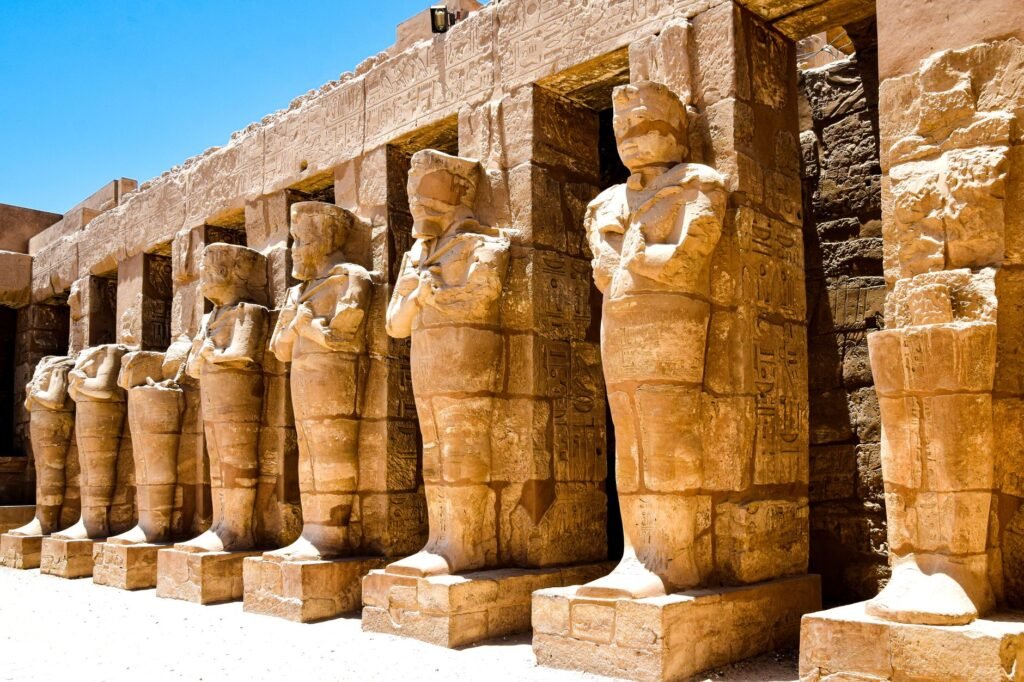
The rise of Thebes as a political and religious center helped elevate Khonsu’s profile. As temple religion developed, he took on a clearer place in official theology, priestly ritual, and monumental architecture. The Temple of Khonsu at Karnak remains one of the best-preserved examples of his worship.
Khonsu’s moon aspect also tied him to practical concerns in Egyptian life:
- the lunar calendar,
- night travel and safety,
- fertility and growth,
- healing and exorcism,
- and the regulation of ritual time.
In Egyptian religious thought, the moon was not merely a light in the sky. It was a divine force that could influence health, order, and the balance between chaos and protection.
Main Characteristics
Khonsu is typically portrayed as a youthful male deity, often with a sidelock of youth, identifying him as a divine child or young god. In art, he may appear in several forms, depending on the period and context.
Common features include:
- a human body with youthful proportions,
- a moon disk and crescent on his head,
- the double plumes or other royal-style adornments in certain representations,
- a striking and sometimes mummiform appearance in some temple iconography,
- and occasionally the crook and flail, symbols of authority.
Khonsu’s image is less fixed than that of some other gods. He could be shown as a man, as a child, or in more protective or solarized forms. This flexibility reflects the diversity of Egyptian religious expression.
Major characteristics of Khonsu
| Aspect | Description |
|---|---|
| Primary domain | Moon, time, healing, protection |
| Religious center | Thebes, especially Karnak |
| Common form | Youthful male deity |
| Iconic headdress | Moon disk and crescent |
| Family role | Son in the Amun-Mut-Khonsu triad |
| Ritual role | Protective and healing deity |
Khonsu is also associated with journeys, especially nocturnal ones, and with the idea of overcoming darkness. This gives him a dual character: gentle and healing, but also powerful enough to drive away dangerous forces.
Family and Genealogy
Khonsu is most commonly identified as the son of Amun and Mut, the third member of the famous Theban triad. This family grouping became central to Theban theology.
The Theban triad
- Amun: major creator and hidden god, later linked with kingship and empire
- Mut: mother goddess associated with sovereignty and protection
- Khonsu: their son, often interpreted as a lunar and youthful divine figure
However, Egyptian mythology was not a single fixed system. In different local or theological traditions, gods could have varying parentage, titles, and family roles. Khonsu’s identity was therefore shaped more by cult and function than by a single universally agreed genealogy.
Spouses and children
Unlike some other Egyptian deities, Khonsu does not have a highly standardized marital mythology. In many traditions, his relationships are not emphasized in the same way as his role within the divine family of Thebes. Some local or later interpretations may include additional familial associations, but these are not as prominent or consistent as his relationship to Amun and Mut.
Symbols
Khonsu’s symbolism reflects his lunar identity and his connection to protection, health, and royal order.
Main symbols
- Moon disk and crescent: the clearest sign of his association with the moon
- Sidelock of youth: a marker of youthful or child divine status
- Crook and flail: symbols of rule and authority in some depictions
- Was-scepter: linked with power and well-being
- Ankh: symbol of life
- Mummiform form: sometimes used in temple iconography, emphasizing divine permanence
Symbolic meanings
- Moon disk and crescent: cyclic renewal, timekeeping, celestial movement
- Youthful sidelock: vitality, divine sonship, rebirth
- Crook and flail: legitimacy, order, and controlled power
- Ankh: life and restorative force
Khonsu’s iconography sometimes overlaps with other lunar or royal deities, which can make precise identification dependent on context and inscription.
Sacred Animals
Khonsu does not have a single universally dominant sacred animal in the way some other Egyptian gods do, but several animals are associated with him through symbolism and religious iconography.
Commonly connected animals
- Falcon: linked to the sky, kingship, and elevated divine vision
- Baboons: in Egyptian religion, these are often associated with the moon, time, and lunar worship more generally
- Bull: sometimes related to divine strength and fertility themes
- Serpent: in protective and apotropaic contexts, especially where lunar gods confront chaos
The animal associations of Khonsu are not as consistently standardized across all periods as his lunar symbols. In Egyptian religion, the same deity could be represented with different animal aspects depending on local theological traditions.
Sacred Plants
Unlike some Egyptian deities, Khonsu is not strongly linked to a particular sacred plant in surviving mainstream sources. No single plant functions as a universal emblem of his cult.
That said, in the broader Egyptian symbolic system, lunar and healing deities could be associated with plants used in medicine, ritual purity, and temple offerings. Plants in Egypt often had religious meanings connected to:
- purification,
- healing,
- rebirth,
- and offering practices.
Because specific plant associations with Khonsu are not firmly established in the sources, any detailed claim should be treated cautiously. The evidence is much stronger for his lunar and healing symbolism than for botanical connections.
Sacred Places
Khonsu’s main sacred place was Thebes, especially the temple complex at Karnak.
Important locations associated with Khonsu
| Place | Significance |
|---|---|
| Thebes | Main cult center for Khonsu |
| Karnak | Location of the Temple of Khonsu |
| Temple of Khonsu | Major surviving monument dedicated to him |
| Upper Egypt | Broad regional setting of his strongest cult |
| Lunar observation sites | Not specific temples, but places where lunar timekeeping mattered |
Temple of Khonsu at Karnak
The Temple of Khonsu at Karnak is one of the best-known monuments dedicated to the god. It shows his importance within Theban religion and preserves inscriptions and architectural features from different phases of construction and decoration.
The temple reflects not just worship of Khonsu, but also the broader religious system of Karnak, where Amun and associated deities played central roles. Temples like this were centers of ritual, divine image cult, priestly activity, and state religion.
Powers and Attributes
Khonsu’s powers combine lunar, protective, and healing functions.
Main powers and domains
- Moon and lunar cycles
- Timekeeping and calendrical order
- Healing and medicine
- Protection against evil and disease
- Night journey and movement
- Exorcism or expulsion of harmful forces
Lunar authority
As a moon god, Khonsu regulated night-time visibility and marked the rhythms of the lunar month. The moon was essential for determining ritual dates in ancient Egypt, making Khonsu a god of both celestial presence and practical scheduling.
Healing power
Khonsu was invoked in healing contexts. In Egyptian thought, illness could have supernatural dimensions, so divine intervention mattered. Khonsu’s protective and restorative nature made him relevant to medical religion, spells, and rituals.
Protective force
Some traditions present Khonsu as a deity who can repel danger. His role is not only passive or decorative; he can be active, forceful, and effective in defending divine and human order.
Main Myths
Unlike Osiris, Isis, or Horus, Khonsu is not the central figure in a large cycle of universally known myths. His mythology survives more through ritual texts, temple inscriptions, hymns, and theological compositions than through one single famous narrative.
The “Bentresh Stela” or Khonsu and the foreign princess
One of the best-known stories involving Khonsu is the account often called the Bentresh Stela. In this tale, Khonsu’s cult image is sent to a foreign land to help heal a princess or noblewoman afflicted by a supernatural illness. The story is generally understood as a literary or priestly composition that highlights the god’s healing power and the prestige of his cult.
Different scholars have debated the historical setting and function of the text, and it should not be read as straightforward historical reporting. It is best understood as a religious narrative that elevates Khonsu’s reputation.
Khonsu as a lunar traveler
In broader mythic terms, Khonsu embodies the moon’s nightly course. This movement links him to passage, renewal, and the cosmic order that governs both the heavens and earthly life. While this is not a “myth” in the narrative sense, it is central to his theological identity.
The Book of the Dead and other funerary texts
Khonsu also appears in texts concerned with protection, passage through the night, and safe transition. His presence in funerary contexts reflects the moon’s association with navigation through darkness and with cycles of renewal.
Relationship with Other Mythological Figures
Khonsu’s most important relationships are with the deities of Thebes and with other gods linked to the moon, healing, and royal protection.
Amun and Mut
His closest and most famous relationships are with Amun and Mut, as their son in the Theban triad. This triad was both theological and political, reinforcing the divine structure of Thebes and, by extension, the legitimacy of pharaonic power.
Thoth
Khonsu is sometimes compared with Thoth, another important deity associated with the moon, time, wisdom, and calculation. In many Egyptian traditions, Thoth and Khonsu could overlap in lunar significance, though they are distinct gods with different primary roles.
Ra and solar theology
In some periods, Egyptian religion emphasized strong links between lunar, solar, and cosmic deities. Khonsu could be integrated into broader theological systems that included Ra and Amun-Ra, though his identity remained lunar rather than solar.
Healing and protective gods
Khonsu’s healing role puts him in conceptual contact with deities such as Isis, who was also known for magical and restorative power, and with various protective gods and ritual specialists. However, these connections vary by source and are not always explicit.
Worship and Cult
Khonsu was worshipped through temple ritual, offerings, hymns, festivals, and priestly service. His cult was especially strong in Thebes.
Forms of worship
- daily temple rites,
- offerings of food, incense, and libations,
- processional worship,
- invocation in healing and protective contexts,
- and use of cult images in ritual action.
In Egyptian religion, the god’s statue in the sanctuary was not merely symbolic. It was treated as a living divine presence, maintained through purified ritual and offerings.
Festivals
Some festivals connected with Khonsu would have taken place in the context of larger Theban celebrations. Precise festival calendars are not always fully preserved, but lunar timing itself was important. Because Khonsu was a moon god, the timing of his rituals would naturally have had strong links to lunar phases and calendar observance.
Priesthood and temple life
Priests at the Temple of Khonsu would have managed offerings, recitations, and sacred maintenance. As with other Egyptian cults, priestly service was a structured and highly specialized institution.
Ancient Sources
Khonsu is known primarily from Egyptian sources rather than Greek literary authors. That makes the corpus more temple-based, inscriptional, and religious than narrative in the classical Greek sense.
Key source types
- Temple inscriptions
- Hymns
- Stelae
- Funerary texts
- Magical and medical texts
- Monumental reliefs
Important ancient evidence
- The Temple of Khonsu at Karnak: major archaeological and inscriptional source
- The Bentresh Stela: important literary-religious narrative
- Lunar and calendrical texts: useful for understanding his timekeeping role
- Funerary and protective spells: evidence of his apotropaic functions
Classical authors
Greek and Roman authors are not the main authorities for Khonsu specifically. Unlike some Egyptian figures who were discussed by authors such as Herodotus, Khonsu is better understood through Egyptian religious remains. Later Greco-Roman interpretations may have identified him with a lunar god, but they do not preserve a rich independent mythology about him.
Roman Equivalent
Khonsu did not have a perfect Roman equivalent, since Roman religion was not built around the same mythological structure as Egyptian theology. However, in broad interpretive terms, he could be compared with Luna or Silvanus-like protective divine functions only in a very limited sense, and such comparisons are not exact.
The most reasonable Roman-style adaptation is simply that Khonsu was understood as a moon deity. In Greco-Roman religious interpretation, Egyptian gods were often mapped onto familiar celestial gods, but Khonsu remained distinct in his Theban and healing characteristics.
Influence on Modern Culture
Khonsu has gained renewed visibility in modern culture, especially through popular portrayals of Egyptian mythology.
In modern media
Khonsu appears or is referenced in:
- novels and fantasy literature,
- video games,
- tabletop role-playing settings,
- comic books,
- and television adaptations inspired by Egyptian mythology.
One reason for his modern popularity is his dramatic combination of moon symbolism, divine youth, and mysterious power. He is also a visually striking figure, often represented with crescent and moon disk imagery that is immediately recognizable.
In art and popular imagination
Modern artists often emphasize:
- lunar imagery,
- ancient Egyptian regalia,
- cosmic and nocturnal themes,
- and a protective or warrior-like aura.
At times, modern portrayals simplify Khonsu into a generic “moon god,” but historical evidence shows a more nuanced deity tied specifically to Thebes, healing, and temple religion.
Curiosities
- Khonsu’s name is sometimes translated in ways that highlight motion, which fits the moon’s visible path through the sky.
- He is one of the clearest examples of a deity whose identity combines astronomy and medicine.
- The Temple of Khonsu at Karnak is one of the most important surviving monuments associated with him.
- In some traditions, Khonsu could be portrayed as a child or youthful god, while in others he appears more solemn and authoritative.
- His cult demonstrates how Egyptian gods were often integrated into larger divine families and local theological systems rather than being worshipped in isolation.
- Khonsu’s healing reputation made him relevant not only to religion but also to practical concerns about illness and protection.
- The story of the foreign princess healed by Khonsu is one of the clearest literary expressions of his cultic prestige.
Frequently Asked Questions
1. Who is Khonsu in Egyptian mythology?
Khonsu is an ancient Egyptian moon god associated with time, healing, protection, and night travel. He was especially important in Thebes and in the Amun-Mut-Khonsu triad.
2. What does the name Khonsu mean?
The name is commonly understood to mean something like “traveler” or “wanderer,” referring to the moon’s movement across the night sky. The exact etymology is not fully certain.
3. What symbols are associated with Khonsu?
His main symbols are the moon disk and crescent, the sidelock of youth, and sometimes royal insignia such as the crook and flail.
4. Is Khonsu the son of Amun and Mut?
Yes, in the best-known Theban tradition, Khonsu is the son of Amun and Mut. This family forms the famous Theban triad.
5. Did Khonsu heal people?
Yes. Ancient sources and later tradition present Khonsu as a healing and protective god. The Bentresh Stela is especially associated with this role.
6. Where was Khonsu worshipped?
His chief cult center was Thebes, particularly at Karnak, where the Temple of Khonsu was built.
7. Is Khonsu the same as Thoth?
No. Both have lunar associations, but they are distinct gods. Thoth is more closely linked with wisdom, writing, and calculation, while Khonsu is more strongly connected with the moon, healing, and youth.
8. Does Khonsu have a Roman equivalent?
Not exactly. He can broadly be compared with lunar deities such as Luna, but there is no perfect Roman counterpart that matches his Egyptian identity.
Conclusion
Khonsu is a significant figure in Egyptian mythology because he unites the moon, time, healing, and divine protection within a single religious persona. As a member of the Theban triad, he played a central role in one of Egypt’s most important cult traditions. His worship at Karnak, his association with lunar cycles, and his reputation as a healer show how Egyptian religion integrated cosmic order with human needs.
Although Khonsu is less famous in modern culture than gods like Ra, Isis, or Osiris, his importance in ancient Egyptian theology is substantial. He remains a compelling example of how ancient Egyptians understood the night sky not as an empty space, but as a living divine landscape shaped by powerful gods.

Orin Vale has spent the better part of two decades tracing the threads that connect the world’s oldest stories — from the halls of Asgard to the banks of the Nile, from Olympus to the jungles of the Maya. What began as a childhood fascination with flood myths and trickster gods grew into years of independent study across comparative mythology and ancient religion, always chasing the same question: what did these stories mean to the people who first told them? Orin writes for readers who want more than trivia — the ones looking for the beliefs, fears, and truths that myths were built to carry.