Introduction
Sobek is one of the most distinctive gods in Egyptian mythology. Usually portrayed as a crocodile or as a man with a crocodile head, he was associated with the Nile, fertility, military power, protection, and the dangerous force of nature. For ancient Egyptians, Sobek embodied both threat and benefit: crocodiles were feared predators, yet the Nile’s waters and floodplain were essential for life. This duality made Sobek an important divine figure in religion, royal ideology, and local cult practice.
Sobek’s significance changed over time and varied by region. In some traditions he was a creator or solar god; in others he was a protective deity tied to kingship, medicine, and the waters of the river. His cult became especially prominent in places such as Faiyum and Kom Ombo, and his image remained influential long after pharaonic Egypt ended.
Origin and Meaning
The name Sobek is commonly connected to the ancient Egyptian forms Sbk, Sbq, or related spellings found in inscriptions. Scholars generally associate his name with the crocodile itself, though the exact etymology is not universally settled. In Egyptian texts, divine names often preserve archaic linguistic forms, and the relationship between the name and the animal likely reflects Sobek’s early identity as a crocodile deity.
Sobek’s origins are ancient. He appears in Old Kingdom texts and probably emerged from earlier local crocodile worship along the Nile. Like many Egyptian gods, he may have begun as a regional god before gaining wider importance through political and theological development. Over time, his character expanded beyond a simple animal deity to include roles in royal protection, fertility, and cosmic order.
Historical Context
Egyptian religion was not monolithic. It developed over millennia and included many local traditions, temple cults, and theological systems. Sobek’s history reflects this diversity.
Crocodiles were common in the Nile and especially in its southern and marshy regions. They could destroy crops, attack livestock, and threaten people, but they were also part of the river ecosystem that made Egyptian agriculture possible. Ancient Egyptians therefore often treated crocodiles with a mixture of awe, fear, and reverence. Sobek gave divine form to that ambiguity.
Sobek became especially important in regions where crocodiles were prominent. His cult centers were linked to the Faiyum oasis, where the crocodile god was associated with the lake and irrigation, and to Kom Ombo, where he was worshipped alongside Horus. In the Middle Kingdom and later, some pharaohs emphasized Sobek to reinforce the power of the monarchy and the fertility of the land.
During the Ptolemaic and Roman periods, Egyptian religion continued to evolve, and Sobek remained worshipped in temples with elaborate rituals. Greek and Roman observers often interpreted him through their own frameworks, sometimes comparing him to river or monster deities, but his Egyptian identity remained distinct.
Main Characteristics
Sobek is best understood as a multi-faceted god with overlapping roles. He was not only a crocodile god but also a divine force tied to water, power, and protection.
Core traits of Sobek
- Crocodile form: Usually shown as a crocodile or a man with a crocodile head.
- Power and ferocity: Associated with predatory strength, royal might, and military aggression.
- Fertility and abundance: Linked to the Nile flood and the productivity of the land.
- Protection: Served as a guardian deity, especially in dangerous environments.
- Solar associations: In some traditions he was linked with the sun god Ra and the cycles of cosmic renewal.
- Aquatic nature: Connected to rivers, marshes, lakes, and the watery forces of creation.
Sobek’s character is not purely destructive. Egyptian religion often transformed dangerous natural forces into protective divine powers. The crocodile, feared in daily life, could become a guardian of order when properly understood and worshipped.
Family and Genealogy
Sobek’s family relationships vary across traditions. Egyptian theology was flexible, and gods often had different genealogies depending on the temple or region.
Common associations
| Relationship | Names / Notes | Variations |
|---|---|---|
| Father | Sometimes linked to Set in certain traditions; other genealogies exist | Not universal |
| Mother | Often not consistently named | Differs by source |
| Spouse | Sometimes associated with Renenutet, a cobra goddess of nourishment and harvest | Strongly regional |
| Child | In some traditions, Khonsu or other deities are linked through local theology | Not standard |
| Divine pairing | Frequently paired with Horus in temple contexts | Especially at Kom Ombo |
One of the best-known theological relationships is Sobek’s association with Renenutet. In some traditions, they form a divine pair representing nourishment, fertility, and protection. In other cases, Sobek is linked to the royal and solar spheres, or incorporated into broader family systems that differ from one cult center to another.
Egyptian gods often had multiple identities, so genealogy should not be understood in the same fixed way as in later mythological systems.
Symbols
Sobek’s iconography is relatively consistent, though symbolic meanings vary by context.
Common symbols associated with Sobek
- Crocodile head or full crocodile body
- Ankh, symbol of life
- Was scepter, symbol of power and dominion
- Sun disk in some depictions, reflecting solar association
- Royal regalia, especially when connected to kingship
- Water imagery, including river and marsh scenes
The crocodile itself is Sobek’s most important symbol. It represents strength, territorial control, danger, and instinctive force. In religious art, the animal’s fearsome qualities were not merely literal; they expressed divine energy.
In some later representations, Sobek appears with a sun disk or alongside solar imagery, emphasizing his role in cosmic renewal and royal legitimacy. When shown with royal symbols, he may signify the pharaoh’s capacity to control chaos.
Sacred Animals
The Nile crocodile was Sobek’s primary sacred animal. Ancient Egyptians observed crocodiles closely and built religious meaning from their behavior.
Symbolic significance of the crocodile
- Predatory power: Crocodiles embodied strength and dominance.
- Liminal nature: They moved between land and water, a boundary zone that lent them sacred meaning.
- Protective force: Their danger could be reimagined as divine guardianship.
- Fertility and life: Their presence in the Nile ecosystem linked them to the life-giving flood.
In some temple centers, crocodiles were not only symbolically associated with Sobek but also physically maintained as sacred animals. At Faiyum and related sites, crocodiles may have been kept, fed, or ritually honored. Archaeological evidence for crocodile mummies confirms that these animals were worshipped in highly organized cultic settings.
Other animal associations
Sobek can also be connected to:
- Fish and aquatic life, through his riverine domain
- Bulls, in some broader fertility or strength associations
- Solar animals, indirectly through his link to Ra in syncretic theology
Sacred Plants
Sobek is not as strongly associated with specific sacred plants as some other Egyptian deities, such as Nefertem with the lotus. However, plants connected to water, fertility, and river agriculture often appear in his broader religious environment.
Plants linked to Sobek’s sphere
- Papyrus: Associated with marshes and the Nile, symbolizing vitality and river landscapes.
- Lotus: Not uniquely Sobek’s, but often connected with rebirth and aquatic creation themes.
- Grain crops: Indirectly linked through fertility and the flood’s agricultural benefits.
Because Sobek was tied to the fertility of the land, plant symbolism around him usually reflects the Nile ecosystem rather than exclusive sacred flora. His cult was more strongly animal- and landscape-oriented than plant-centered.
Sacred Places
Sobek was worshipped in many places, but several sites are especially important.
Major sacred locations
| Place | Importance |
|---|---|
| Faiyum | Major cult center; Sobek was closely tied to the lake and local crocodile worship |
| Kom Ombo | Temple shared with Horus; one of the best-known Sobek sanctuaries |
| Crocodilopolis (ancient name for parts of Faiyum/Medinet Madi area in Greek usage) | Greek and Roman-era center of crocodile worship |
| Thebes region | Sobek appears in broader temple theology and divine titles |
| Nile marshes and river zones | Natural sacred landscape of the crocodile god |
The Faiyum Oasis was especially important because of its relationship to water management, irrigation, and agriculture. Sobek’s role there reflects the close connection between divinity and the practical control of nature.
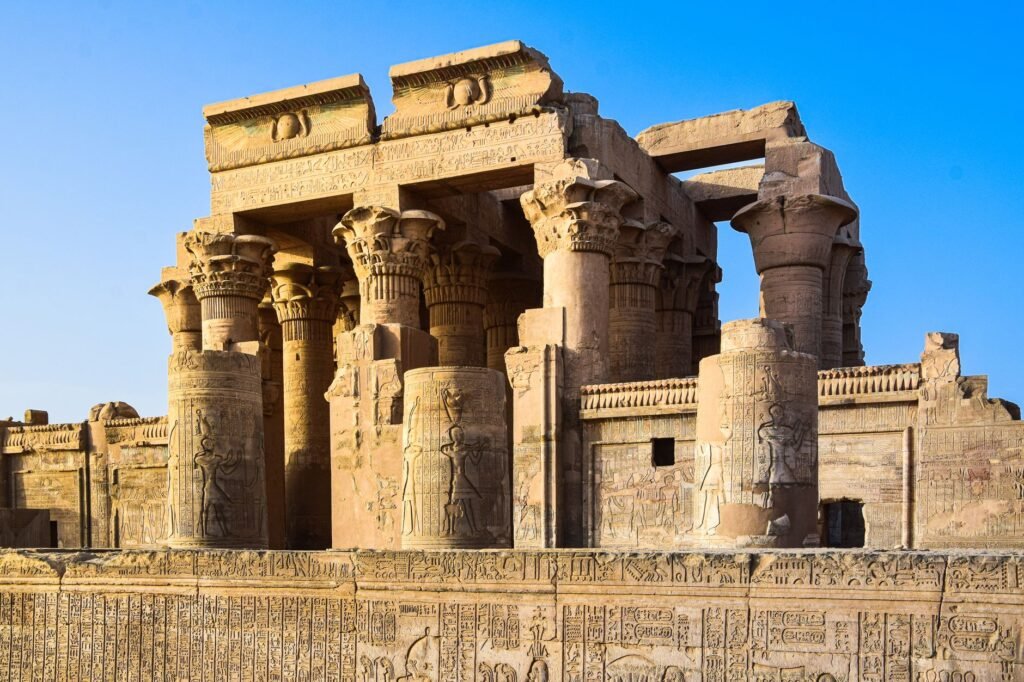
At Kom Ombo, Sobek shared a temple with Horus the Elder. This dual temple is famous for its balanced design and for inscriptions that present Sobek as a major protective deity. The site demonstrates how Egyptian religion could combine rival or complementary divine powers in a single sacred space.
Powers and Attributes
Sobek’s powers were broad and sometimes overlapping. Different sources emphasize different aspects of his divine function.
Main domains of Sobek
- Nile waters and river power
- Fertility and agricultural abundance
- Protection against danger
- Royal authority and kingship
- Military strength
- Healing and medical protection
- Cosmic order through control of chaos
Sobek’s association with fertility may seem surprising given his fearsome animal form, but this combination is typical of Egyptian thought. The Nile flood was both destructive and productive, and Sobek embodied that paradox.
In some traditions, Sobek is also a creator figure. He may be linked to the emergence of the world from watery chaos, a theme common in Egyptian cosmology. In solar theology, he can be connected with Ra, suggesting that his power extends beyond the river into the cosmic cycle of day and rebirth.
Main Myths
Sobek appears in mythological and religious texts in varied ways. There is no single “Sobek myth” equivalent to the best-known stories of Osiris or Isis, but several important themes recur.
1. Guardian of the Nile and the land
Sobek is frequently linked to the protective forces that keep the Nile productive and the land fertile. His presence helps explain why the river could nourish Egypt while also threatening it. This mythic role is less a single narrative than a recurring theological idea.
2. Association with Horus and kingship
In some traditions, Sobek supports royal power and the order represented by Horus. This relationship may reflect the political symbolism of combining fierce strength with legitimate rule. At Kom Ombo, the pairing of Sobek and Horus suggests a balance between danger and control.
3. Solar and creator theology
Some temple texts identify Sobek with the sun god or integrate him into creation stories. He may be described as emerging from primeval waters or assisting in the organization of the world. These accounts vary by period and temple tradition.
4. The crocodile god and human fear
A major underlying mythic theme is the transformation of feared animals into divine protectors. Crocodiles were dangerous in everyday life, but through ritual and theology they became signs of sacred power. Sobek mythologizes this process.
Because Egyptian religious literature is fragmented and locally diverse, Sobek’s myths are often indirect, embedded in hymns, temple inscriptions, magical texts, and funerary material rather than in a single narrative cycle.
Relationship with Other Mythological Figures
Sobek’s relationships reveal how Egyptian gods could overlap, merge, or contrast with one another.
With Horus
Sobek is often paired with Horus, especially at Kom Ombo. Horus represents kingship, order, and legitimate rule, while Sobek adds force, aggression, and protective power. Their relationship is sometimes complementary rather than hostile.
With Ra
Sobek can be associated with Ra, the sun god. This connection gives him a solar dimension and links him to creation, illumination, and cyclical renewal. In syncretic theology, gods often combined features to express broader divine power.
With Set
Some traditions connect Sobek with Set, another complex deity associated with desert power, storms, and ambiguous force. This association may reflect a shared role as embodiments of dangerous, untamed energy. However, it is not universal and should not be overstated.
With Renenutet
Sobek is sometimes paired with Renenutet, goddess of nourishment and harvest. Together they represent the union of protective strength and agricultural abundance.
With Osiris and Isis
Sobek is not central to the Osiris cycle, but in broader Egyptian theology he can stand in relation to the themes of death, rebirth, and restoration that also shape Osirian religion. His riverine and fertility associations complement the life-renewing aspects of Egyptian myth.
Worship and Cult
Sobek was worshipped for centuries, and his cult included temple rituals, offerings, and the veneration of living crocodiles.
Forms of worship
- Temple offerings of food, drink, and incense
- Processions and festivals connected to water, fertility, and local sacred calendars
- Animal cult practices, including the reverence and burial of crocodiles
- Prayer for protection against crocodile attacks and river dangers
- Royal patronage, especially when kings emphasized Sobek’s power
Archaeological evidence from crocodile mummies shows that Sobek worship involved actual animal cults. In some sacred precincts, crocodiles were treated as living manifestations or companions of the god. When they died, they could receive mummification and ritual burial.
Sobek’s cult may also have involved oracular or protective functions. As a god of dangerous nature, he could be appealed to for safety, fertility, and the maintenance of social and cosmic order.
Ancient Sources
Sobek is known from a wide range of Egyptian sources rather than from Greek literary epics. Classical Greek and Roman authors mention crocodile worship in Egypt, but much of what we know comes from inscriptions, temple texts, and archaeological evidence.
Important source categories
- Pyramid Texts and later funerary literature
- Temple inscriptions from major cult centers
- Papyri containing hymns, spells, and religious references
- Archaeological remains such as crocodile mummies and temple reliefs
- Greco-Roman descriptions of Egyptian animal cults
Classical authors and relevance
Greek and Roman writers such as Herodotus, Strabo, and Diodorus Siculus describe aspects of Egyptian animal worship, including crocodiles. Their accounts are valuable but should be used cautiously, since they interpret Egyptian religion through outsider perspectives and sometimes simplify local practice.
Egyptian texts are more directly authoritative for Sobek’s cult. They show that he was not merely an exotic animal deity but a deeply integrated part of Egyptian theology.
Roman Equivalent
Sobek does not have a perfect Roman equivalent. Roman religion did not preserve a direct one-to-one counterpart for him.
In Roman Egypt, Sobek was sometimes interpreted through interpretatio graeca or interpretatio romana, meaning that Greek and Roman observers compared him to familiar gods or concepts. However, these comparisons were approximate rather than exact.
Possible Roman parallels included:
- Neptune, due to water associations, though Sobek is not a sea god
- Mars, in relation to power and warlike force, though the match is limited
- Local river or protective deities, depending on context
The best way to understand Sobek in Roman times is not as a Roman god with a simple equivalent, but as an Egyptian deity whose cult continued under Roman rule, often adapted to imperial religious environments.
Influence on Modern Culture
Sobek remains well known in modern popular culture, especially in works that draw on Egyptian mythology.
Modern appearances and influence
- Literature: Sobek appears in novels and fantasy works inspired by ancient Egypt.
- Video games: He is often featured as a boss, summon, or deity in games using mythological settings.
- Films and television: Egyptian-themed stories sometimes reference Sobek as a crocodile god or ancient protector.
- Art and illustration: His crocodile-headed form makes him visually memorable in modern depictions.
- Education and museums: Sobek is frequently discussed in exhibitions about Egyptian religion, animal cults, and the Nile.
Modern portrayals sometimes oversimplify him as only a “crocodile god,” but historically he was much more complex. Scholarly and museum contexts now emphasize his roles in fertility, kingship, and theology, not just animal symbolism.
Curiosities
- Sobek is one of the clearest examples of an Egyptian god whose sacred animal was also a real and feared predator.
- His cult demonstrates how ancient Egyptians transformed environmental danger into divine order.
- Crocodile mummies dedicated to Sobek have been found in large numbers, especially from later periods.
- He could be both a protective deity and a symbol of lethal force.
- Some temple traditions treated Sobek as part of the solar cycle, showing how flexible Egyptian theology could be.
- His association with irrigation and the Nile reflects the practical importance of water management in ancient Egypt.
- At Kom Ombo, Sobek’s temple remains one of the most visually striking religious monuments of Ptolemaic Egypt.
Frequently Asked Questions
Who is Sobek in Egyptian mythology?
Sobek is the ancient Egyptian crocodile god associated with the Nile, fertility, protection, strength, and sometimes kingship and the sun.
Why was Sobek important to ancient Egyptians?
He represented both the danger and the life-giving power of the Nile. Egyptians worshipped him for protection, fertility, and control over natural forces.
Was Sobek good or evil?
Sobek was neither purely good nor evil. Like many Egyptian gods, he embodied powerful forces that could protect, destroy, or sustain life depending on context.
Where was Sobek worshipped most?
His major cult centers included the Faiyum Oasis and Kom Ombo. He was also honored in other Nile regions where crocodiles were present.
What animal represents Sobek?
Sobek is represented by the crocodile, usually the Nile crocodile, and is often shown as a crocodile-headed man.
Did Sobek have a family?
His family relations vary by tradition. He is sometimes linked with Renenutet and, in some sources, with other divine lineages, but no single genealogy is universal.
Is Sobek mentioned in Greek sources?
Yes, Greek and Roman authors such as Herodotus and Strabo mention crocodile worship in Egypt, though Egyptian sources are more important for understanding Sobek himself.
Is Sobek still important today?
Sobek remains important in the study of Egyptian religion and continues to appear in modern books, games, and art inspired by ancient mythology.
Conclusion
Sobek is one of the most compelling gods in Egyptian mythology because he unites opposites: fear and protection, danger and fertility, chaos and order. As a crocodile deity of the Nile, he reflected the realities of life in ancient Egypt, where the river could feed the land while also threatening it. His worship reveals the sophistication of Egyptian religious thought, in which even the most dangerous natural forces could become sacred and beneficial when understood through divine power.
Across long centuries, Sobek remained an adaptable and influential figure. He was worshipped as a local crocodile god, a protector of kings, a guarantor of fertility, and sometimes a solar or creator deity. His legacy survives in archaeology, scholarship, and modern popular culture, where he continues to symbolize the enduring connection between mythology, nature, and human survival.

Orin Vale has spent the better part of two decades tracing the threads that connect the world’s oldest stories — from the halls of Asgard to the banks of the Nile, from Olympus to the jungles of the Maya. What began as a childhood fascination with flood myths and trickster gods grew into years of independent study across comparative mythology and ancient religion, always chasing the same question: what did these stories mean to the people who first told them? Orin writes for readers who want more than trivia — the ones looking for the beliefs, fears, and truths that myths were built to carry.