Who Is Min in Egyptian Mythology?
Introduction

Min is one of the oldest and most distinctive deities in ancient Egyptian religion. He was primarily a god of fertility, virility, vegetation, and male creative power, and he also served as a patron of the eastern desert routes and quarry regions. In Egyptian art, Min is usually shown as an anthropomorphic male figure with an erect penis, one arm raised high, and often a flail in the other hand. His visual form is among the most recognizable in the Egyptian divine repertoire.
Understanding who Min is in Egyptian mythology is important because he reflects several central themes in ancient Egyptian thought: fertility, kingship, agricultural renewal, and the life-giving force that ensured continuity in nature and society. His cult was especially significant in southern Egypt and persisted for a very long time, from the Predynastic and early dynastic periods into the Greco-Roman era.
Origin and Meaning
The name Min is usually written in Egyptian as mnw or related forms in transliteration, though ancient spellings vary. The exact etymology is not fully certain. Scholars generally treat Min as an ancient Egyptian god whose name and cult are deeply rooted in local religious tradition rather than in a later imported mythology.
In ancient sources, Min was associated with ideas of procreation, potency, and renewal. His name is often connected with the concept of what is firm, enduring, or established, but precise linguistic explanations remain debated. Because Egyptian writing often omitted vowels, the modern form “Min” is a conventional scholarly rendering.
The god’s cult probably originated in very early Egyptian religion, long before the major state temples of the New Kingdom. His oldest centers were in Upper Egypt, especially around Coptos and Akhmim.
Historical Context
Min belongs to the earliest layers of Egyptian religious history. Evidence for his worship appears already in Predynastic and Early Dynastic times, showing that he was not a late theological invention. Over time, he became integrated into the official state religion while retaining strong local associations.
He was especially important in:
- Upper Egypt, where his cult centers were concentrated
- Agrarian society, because fertility and harvest cycles were central concerns
- Royal ideology, where the pharaoh was linked to Min as a force of generative power
- Desert-travel and mining regions, where he could act as a protector of routes and expeditions
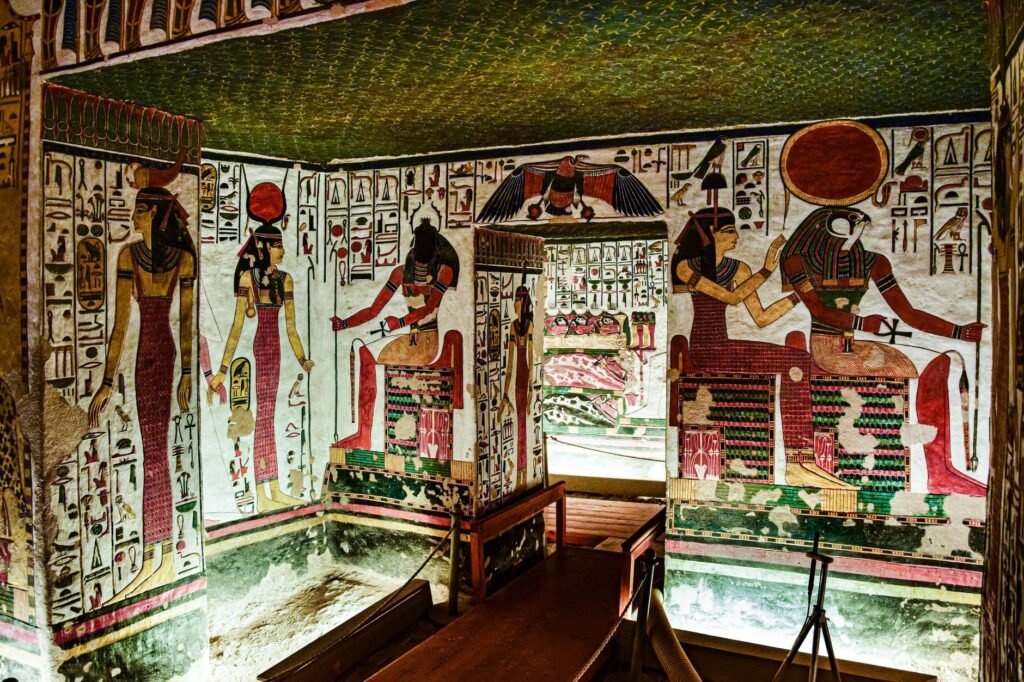
Min’s importance increased in festival settings during the Middle Kingdom and New Kingdom, when kings publicly participated in his cult. His image also appears in temple contexts, on votive objects, and in ritual scenes connected with renewal and abundance.
Although Egyptian religion was highly diverse and changed over time, Min remained remarkably stable in his core identity. He was not usually a god of mythological narrative in the same way as Osiris or Isis, but rather a potent divine presence tied to ritual fertility and kingship.
Main Characteristics
Min’s defining traits are easily recognizable in Egyptian iconography. His most common form is a mummiform male figure with an erect phallus, standing upright on a pedestal or shrine base. He often raises one arm upward, a gesture that may symbolize action, power, or readiness.
Common features of Min’s depiction
- Mummiform body: he is often shown wrapped or stylized like a mummy
- Erect penis: a direct symbol of generative power and fertility
- Raised arm: frequently holding a flail or similar implement
- Feathered crown: a tall crown with two large feathers is one of his main attributes
- Beard: sometimes included, reinforcing his divine status
- Shrine or pedestal: he may appear within a cultic setting
Min’s iconography strongly emphasizes male sexuality as divine creative force. In Egyptian thought, fertility was not merely biological but cosmological: it represented the renewal of life, crops, and kingship.
He is also linked to the eastern horizon and desert, where renewal and the sun’s emergence could be symbolically connected to vitality and rebirth.
Family and Genealogy
Min’s family relationships vary across traditions, and he does not have a single universally fixed genealogy. Different centers and periods associated him with different divine families.
Common associations
- Consort: In some traditions, Min was linked with Qadesh, a goddess of fertility and eroticism introduced from the Levant into Egyptian religion. This pairing reflects a broader Near Eastern fertility pattern.
- Consort or local partner: In other contexts, he is associated with Isis or forms connected with her cult, though this is not always presented as a direct mythic marriage.
- Son or manifestation: He was sometimes assimilated to Horus or connected with royal divine succession.
- Fatherly role: In fertility theology, Min could function as a generative father figure, though not as a central mythic patriarch like Atum or Geb.
Because Egyptian mythology was not a single fixed canon, Min’s genealogy must be handled carefully. He is better understood as a deity whose sexual and generative power allowed him to be linked flexibly to other gods and goddesses rather than as a figure with one universally agreed family tree.
Symbols
Min’s symbols are among the most vivid in Egyptian religion. They express his role as god of fertility and divine potency.
| Symbol | Meaning |
|---|---|
| Erect phallus | Fertility, generative force, sexual power |
| Flail | Authority, strength, divine action |
| Two-feather crown | Divine kingship, elevated sacred status |
| Lettuce | Fertility and sexual vitality |
| Shrine or pedestal | Cultic presence and sacred embodiment |
| Bull imagery | Strength and masculine potency |
The lettuce symbol
One of Min’s best-known plant symbols is lettuce. In Egyptian belief, lettuce was associated with fertility and had a milky sap that could be linked symbolically to generative power. Min may be shown with lettuce or surrounded by it in ritual scenes.
The flail
The flail, a symbol also used by kings and other deities, may indicate authority, control, and the ability to animate or sustain life. In Min’s case, it contributes to his image as an empowered divine being.
The feathers
Min’s feathered crown may allude to his elevated divine status and to his connection with the sky or desert region. The exact meaning of the feathers is debated, but they are a stable feature of his iconography.
Sacred Animals
Min is not as strongly associated with a single sacred animal as some other Egyptian deities, but several animals are relevant to his cult and symbolism.
Bull
The bull is the most important animal associated with Min. Bulls were widely linked to fertility, strength, and male power in ancient Egypt. Min’s virility was often compared with the force of the bull, making the animal an appropriate emblem of his divine role.
Desert and wild animals
Because Min had connections with the desert and borderlands, he may also have been conceptually linked to animals of the eastern desert. However, these associations are less standardized than his bull symbolism.
Birds and the sky
Min’s feathered crown may invite comparisons with birds or sky imagery, but this does not amount to a fixed sacred-animal cult in the way of the ibis for Thoth or the falcon for Horus.
Sacred Plants
Min is especially connected with lettuce, one of the most famous sacred plants in Egyptian religion. The association is unusual but well attested.
Lettuce
Lettuce was sacred to Min because of its erect growth form and milky sap, which ancient Egyptians may have interpreted symbolically as signs of sexual potency and fertility. It appears in iconographic and ritual contexts tied to his worship.
Vegetation and renewal
More broadly, Min belongs to the realm of plant fertility and agricultural regeneration. He was not limited to a single crop, but lettuce is the plant most directly associated with him in surviving evidence.
Sacred Places
Min’s cult was centered mainly in Upper Egypt, especially at the following locations:
Coptos (Qift)
Coptos was one of Min’s principal cult centers. It lay near trade routes leading to the eastern desert and the Red Sea, which helps explain Min’s connection with desert travel and expeditions.
Akhmim
Akhmim, another major center in Upper Egypt, was closely linked with Min and his worship. Greek writers often identified the local god of Akhmim with Pan, due to Min’s fertility and sexual symbolism.
Desert routes and quarry regions
Min was also connected with routes into the eastern desert and areas where mining and quarrying were conducted. This makes sense in practical and religious terms: expeditions into dangerous terrain often sought divine protection.
Temple contexts
Min appears in temple reliefs and ritual spaces across Egypt, especially in later periods when his cult was integrated into broader state religion. He was not confined only to one city, but his strongest local identity remained southern.
Powers and Attributes
Min’s powers centered on life, fertility, and regeneration. He is one of the clearest Egyptian examples of a deity whose sexuality was explicitly divine and cosmological rather than merely symbolic.
Main powers
- Fertility of humans
- Fertility of animals
- Fertility of crops and vegetation
- Renewal of life and cyclical abundance
- Protection of desert journeys and expeditions
- Support of royal vitality and legitimacy
Min was also linked with the male creative principle, making him important in rites of kingship and ritual renewal. His power was not destructive or warlike in the primary sense; instead, it was productive, life-giving, and sustaining.
Main Myths
Min is less central to famous narrative myths than gods such as Osiris, Isis, or Horus. Nevertheless, several important mythic and ritual themes surround him.
Fertility and renewal mythic pattern
Min’s myths are often embedded in ritual performance rather than narrative storytelling. He embodies the force that brings life into being and renews it after decline.
Kingship and renewal
In festival scenes, Min can appear as the divine power that revitalizes the king, supporting both political order and cosmic continuity.
Protection of expeditions
Min’s desert connections may reflect a mythic role as a divine protector in dangerous liminal spaces. This is less a single story than a religious function inferred from his cult geography and inscriptions.
Syncretic forms
In later periods, Min was sometimes merged with other deities or interpreted through broader theological frameworks. Such syncretism helped preserve his relevance even when Egyptian religion became more diverse and cosmopolitan.
Relationship with Other Mythological Figures
Min interacted with several major Egyptian deities, though these relationships could differ by time and place.
With Amun
Min was sometimes combined with Amun, especially in the New Kingdom. The composite deity Amun-Min united hidden divine power with generative fertility. This fusion illustrates how Egyptian gods could be merged to express overlapping functions.
With Horus
Because of his association with kingship and vitality, Min could be connected to Horus, the divine patron of the pharaoh. The relationship is not always direct, but both support royal legitimacy.
With Isis
Min’s cult was sometimes linked with Isis, especially in later or regional traditions where fertility and divine kingship were emphasized together. These associations should be understood cautiously, since they are not universal.
With Qadesh and fertility deities
Min shares functional territory with fertility goddesses and erotic deities such as Qadesh. This pairing reflects a broader religious logic in which male and female generative powers complement one another.
With Pan in Greek interpretation
Greek observers often compared Min to Pan because of his fertility symbolism and explicit sexuality. This was an interpretive association rather than an Egyptian equation.
Worship and Cult
Min’s worship included festivals, offerings, processions, and royal participation. Although the details varied over time, the cult was clearly important and long-lasting.
Ritual practices
Offerings to Min could include:
- Food and drink
- Incense
- Agricultural produce
- Lettuce and plants associated with fertility
- Ritual displays emphasizing generative power
Festivals
Min had prominent festivals in which the king or elite participants may have taken part. These festivals probably focused on renewal, abundance, and the reaffirmation of the social order.
A well-known element in Min’s festival imagery is the raising of the ceremonial pole, a symbolic act linked with regeneration and divine power. Such rites likely dramatized the god’s life-giving force.
Royal involvement
The pharaoh’s participation in Min’s cult was significant because it symbolized the ruler’s own vitality and capacity to sustain Egypt. In ancient Egyptian ideology, the king was not merely political; he was also ritually tied to fertility and cosmic maintenance.
Local and state worship
Min was worshipped both locally and in state contexts. His cult did not disappear when theology became more centralized; instead, it was absorbed into broader religious life.
Ancient Sources
Direct ancient evidence for Min comes mainly from Egyptian inscriptions, temple reliefs, and ritual scenes rather than from the Greek literary canon. This means that the standard classical authors are not the best sources for understanding him, though Greek and Roman writers sometimes mention the god indirectly or under interpretive names.
Primary Egyptian sources
Important evidence includes:
- Temple inscriptions and reliefs
- Festival scenes
- Offerings and votive objects
- Statues and iconographic representations
- Texts from the New Kingdom and later periods
Classical references
Greek and Roman authors did not systematically describe Min in the way they did some better-known gods, but they did comment on Egyptian deities through interpretive comparison. When Min was associated with Pan, that comparison reflects Greek religious categories rather than Egyptian theology.
Scholarly caution
Because Min is best known through material culture and Egyptian ritual texts, modern understanding depends heavily on archaeology and Egyptological analysis. It is important not to overstate what the surviving literary sources explicitly say.
Roman Equivalent
Min did not have a perfect Roman equivalent. In Greco-Roman interpretation, he was often compared to Pan because of his fertility symbolism, erect phallus, and pastoral or sexual associations. This comparison, however, is only partial.
Why Pan?
Pan was a Greek rustic god associated with sexuality, nature, and wild spaces. Greek observers used him as a familiar analogy for Min, especially in areas where Egyptian religion met Hellenistic culture.
Limits of the comparison
The comparison should not be taken too literally. Min was not a shepherd god in the Greek sense, nor was his religious role identical to Pan’s. His identity remained distinct within Egyptian tradition.
Influence on Modern Culture
Min is not as widely known in modern popular culture as Osiris, Isis, or Anubis, but he has still attracted scholarly and artistic attention.
In scholarship
Min is frequently discussed in books and articles on:
- Egyptian fertility religion
- Kingship and ritual renewal
- Sexual symbolism in ancient religions
- The relationship between Egyptian and Greek cults
In art and museum display
His distinctive image, especially the erect phallus and feather crown, makes him a striking figure in museum collections and exhibitions on ancient Egypt.
In popular culture
Min may appear indirectly in:
- Video games set in ancient Egypt
- Historical fiction
- Documentaries on Egyptian religion
- Artworks exploring ancient fertility symbols
His influence is more academic and visual than narrative, since he is not a major protagonist in widely retold myths.
Curiosities
- Min is among the few Egyptian gods whose sexuality is shown so explicitly in art.
- His festival imagery often emphasizes renewal rather than storytelling.
- Lettuce, an everyday plant, became a sacred fertility symbol in his cult.
- Greek interpreters frequently linked him to Pan, though the two gods were not identical.
- Min’s cult remained significant for thousands of years, showing unusual continuity.
- He is sometimes treated as a god of the eastern desert, which gave him a protective role in mining and trade expeditions.
- His iconography is so distinctive that he is often identified immediately even in fragmentary reliefs.
Frequently Asked Questions
1. Who is Min in Egyptian mythology?
Min is an ancient Egyptian god of fertility, male potency, vegetation, and renewal. He was also associated with kingship and desert travel.
2. What does Min look like?
He is usually shown as a mummiform male figure with an erect phallus, one raised arm, a flail, and a tall feathered crown.
3. Was Min an important god in ancient Egypt?
Yes. Min was an important and very ancient deity, especially in Upper Egypt, and his cult remained influential for a long period.
4. What animals are associated with Min?
The bull is the most important animal associated with Min because it symbolizes strength and fertility.
5. Why is lettuce connected with Min?
Lettuce was associated with fertility and male vitality in ancient Egyptian symbolism, making it a suitable sacred plant for Min.
6. Is Min the same as Pan?
No. Greek writers sometimes compared Min to Pan because both were linked with fertility and sexuality, but they were different gods from different religious systems.
7. Where was Min worshipped?
His main cult centers were Coptos and Akhmim in Upper Egypt, though his worship spread more widely.
8. Did Min have a fixed family in Egyptian mythology?
Not completely. Different traditions linked him with different gods and goddesses, and his genealogy was not uniform across all periods.
Conclusion
Min is a major figure in Egyptian mythology and religion, even though he is less famous in popular culture than some other gods. He represents the life-giving force of fertility, the renewal of vegetation, and the generative power that sustained both the land and the royal order. His striking iconography, ancient cult centers, and long continuity in Egyptian religious life make him one of the most distinctive deities of the Egyptian pantheon.
For anyone asking who is Min in Egyptian mythology, the answer is that he is not merely a fertility god in a narrow sense. He is a deeply rooted divine expression of vitality, creation, and continuity — a reminder of how central renewal was to the ancient Egyptian worldview.

Orin Vale has spent the better part of two decades tracing the threads that connect the world’s oldest stories — from the halls of Asgard to the banks of the Nile, from Olympus to the jungles of the Maya. What began as a childhood fascination with flood myths and trickster gods grew into years of independent study across comparative mythology and ancient religion, always chasing the same question: what did these stories mean to the people who first told them? Orin writes for readers who want more than trivia — the ones looking for the beliefs, fears, and truths that myths were built to carry.