Who Is Mut in Egyptian Mythology?
Introduction
Mut is a major goddess in ancient Egyptian religion, best known as a mother deity and a protective divine figure. Her name is strongly associated with motherhood, kingship, and the powerful female principle in Egyptian cosmology. In many texts and artistic representations, Mut appears as a principal goddess of Thebes and as part of the Theban divine triad with Amun and their son Khonsu.
For modern readers asking “who is Mut in Egyptian mythology?”, the answer is both simple and complex: she is one of the most important goddesses in Egypt’s religious history, yet her identity changed over time and absorbed traits from other deities. Like many Egyptian gods, Mut was not fixed in a single role. She was worshipped as a mother, a queen of the gods, a creator figure, and a divine protector associated with royal power.
Origin and Meaning
The name Mut is usually translated as “mother” in ancient Egyptian. The word is closely related to the Egyptian concept of maternity and may reflect her role as a universal mother goddess. However, Egyptian divine names often carried layered meanings, so Mut was not merely a literal personification of motherhood.
Her theological development is not fully documented in a single origin story. Scholars generally understand Mut as a deity who gained prominence in Thebes during the rise of the New Kingdom, when the local god Amun became one of the most important gods in Egypt. Over time, Mut’s status rose with Amun’s, and she became integrated into state religion.
Some evidence suggests that Mut may have absorbed characteristics of earlier mother goddesses or protective female divinities. As with many Egyptian gods, her identity was shaped through syncretism and local religious traditions rather than through a single mythological invention.
Historical Context
Mut’s importance is tied closely to the religious history of Thebes and the political rise of the New Kingdom, especially from the 18th Dynasty onward. When Thebes became a dominant political and religious center, its gods also gained prominence.
Theban Triad
Mut formed part of the famous Theban Triad:
- Amun as the father
- Mut as the mother
- Khonsu as the son
This family structure gave Thebes a divine royal household and reflected broader Egyptian ideas about order, legitimacy, and fertility. The triad became especially important in temple religion, processions, and royal ideology.
Broader Religious Role
Mut’s worship was not limited to a single role. In different periods she could appear as:
- a mother goddess
- a royal consort
- a lioness-like protector
- a creator or primordial mother
- an aspect of the great divine feminine
Her cult also reflects a broader Egyptian pattern in which major deities could merge with or adopt the attributes of other gods. In later periods, she was sometimes linked with goddesses such as Sekhmet, Bastet, and Nekhbet, depending on local theology.
Main Characteristics
Mut is generally depicted as a majestic woman wearing the double crown of Upper and Lower Egypt, a symbol of royal authority. In artistic and religious contexts, she is often shown with strong connections to queenship and divine motherhood.
Common Features
Mut’s main characteristics include:
- motherhood and nurturing authority
- protection of kings and the state
- association with royal legitimacy
- a strong, often regal feminine presence
- occasional lioness symbolism
- connection to Thebes and the Amun cult
She is frequently represented as a calm but powerful goddess rather than as a dramatic or aggressive figure. Nevertheless, some traditions emphasize her fierce protective qualities, especially when she is linked to solar and lioness goddesses.
Iconography
Mut may be shown as:
- a woman in a long gown
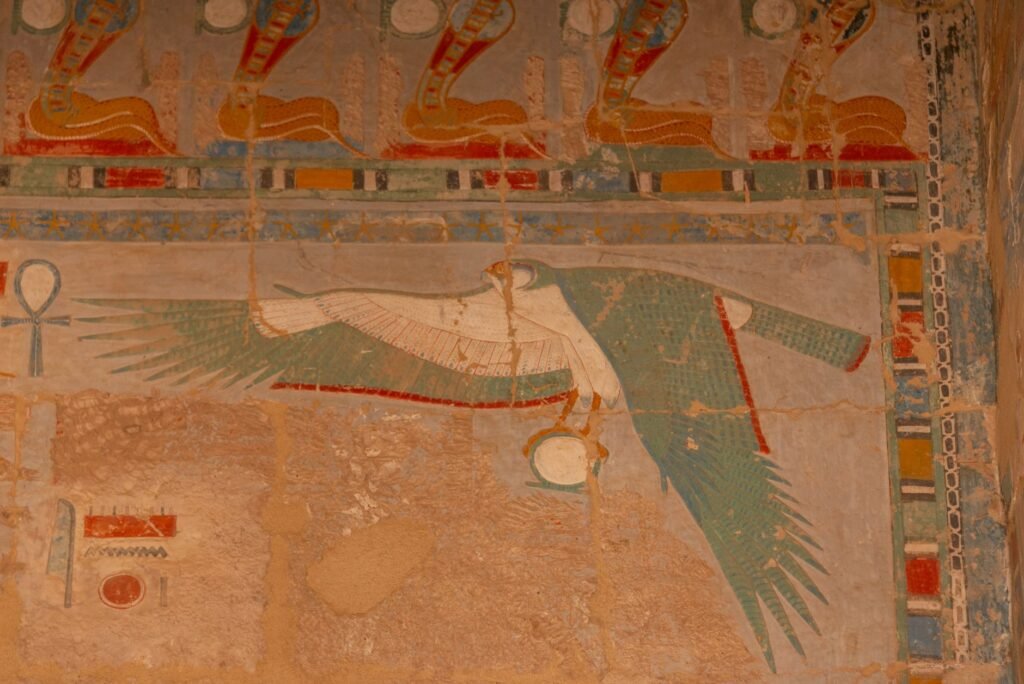
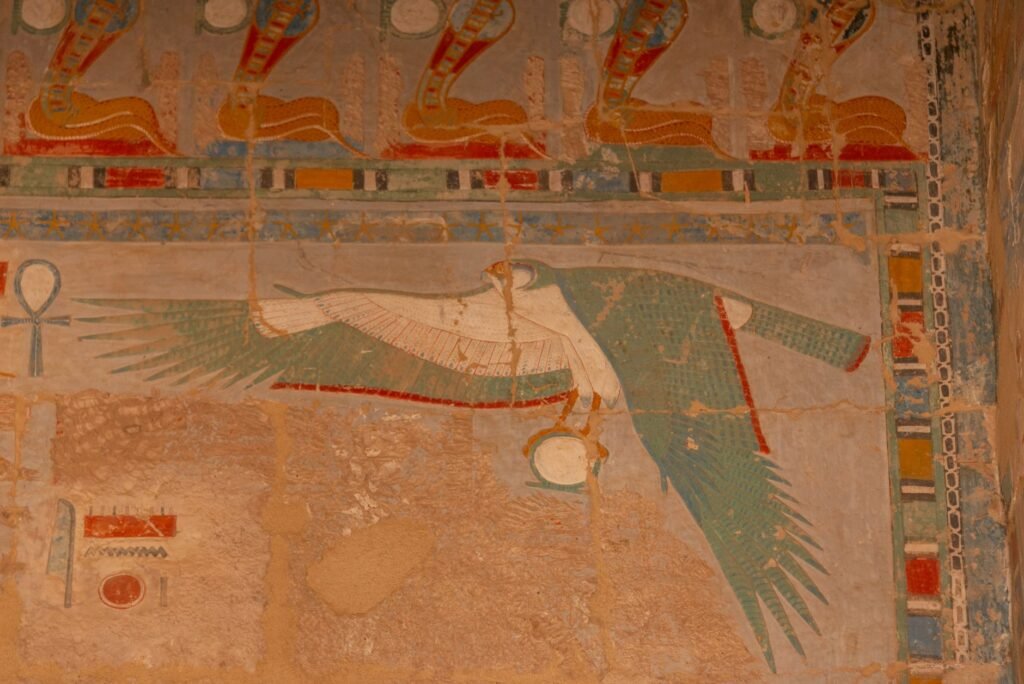
- wearing the vulture headdress
- wearing the double crown
- carrying an ankh or was-scepter
- sometimes with a papyrus scepter or other symbols of rule
- occasionally with a lioness head in syncretic forms
The vulture is especially important because it symbolized motherhood and divine protection in Egyptian religion.
Family and Genealogy
Mut’s family relationships vary depending on the tradition and period. The best-known relationship is her role in the Theban Triad.
Main Family Relationships
| Figure | Relationship to Mut | Notes |
|---|---|---|
| Amun | Husband or consort | Central god of Thebes; their union was important in temple theology |
| Khonsu | Son | Lunar god and member of the Theban Triad |
| Pharaoh | Symbolic child or protected ruler | In royal ideology, the king was often placed under Mut’s care |
Genealogical Variations
Egyptian mythology does not always preserve a single, consistent family tree. In some contexts:
- Mut is treated as the spouse of Amun
- in theological developments, she may be identified with or incorporated into broader goddess forms
- some traditions emphasize her as a universal mother rather than focusing on literal genealogy
Her importance lies less in fixed mythic genealogy and more in her religious function as a divine mother and queen.
Symbols
Mut was associated with several symbols that conveyed her divine status and maternal power.
Key Symbols
- Vulture headdress: Symbol of motherhood, protection, and divine femininity
- Double crown: Sign of sovereignty over Upper and Lower Egypt
- Ankh: Life-giving power
- Was-scepter: Authority and control
- Uraeus: Royal protection and fiery divine force
- Crown ornaments and sacred emblems: Indicating rank and cultic importance
Meaning of the Symbols
| Symbol | Meaning |
|---|---|
| Vulture | Maternal protection, divine care |
| Double crown | Royal authority over unified Egypt |
| Ankh | Life and vitality |
| Uraeus | Protective power, especially in royal and solar contexts |
| Was-scepter | Dominion, divine command |
These symbols show that Mut was not only a nurturing mother figure but also a goddess of political power and sacred protection.
Sacred Animals
Mut is most closely associated with the vulture, but she also appears in traditions that connect her with other protective or fierce animals.
Vulture
The vulture was the most important animal linked to Mut. In Egyptian symbolism, the vulture was not a negative creature but a sign of maternal care and divine safeguarding. Female vultures were believed in ancient thought to provide powerful protection for their young, which made them appropriate emblems for mother goddesses.
Lioness Connections
In some later or blended forms, Mut absorbed traits of lioness goddesses. This connection aligns her with fierce protection, solar power, and royal defense. It is important to note that this is a theological overlap rather than a separate stable myth in all sources.
Symbolic Significance
Animals associated with Mut usually express one or more of the following:
- motherhood
- protection
- kingship
- divine authority
- fierce defense against chaos
Sacred Plants
No single plant is universally and uniquely associated with Mut in the way that some other Egyptian deities are connected to specific flora. Egyptian religious symbolism, however, often linked goddesses to vegetation through fertility and renewal imagery.
Plant Associations in Context
Mut’s broader maternal role may connect her symbolically to:
- papyrus, associated with life, Lower Egypt, and divine legitimacy
- lotus, associated with rebirth and sacred beauty
- sedge and reed motifs, which appear in royal iconography
These are contextual associations rather than exclusive sacred plants. The evidence for a distinct “plant of Mut” is limited, so it is best to treat plant symbolism cautiously.
Sacred Places
Mut was especially important in Thebes, but her worship extended to other parts of Egypt as well.
Key Locations
| Place | Significance |
|---|---|
| Karnak | Major center of the cult of Amun and Mut |
| Luxor/Thebes | Core region of her worship |
| Mut Precinct at Karnak | Dedicated temple complex for the goddess |
| Medamud | Site with religious associations to local forms of Mut and other gods |
| Hermonthis | Connected in some traditions to nearby Theban cultic geography |
The Precinct of Mut at Karnak
The most important sacred site associated with Mut is the Precinct of Mut at Karnak, south of the main Amun temple complex. This area included temples, lakes, and cultic structures and served as a major center for her worship.
The precinct reflects her importance as a state goddess, not just a household or local deity. Its architecture and ritual setting demonstrate how deeply she was integrated into official religion.
Powers and Attributes
Mut’s powers are broad and reflect her elevated position in Egyptian religion.
Main Domains
- motherhood and fertility
- protection of the king
- divine queenship
- legitimacy and political order
- safeguarding Thebes and the temple state
- nurturing cosmic balance
Protective Role
As a mother goddess, Mut could be invoked to protect individuals, the royal family, and the nation. Egyptian gods often protected against chaos, illness, and disorder, and Mut belonged to this wider protective framework.
Royal and Cosmic Importance
Her association with kingship made her especially important in:
- royal rituals
- temple theology
- state ideology
- the divine validation of pharaohs
In some traditions, she can also be understood as a cosmic mother, a figure who supports creation and sustains divine order.
Main Myths
Mut does not have a large body of independent myths comparable to those of Osiris, Isis, or Horus. Instead, her significance appears mainly through temple theology, hymns, and ritual texts.
Theban Triad Mythology
The best-known mythic framework involving Mut is the Theban Triad. In this model:
- Amun is the powerful divine father
- Mut is the divine mother
- Khonsu is the divine child
This structure is less a single story than a theological representation of divine family and continuity.
Motherhood and Divine Succession
Mut’s role as mother helped express the idea that kingship and divine rule were sustained through generative female power. In this sense, she participated in myths of renewal, succession, and cosmic stability.
Solar and Protective Aspects
In some traditions, Mut is connected to solar theology and fierce protective goddesses. These overlapping identities are part of the complex Egyptian habit of merging divine roles.
Important Note on Sources
Unlike some deities, Mut is not central to many surviving narrative myths. Most of what is known comes from:
- temple inscriptions
- hymns
- reliefs
- royal theology
- later interpretive traditions
Relationship with Other Mythological Figures
Mut’s relationships with other gods are central to understanding her role.
Amun
Mut’s closest and most famous relationship is with Amun. Their pairing became one of the most powerful divine partnerships in Egyptian religion.
Their relationship symbolized:
- cosmic balance between masculine and feminine divinity
- legitimacy of rulership
- fertility and regeneration
- the prestige of Thebes
Khonsu
Mut’s son Khonsu completes the Theban Triad. He is associated with the moon, healing, and time. His relationship to Mut reinforces her maternal identity.
Other Goddesses
Mut was often linked with:
- Sekhmet, when emphasizing fierce protection
- Bastet, in some lioness-related theological overlaps
- Nekhbet, through royal protection and maternal symbolism
- Isis, by broader maternal and royal associations
These connections do not mean Mut and these goddesses were identical in all contexts. Rather, Egyptian religion allowed overlapping identities and local fusion.
Worship and Cult
Mut was widely worshipped in temples and festivals, especially in Thebes.
Forms of Worship
Her cult likely included:
- offerings of food, drink, incense, and incense-burners
- prayers for protection and fertility
- temple rituals conducted by priests
- processions during religious festivals
- royal participation in major ceremonies
The Opet Festival
Mut was especially important in the Opet Festival, a major Theban celebration involving Amun, Mut, and Khonsu. The festival strengthened the divine legitimacy of the pharaoh and reaffirmed the religious centrality of Thebes.
Priesthood and Temple Culture
Priests and priestesses served in her temples. Her cult was part of the broader temple economy and religious administration of ancient Egypt. As with many major deities, her worship was not only spiritual but also social, political, and economic.
Ancient Sources
Because Mut is primarily known through Egyptian sources, her interpretation depends on inscriptions, temple texts, hymns, and iconography rather than on the Greek literary canon.
Egyptian Primary Sources
Important categories of sources include:
- temple inscriptions at Karnak
- reliefs and texts from the Precinct of Mut
- hymns to Amun and the Theban triad
- funerary and ritual texts
- royal inscriptions from the New Kingdom and later periods
Classical Authors
Classical Greek and Roman writers occasionally discussed Egyptian religion, but they often interpreted it through their own frameworks. Authors such as:
- Herodotus
- Diodorus Siculus
- Plutarch
provide useful background on Egyptian religion generally, though they do not always offer detailed, reliable accounts of Mut specifically.
Caution with Ancient Evidence
Egyptian religion changed over time, and later sources may reflect theological developments that differ from earlier ones. A responsible reading of Mut requires attention to period, region, and ritual context.
Roman Equivalent
Mut did not have a perfect Roman equivalent. Egyptian gods were often compared with Roman deities through interpretatio Romana, but these comparisons were not exact.
Possible Roman Comparisons
Mut has sometimes been loosely compared with:
- Juno, as a queenly mother figure
- Cybele, as a powerful mother goddess
- Minerva in some protective aspects, though this is less direct
These comparisons are approximate only. Mut belonged to an Egyptian religious system with its own logic, and Roman parallels should not be treated as identical counterparts.
Influence on Modern Culture
Mut is less widely known in modern popular culture than Isis, Anubis, or Ra, but she appears in scholarship, museum displays, and contemporary retellings of Egyptian mythology.
Areas of Modern Influence
- Egyptology and academic studies
- museum exhibitions and temple reconstructions
- fiction inspired by Egyptian gods
- video games and role-playing settings
- artworks and symbolic feminist reinterpretations
Modern Interpretation
In modern contexts, Mut is often presented as:
- a powerful mother goddess
- a queenly divine protector
- a symbol of ancient female authority
However, many popular works simplify or merge Egyptian deities in ways that do not reflect ancient religious distinctions. Scholarly sources remain the best basis for understanding her historical role.
Curiosities
Here are some lesser-known facts about Mut:
- Her name literally connects her to the concept of motherhood.
- She was one of the main goddesses of Thebes, one of ancient Egypt’s most important cities.
- The Precinct of Mut at Karnak was a major sacred complex, not a minor shrine.
- In some religious settings, Mut could absorb traits from lioness goddesses, showing the flexibility of Egyptian theology.
- Her image often reflects royal authority, not just maternal gentleness.
- The Egyptian view of a mother goddess could include both nurture and protection, meaning Mut was not only caring but also formidable.
- The Theban triad helped connect divine family structure with political legitimacy.
Frequently Asked Questions
Who is Mut in Egyptian mythology?
Mut is an important Egyptian goddess associated with motherhood, protection, queenship, and the Theban religious tradition. She is best known as the consort of Amun and mother of Khonsu in the Theban Triad.
What does the name Mut mean?
The name Mut is commonly understood to mean “mother” in ancient Egyptian.
What symbols are associated with Mut?
Her major symbols include the vulture, the double crown, the ankh, and royal emblems of authority and protection.
Is Mut the same as Isis?
No. Mut and Isis are different goddesses, although both are associated with motherhood and protection. They belong to separate mythological traditions, even if their roles sometimes overlap.
What animals are sacred to Mut?
The vulture is the most important animal associated with Mut. In some contexts, she also takes on lioness-like qualities.
Where was Mut worshipped?
She was especially worshipped in Thebes and at the Precinct of Mut at Karnak.
Did Mut have a major myth of her own?
Not in the way some other Egyptian gods did. Her importance is seen mainly in temple theology, royal religion, and her role in the Theban Triad.
What is Mut’s role in the Theban Triad?
She is the mother figure of the triad, with Amun as the father and Khonsu as the son.
Conclusion
Mut is one of the great goddesses of ancient Egypt, especially important in Theban religion and royal ideology. Her name, meaning “mother,” reflects only part of her significance. She was also a queenly protector, a divine consort, a maternal force of legitimacy, and a symbol of sacred feminine power.
Although she is not the central figure of a single famous myth, Mut played a crucial role in Egyptian theology, temple ritual, and political symbolism. Through her association with Amun and Khonsu, she became part of one of the most important divine families in Egyptian religion. Her enduring legacy lies in her representation of motherhood joined to authority, care joined to protection, and fertility joined to royal power.

Orin Vale has spent the better part of two decades tracing the threads that connect the world’s oldest stories — from the halls of Asgard to the banks of the Nile, from Olympus to the jungles of the Maya. What began as a childhood fascination with flood myths and trickster gods grew into years of independent study across comparative mythology and ancient religion, always chasing the same question: what did these stories mean to the people who first told them? Orin writes for readers who want more than trivia — the ones looking for the beliefs, fears, and truths that myths were built to carry.