Who Is Anhur in Egyptian Mythology?
Introduction
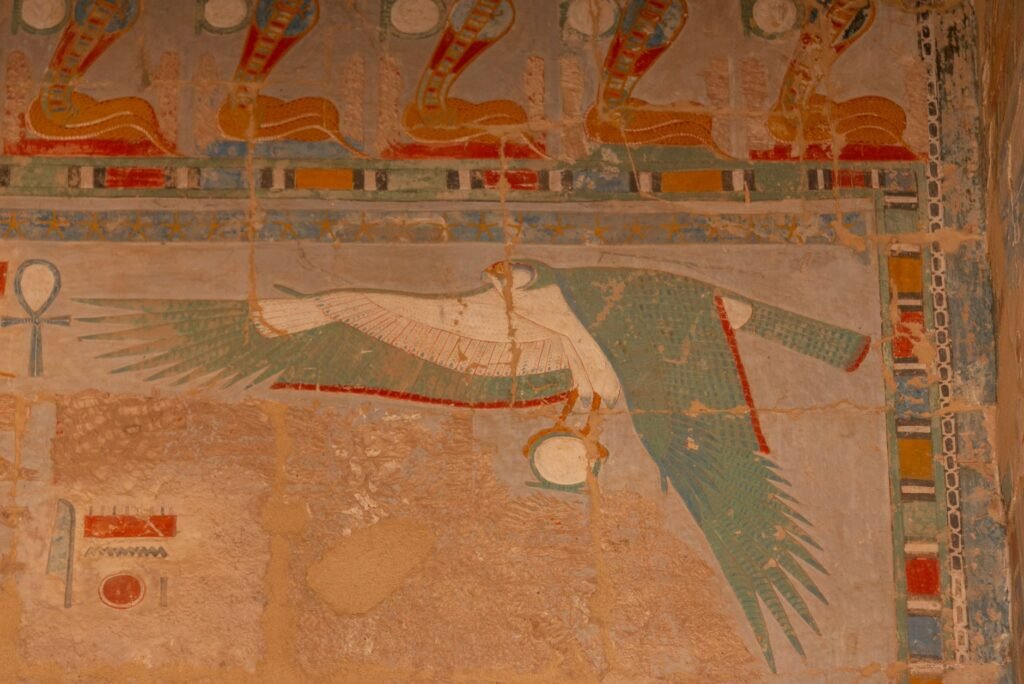
Anhur is a significant god in Egyptian mythology, best known as a warrior and sky-associated deity whose cult was especially important in Upper Egypt. He is often presented in modern summaries as a hunt-like or martial god, but his role was broader and changed over time. In ancient Egyptian religion, gods were rarely fixed to one narrow function; instead, they accumulated attributes, titles, and local meanings across centuries.
Anhur is especially important because he illustrates how Egyptian deities could grow through syncretism, local worship, and royal ideology. He was worshipped as a powerful divine defender, a patron of kingship and military force, and in some traditions a sky god connected with the safeguarding of cosmic order. Later Egyptian texts also merged him with other gods, showing the flexibility of Egyptian theology.
Origin and Meaning
The name Anhur is usually understood as a Greek rendering of the Egyptian name 𓅓𓏏𓊖 or related forms commonly transliterated as Anḥur or Onuris in older scholarship. The Greek form Onuris became widespread in classical and modern literature, while Anhur is a more direct modern rendering used in Egyptological writing.
The meaning of the name is not entirely certain. Ancient Egyptian divine names can be difficult to interpret because of changes in pronunciation over long periods and the absence of vowel notation in hieroglyphic writing. Scholars have proposed that the name may mean something like “the one who brings back the distant one” or may be connected with a divine role as a rescuer or bringer. However, etymological certainty is limited, and different reconstructions exist.
His historical origin appears to lie in Upper Egypt, especially in the region of Thinis and Abydos, where local cults were influential in early dynastic and Middle Kingdom religion. Over time, Anhur became known beyond his home region and acquired more general religious significance.
Historical Context
Anhur belongs to the long and layered history of Egyptian religion, which developed over more than three thousand years. His earliest importance was regional, but his image expanded as Egyptian political and religious systems became more centralized.
Key historical features of his cult
- Early local worship in Upper Egypt
- Royal association, especially with protection and military strength
- Integration into solar and sky symbolism
- Syncretism with other deities in later periods
- Continued importance in temple religion into the Late and Greco-Roman periods
Anhur’s role fits the broader Egyptian pattern in which local gods could be elevated into major religious figures when their cult centers gained political prominence. As a martial and protective deity, he was especially suitable for kingship ideology. Egyptian rulers often portrayed themselves as divinely supported warriors who maintained order against chaos, and gods like Anhur were valuable symbols of that ideal.
In some periods, Anhur also became associated with the sun’s journey and with the protection of the heavens. This is one reason he was linked with ideas of cosmic defense rather than simple aggression.
Main Characteristics
Anhur is most often depicted as a man wearing a tall crown with four feathers. He is usually shown in a dynamic, powerful stance, sometimes holding spears or a rope, and in some representations he appears as a warrior-god.
Main traits associated with Anhur
- Warrior and protector
- Sky or celestial deity
- Royal defender
- Hunter-like or martial figure
- Associated with force, authority, and order
- Sometimes linked with the sun and divine movement
His iconography is striking. The four-feather crown is among his most recognizable features. Feathers in Egyptian art can signify height, lightness, divinity, or celestial association. The exact meaning of the four feathers in Anhur’s crown is debated, but they clearly mark him as a distinguished and elevated deity.
Anhur is not usually among the most famous gods in modern popular culture, but in the ancient religious landscape he was a serious and respected figure whose imagery communicated strength and divine legitimacy.
Family and Genealogy
Egyptian myths often provide multiple and sometimes contradictory genealogies for the same deity. Anhur is no exception. His family relationships are not as standardized as those of major gods such as Osiris, Isis, or Horus.
Commonly associated relationships
- Consort: In some traditions, Mehit is identified as Anhur’s wife or female counterpart.
- Children: Some local traditions connect him with divine offspring, but these are not consistently attested.
- Parental origins: Ancient sources do not preserve a single universally accepted parentage for him.
Mehit and Anhur
One of the most important divine relationships linked to Anhur is his association with Mehit, a lioness goddess. In some traditions, Mehit appears as his wife or complement. This pairing reflects the Egyptian tendency to conceptualize divine powers as balanced male-female forces, especially where protection and aggression were concerned.
Because Egyptian religion was highly local, the exact family structure of Anhur may differ depending on the temple, region, and historical period. It is best to treat his genealogy as variable rather than fixed.
Symbols
Anhur’s symbols reflect his martial, celestial, and royal qualities.
| Symbol | Meaning |
|---|---|
| Four-feather crown | Divine status, elevation, sky association |
| Spear or lance | Martial power, defense, royal force |
| Rope or cord | Control, capture, or triumph over enemies |
| Solar or celestial motifs | Sky-related and cosmic aspects |
| Lion or lioness imagery | Strength, protection, and aggressive divine force |
The four-feather crown is the most distinctive symbol associated with him. It sets him apart from gods with animal heads or simpler crowns. The feathers may evoke the heavens or divine authority rather than a single narrow meaning.
His weapons and regalia emphasize that he was not a passive or purely abstract deity. He is portrayed as a god who acts, defends, and overpowers enemies. This made him particularly suitable for royal and military contexts.
Sacred Animals
Unlike gods who are strongly identified with one sacred animal, such as Sobek with the crocodile or Bastet with the cat, Anhur is not consistently represented by a single animal form. However, he is associated in some traditions with lion-like qualities and with Mehit, who is a lioness goddess.
Animal associations
- Lion / lioness
- Symbolizes royal power, aggression, protection, and solar strength
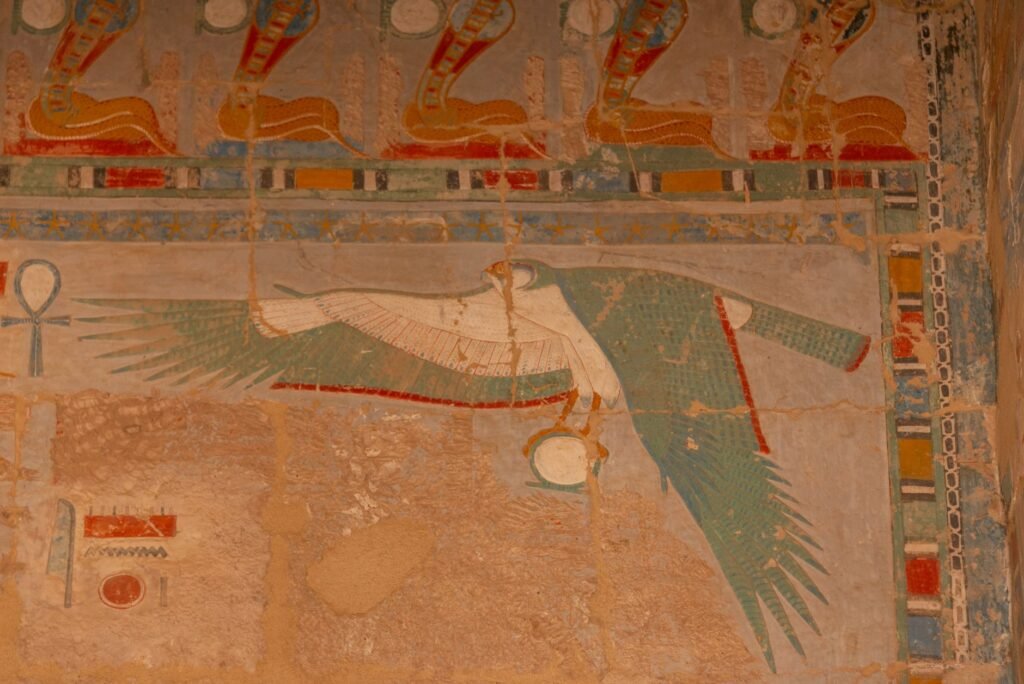
- Falcon-like celestial imagery
- Sometimes indirectly connected through sky symbolism
- Bull and other strong animals
- Not primary identifiers, but sometimes used in broader protective contexts
The lion association is especially meaningful in Egyptian religion because lions often symbolized the power to ward off chaos and protect sacred space. If Anhur is understood as a military and guardian deity, then the lioness connection strengthens his role as a force of defense and retaliation.
Sacred Plants
There are no universally recognized sacred plants uniquely and consistently tied to Anhur in the way that the persea tree is associated in some contexts or the papyrus with Lower Egypt. However, Egyptian temple symbolism sometimes links deities with specific sacred flora through local cult and ritual decoration.
Important caution
Because Anhur’s cult was regionally diverse and his surviving mythological profile is incomplete, it is difficult to name a single plant with confidence as his exclusive sacred plant. Any plant association should therefore be treated as local, contextual, or uncertain unless supported by a specific source.
In general Egyptian religious symbolism, plants could represent:
- regeneration
- life
- offering and purity
- the fertile ordered world protected by the gods
These themes are compatible with Anhur’s wider divine role, even if no unique botanical emblem is securely established.
Sacred Places
Anhur’s cult was especially connected with Upper Egypt.
Major cult centers and associated places
| Place | Significance |
|---|---|
| Thinis / This | Often linked with early worship and regional importance |
| Abydos | Important religious center in Upper Egypt; connected with several major cults |
| Akoris (Tjebu) | In later periods, associated with temple worship of Onuris/Anhur |
| Upper Egyptian temple networks | Broader regional cult development |
Abydos was among the most significant religious centers in ancient Egypt, especially associated with Osiris and funerary belief. While Anhur was not as dominant there as Osiris, Upper Egyptian temple culture helped preserve and elevate regional gods like him.
In the Greco-Roman period, Anhur was often identified with Onuris, and his cult had notable development in some temple complexes where Egyptian and Hellenistic religious expressions interacted.
Powers and Attributes
Anhur’s powers center on protection, force, and celestial authority.
Main domains
- War and martial protection
- Defense of the king
- Maintenance of order
- Sky or celestial guardianship
- Forceful action against enemies
- Possibly solar movement or escorting divine presence
Anhur’s character should not be reduced to “god of war” in a modern sense. In Egyptian religion, martial deities were often linked to the protection of cosmic order, the king, and the temple. They were not merely gods of violence but of legitimate force.
His attributes reflect the Egyptian idea that the universe is vulnerable to disorder and must be defended by divine power. Anhur’s role fits that framework well. He is a god of action, vigilance, and divine support.
Main Myths
Anhur does not have a single famous myth cycle as extensive as the Osiris story or the adventures of Horus and Seth. Instead, his mythic identity emerges through local traditions, hymns, epithets, and ritual roles.
Common mythic themes
1. Divine warrior and protector
Anhur often appears as the god who protects sacred order and helps defeat enemies of the gods or king.
2. Sky and celestial force
Some traditions connect him with the heavens, suggesting that he is not only a terrestrial warrior but also a divine power linked with cosmic space.
3. The “bringer back” or “retriever” tradition
The interpretation of his name as someone who brings back the distant one has led to interpretations that connect him with retrieval or restoration. In some scholarly discussions, this may reflect ritual or mythic themes rather than a single well-preserved narrative.
4. Syncretic myths
Later Egyptian religion often merged gods. Anhur could be identified with or paired alongside other deities, and these overlaps created layered mythological roles.
Because the surviving textual record is fragmentary, it is important to avoid overstating the certainty of any one myth about him. His significance lies more in his ritual function and iconography than in one canonical narrative.
Relationship with Other Mythological Figures
Anhur’s religious identity was shaped by relationships with other gods and goddesses.
Mehit
Mehit is the most notable female divine counterpart associated with Anhur. Their pairing suggests a complementary balance between masculine and feminine protective power.
Horus
As a sky-linked and royal protector, Anhur can overlap conceptually with Horus. Both are associated with kingship, legitimacy, and protection, though Horus is far more central in Egyptian mythology overall.
Ra
Some later interpretations and syncretic forms connect Anhur with solar theology. This does not mean he replaces Ra, but rather that his character may be absorbed into broader solar frameworks.
Shu
Because Anhur has sky-related features, he is sometimes compared with Shu, the air and sky-related god. The comparison is conceptual rather than evidence of direct identity in all periods.
Regional deities
As with many Egyptian gods, Anhur’s profile varied depending on the local theological environment. He could be integrated into temple systems where other gods dominated, resulting in complex and sometimes overlapping roles.
Worship and Cult
Anhur was worshipped in temples and local sanctuaries, especially in Upper Egypt. His cult likely included standard Egyptian temple practices: offerings, hymns, processions, purification rites, and priestly service.
Forms of worship
- Daily temple offerings
- Incense and libations
- Recitation of hymns and divine epithets
- Festival processions
- Royal ritual association
- Local devotional practices
In temple religion, gods were honored not only through myth but through ritual maintenance. Anhur’s power as a guardian would have been activated through offerings and ritual speech. Kings and officials may have invoked him for protection, especially in martial or state contexts.
Festivals
Specific festivals dedicated exclusively to Anhur are not among the best documented in surviving sources. However, he may have taken part in local temple festivals, especially in places where Onuris/Anhur had an established cult. As with many Egyptian gods, festival traditions often combined local, royal, and seasonal meanings.
Ancient Sources
Anhur is not as prominent in the surviving Greek literary canon as some better-known Egyptian deities, but he is documented in Egyptian and Greco-Egyptian sources.
Types of sources
- Temple inscriptions and reliefs
- Hymns and religious texts
- Later Greek references to Onuris
- Egyptological studies of inscriptions and cult centers
Classical and later authors
Classical authors do not provide a single extensive narrative about Anhur comparable to Homer’s treatment of Greek gods. Instead, his name and role appear more indirectly in Greco-Roman descriptions of Egyptian religion. The identification with Onuris is important for reading these references.
Egyptian primary evidence
The most reliable evidence for Anhur comes from:
- temple inscriptions
- divine iconography
- ritual texts
- local cult records
- syncretic divine lists
Because the surviving material is uneven, some aspects of his mythology remain uncertain. Modern understanding depends heavily on Egyptology rather than on a continuous ancient narrative tradition.
Roman Equivalent
Anhur does not have a perfect Roman equivalent. Egyptian gods were often interpreted through the lens of Roman religion, but many remained distinctly Egyptian even under Roman rule.
Possible interpretive parallels
- Mars, because of martial attributes
- Jupiter or celestial gods, because of sky associations
- Apollo, in some Greco-Roman interpretive frameworks, though this is not a direct equivalence
These parallels are only approximate. Roman religion did not absorb Anhur into a single universally accepted counterpart in the way some Egyptian gods were equated with well-known Roman figures. In Greco-Roman Egypt, he remained largely an Egyptian deity with local importance.
Influence on Modern Culture
Anhur is not as widely represented in modern popular culture as Isis, Osiris, Anubis, or Ra. Nevertheless, he appears in modern discussions of Egyptian mythology, comparative religion, fantasy literature, and educational media.
Areas of modern influence
- Egyptology and museum displays
- Academic studies of Egyptian religion
- Fantasy fiction and role-playing games
- Documentaries and popular history programs
- Online mythology databases and encyclopedias
In some games and fictional settings, Egyptian gods are simplified into standard archetypes such as “war god” or “sky god,” and Anhur may be used in those frameworks. However, such depictions often compress his complex historical identity into a more generalized divine warrior figure.
His main modern significance lies in scholarly and educational contexts, where he helps illustrate the diversity of Egyptian religion beyond the best-known gods.
Curiosities
Lesser-known facts about Anhur
- Anhur is one of several Egyptian deities whose importance was strongly regional before becoming more widely recognized.
- His most distinctive visual marker is the four-feather crown.
- He is often discussed under the Greek name Onuris in older literature.
- His mythology is less narrative and more ritual-iconographic than that of Osiris or Isis.
- His relationship with Mehit highlights the Egyptian habit of pairing gods and goddesses as complementary forces.
- Some interpretations of his name are still debated, which is common in ancient Egyptian studies.
- His role as a protector made him compatible with royal and military ideology.
Frequently Asked Questions
1. Who is Anhur in Egyptian mythology?
Anhur is an ancient Egyptian god associated with war, protection, kingship, and sky symbolism. He was especially important in Upper Egypt and is often depicted wearing a crown of four feathers.
2. Is Anhur the same as Onuris?
Yes, Onuris is the Greek form commonly used for the Egyptian god Anhur in older scholarship. The names refer to the same deity.
3. What is Anhur the god of?
Anhur is primarily connected with war, protection, royal power, and celestial or sky-related functions. Different sources and periods emphasize different aspects of his role.
4. Does Anhur have a well-known myth like Osiris?
No single major myth about Anhur survives in the same way as the Osiris cycle. His importance comes more from his cult, titles, symbolism, and temple representation.
5. What does Anhur’s crown mean?
His four-feather crown is a distinctive symbol of divine rank and may suggest sky or celestial association. The exact meaning is not fully certain.
6. Who was Anhur’s wife?
In some traditions, Mehit is identified as Anhur’s consort or female counterpart. However, Egyptian divine genealogy can vary by region and period.
7. Where was Anhur worshipped?
Anhur was especially worshipped in Upper Egypt, with associations to places such as Thinis, Abydos, and later temple centers linked to Onuris.
8. What animals are associated with Anhur?
He is not fixed to one sacred animal, but he is often associated with lioness imagery through Mehit and with general symbols of strength and protection.
Conclusion
Anhur is an important but sometimes overlooked figure in Egyptian mythology. He represents the protective, martial, and celestial dimensions of ancient Egyptian religion, and his cult shows how local gods could gain lasting significance through temple worship, royal association, and theological adaptation.
Although he does not have a single dominant narrative like Osiris or Horus, Anhur remains valuable for understanding the complexity of Egyptian belief. His four-feather crown, his protective role, and his connections to Upper Egypt reveal a deity deeply embedded in the religious imagination of the Nile Valley.
For anyone asking who is Anhur in Egyptian mythology, the answer is that he is a powerful Egyptian god of defense and authority whose meaning evolved over centuries and whose worship reflects the richness, flexibility, and regional diversity of ancient Egyptian religion.

Orin Vale has spent the better part of two decades tracing the threads that connect the world’s oldest stories — from the halls of Asgard to the banks of the Nile, from Olympus to the jungles of the Maya. What began as a childhood fascination with flood myths and trickster gods grew into years of independent study across comparative mythology and ancient religion, always chasing the same question: what did these stories mean to the people who first told them? Orin writes for readers who want more than trivia — the ones looking for the beliefs, fears, and truths that myths were built to carry.