Who Is Nekhbet in Egyptian Mythology?
Introduction
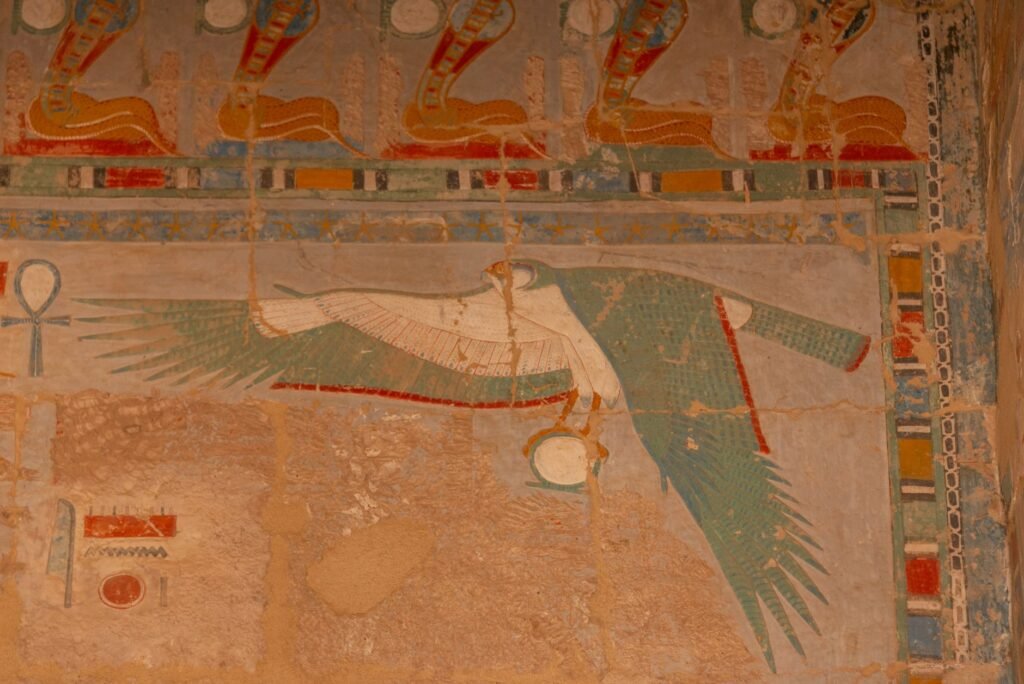
Nekhbet is one of the major protective deities of ancient Egypt and a prominent symbol of royal power, especially in Upper Egypt. In Egyptian mythology, she is best known as a vulture goddess, a guardian of kings, and one of the divine protectors of the Egyptian state. She appears frequently in royal iconography, temple reliefs, and inscriptions, often paired with the cobra goddess Wadjet as part of the symbolic unity of Upper and Lower Egypt.
Understanding who Nekhbet is in Egyptian mythology matters because she is not a minor local figure. She represents some of the most important themes in ancient Egyptian religion: kingship, divine protection, maternal care, territorial identity, and the sacred relationship between gods and the pharaoh. Her image endured for millennia and became part of the visual language of Egyptian civilization.
Origin and Meaning
The name Nekhbet is commonly rendered from Egyptian as Nḫb.t, usually associated with Nekheb, the ancient city of El Kab in Upper Egypt. The goddess is therefore closely linked to that regional cult center.
Her name is often translated or interpreted in connection with the place-name rather than as a descriptive epithet in the modern sense. In ancient Egyptian thought, deities were frequently tied to specific cities, shrines, or landscapes, and their names could reflect those associations.
Etymological and historical notes
- Nekhbet is the Greek-derived conventional form used in modern scholarship.
- Her Egyptian cult center was Nekheb (modern El Kab).
- She is usually identified with the Egyptian vulture, a species that became a royal and protective symbol.
- Her origins likely go back to early dynastic or even predynastic religious traditions, though precise beginnings cannot be fixed with certainty.
Because the surviving evidence comes from inscriptions, royal art, and temple contexts rather than narrative myth in the later Greek sense, her early development must be reconstructed carefully. Scholars generally view her as an ancient local tutelary goddess who later acquired nationwide importance.
Historical Context
Nekhbet emerged within the religious system of ancient Egypt, where gods were deeply connected to geography, political authority, and cosmic order. Unlike many later mythologies with extensive literary narratives, Egyptian religion developed through ritual practice, temple tradition, royal ideology, and symbolic representation.
Upper Egypt and royal authority
Nekhbet was especially associated with Upper Egypt, the southern part of the Nile Valley. In the political and symbolic structure of pharaonic Egypt, Upper Egypt and Lower Egypt were distinct yet united realms. Nekhbet’s role became crucial in expressing this dual kingship.
She was often shown alongside Wadjet, the cobra goddess of Lower Egypt. Together, the two goddesses represented the united land and the legitimacy of the king over both regions.
Early dynastic prominence
By the Early Dynastic period, Nekhbet was already closely connected with the pharaoh and the royal institution. She appears in royal insignia and protective imagery. Her vulture form, with wings spread in a shielding gesture, became a lasting emblem of divine protection.
Religious and political significance
Her importance was not only devotional but also ideological. She served as:
- a guardian of the king
- a symbol of sovereignty
- a protector of childbirth and vulnerability
- an emblem of Upper Egyptian identity
This combination made her one of the most visible female deities in royal contexts.
Main Characteristics
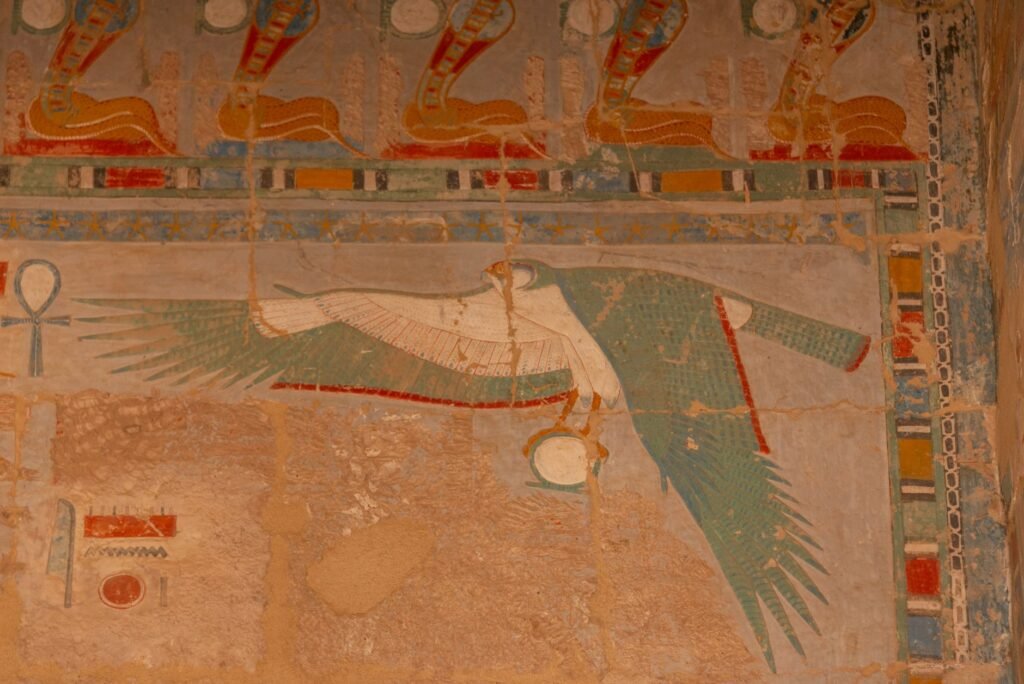
Nekhbet is most often depicted as a vulture goddess, usually an Egyptian vulture with white plumage and dark wing tips. In some scenes she appears as a human woman wearing the vulture headdress. She may also be represented as a vulture spreading its wings protectively over the pharaoh.
Identifying traits
| Feature | Meaning |
|---|---|
| Vulture form | Protection, motherhood, royal guardianship |
| White crown of Upper Egypt | Political authority over Upper Egypt |
| Spread wings | Shelter, defense, divine embrace |
| Association with royal titles | Legitimacy and divine sanction |
| Presence with Wadjet | Unity of Upper and Lower Egypt |
Core qualities
Nekhbet is usually understood as:
- protective
- maternal
- royal
- territorial
- guardian-like
The vulture was not chosen randomly. In Egyptian symbolism, vultures were associated with maternal care and protection rather than merely scavenging. Ancient Egyptians observed the bird’s nesting and nurturing behavior and transformed it into a religious emblem of watchfulness and support.
Family and Genealogy
Egyptian mythology does not preserve a single fixed genealogy for Nekhbet. Like many local goddesses, she is better understood by her functions and cult than by a standardized family tree.
Relationships in tradition
Different sources and periods may place Nekhbet in different relational frameworks:
- She is sometimes treated as a local mother goddess.
- She is often connected to the king rather than to a divine spouse or offspring.
- In some contexts, she may be linked conceptually with other protective female deities, but not through a stable mythological family line.
Spouse and offspring
No universally accepted spouse or set of children is consistently associated with Nekhbet in the surviving evidence. Unlike goddesses such as Isis, Hathor, or Mut, whose family roles are more developed in mythological literature, Nekhbet’s importance lies mainly in her protective and political functions.
This absence is itself meaningful: she is a goddess of state symbolism and guardianship rather than a character defined by dramatic family myths.
Symbols
Nekhbet’s symbolism is closely tied to royal iconography and the visual culture of pharaonic Egypt.
Primary symbols
- Vulture: her principal animal form and divine emblem
- White crown of Upper Egypt: a symbol of rulership in the south
- Spread wings: protection over the king, temples, and sacred space
- Royal cartouches and standards: association with kingship
- Uraeus pairing: often paired with the cobra goddess Wadjet, especially in royal contexts
Meaning of the symbols
The vulture was especially important because it conveyed a blend of motherly vigilance and sacred power. The outstretched wings, often seen on temple ceilings, tombs, and protective amulets, express the idea of a deity enfolding the ruler or sacred space in divine care.
The white crown, called the hedjet, reinforced her role as guardian of Upper Egypt and as a legitimizing power in the royal order.
Sacred Animals
The sacred animal most strongly associated with Nekhbet is the Egyptian vulture.
The Egyptian vulture
This bird became a symbol of:
- motherhood and care
- divine protection
- purity and order
- the royal south
The bird’s image was not based on a simplistic “bird goddess” idea alone. In ancient Egyptian religious symbolism, the vulture had strong positive associations, especially in royal and maternal contexts.
Other animal associations
Unlike some Egyptian gods, Nekhbet is not strongly associated with a broad range of sacred animals. Her identity is remarkably consistent and focused. The vulture is central and defining.
Sacred Plants
No sacred plant is universally and specifically linked to Nekhbet in the way that some other deities are associated with particular trees, flowers, or crops.
That said, Egyptian religious iconography often places Nekhbet within broader symbolic landscapes that include papyrus, lotus, and other ritual plants associated with Lower Egypt, Upper Egypt, rebirth, and divine order. However, these are general cultural symbols rather than exclusive emblems of Nekhbet herself.
Sacred Places
Nekhbet’s principal sacred place was Nekheb, ancient El Kab in Upper Egypt.
El Kab and Nekheb
El Kab was an important religious and administrative site on the east bank of the Nile. Its ancient name, Nekheb, became so closely connected to the goddess that it effectively anchored her identity.
Significance of the location
- major cult center of Nekhbet
- linked to royal ideology
- part of the sacred geography of Upper Egypt
- important in early dynastic and later periods
Other associated places
Because Nekhbet was a national protective deity, her imagery appears across Egypt in temples, tombs, and royal monuments. She was not limited to one shrine. Her protective role made her relevant wherever the king’s power was represented.
Powers and Attributes
Nekhbet’s powers are best understood through her roles in religion and kingship.
Major domains
| Domain | Description |
|---|---|
| Protection | Shields the king and sacred spaces |
| Kingship | Sanctifies royal authority |
| Upper Egypt | Represents the southern land |
| Maternal care | Protects with nurturing symbolism |
| State unity | Works with Wadjet to symbolize the Two Lands |
Protective function
Her most famous role is as a protective deity. She was believed to guard the pharaoh, especially at moments of vulnerability such as birth, coronation, warfare, and ceremonial processions.
Royal sanction
Nekhbet also affirmed divine legitimacy. Her appearance in royal imagery indicated that the ruler was under divine protection and approved by the gods.
Maternal and nurturing power
The vulture’s symbolism also gave Nekhbet a maternal character. She is often understood as a motherly protector, not because of an elaborate mythological motherhood narrative, but because ancient Egyptians saw the vulture as a nurturing guardian.
Main Myths
Egyptian mythology does not preserve many extended narrative myths about Nekhbet in the way that later cultures preserve epic stories. Her significance is instead revealed through ritual texts, royal titulary, and visual symbolism.
Protective role in royal mythology
One of her central mythic functions is the protection of the king from birth onward. In royal ideology, Nekhbet is among the divine powers who watch over the pharaoh as the representative of order and legitimacy.
The Two Ladies
A key religious concept involving Nekhbet is the “Two Ladies” motif, where she and Wadjet act together as tutelary goddesses of Egypt’s two regions.
- Nekhbet: Upper Egypt, vulture, white crown
- Wadjet: Lower Egypt, cobra, red crown
Together they form a balanced divine pairing supporting the king.
Temple and funerary imagery
Her wings are often shown protecting the king, divine barques, or sacred emblems. This protective imagery functions almost like a myth in visual form, expressing the idea that the goddess literally shelters and legitimizes Egyptian kingship.
Relationship with Other Mythological Figures
Nekhbet’s most important relationship is with Wadjet, but she also interacts conceptually with several other deities.
Nekhbet and Wadjet
This is the most famous divine partnership involving Nekhbet. The two goddesses represent the political unity of Egypt.
| Goddess | Region | Animal | Crown |
|---|---|---|---|
| Nekhbet | Upper Egypt | Vulture | White crown |
| Wadjet | Lower Egypt | Cobra | Red crown |
Together they are often called the Two Ladies, an important royal epithet. Their pairing appears on crowns, temple walls, and royal insignia.
Nekhbet and the king
Nekhbet is closely linked to the pharaoh, whose power she legitimizes and protects. She often appears above or behind the king in a guardian role.
Nekhbet and other goddesses
In broader Egyptian religion, Nekhbet may be visually and conceptually associated with other motherly or protective goddesses such as Isis, Hathor, or Mut. However, these relationships are functional rather than genealogical and should not be overstated.
Worship and Cult
Nekhbet was worshiped through temple imagery, local cult practice, and royal ritual rather than through a large body of surviving hymns or myths.
Forms of worship
Her cult likely included:
- offerings in temples
- ritual invocations in royal ceremonies
- protective amulets and images
- honorary representations on monuments
- use in official titulary and insignia
Royal worship
Because she was so closely tied to kingship, her worship often took place in royal and state contexts. The pharaoh’s relationship with Nekhbet was part of the larger religious framework that supported Egyptian monarchy.
Festivals and rituals
Specific festivals devoted exclusively to Nekhbet are not well documented in surviving sources. However, she would have been present in broader temple and state rituals, especially those connected to the king, coronation, and annual festivals involving divine procession.
Protective use
Her image was popular in contexts where protection was desired:
- temples
- tombs
- funerary equipment
- amulets
- royal regalia
Ancient Sources
Nekhbet is primarily known from Egyptian sources rather than from Greek or Roman literature. Classical authors such as Homer, Hesiod, and Ovid do not discuss her, since she belongs to Egyptian religion, not the Greek mythic corpus.
Main source types
| Source type | What it reveals |
|---|---|
| Royal inscriptions | Association with kingship and sovereignty |
| Temple reliefs | Protective imagery and divine presence |
| Tomb decoration | Funerary protection |
| Amulets and regalia | Popular and elite devotional use |
| Religious texts | Symbolic and ritual functions |
Important Egyptian evidence
Nekhbet appears in:
- early dynastic royal iconography
- temple decoration
- inscriptions naming the Two Ladies
- scenes where she spreads her wings protectively over the king
- depictions of royal crowns and protective emblems
Because much of the evidence is iconographic rather than narrative, interpretation depends on careful reading of context.
Roman Equivalent
Nekhbet does not have a precise Roman equivalent in the way some Egyptian gods were directly identified with Roman deities. The Romans often adapted Egyptian gods into their own religious and interpretive systems, but Nekhbet remained primarily an Egyptian symbolic figure.
Possible parallels
Her protective maternal and political functions may loosely resemble aspects of Roman goddesses such as:
- Minerva, for protective wisdom and state guardianship
- Juno, for royal and maternal dignity
- Victoria, for state legitimacy and success
These are only approximate parallels. None of them is a true one-to-one Roman counterpart.
Influence on Modern Culture
Nekhbet is less widely known in modern popular culture than Isis, Anubis, or Ra, but she continues to appear in Egyptological writing, museum displays, and visual reconstructions of ancient Egypt.
Modern presence
Her influence can be seen in:
- academic studies of Egyptian kingship
- museum labels and exhibitions on Egyptian religion
- reproductions of the winged vulture motif in art and design
- digital media and educational content about ancient Egypt
Popular culture visibility
Nekhbet is sometimes mentioned in:
- historical fiction
- fantasy novels inspired by Egypt
- video games with Egyptian settings
- documentaries on pharaonic symbolism
However, she remains relatively obscure to the general public. When she appears, it is usually in the context of royal emblems or temple iconography rather than as a standalone mythological character.
Curiosities
1. Nekhbet is one of the oldest royal protectors in Egyptian religion
Her presence in early dynastic iconography suggests a very ancient origin, even if the exact beginning of her cult cannot be dated precisely.
2. She is more a symbol of kingship than a story character
Unlike gods with elaborate myths, Nekhbet is known mainly through images, titles, and ritual functions.
3. The vulture had positive religious value in Egypt
Modern readers often associate vultures with death, but in ancient Egypt the bird could symbolize protection and motherly care.
4. Her role was political as well as religious
She was part of the visual and ideological system that represented Egypt as a united kingdom.
5. She commonly appears in pairs
Her identity is strongly linked to Wadjet, showing how Egyptian deities often worked in complementary duos.
6. Her imagery was deeply integrated into royal regalia
She was not confined to temples; her symbols appeared on crowns, ornaments, and ceremonial objects.
Frequently Asked Questions
Who is Nekhbet in Egyptian mythology?
Nekhbet is a vulture goddess of Upper Egypt, best known as a divine protector of the pharaoh and a symbol of royal legitimacy and state unity.
What does Nekhbet symbolize?
She symbolizes protection, motherhood, kingship, and the authority of Upper Egypt. Her outspread wings represent divine shelter.
Is Nekhbet a bird goddess?
Yes, she is usually depicted as a vulture goddess, specifically connected to the Egyptian vulture.
What is the relationship between Nekhbet and Wadjet?
Nekhbet and Wadjet are the two protective goddesses of Egypt, representing Upper and Lower Egypt respectively. Together they are called the Two Ladies.
Where was Nekhbet worshiped?
Her principal cult center was Nekheb, ancient El Kab, in Upper Egypt.
Did Nekhbet have a family in Egyptian mythology?
No stable family genealogy is preserved for her. She is better known for her protective and royal roles than for spouse or offspring traditions.
Is Nekhbet the same as Mut or Isis?
No. Although all three can have protective or maternal aspects, Nekhbet is a distinct goddess with her own identity, symbolism, and cult association.
Why was the vulture associated with protection?
Ancient Egyptians saw the vulture as a nurturing and watchful mother bird, making it an effective symbol of divine guardianship.
Conclusion
Nekhbet is a central figure in Egyptian mythology and religion, though she is often encountered through symbolism rather than extended mythological tales. As the vulture goddess of Upper Egypt, she served as a powerful protector of the pharaoh, a guardian of royal authority, and a symbol of the political unity of the Two Lands.
Her enduring importance lies in the way she fused religion, kingship, and visual symbolism. Nekhbet was not merely a local deity from El Kab; she became part of the core language of ancient Egyptian state ideology. Through her wings, her vulture form, and her partnership with Wadjet, she remained a lasting emblem of protection and legitimacy in one of the world’s oldest civilizations.

Orin Vale has spent the better part of two decades tracing the threads that connect the world’s oldest stories — from the halls of Asgard to the banks of the Nile, from Olympus to the jungles of the Maya. What began as a childhood fascination with flood myths and trickster gods grew into years of independent study across comparative mythology and ancient religion, always chasing the same question: what did these stories mean to the people who first told them? Orin writes for readers who want more than trivia — the ones looking for the beliefs, fears, and truths that myths were built to carry.