Who Is Loki in Norse Mythology?
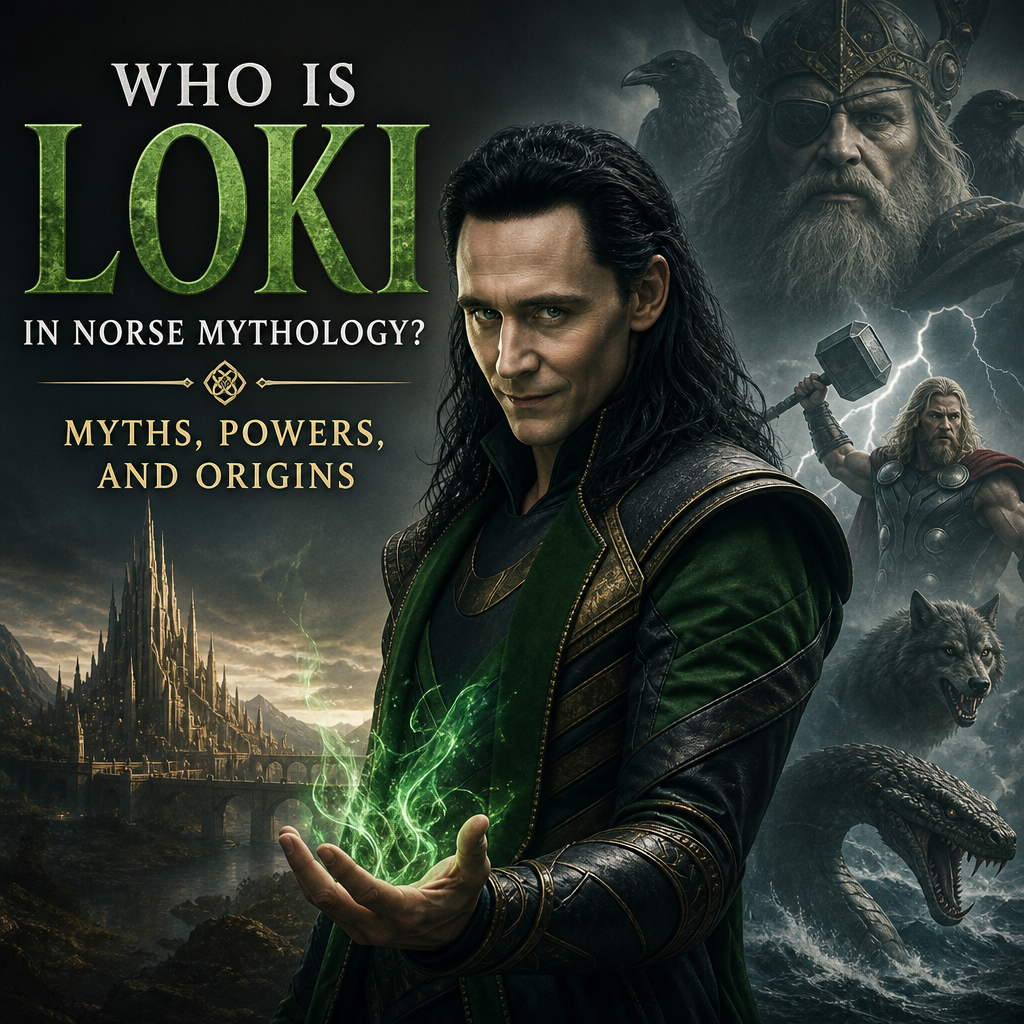
Loki is one of the most fascinating and complicated figures in Norse mythology. He is not simply a villain, a hero, or a comic trickster. Instead, Loki is a shapeshifter, mischief-maker, problem-solver, and eventually a destructive force whose actions help bring about Ragnarök, the end of the world in Norse myth.
So, who is Loki in Norse mythology? He is a figure who lives between categories. He moves among the gods but is not always one of them. He helps the gods many times, yet he also betrays them. His intelligence saves Asgard from disaster, but his jealousy and cruelty create some of its greatest tragedies.
Loki’s Origins and Place Among the Gods
Loki is often associated with the Æsir, the main tribe of Norse gods that includes Odin, Thor, Frigg, and Baldr. However, Loki’s background is different from many of the gods around him. His father is usually named as Fárbauti, a giant, and his mother as Laufey or Nál.
This giant heritage matters because the gods and giants are often in conflict in Norse mythology. Loki’s presence among the Æsir makes him a boundary-crossing figure. He belongs partly to the world of the gods and partly to the world of their enemies.
Loki is also described as Odin’s blood brother in some sources. This relationship helps explain why he is tolerated in Asgard for so long, despite the trouble he causes.
Loki the Trickster
Loki is best known as a trickster. In mythology, a trickster is a character who breaks rules, challenges authority, and creates chaos. Tricksters are not always evil. Sometimes their mischief leads to useful outcomes.
Loki’s tricks often begin as selfish or reckless acts. However, he frequently repairs the damage by using cleverness, negotiation, or deception. This makes him unpredictable. The gods may be angry with Loki, but they also rely on his sharp mind.
Some of Loki’s most famous traits include:
- Shapeshifting into animals and other forms
- Using clever speech and lies
- Creating problems for gods and giants alike
- Solving crises that he helped cause
- Moving between loyalty and betrayal
Loki and the Treasures of the Gods
One of the best examples of Loki’s tricky nature involves the treasures of the gods. In one story, Loki cuts off the golden hair of Sif, Thor’s wife. Thor becomes furious and threatens him.
To fix the situation, Loki goes to the dwarves, master craftsmen of Norse mythology. Through cunning and wagers, he helps obtain several magical treasures, including:
- New golden hair for Sif
- Thor’s hammer, Mjölnir
- Odin’s spear, Gungnir
- Freyr’s ship, Skíðblaðnir
- Odin’s ring, Draupnir
This story shows Loki at his most typical. He causes harm for no good reason, but his effort to escape punishment results in great gifts for the gods.
Loki as a Shapeshifter
Loki’s ability to change form is one of his defining powers. He transforms into many creatures throughout the myths, including a salmon, a fly, a mare, and a falcon. These transformations allow him to escape danger, spy on enemies, or carry out schemes.
One of the strangest stories involving Loki’s shapeshifting tells how he becomes a mare and distracts the stallion of a giant builder. As a result, Loki later gives birth to Sleipnir, the eight-legged horse that becomes Odin’s famous steed.
This tale highlights how fluid and unusual Loki’s identity is. He crosses boundaries of species, gender, and social role in ways that few other figures in Norse mythology do.
Loki’s Children
Loki’s children are among the most important and fearsome beings in Norse myth. With the giantess Angrboða, Loki fathers three monstrous children:
Fenrir
Fenrir is a giant wolf destined to kill Odin during Ragnarök. The gods fear his strength so much that they bind him with a magical chain.
Jörmungandr
Jörmungandr, the Midgard Serpent, is a massive snake that encircles the world. He is the great enemy of Thor, and the two are fated to kill each other at Ragnarök.
Hel
Hel rules over the realm of the dead that bears her name. She receives many of those who do not die in battle.
Loki is also the parent of Sleipnir, Odin’s extraordinary horse. His children connect him directly to fate, death, chaos, and the final destruction of the gods.
Loki and the Death of Baldr
Loki’s darkest role appears in the myth of Baldr’s death. Baldr is the beloved son of Odin and Frigg, known for his beauty and goodness. After Baldr dreams of his own death, Frigg secures promises from nearly all things in the world not to harm him.
However, she overlooks mistletoe, thinking it too harmless. Loki discovers this weakness. He tricks the blind god Höðr into throwing a mistletoe weapon at Baldr, killing him.
This act marks a turning point. Loki is no longer merely mischievous or troublesome. He becomes a murderer and betrayer of the divine family.
Loki’s Punishment
After Baldr’s death, Loki is hunted by the gods. He tries to hide by changing into a salmon, but he is caught. The gods bind him beneath the earth with the entrails of one of his sons.
A serpent is placed above him, dripping venom onto his face. Loki’s wife, Sigyn, holds a bowl to catch the poison, but when she turns away to empty it, venom falls on Loki. His writhing is said to cause earthquakes.
This punishment lasts until Ragnarök.
Loki at Ragnarök
At Ragnarök, Loki breaks free from his bonds. He joins the enemies of the gods and sails against Asgard with the forces of chaos. In the final battle, Loki fights Heimdall, the watchman of the gods. The two kill each other.
Loki’s role in Ragnarök completes his transformation from troublesome companion to enemy of the gods. Yet even here, he is part of the larger pattern of fate in Norse mythology. His actions are terrible, but they are also woven into the destined end and renewal of the world.
Why Loki Still Fascinates Us
Loki remains popular because he is complex. He is clever, funny, dangerous, charming, and cruel. He refuses to fit neatly into a single role. In some stories, he is useful and even necessary. In others, he is the source of grief and destruction.
When asking “who is Loki in Norse mythology,” the best answer is that Loki is a boundary-breaker. He stands between gods and giants, order and chaos, helper and enemy. His myths reveal the Norse understanding that chaos can create as well as destroy.
Loki is not just the god of mischief. He is a symbol of unpredictability, transformation, and the dangerous power of intelligence without loyalty.

Orin Vale has spent the better part of two decades tracing the threads that connect the world’s oldest stories — from the halls of Asgard to the banks of the Nile, from Olympus to the jungles of the Maya. What began as a childhood fascination with flood myths and trickster gods grew into years of independent study across comparative mythology and ancient religion, always chasing the same question: what did these stories mean to the people who first told them? Orin writes for readers who want more than trivia — the ones looking for the beliefs, fears, and truths that myths were built to carry.