Hera’s Peacock
Introduction
Hera’s peacock is one of the most recognizable animal symbols in Greek mythology. In later classical tradition, the peacock becomes closely associated with Hera, queen of the gods, and appears as one of her most enduring emblems in art, literature, and popular imagination. The bird is not merely decorative: it reflects themes of royal authority, watchfulness, beauty, pride, and divine punishment.
The association is especially important because it illustrates how Greek mythology developed over time. While Hera is an ancient Olympian goddess well attested in early Greek religion, the peacock itself was not part of the earliest phase of her worship in the Aegean world. Its prominence grows in later tradition, especially through the myth of Argus Panoptes and in Hellenistic and Roman art. As a result, Hera’s peacock is both a mythological symbol and a cultural product of changing religious imagery.
Origin and Meaning
The name “peacock” in English refers to the male bird of the peafowl species, while the female is technically called a peahen. In mythology, the bird is usually associated with the male peacock because of its brilliant tail feathers.
In Greek, the peacock was called taôs or taos in later usage, a word often connected with the bird’s exotic origin. Ancient writers were aware that peacocks were not native to Greece. They were associated with regions farther east, especially India and the Persian world, and were introduced into the Mediterranean through trade and royal display.
The link between Hera and the peacock does not appear in the earliest surviving Greek texts. Instead, it develops in later mythic tradition, where the bird is explained through the story of Argus Panoptes, the many-eyed giant who guarded Io. After Argus was killed, Hera was said to have transferred his hundred eyes to the peacock’s tail feathers. This myth gave the bird an explanatory origin and a strong symbolic connection to Hera.
Historical Context
Hera was one of the major deities of ancient Greek religion, worshiped as goddess of marriage, women, childbirth, and queenship. Her sanctuaries were among the most important in the Greek world, including the Heraion at Samos and the Heraion near Argos. However, the peacock is not central to early cult evidence from the Archaic period.
The bird became associated with Hera in a later cultural environment shaped by:
- East-west contact and luxury goods
- Royal iconography in the Hellenistic world
- The development of visual storytelling in sculpture, painting, and mosaics
- Roman adaptation of Greek mythology
Because peacocks were exotic and visually striking, they suited a goddess linked to dignity, majesty, and splendor. Their eye-like tail patterns also made them suitable for myths about vigilance and divine watchfulness.
Ancient authors and later artists gradually reinforced the connection. By the classical and especially Roman periods, the peacock was widely understood as Hera’s bird, even if earlier traditions may have placed less emphasis on it.
Main Characteristics
Hera’s peacock is identified by a set of symbolic and visual traits that made it especially suitable as a divine emblem.
Identifying features
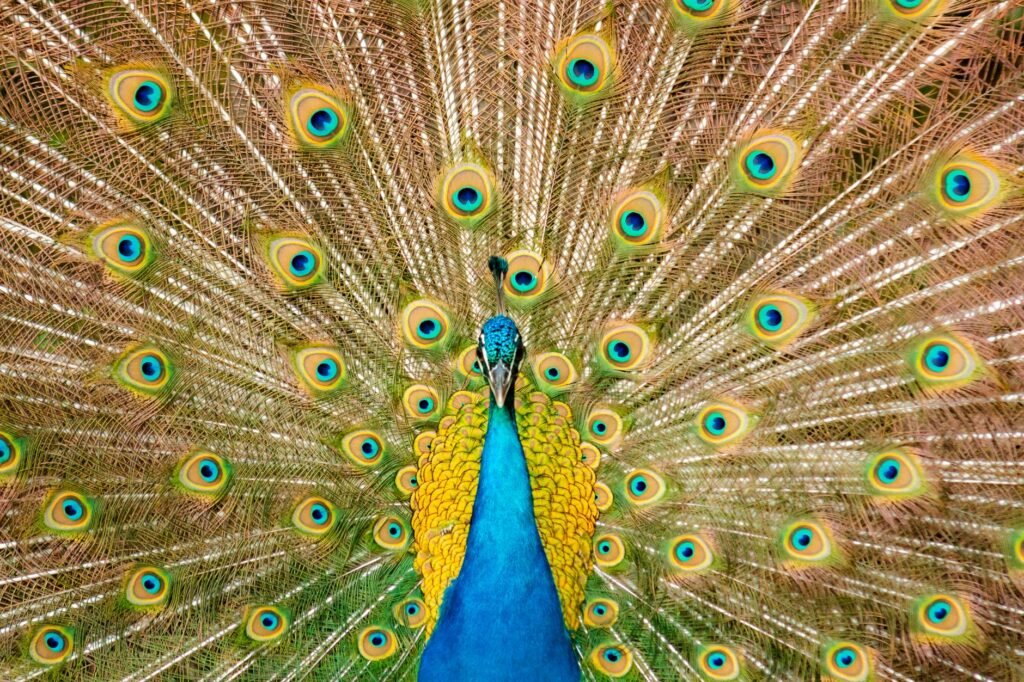
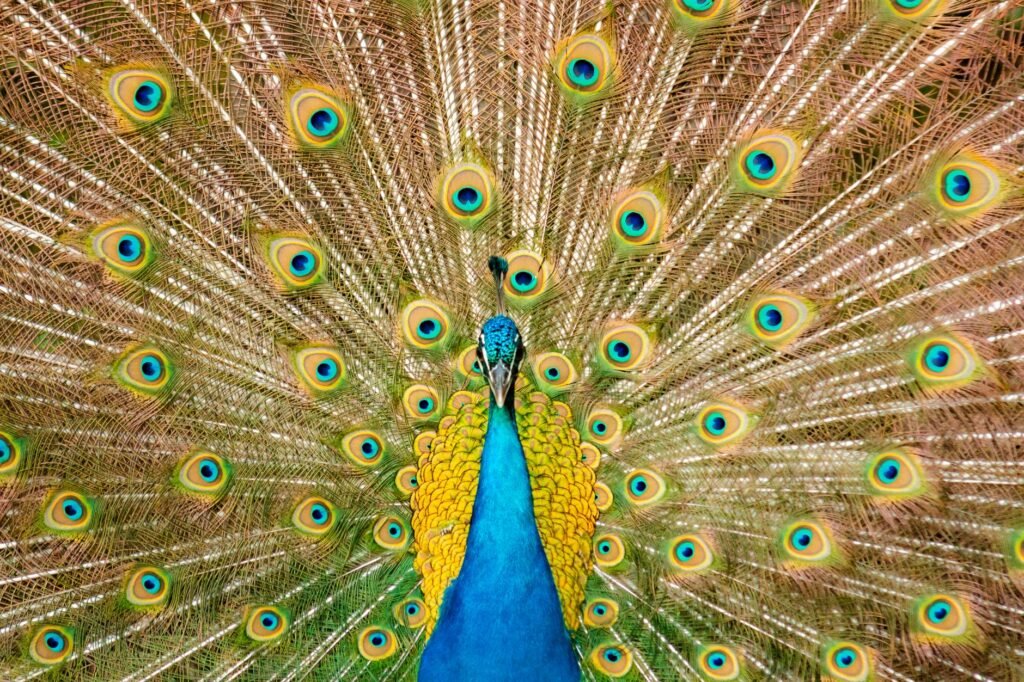
- Brilliant tail feathers with iridescent “eyes”
- Regal posture and ornate display
- Association with beauty and pride
- Strong visual presence in art and decorative contexts
- Connection to divine observation through the “eyes” motif
The bird’s tail feathers were often understood as representing the eyes of Argus. This interpretation gave the peacock a mythological explanation and a symbolic role tied to Hera’s authority.
Symbolic traits
The peacock represents several qualities associated with Hera:
- Majesty and sovereignty
- Guarded awareness
- Fertility and life
- Beauty and splendor
- Jealousy and vindication, through myths involving Hera’s rivalries
The bird is not a simple emblem of kindness or gentleness. Like Hera herself, it embodies a more complex mix of dignity, power, and severity.
Family and Genealogy
As a mythic symbol, Hera’s peacock does not have a family in the biological sense, but its genealogy is explained through myth.
Mythic origin
According to the best-known tradition, the peacock arose from the story of:
- Hera: queen of the gods
- Argus Panoptes: the hundred-eyed giant who served Hera
- Hermes: who killed Argus on Zeus’s orders
- Io: the mortal woman transformed into a cow and persecuted by Hera
After Hermes killed Argus, Hera was said to have preserved his eyes in the peacock’s tail. This myth links the bird directly to Hera’s service and her grief or memorialization of Argus.
Relationships in the mythic network
The peacock is indirectly connected to Zeus, Hermes, Io, and Argus. It is also tied to Hera’s broader family sphere as queen of Olympus and wife of Zeus. In mythological art, the peacock often appears beside Hera’s chariot or throne, emphasizing her status within the divine household.
Symbols
The peacock is one of several symbols associated with Hera.
Common symbols of Hera
| Symbol | Meaning |
|---|---|
| Peacock | Royal splendor, watchfulness, mythic memory |
| Diadem or crown | Queenship and authority |
| Scepter | Sovereignty and governance |
| Throne | Divine status and stability |
| Pomegranate | Fertility and marriage, in some contexts |
| Cow / ox | Fertility, abundance, and sacrificial significance |
| Lily | Beauty and purity in later artistic traditions |
Meaning of the peacock
The peacock’s most distinctive symbolic functions are:
- Watchfulness: the eye-like feathers recall Argus’s many eyes
- Royal display: the bird’s beauty suggests divine dignity
- Protection: in some later traditions, eyes are protective symbols
- Transformation: the bird reflects a mythic transition from death to divine memory
In later art, the peacock often serves as an attribute, a visual shorthand that identifies Hera without the need for text.
Sacred Animals
In Greek mythology, Hera is associated with several animals, but the peacock is the most famous in later tradition.
Hera’s associated animals
- Peacock: her best-known emblem in post-classical art
- Cow: linked to fertility and to the myth of Io
- Lion: sometimes associated with majesty and power in broader symbolic contexts
- Vulture or other birds of omen: less consistently, in later symbolic readings
The peacock is unique because it combines visual beauty with a mythological explanation. It does not appear as an early cult animal in the same way that the cow does, but it became Hera’s primary avian symbol in art and literature.
Symbolic significance of the peacock
The peacock’s feathers resemble many eyes, making the bird an ideal symbol of vigilance. In mythology, that vigilance is explained through the many eyes of Argus. In artistic usage, the bird often frames Hera as a sovereign who sees all and commands attention.
Sacred Plants
Unlike some deities, Hera is not strongly associated with a single sacred plant across all traditions. However, several plants appear in her symbolic or cultic sphere.
Plants linked to Hera in various traditions
- Lily: associated with beauty and later decorative symbolism
- Pomegranate: linked with fertility, marriage, and female power
- Willow and other vegetation: appear locally in sanctuaries or ritual settings
- Grove trees: sacred groves were important in Greek religion and could accompany Hera’s sanctuaries
No plant is as central to Hera as the peacock is in later iconography. The bird remains the most distinctive emblem attached to her name.
Sacred Places
Hera’s peacock is connected less to a specific holy site than to the broader cult of Hera. Still, several important places shaped Hera’s religious image.
Major sanctuaries of Hera
| Site | Importance |
|---|---|
| Heraion of Samos | One of the most ancient and important Hera sanctuaries |
| Heraion near Argos | Major cult center associated with Hera in the Peloponnese |
| Olympia | Hera had a cult presence in the sanctuary complex |
| Delos | Hera appears in the wider sacred landscape of the Aegean |
| Croton and other Greek colonies | Hera worship spread through the Greek world |
The peacock itself is not specifically tied to one sanctuary in early evidence. Its importance is primarily iconographic and mythic, not topographical.
Sacred spaces in art
In temples, mosaics, and wall paintings, the peacock often appears in scenes that place Hera in a throne room, procession, or divine court. In such works, the bird functions as a marker of her presence, much like Zeus’s eagle or Athena’s owl.
Powers and Attributes
The peacock does not possess powers independently of Hera, but it symbolizes or reflects several of her divine attributes.
Hera’s domains reflected in the peacock
- Queenship: the peacock is a royal bird
- Marriage: Hera governs lawful marriage and domestic order
- Legitimacy: she defends proper succession and status
- Watchfulness: the eyes of the feathers suggest surveillance
- Punishment and retribution: tied to Hera’s pursuit of rivals
- Memory and memorialization: the bird preserves the story of Argus
Attribute as symbol, not deity
In mythology, sacred animals often serve as extensions of divine identity. Hera’s peacock is not worshiped in place of the goddess; rather, it visualizes her qualities. This distinction matters in scholarly interpretation. The bird should be understood as an emblem within myth and art, not as an independent divine being.
Main Myths
The peacock is not central to the oldest surviving myths of Hera, but it becomes important through later narrative development.
The myth of Argus Panoptes
The most famous story explaining the peacock’s origin involves Argus Panoptes. In this myth:
- Zeus falls in love with Io.
- To conceal Io, Zeus changes her into a cow.
- Hera suspects deception and places Io under the watch of Argus, the giant with many eyes.
- Zeus sends Hermes to free Io.
- Hermes kills Argus.
- Hera honors or memorializes Argus by placing his eyes in the peacock’s tail.
Different versions of the story vary in detail. Some say Hera herself transformed Argus’s eyes into the bird’s feathers. Others say she decorated the peacock with his eyes. The core idea remains the same: the bird’s eye-patterned tail is explained as the visible memory of Argus.
Hera and Io
The Io cycle is one of the central myths linking Hera to jealousy and divine conflict. Hera’s hostility toward Io is often read as a response to Zeus’s infidelity. The peacock enters the story indirectly, as part of the aftermath of Argus’s death.
Other mythic associations
In later literature and art, the peacock may also appear in scenes involving:
- Hera’s marriage to Zeus
- Her role as queen of Olympus
- Processions of the gods
- Celebratory or triumphal imagery in Roman contexts
Relationship with Other Mythological Figures
Hera’s peacock is most closely related to figures in the Io and Argus myth complex.
Hera and Zeus
Zeus and Hera are the central divine couple of Greek myth. The peacock reflects Hera’s dignity as queen of the gods, but also the tension in her marriage. Some of the best-known myths involving the bird arise from Zeus’s affairs and Hera’s responses.
Hera and Argus
Argus Panoptes is the figure most directly associated with the peacock’s origin. Whether as servant, guardian, or victim, Argus becomes part of the bird’s mythic identity through his eyes.
Hera and Hermes
Hermes acts as Zeus’s messenger and enforcer in the killing of Argus. His role in the story indirectly contributes to the peacock’s symbolism, since the bird is a product of the conflict between divine power and clever intervention.
Hera and Io
Io is one of Hera’s most famous rivals or victims in myth. The peacock thus belongs to a larger cycle of stories about jealousy, transformation, and divine punishment.
Worship and Cult
There is no evidence that peacocks were worshiped as independent sacred animals in the Greek cult of Hera in the way that sacred bulls or cows could be ritually important in broader Near Eastern and Mediterranean religion. However, the bird entered religious and artistic expression as Hera’s emblem.
Cultic context
Hera’s worship involved:
- Offerings at sanctuaries
- Processions and festivals
- Sacrificial rites
- Dedications by women, households, and civic communities
The peacock likely functioned as a decorative and symbolic element in temples, votive art, and later religious imagery, especially where Hera was represented in a majestic or royal manner.
Ritual significance
The bird’s symbolic eye-patterns may have made it attractive as a protective emblem. In some later cultural traditions outside strict Greek cult, eye motifs are used apotropaically, or to ward off evil. The peacock could therefore acquire a protective aura, though this should not be overstated as an early Greek cult fact.
Ancient Sources
The peacock’s association with Hera is best understood through a combination of mythographic, literary, and artistic evidence.
Important ancient and classical sources
- Homer: Hera is prominent in the Iliad and Odyssey, though the peacock is not a major Homeric motif.
- Hesiod: Provides important early mythic context for the divine family but not the peacock’s later symbolism.
- Apollodorus: In the Bibliotheca, he preserves the Argus and Io myth in a form that helps explain the peacock’s origin.
- Ovid: The Metamorphoses presents the Io and Argus story in a highly influential Roman version.
- Pausanias: Offers valuable evidence on cult, sanctuary, and local myth, though not always on the peacock specifically.
- Hyginus: Latin mythographic traditions also help preserve the story.
- Later scholia and mythographers: Provide variants explaining the eyes on the peacock’s tail.
Caution about sources
Because the peacock’s association with Hera becomes more visible in later sources, scholars distinguish between:
- Early cult evidence, where the bird is not prominent
- Later mythographic explanation, where the bird is fully integrated into Hera’s imagery
This distinction is essential for an accurate historical account.
Roman Equivalent
In Roman religion, Hera was identified with Juno. The peacock became just as important, and in some respects even more prominent, in Roman art and literature than in earlier Greek contexts.
Juno and the peacock
The peacock is one of Juno’s best-known attributes. Roman art frequently shows Juno with peacocks pulling her chariot or standing beside her. The association became so widespread that the peacock is often considered a standard symbol of Juno in Western art.
Roman adaptation
Roman writers and artists embraced the Greek myth of Argus and Io, but adapted it to their own visual language of imperial grandeur. The peacock suited Roman ideals of spectacle, luxury, and divine authority. Thus, Hera’s peacock became firmly established in the Roman imagination as an emblem of Juno.
Influence on Modern Culture
Hera’s peacock remains a recognizable mythological motif in modern culture.
In art
The peacock appears in:
- Neoclassical painting
- Decorative arts
- Jewelry and textile design
- Museum reconstructions of mythological scenes
In literature
Modern retellings of Greek myth frequently mention Hera’s peacock as a shorthand for her majesty and jealousy. The bird is especially common in works that reinterpret the Argus and Io story.
In film, television, and games
The peacock may appear as a visual symbol in:
- Fantasy adaptations of Greek mythology
- Television series inspired by the Olympian gods
- Video games set in mythological worlds
- Illustrations and character design for Hera or Juno
In popular symbolism
Beyond mythology, the peacock is often used to symbolize:
- Beauty
- Pride
- Vanity
- Nobility
- Renewal or immortality
These broader meanings overlap with, but do not fully match, the mythic role of Hera’s peacock.
Curiosities
- The peacock was not originally native to Greece, which helps explain why its mythic association appears later than that of many indigenous animals.
- The “eyes” on the tail are one reason the bird became linked to Argus Panoptes, whose many eyes were famous in myth.
- In many artistic traditions, the peacock functions as an attribute of Hera even when the goddess herself is not shown.
- The bird’s association with Hera became especially strong in Roman art, where Juno and the peacock are almost inseparable.
- Ancient authors did not always agree on the exact origin of the bird’s eye-patterns, so different versions of the myth should be treated as parallel traditions rather than a single canonical story.
- The peacock’s symbolism can be both positive and ambivalent: it suggests splendor, but also pride and watchful severity.
Frequently Asked Questions
1. Why is the peacock associated with Hera?
The peacock is associated with Hera mainly through the myth of Argus Panoptes. According to later tradition, the eyes of Argus were transferred to the peacock’s tail after his death.
2. Was the peacock sacred to Hera in early Greek religion?
There is little evidence that the peacock was a major cult animal in the earliest phase of Hera worship. Its prominence grows in later mythology and art.
3. What does the peacock symbolize in relation to Hera?
It symbolizes queenship, majesty, watchfulness, and divine memory. It can also reflect jealousy and punishment through the myths of Io and Argus.
4. Is Hera’s peacock the same as Juno’s peacock?
Yes. In Roman religion, Hera was identified with Juno, and the peacock became one of Juno’s principal symbols.
5. Which ancient story explains the peacock’s eyes?
The story of Argus Panoptes explains the eyes on the peacock’s tail. Different ancient sources give slightly different versions of the myth.
6. Did all ancient Greeks connect Hera with peacocks?
Probably not in the same way or to the same degree. The association is strongest in later Greek and Roman tradition rather than in the earliest surviving evidence.
7. Where can Hera’s peacock be seen in ancient art?
It appears in Greek and Roman mosaics, vase painting, sculpture, and later decorative art, especially in scenes featuring Hera or Juno.
Conclusion
Hera’s peacock is one of the most enduring symbols in the mythology of ancient Greece and Rome. Though not central to the earliest evidence for Hera’s worship, the bird became deeply associated with the queen of the gods through later myth, especially the story of Argus Panoptes. Its eye-like feathers made it a natural emblem of watchfulness, dignity, and divine presence.
As an image, the peacock captures the complexity of Hera herself: majestic yet formidable, beautiful yet severe, protective yet capable of punishment. For that reason, Hera’s peacock remains an important mythological symbol, bridging ancient religion, classical literature, and modern cultural memory.

Orin Vale has spent the better part of two decades tracing the threads that connect the world’s oldest stories — from the halls of Asgard to the banks of the Nile, from Olympus to the jungles of the Maya. What began as a childhood fascination with flood myths and trickster gods grew into years of independent study across comparative mythology and ancient religion, always chasing the same question: what did these stories mean to the people who first told them? Orin writes for readers who want more than trivia — the ones looking for the beliefs, fears, and truths that myths were built to carry.