How Many Major Roman Gods Are There?
The question “How many major Roman gods are there?” does not have a single fixed answer. In Roman religion, the number of “major” gods depends on which list, period, or author is being used. In the broadest and most traditional sense, Rome’s chief divine group is often identified with the twelve major gods, known in Latin as the Dii Consentes or Dii Complices. However, Roman religion also included many other important gods and goddesses, local deities, household spirits, and specialized divine powers.
In other words, the Roman pantheon was hierarchical rather than closed. Some gods were universally recognized as principal deities of state religion, while others were prominent in specific cults, regions, or families. The most common answer, especially in school texts and general reference works, is that there were 12 major Roman gods. Yet this is only one way of counting.
Origin and Meaning
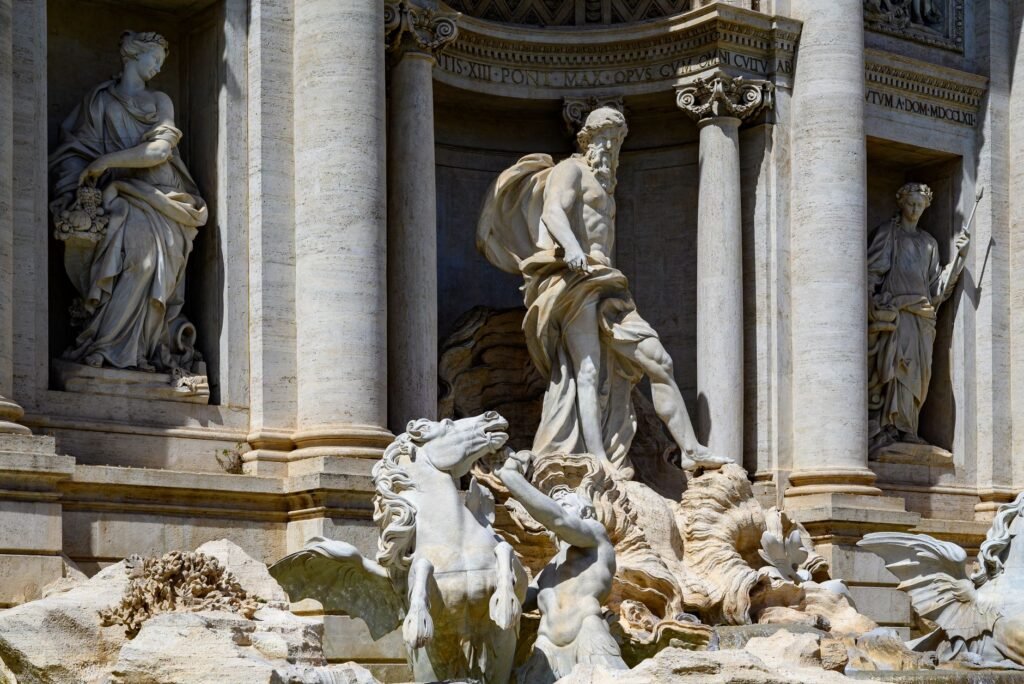
The phrase “major Roman gods” is a modern descriptive term, not an ancient official category with a single legal definition. Romans themselves spoke of their gods in terms such as:
- dii or dei: gods
- dii consentes: “the agreed-upon gods,” often understood as a council of twelve principal deities
- dii maiores: greater gods, in contrast to lesser or more specialized divine beings
The idea of a core group of twelve gods may have been influenced by Greek models, especially the Greek Olympians, who also numbered twelve in many traditions. Roman religion absorbed, adapted, and reinterpreted many Greek deities, though Roman gods often had older Italic roots and distinct civic functions.
The word Roman in this context refers not only to the city of Rome but to the religious system that grew throughout the Roman Republic and Empire. That system combined public state worship, private domestic religion, priesthoods, festivals, vows, omens, and local cults.
Historical Context
Roman religion developed over many centuries and was deeply connected to public life. It was not based on sacred scripture in the way some later religions are. Instead, it consisted of ritual practice, inherited custom, priestly interpretation, and state observance.
Early Roman and Italic Foundations
Early Roman religion likely inherited elements from:
- Italic and Latin traditions
- Etruscan religious practices
- Later Greek influence
This mixture produced a pantheon that was both highly local and widely adaptable. Some of the best-known Roman gods, such as Jupiter, Mars, and Quirinus, may reflect very old Indo-European or Italic traditions, while others became more clearly identified with Greek deities over time.
The Twelve Principal Gods
The most widely cited list of Roman major gods is the group of twelve often associated with the Dii Consentes. Ancient authors describe this divine council as a central feature of Roman religion. A famous poem by the Augustan poet Ennius, preserved by later writers, refers to this group, and Varro and Livy also help modern scholars understand Roman divine classification.
The standard list commonly includes:
| Roman deity | Common Greek equivalent | Main sphere |
|---|---|---|
| Jupiter | Zeus | Sky, sovereignty, law |
| Juno | Hera | Marriage, queenship, women |
| Neptune | Poseidon | Sea, horses, earthquakes |
| Minerva | Athena | Wisdom, crafts, strategy |
| Mars | Ares | War, military power |
| Venus | Aphrodite | Love, beauty, fertility |
| Apollo | Apollo | Healing, prophecy, arts |
| Diana | Artemis | Hunt, wilderness, childbirth |
| Vulcan | Hephaestus | Fire, metalworking |
| Vesta | Hestia | Hearth, home, sacred fire |
| Mercury | Hermes | Commerce, travel, messages |
| Ceres | Demeter | Grain, agriculture, fertility |
Different traditions occasionally vary in how this list is arranged or interpreted, but these twelve are the most familiar “major Roman gods.”
Expansion Under the Empire
As Roman power expanded, religious practice became increasingly inclusive. Gods from conquered peoples could be adopted into Roman cult, and foreign mystery cults also flourished. This means the “major gods” of Roman religion were never the only gods worshiped in the Roman world.
Main Characteristics
The major Roman gods were typically understood as powerful, socially important, and closely tied to public order. Their characteristics can be summarized in several ways.
1. They governed essential areas of life
These gods were responsible for fundamental human and civic concerns:
- sovereignty and state authority
- war and defense
- marriage and family
- agriculture and food supply
- trade and travel
- health, healing, and prophecy
- domestic life and sacred fire
2. They were closely tied to Roman identity
Roman religion linked divine favor to the success of the state. Public ritual was not merely symbolic; it was believed to maintain the pax deorum, the “peace of the gods,” meaning right relationship between gods and community.
3. They were highly anthropomorphic
Like Greek deities, Roman gods were often imagined in human form with distinct personalities. However, Roman religion also retained a more practical and ritual-centered tone than much Greek myth.
4. They often had both Italian and Greek identities
Many Roman gods were identified with Greek counterparts, but this was not simple copying. Roman Jupiter was not exactly the same as Greek Zeus, and Roman Mars had a broader civic prestige than Greek Ares.
Family and Genealogy
Roman gods form a large and sometimes inconsistent family network. Ancient sources do not always agree on exact parentage, because myths evolved and were adapted from Greek traditions.
Key divine relationships
- Jupiter and Juno were the central royal pair in Roman religion.
- Mars was often presented as the son of Jupiter and Juno, though traditions vary.
- Minerva was born from Jupiter alone in the well-known myth adapted from Greek tradition.
- Venus had multiple genealogical traditions; in Roman literature she is linked both to cosmic origins and to the Trojan line through Aeneas.
- Apollo and Diana are usually treated as twins in the Greek-derived tradition.
- Vulcan is sometimes described as the son of Juno alone or of Jupiter and Juno, depending on the source.
- Mercury is the son of Jupiter and the nymph Maia in the usual classical tradition.
- Ceres is typically the daughter of Saturn and Ops, sister of Jupiter, Neptune, Juno, Pluto, and Vesta.
- Vesta is also a daughter of Saturn and Ops.
- Neptune is likewise a child of Saturn and Ops in Romanized mythology.
Family table of the most common major gods
| Deity | Common family connections |
|---|---|
| Jupiter | Husband of Juno; father of many gods and heroes |
| Juno | Wife and sister of Jupiter; mother of Mars in some traditions |
| Neptune | Brother of Jupiter and Pluto; linked to Salacia |
| Minerva | Usually daughter of Jupiter |
| Mars | Son of Jupiter and Juno in many accounts; associated with Rhea Silvia and Romulus through later myths |
| Venus | Mother of Aeneas; associated with Anchises in Roman tradition |
| Apollo | Twin of Diana; son of Jupiter and Latona in the Greco-Roman myth |
| Diana | Twin of Apollo; daughter of Jupiter and Latona |
| Vulcan | Husband of Venus; sometimes son of Juno alone |
| Vesta | Virgin goddess; no husband or children in the usual tradition |
| Mercury | Son of Jupiter and Maia; associated with the nymphs and occasional offspring in later myths |
| Ceres | Mother of Proserpina/Persephone in the borrowed Greek myth |
Symbols
Roman gods were recognized through specific symbols, ritual objects, and visual attributes in art and literature.
Common symbols of the major gods
| Deity | Symbols |
|---|---|
| Jupiter | Thunderbolt, eagle, oak |
| Juno | Peacock, diadem, scepter |
| Neptune | Trident, horse, dolphin |
| Minerva | Owl, spear, helmet, olive branch |
| Mars | Spear, shield, helmet, wolf, woodpecker |
| Venus | Dove, mirror, rose, myrtle |
| Apollo | Laurel wreath, lyre, bow |
| Diana | Bow, quiver, crescent moon |
| Vulcan | Hammer, anvil, tongs, fire |
| Vesta | Hearth fire, veil, round temple form |
| Mercury | Caduceus, winged sandals, winged cap |
| Ceres | Sheaf of grain, torch, cornucopia |
These symbols were important in sculpture, coinage, temple decoration, and public ritual. They allowed worshippers to identify a god visually and to associate divine powers with particular objects.
Sacred Animals
Animals played an important symbolic role in Roman religion. Some were sacred to one deity, while others carried broader cultural meanings.
Key sacred animals
- Eagle: sacred to Jupiter, representing power and divine sovereignty
- Peacock: linked to Juno, symbolizing majesty and watchfulness
- Horse: connected to Neptune and Mars in different contexts
- Wolf: associated with Mars and the founding myth of Rome through the she-wolf and Romulus and Remus
- Woodpecker: also associated with Mars in Roman tradition
- Owl: linked to Minerva, symbolizing wisdom
- Dolphin: associated with Neptune and maritime power
- Goose: sometimes linked to Juno, especially in the story of the sacred geese that warned Rome of danger
- Snake: often connected with healing, domestic cult, or the underworld, though not exclusive to one god
- Cow and ox: important in agricultural and sacrificial rites, especially associated with Ceres and Jupiter
Sacred Plants
Plants and trees also carried religious meaning in Roman worship.
Notable sacred plants
- Oak: sacred to Jupiter, especially associated with strength and lightning
- Laurel: sacred to Apollo, symbolizing victory, purification, and poetic inspiration
- Myrtle: associated with Venus, love, and marriage
- Olive: linked to Minerva, peace, wisdom, and useful labor
- Grain and wheat: associated with Ceres and agricultural abundance
- Fig tree: important in Roman foundation legend and often connected with fertility and domestic life
- Reed and marsh plants: sometimes associated with riverine or pastoral divine contexts
Plant symbolism mattered in ritual garlands, sacrifice, and temple decoration.
Sacred Places
Major Roman gods were worshiped in temples, shrines, groves, and state sanctuaries throughout the Roman world.
Important sites in Rome
- Temple of Jupiter Optimus Maximus on the Capitoline Hill, the most important temple of Roman state religion
- Temple of Juno Moneta on the Capitoline, later linked to the mint and the word “money”
- Temple of Mars Ultor in Augustus’s Forum
- Temple of Vesta in the Roman Forum, center of the sacred hearth
- Temple of Ceres, Liber, and Libera on the Aventine
- Sanctuary of Mercury near the Circus Maximus, reflecting his commercial role
- Temple of Venus Genetrix in Caesar’s Forum
- Temple of Apollo Palatinus on the Palatine Hill
Wider sacred geography
Roman gods were worshiped not only in Rome but across the empire in:
- provincial temples
- military camps
- local sanctuaries
- household shrines
- crossroads shrines
- rural altars
Special places linked to divine functions
Some locations became associated with the gods through legend or ritual rather than through a single temple. For example:
- the Capitoline Hill as the political and religious center of Jupiter’s cult
- the Roman Forum as the setting of Vesta’s sacred fire and civic religious life
- the Palatine Hill as linked to Apollo and imperial ideology
Powers and Attributes
The major Roman gods each ruled a domain or set of responsibilities.
Jupiter
Jupiter was the supreme sky god, guardian of oaths, law, and state authority. He was the most important god in official Roman religion and the patron of Roman victory.
Juno
Juno protected marriage, women, and the Roman state, especially in her role as queen of the gods. She could also be a severe and protective deity.
Neptune
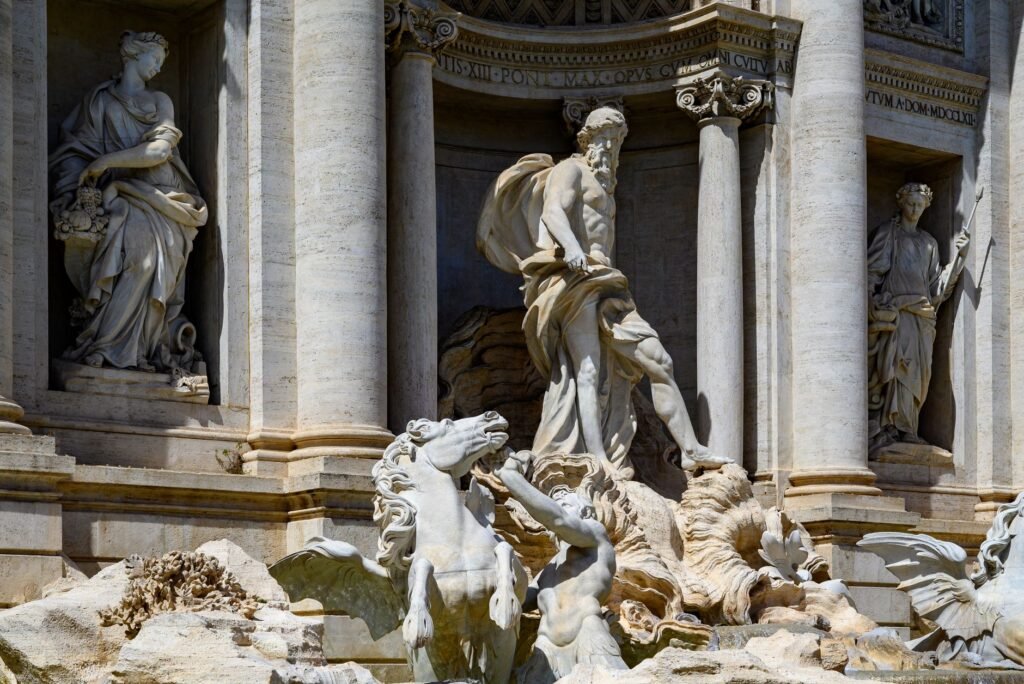
Neptune governed the sea and waters, but also horses and earthquakes. In some early contexts, his importance may have been broader than purely maritime.
Minerva
Minerva represented wisdom, crafts, strategy, and skilled work. She was especially valued by artisans, teachers, and those who admired intelligence over brute force.
Mars
Mars was the god of war, but in Roman religion he was not merely destructive. He was also linked to agricultural protection and the defense of the community. This makes him more complex than the Greek Ares.
Venus
Venus embodied love, beauty, attraction, fertility, and, in Roman political ideology, ancestral legitimacy through the line of Aeneas and the Julian family.
Apollo
Apollo was associated with prophecy, healing, music, purity, and archery. He became especially important in Augustan Rome.
Diana
Diana was a goddess of the hunt, wild places, the moon in later traditions, and childbirth. She had strong connections to women and liminal spaces.
Vulcan
Vulcan ruled fire, metalworking, and the destructive and creative power of the forge. He was essential to craftsmanship and to the symbolic control of fire.
Vesta
Vesta embodied the sacred hearth and the continuity of the Roman household and state. Her cult was one of the most ancient and enduring in Roman religion.
Mercury
Mercury presided over trade, movement, communication, travelers, and boundary-crossing. He was also associated with cleverness and quick thinking.
Ceres
Ceres was the goddess of grain, agriculture, and growth, central to food security and the seasonal cycle.
Main Myths
The Roman gods inherited many myths from Greek tradition, but they were often adapted to Roman values and politics.
Jupiter’s rule and divine kingship
Jupiter’s myths emphasize sovereignty, lightning, and the establishment of order. He functions as the highest divine authority and the protector of Rome’s oaths and treaties.
Mars and the founding of Rome
Mars is central to Rome’s legendary foundation because he is traditionally identified as the father of Romulus and Remus through Rhea Silvia in later accounts. This made Mars a divine ancestor of the Roman people.
Venus and the Trojan heritage
Venus became especially important through the story of Aeneas, the Trojan hero who was said to be her son. Roman writers used this myth to connect Rome’s origins with the fall of Troy and to give Roman power a noble epic ancestry.
Ceres and Proserpina
The myth of Ceres and Proserpina explains seasonal loss and return, paralleling the Greek Demeter and Persephone story. It became important in agricultural symbolism and mystery cult traditions.
Apollo and the Augustan age
Apollo’s myths and cult were closely linked to the reign of Augustus, who promoted Apollo as a symbol of order, healing, and cultural renewal.
Vesta and the sacred fire
Vesta’s mythology is less narrative and more ritual-based. Her sacred fire in Rome symbolized the continuity of the city and the state.
Relationship with Other Mythological Figures
The major Roman gods interact with one another, with heroes, and with foreign deities in complex ways.
Alliances and family ties
- Jupiter and Juno form the central divine marriage.
- Venus and Mars are frequently linked as lovers in later literature.
- Apollo and Diana function as divine twins.
- Ceres and Vesta are associated with domestic and agricultural stability.
Conflicts and rivalries
Roman myth includes divine rivalries, often adapted from Greek models:
- Juno frequently opposes heroes favored by Jupiter.
- Neptune may contest power or territory in myths borrowed from Greece.
- Mars appears as both a protective father of Rome and a force of conflict.
Interaction with heroes and mortals
The gods frequently intervene in the lives of:
- Aeneas
- Romulus
- Hercules
- Julius Caesar and Augustus, in later political mythology
Roman religion and myth were deeply intertwined with politics, so divine relationships often had ideological meanings.
Worship and Cult
Roman worship was formal, ritualized, and communal. It focused less on private mysticism and more on correct practice.
Forms of worship
Roman people honored the major gods through:
- sacrifice of animals and offerings
- prayers and vows
- public festivals
- temple dedications
- processions
- household rites
- divination and consultation of signs
Priests and priesthoods
Several priestly bodies served the gods:
- Pontifices
- Flamines
- Augurs
- Vestals
- Salii
- Quindecimviri sacris faciundis
Different priesthoods had different responsibilities, and some were linked to particular deities.
Festivals
Major Roman festivals included:
- Ludi Romani for Jupiter
- Matronalia for Juno
- Neptunalia for Neptune
- Quinquatria for Minerva
- Equirria and October Horse rites for Mars
- Vinalia and other festivals connected to Venus and agriculture
- Apollo’s games under the later Republic and Empire
- Vestalia for Vesta
- Mercuralia for Mercury
- Cerialia for Ceres
Household religion
Roman families also honored gods in the home through:
- lararia or household shrines
- offerings to household spirits
- daily prayers
- domestic meals and libations
Ancient Sources
Our knowledge of Roman major gods comes from literary, epigraphic, archaeological, and comparative evidence.
Important ancient authors
- Livy: records Roman history and religious institutions
- Varro: an essential source for Roman religious antiquity
- Cicero: discusses theology, divination, and state religion
- Ovid: especially useful for mythological reinterpretation in the Fasti and Metamorphoses
- Virgil: central for Venus, Aeneas, and Roman destiny
- Ennius: early references to the divine council
- Plutarch: later but valuable for Roman custom and religion
- Pausanias and Apollodorus: mostly Greek, but useful for comparison with Romanized myths
- Hesiod and Homer: not Roman sources, but crucial for the Greek background that shaped Roman myth
What the sources show
The sources do not give a single rigid list of “major Roman gods.” Instead, they reveal:
- shifting cult priorities
- regional variation
- Greek reinterpretation
- political use of religion
- differing scholarly classifications in antiquity
Roman Equivalent
Because this article concerns Roman gods, the “Roman equivalent” section is best understood as the Roman adaptation of Greek deities and traditions.
Adaptation rather than simple replacement
Most major Roman gods were equated with Greek gods, but their Roman roles could differ significantly.
- Jupiter = Greek Zeus, but with stronger civic and legal authority in Roman religion
- Mars = Greek Ares, but far more honored and central to Roman identity
- Venus = Greek Aphrodite, but politically tied to Roman ancestry
- Minerva = Greek Athena
- Neptune = Greek Poseidon
- Mercury = Greek Hermes
- Apollo retains the same name in both traditions
- Diana = Greek Artemis
- Vulcan = Greek Hephaestus
- Vesta = Greek Hestia
- Ceres = Greek Demeter
- Juno = Greek Hera, though Roman Juno had her own distinct civic and protective roles
This correspondence helps explain why modern readers sometimes ask how many major Roman gods there are: the Roman and Greek pantheons overlap, but they are not identical.
Influence on Modern Culture
The major Roman gods continue to shape modern culture in many ways.
Literature and education
Roman gods appear in:
- classical studies
- mythology textbooks
- poetry
- historical fiction
- comparative religion
- children’s retellings of myths
Art and architecture
Their imagery appears in:
- Renaissance and neoclassical painting
- fountains and sculpture
- government buildings
- symbolic public monuments
- museum collections
Film, television, and games
Roman gods and Roman-inspired divine figures appear in:
- fantasy novels and films
- video games
- tabletop role-playing games
- television series about ancient history
- comic books and superhero fiction
Public symbolism
Many countries still use Roman divine symbols indirectly in:
- names of planets
- calendar months
- brands and logos
- civic architecture
- legal and political language
For example, the legacy of Jupiter, Mars, Venus, and Mercury survives in the names of planets visible to the naked eye.
Curiosities
- The Dii Consentes are often treated as the Roman equivalent of the twelve Olympians, but Roman religion was never as neatly fixed as a classroom list suggests.
- Mars was one of the most important Roman gods, unlike his Greek counterpart Ares, who had a less honored status in Greek mythology.
- Jupiter Optimus Maximus means “Best and Greatest Jupiter,” showing his supreme rank in Roman state religion.
- Vesta had no elaborate myth cycle, but her cult was among the most politically important in Rome.
- Mercury was especially important to merchants, travelers, and those seeking profitable change.
- Roman religion allowed gods to be invited from outside the city through a practice sometimes called evocatio, especially during war.
- The list of “major gods” tells us as much about Roman values as about theology: public order, agriculture, family, military success, and civic stability were central concerns.
Frequently Asked Questions
1. How many major Roman gods are there?
The most common answer is 12 major Roman gods, usually identified with the Dii Consentes. However, Roman religion also included many other important gods and spirits.
2. Why are there 12 major Roman gods?
Twelve was a traditional sacred number in several ancient Mediterranean systems, and Roman religion adopted a twelve-god core group that resembles the Greek Olympians. The exact historical origins are not fully clear.
3. Are the major Roman gods the same as the Greek gods?
Not exactly. Many Roman gods were identified with Greek counterparts, but their roles, personalities, and political meanings could differ.
4. Was Jupiter the most important Roman god?
Yes. Jupiter was generally regarded as the supreme god of Roman state religion, especially as protector of law, oaths, and public authority.
5. Was Mars really important in Rome?
Very much so. Mars was one of Rome’s most important gods because he was associated with war, defense, and the identity of the Roman people.
6. Did Romans worship only the major gods?
No. Romans also worshiped household gods, local deities, agricultural spirits, ancestral powers, and imported gods from other cultures.
7. Is there one official ancient list of Roman major gods?
No single universally fixed list exists across all sources. The twelve-god group is the best-known traditional list, but Roman religion was flexible and varied by region and era.
Conclusion
So, how many major Roman gods are there? The most widely accepted answer is twelve, referring to the Dii Consentes, the principal gods of Roman tradition. Yet the deeper and more accurate answer is that Roman religion did not have a rigidly closed pantheon. The number of “major” gods changed depending on context, period, and purpose.
The Roman divine world was broad, practical, and deeply integrated into civic life. Its major gods shaped ideas of law, war, fertility, wisdom, commerce, agriculture, and the sacred continuity of Rome itself. Their stories, symbols, and cults influenced Western art, literature, politics, and religious imagination for centuries.

Orin Vale has spent the better part of two decades tracing the threads that connect the world’s oldest stories — from the halls of Asgard to the banks of the Nile, from Olympus to the jungles of the Maya. What began as a childhood fascination with flood myths and trickster gods grew into years of independent study across comparative mythology and ancient religion, always chasing the same question: what did these stories mean to the people who first told them? Orin writes for readers who want more than trivia — the ones looking for the beliefs, fears, and truths that myths were built to carry.